


I’m looking for a sponsor. Click for more information.
The byes are here. Over the next month, every club will have a week off. As they do, I want to consider how they’re travelling relative to pre-season expectations. Thankfully, I won’t be doing it myself. I’ve asked some friends to share their own thoughts about their teams, and how the first half of the season has updated their beliefs about what’s possible in 2026. I’ll then respond with my own thoughts. The first batch of clubs perfectly illustrate that there are good byes and there are bad byes. Adelaide and Gold Coast are both probably relieved to get some time off, address specific tactical problems, and give key players time to rest and recuperate. North Melbourne’s players and supporters, meanwhile, would probably prefer the opportunity to capitalise on the momentum created by the side’s stirring comeback victory against Gold Coast last Saturday. Let’s get into it.
Adelaide
Win-loss: 6-5
Ladder position: 7th
Next four games: Geelong (H), Western Bulldogs (A), Melbourne (H), Port (A)
Michael from the Adelaide FC subreddit Discord server (shout-out)
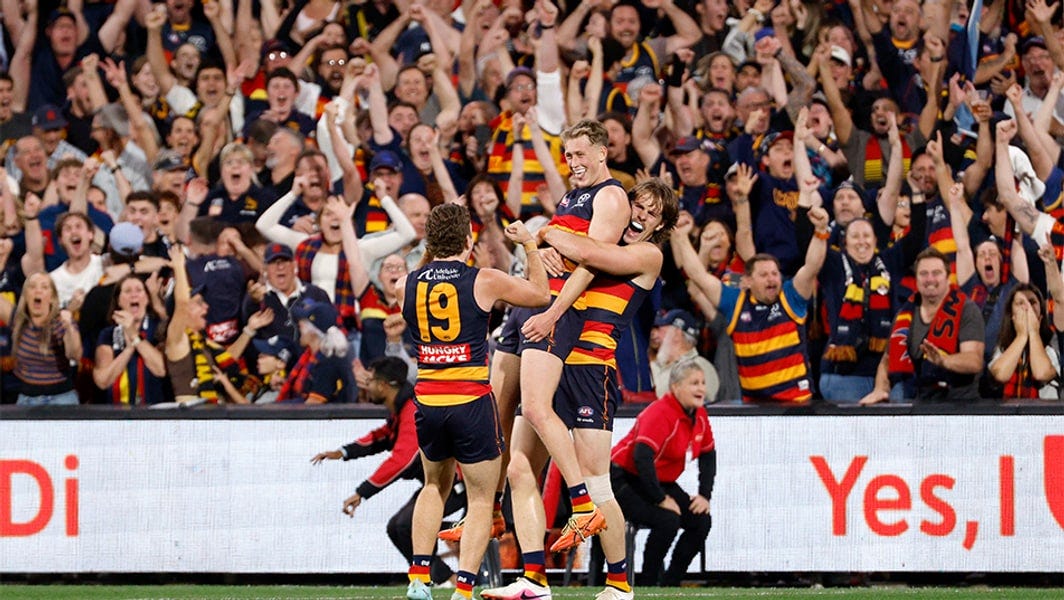
Losing Mark Keane, Mitch Hinge, and Dan Curtin for most of the first half of the season has brutalised us this season. However, while it is an excuse, I’ve seen enough to put it plainly: we aren’t nearly good enough to contend with the best sides.
Regression from last year’s surprisingly dizzying highs were expected, but when you watch us and then watch the benchmarks of the competition (Sydney, Freo, Brisbane) you can’t help but notice the chasm between game styles. Theirs are built for winning premierships; ours is built to limit as much damage as possible – unless the opponent has big flaws, in which case Adelaide adopts a more aggressive game plan. However, it’s not all bad. The Crows have shown that there’s talent on multiple lines, and Jordan Dawson is the perfect leader to nurture and lead that talent. Add a Zac Bailey in the middle, Darcy Wilson and/or Kade Chandler and/or Tom Swallow in and around the forward/mid rotation [Mateo: surely that’s not too much to ask?] and optimism will return to West Lakes.
Perhaps the biggest concern, beyond player availability, is the reluctance to use overlap handball or move the ball with urgency – especially compared to 2023 and (parts of 2025), when Adelaide was one of the most exciting teams in the competition. The Crows’ continued reliance on aerial and ground-level contest wins means they’ve been left by the wayside. The coaching staff has recognised this over the last couple of games, but it might be too late to salvage the season. The Crows are 18th in the AFL for average metres gained per handball at 0.7m; Sydney, who are the best team in the competition at the time of writing, are running at 4m gained per handball. There’s nothing wrong with going with your own style, and you can understand Matthew Nicks’ reluctance to depart from a game plan which was successful for most of 2025, but it clearly isn’t working anywhere near as well in 2026.
Brayden Cook has been the silver lining. How he’s gone from the last-chance saloon to a near AA-calibre wing option is the story of the season. Credit to the club for sticking with him when everyone was just starting to ask, ‘if only’. Shoutout to Sam Berry too. I’m [Tom] a big, big critic (and I still think he’s too fumbly at times) but his centre square clearance work has gone from merely okay to very good. If he can get his kicking and ground ball game sorted, the Crows have a viable long-term prospect in the engine room.
The worst-case outcome for the rest of the season would be for Adelaide to continue on its current trajectory and finish 9th-10th – not good enough to be a “true” finalist, yet not bad enough to get one of the best players in the draft. To be avoided. The normal outcome would be finishing near the bottom of the top six. Given the current issues, an Elimination Final berth (and win) would be a good season, all things considered. There are two types of good outcomes. The first would be if Adelaide had the sort of resurgence it did after the bye last season [remember: the Crows lost their game immediately before the bye to Hawthorn at Launceston before winning out for the rest of the Home & Away season]. The other is to completely fall off a cliff, draft one of the best midfielders in the draft pool, and appoint a new coach. It might be the recession the club needs to have.
Michael’s grade: C-
Tom from the Adelaide FC subreddit Discord server
As a Crows fan who leans on the more pessimistic side, I tend to feel Adelaide is at the level I expected heading into the season; a bottom eight to wildcard side – but I do feel we are quite lucky to be around that mark on the ladder. To be frank, we don’t pass the eye test. A team that realistically overachieved last season, off the back of some luck, easy fixtures and the cohesive rhythm of healthy star players carrying the side (Rankine, Dawson, Thilthorpe, Worrell, Keane). Yet, despite trying to maintain a sense of pragmatism, I still feel as disillusioned as I did after the horrendous 2025 finals.
Once the excitement of watching a young side grow – from new faces debuting and inexperienced players showing glimpses of star power – deteriorates and the expectations rise, you lose a sense of enjoyment for the game. Your enjoyment becomes results-driven. In those early rebuild years, you could excuse the inability to control games, lack of proactive decision making and sometimes leaders not standing up in big moments. But your patience as a fan becomes thin and, as time goes on, entitlement grows. Adelaide might be having a down year, but I feel I’ve seen this movie before under Matthew Nick’s tenure and I hope post-bye the club can start banking some results and look like a more competent side.
As you articulated in your season preview [Mateo: I promise I did not add this in], Adelaide’s game plan in 2025 had a scheme of piercing and slicing kicks, creating space for your one-on-one contests. But being first on the ladder means you become the hunted. Teams have gone to work and the failure to adapt to the stand rule is part of why Adelaide has become a very predictable side in possession. While other teams embraced the changes in their offseason, Adelaide has been caught on the hop.
It’s not necessarily doom and gloom as a fan. Players like Brayden Cook, Wayne Milera and Sam Berry have exploded onto the scene and as a strong past critic of all three, I’ve been thoroughly rapt to see them performing to a high standard. Cook’s development has honestly kept me engaged with this season. As for the most disappointing player, I know most fans would say Thilthorpe, but I am going to say Jake Soligo. Pre-season health scare aside, he’s been pushed out of a vanilla midfield. It’s left me contemplating where he goes from here.
Tom’s grade: C-
My thoughts
Adelaide has regressed in more or less exactly the ways I warned of in my season preview. In 2025, the Crows leveraged real physical advantages to become the league’s best post-clearance contest team. They took big grabs, brushed off opposition tackles while making their own stick, and regularly won contests in high-value parts of the ground. But relying on winning contests is dangerous, both because it’s so sensitive to the form and fitness of the players who make it work and because it can defer the creation of a more unsustainable style based on the manipulation of space. As that advantage has been whittled away, the Crows have regressed. They are currently a middling side.
Tom and Michael both lamented the rigidity of the Crows’ game plan under coach Matthew Nicks. I have a small measure of sympathy for Nicks here. I think it’s reasonable to believe that a style which helped deliver a club-record 18-win season is viable. Losing Dan Curtin and Mark Keane to freak injuries in pre-season was a bigger blow than most non-supporters realise. But the most devastating riposte is that Nicks and his assistants successfully overhauled how the Crows played out-of-possession after a month of last season – so why have they been largely unable to improve the side’s rudimentary ball movement scheme thus far this season? The charitable answer is that it’s tougher to change how you attack than how you defend mid-season, and that without Mark Keane, Adelaide doesn’t have enough good kicks in its backline. The other answer is the one that an increasing number of Crows fans have reached on their own: if your style relies on Izak Rankine, or Jordan Dawson, or Riley Thilthorpe winning their direct contest more than it does on structured possession chains – that’s probably not a viable style in 2026. It’s true there have been some changes. For the last month, Adelaide has been handballing more often and moving the ball slightly better. The defence remains a strength. But it still looks like a low-tech brand in a high-tech world.
The club’s injury burden (not catastrophic, but a big change from a relatively serene run in 2025) is largely out of its control. Keane’s return could make a big difference. The most perplexing question, and probably the one in most need of an answer, is what the hell’s happened to Thilthorpe. The ideal outcome is the extended break afforded by the bye and his one-week suspension for a gut punch on Lloyd Meek gives him the chance to physically and mentally refresh. If he rediscovers his 2025 form, the Crows become a significantly better side. If he can’t, the wildcard round (or worse) looms. That’s probably the most likely outcome for the remainder of this season. The worst-case scenario – the bottom falling out of the season – has a silver lining: a good draft pick and a new coach.
My grade: C
Gold Coast
Win-loss: 7-4
Ladder position: 5th
Next four games: Brisbane (H), Geelong (A), Hawthorn (H), Fremantle (A)
Keegan from the Turnover the Tape podcast
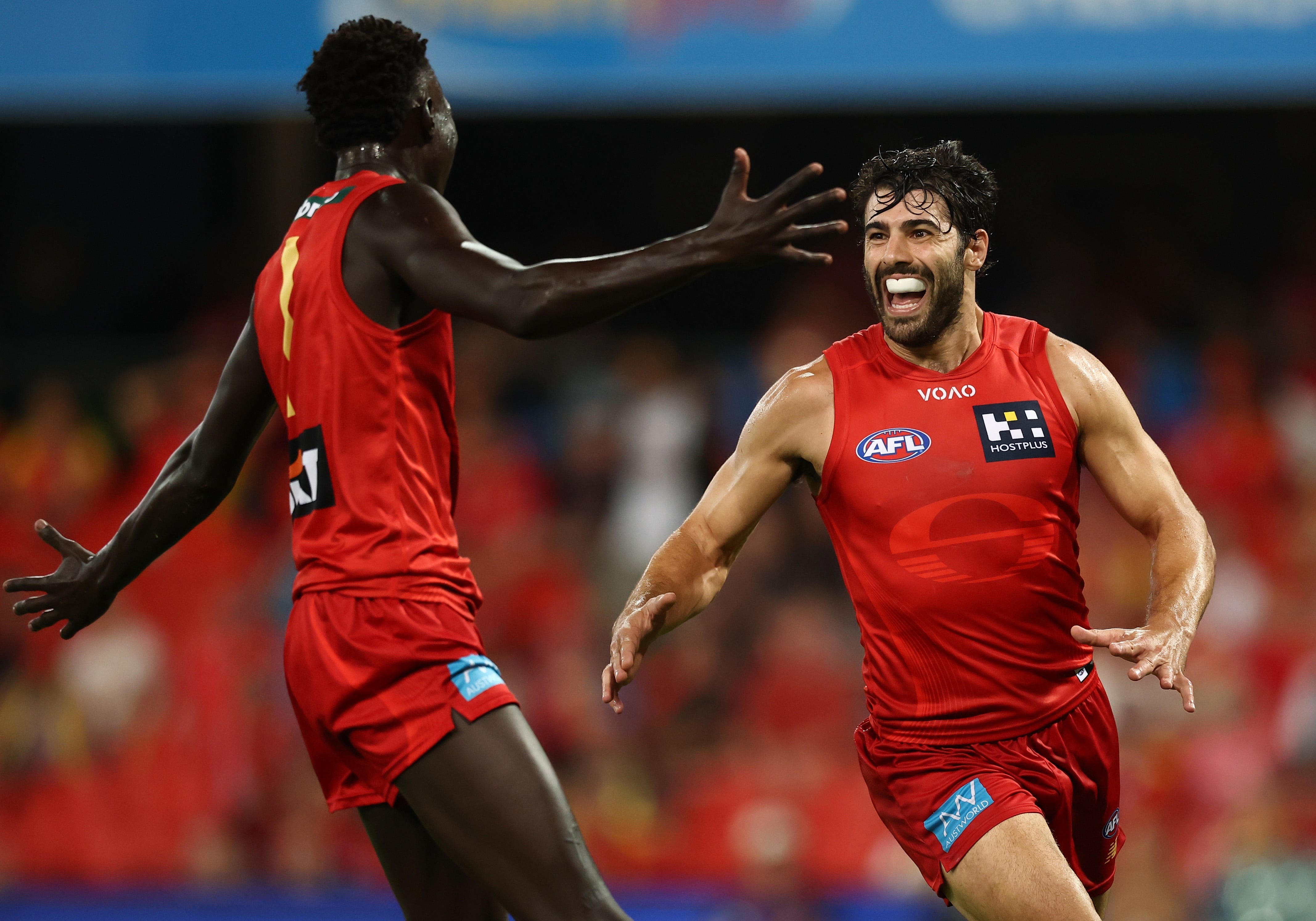
The first half of the season for the Suns has been one of underperformance while still putting wins on the board. The club has been saying it has taken one step back to take two steps forward, and so far this season feels like that. We have shed some experienced depth (Ainsworth, Fiorini, Budarick) to fit in more academy players and big name recruits which has left us with a bottom five or six players that are currently not producing at AFL level each week.
At the start of the season I had us down for a top six finish, and I still believe we are capable of that at our best, but some down performances are a cause for concern with a hard run of games incoming. The forward line mix has been a headache for the club and continues to be so, with Damien Hardwick rotating in search of a forward line that can do the things he wants. The Jed Walter story continues to bubble in the background. I’m unsure about where he will play next year. The lack of a quality small forward has hurt, especially when our tall forward can’t take a mark as well.
Ned Moyle has now ascended to the #1 ruck role and looks like he will keep a hold of it going forward, helping with clearances while also being a threat forward. This has relegated Witts to the backup spot after he has struggled with the new ruck rules. Christian Petracca has exceeded all expectations since coming to the club. I haven’t been this excited to see the ball in a player’s hand since prime Gaz – his ability to hit the scoreboard is not something we have seen in our midfield in some time. Uwland is looking to improve on his second-place Best & Fairest finish from 2024 and has been so solid down back, adding rebound to his game and no doubt piquing the interests of some All-Australian selectors. He’s been a key part of our defensive unit which has been our strongest line this year. Sam Collins is in career best form, Mac Andrew is playing well, while Oscar Adams has improved out of sight holding Charlie Ballard out of the team. The Rioli and Noble combo off HB continue to be so important to our ball movement.
Conversely, despite the names on the sheet, the Suns’ midfield has been subpar with Rowell and Anderson being impacted by injury and sickness for parts of the year. We have been conceding clearance deficits most games and the inability to defensively pressure has meant opposing midfielders have been able to slice through and hit up forward targets at will, not giving our defenders a chance.
The worst-case plausible outcome from here would be failing to make the top eight and travelling away for the first wildcard game ever played. A normal outcome would be finishing in the top six and hosting our first-ever home final. A good outcome would mean beating the teams around us in the second half of the year – starting in the next four games – and pushing for the double chance.
Keegan’s grade: C+
My thoughts
Following the first month of the season, I was halfway convinced the Suns were already the best team in the league, and, given their absurd wealth of academy talent, concerned about what portended for the rest of the decade. I arrived at the MCG on April 5th fully expecting them to dispatch the Demons and frank those credentials. Instead – and admittedly, they were without Petracca that day – they lost by 20 points and showed the first signs of the frailties that have plagued them since.
I don’t think I was alone in expecting a core midfield trio of Petracca, Rowell, and Anderson to be one of the league’s most formidable. In some respects, it has. Gold Coast is ranked seventh for scores from stoppages, and Petracca is, implausibly, enjoying a career-best season. But the deterioration in the Suns’ ability to win first possession or defend clearance losses is alarming. They are currently 14th for first possession, 15th for clearances won, and seventh for scores from clearance differential. What should be a great strength looks instead like a liability. Hardwick has moved some magnets in search of a more defensively secure on-ball rotation, giving the likes of Alex Davies, Touk Miller, and Bailey Humphrey more CSB attendances in over the past month. Part of the problem, as identified by Keegan in their write-up, is that neither Rowell nor Anderson have been able to be quite at their best so far. But part of the problem is structural: Petracca’s ability forward of the ball will mean he takes up aggressive positions both at stoppages and in transition. That looks great when it works, but it often requires a player assuming a more sacrificial role to patch up defensive holes. At Melbourne, that role was often performed by Alex Neal-Bullen. I’m not sure Hardwick has quite found the answer yet.
I also share Keegan’s concerns about the composition and efficacy of the forward line. I’m not sure I see what many others claim to see in Jed Walter. Ben King is an elite finisher, but his non-contributions both in build-up and out of possession is part of the reason why the Suns are mediocre in preventing opposition transition. The lack of a true small forward is obvious – Ben Long, Bailey Humphrey, and Leo Lombard do an admirable role, but it means that Gold Coast aren’t as dangerous at ground level inside-50 as most true contenders are. It’s up to Hardwick to see if the solution to these issues exists on the current list.
The collapse against North Melbourne was the product of the fatigue accumulated by a fortnight in Darwin. But it was still inexcusable, and followed a concerning string of performances. Since that defeat to Melbourne (a side we now know is much better than most expected them to be), the Suns have been comfortably beaten by Sydney and Hawthorn, and registered unconvincing victories over Essendon and Port Adelaide. It’s not the formline of a top-four side. They’ve banked enough wins to still be in touch with the leading pack. But they need to improve.
My grade: B-
North Melbourne
Win-loss: 5-6
Ladder position: 13th
Next four games: Fremantle (H – but in Bunbury), West Coast (H – but in Perth), Richmond (A), Essendon (H)
Ricky Mangidis of The Shinboner
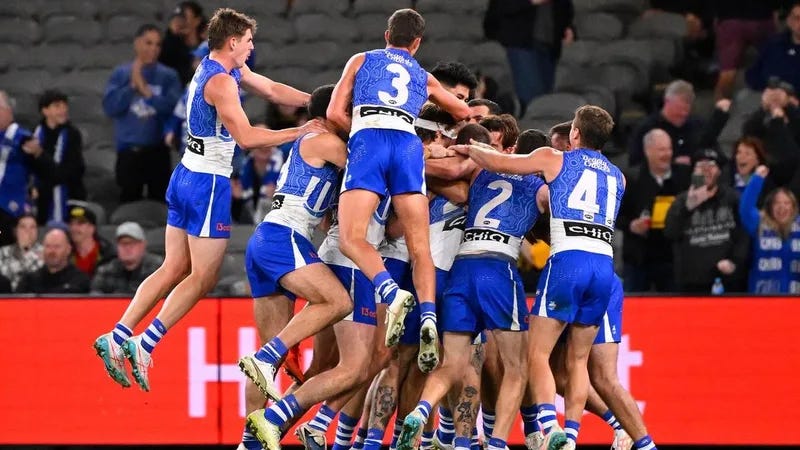
Through six rounds, it was obvious to anyone with a functioning set of eyes that North Melbourne had improved. It was the level of improvement which remained a mystery due to the level of opposition. Five of those six games against Port Adelaide (home), West Coast (away), Essendon, Carlton, and Richmond didn’t exactly scream murderer’s row.
Five rounds later, after GWS (away), Geelong (GMHBA), Sydney (home), Adelaide (away), and Gold Coast (home), the improvement is now large enough to be notable. While those five rounds only yielded one win, there were just three poor quarters – the fourth vs. Geelong, a historically bad second vs. Adelaide, and the second vs. Gold Coast. Elsewhere the underlying process remained relatively sound, with a couple of key focus areas.
Scoring from forward half turnovers: It may shock readers to learn that in the last four years, North ranked 18th (2025), 16th (2024), 15th (2023), and 18th (2022) in points scored from forward half turnovers. After 11 games this year, North ranks seventh in the same stat. It is slightly inflated because of their blinding efficiency at scoring from those turnovers – second in points per turnover forced – but that efficiency had also been non-existent in previous years.
Possession as control: While it’s a thin line between using possession to defend, possession to progress, and then knowing when to shift between each, North have been much better in achieving both so far this year. The side is ranked first for uncontested possession differential and sixth for time in possession differential. Combine it with a simplified system behind the ball and it’s allowed the defence to be protected more often after turnover while dedicating a larger focus on forward half play. There’s still a long way to go in the area, of course, but the steps forward are obvious.
Individually, with the exception of bedding Colby McKercher down into his best position as – opinion alert – a high half-back coming up to contests and playing with the field in front of him – the first choice on-ball unit has consolidated into the look we’ll see for the medium to long term, health pending. Finn O’Sullivan has been the revelation to some outside the North bubble, graduating into a position as the midfield glue to unlock his teammates. Whether it’s Luke Davies-Uniacke as the explosive ball winner, Harry Sheezel as more of a first receiver, or George Wardlaw as the manic wrecking ball, it’s O’Sullivan’s presence, positioning, and work without the ball making most of it possible without having to sacrifice too much elsewhere.
Looking forward, while the last month of Hawthorn, Bulldogs, Geelong, and Sydney is brutal, the eight weeks beforehand present real opportunities. Put Fremantle to one side and the other seven opponents read, in order: West Coast, Richmond, Essendon, Port Adelaide, Collingwood, Melbourne, and St Kilda. None of those outfits should present North with any nightmares. It’s not to say they should or will go anywhere close to running the table, but it presents the perfect opportunity for football with actual (relatively low) stakes as they aim for a wildcard position. It’s a position they haven’t been in for a decade.
Ricky’s grade: B
My thoughts
As I made clear in my 2026 season preview, I was a committed North Melbourne sceptic. I wasn’t enamoured with their list build and really didn’t like their style of play under coach Alastair Clarkson. North were almost totally dependent on clearance wins to generate scores and well below AFL standard at defending turnovers, which is increasingly where games are won and lost. So it’s been a surprise, albeit a pleasant one, to see their real improvement through 11 games of 2026.
From my perspective – and I will defer to Ricky here, whose week-by-week reviews are the highest standard of writing about North Melbourne anywhere on the internet – the improvement has been driven by organic improvement and by a simplified structure out-of-possession (in short: moving away from a zonal structure to something closer to back-shoulder one-on-one defending). North look significantly more resilient when they don’t have the ball. While it’s true that they remain poor at preventing the opposition from moving the ball, they are (very) slightly better than league average when it comes to preventing opposition scores from turnover.
Ricky has identified the main statistical sources of improvement. I think the statistic which should provide North supporters, who should finally believe there is an escape from the hell of the last five years, with the most confidence is that four of the club’s 10 highest-rated players (across the last 20 games) are 21 or younger. While it’s true that the likes of Tristan Xerri, Luke Parker, and Jack Darling are carrying a big load, Finn O’Sullivan, George Wardlaw, Cooper Trembath (despite a quiet month), and Harry Sheezel are showing that the kids are alright. It’s not like Luke Davie-Uniacke is nearing the end, either.
North is by no means fully out of the woods. Flashes of the old, bad North are much rarer but still present. They’re probably a win behind where they ought to be given the softness of their opening run of fixtures. But these are entirely different problems to the 2021-2025 Omnicrisis era, where the footy team and footy club were very bad at everything. If North can produce the type of footy they’ve already shown this season, including against sides like Sydney, over the next month, then a wildcard berth is by no means out of the equation.
My grade: B
Enjoying my first mid-season report card? Share it with a friend.
Port Adelaide
Win-loss: 3-8
Ladder position: 15th
Next four games: West Coast (A), Sydney (H), Collingwood (A), Adelaide (H)
Patrick McCabe, barrister and good friend of the newsletter
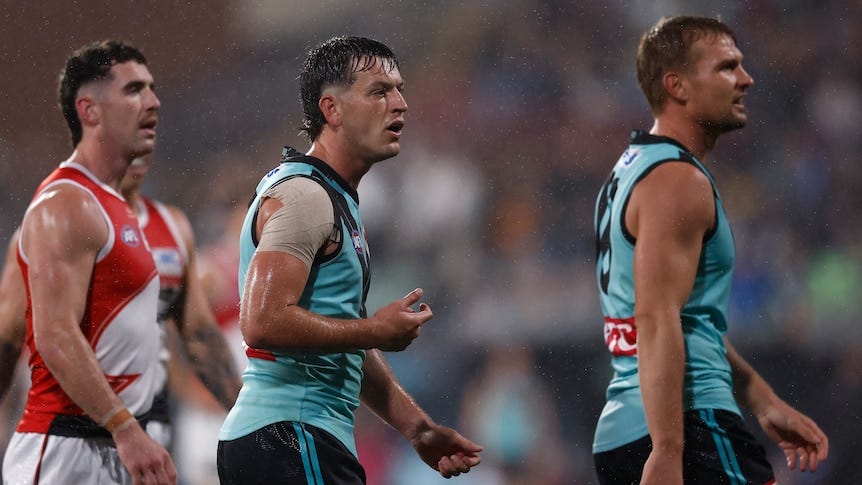
Port Adelaide has always loved to anoint its favourite sons as coach. The only exception over the near century separating Sampson Hosking and Mark Williams was Mark’s legendary dad Fos. Fos, now regarded as perhaps the most Port Adelaide person of them all, infamously moved from West Adelaide in 1950 to become Port’s player-coach.
Port’s next outsider experiment was, of course, Ken Hinkley in 2013. When that experiment began to falter, it was no wonder the faithful began to salivate over the prospect of Josh Carr replacing him. There was something nostalgic and familiar about it – another favourite returned son, another premiership player. Not only that but a player whose hard and physical approach encapsulated what fans delight in calling the “Port Adelaide way”, and someone so thoroughly Port Adelaide he (allegedly) actually initiated the iconic Ramsgate fight with Mark Ricciuto. How could it go wrong?
Well, unfortunately, so far it has. After truly terrible performances in the first month of the season against North and West Coast, and a feeble win against even-more-atrocious Essendon, the wind was out of Port’s sails before the anchor had even been raised. The breeze seemed briefly to stiffen with a tantalisingly gallant loss against Hawthorn, an invigorating, romping win over Geelong, and a just-forgivable loss to the Crows over consecutive rounds. But as Port head into the mid-season bye, it is hard to hold on to hope following consecutive and convincing defeats to the Bulldogs, Gold Coast, and worst of all, Carlton.
Causes for optimism are thinning as rapidly as Ken Hinkley’s hair over the latter years of his tenure. There have been significant injuries – to captain Connor Rozee, Sam Powell-Pepper and Miles Bergman (who, even when he was playing, did not seem to be doing so on a full tank). But, as significant as these absences are, they seem like excuses papering over what is increasingly hard to deny – Port’s list is not what it once was. Mitch Georgiades has been a dependable if inaccurate presence up forward, but it is hard to resist the conclusion his impressive goalkicking figures (currently sixth on the Coleman Medal count) are mostly a function of the dearth of talent surrounding him. Aliir Aliir has found some of the form that made him a fan favourite a few years back, but he similarly has had few reliable assistants.
Meanwhile, Zak Butters dominates almost every game. But this is cold comfort given he’s almost certainly departing Alberton at season’s end. Jason Horne-Francis continues to be inconsistent, Ollie Wines has slowed up, and after that the pickings quickly start to become meagre. Burgoyne, Drew and Farrell have been solid enough. There have been some enjoyable performances from new youngsters like Ewan Mackinlay, Jack Whitlock, and Josh Lai. But are they going to replace Travis Boak, Dan Houston, Charlie Dixon, and the rest? I hope so. But I don’t see it quite yet.
This brings us back to that fundamental, and fundamentally unanswerable, question of football punditry – how much of a difference does a coach make? It would be harsh to judge Carr’s performance when he can only work with what he has got, and has only had 10 games to do so. But so far, our favourite son has not achieved the Williamsesque feats so many fans indulgently allowed themselves to think he might. The attention of many Port fans has already turned to the enticing prospect of Dougie Cochrane and the exciting 2027 crop of father-son and NGA prospects. If, that is, the AFL hasn’t completely ruined that for us too.
Patrick’s grade: C
My thoughts
I’m going to disagree with Patrick here! Port’s start to the season was very bad. And the recent sequence of close losses – especially the heartbreak of the Showdown (not that I think there’s any shame in being beaten by Brayden Cook, the best player in the AFL) – would no doubt sting. But overall, I think the season is well on track to deliver the outcomes most realistic Port fans would have wanted: evidence of Josh Carr’s coaching acumen, growth from young players, and maintaining a good draft hand.
Carr has transformed Port’s defensive profile virtually overnight. Here are some relevant numbers:
There are probably some beneficial fixture and sample size effects here – it’s only 11 games, after all – but the improvement from Ken Hinkley’s final year in charge has been stark. (Perhaps it’s evidence in favour of the argument that Ken really was in charge in 2025.) Without having closely reviewed the tape, my impressions are that Carr has significantly improved his side’s ability to slow the opposition in transition, funnel them wide, and maintain disciplined defensive spacing. If Port was at all a relevant side this season, it would be one of the bigger stories in footy. It’s been genuinely impressive, and, in my opinion, enough to give Port supporters confidence that Carr knows what he’s doing.
Crucially, that improvement hasn’t translated into too many inconvenient wins. Sometimes we need to acknowledge realities that the AFL would prefer didn’t exist. Outside of an implausible jump up the ladder that persuaded Butters that his long-term future lay at Alberton, it’s not really in Port Adelaide’s interests to win many games this season. They’re headed to the draft. If (realistically, when) Butters leaves, Port will have several picks in addition to its natural first-rounder. Dougie Cochrane looks like such an enticing prospect that he will be a top-two draft pick without playing many, if any, games in his draft year. The AFL’s recent changes to the bidding rules will make him more expensive. Had Port won the four games they’d lost by less than a goal this season, matching a bid on Cochrane would have looked much more complicated.
The players that Port has selected with its few meaningful recent draft picks are showing good flashes. Joe Berry looks much more at home at AFL level in his second year. His late goal almost won the Showdown. Jack Whitlock is the real revelation, however: the spring-heeled tall forward looks like a set-and-forget forward for the next decade. That’s a great outcome from Pick 33. Now that he’s regained match fitness, Jason Horne-Francis looks like he’s about to go to the next level.
I understand that, on some fundamental level, it sounds silly to say given the point of footy is to win, but I truly believe that, in almost every respect except the win-loss record, it’s been an encouraging season for Port Adelaide. The problem is that the guy who’s done the most to make that happen on the field almost certainly won’t be there next year. The clock will reset.
My grade: B
I’ll be back this time next week with thoughts on how GWS and Richmond are going so far.