


The first of my season previews takes me to West Lakes.
2025 ladder position: 1st (18 wins, 5 losses – eliminated at Semi Final stage)
2025 best-and-fairest: Jordan Dawson
Senior coach: Matthew Nicks
Story of the season
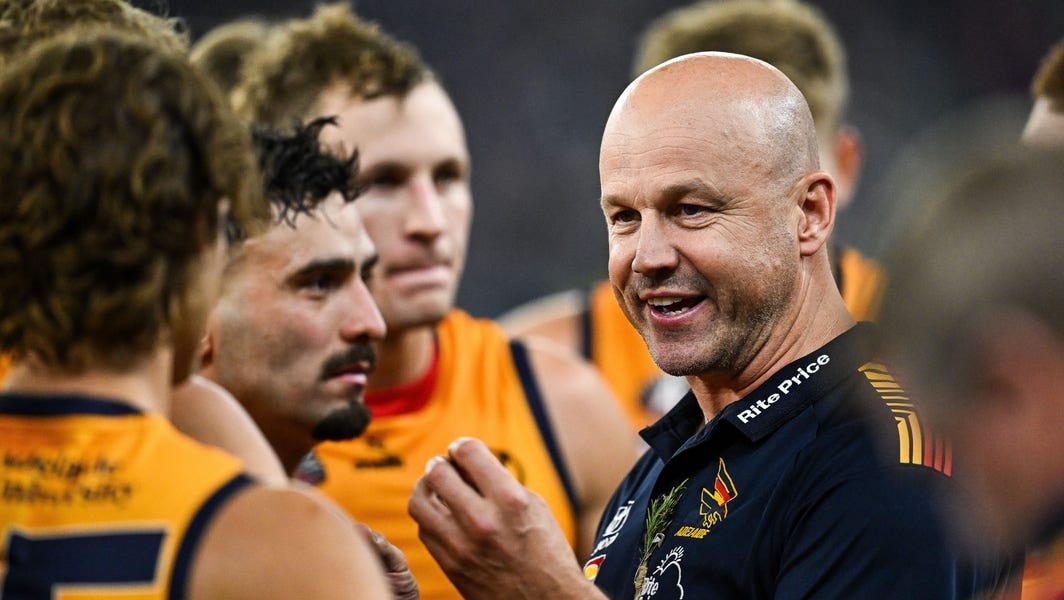
The greatest tragedies are the ones where emotional alchemy turns excited hope into dashed expectation. The Crows came out guns blazing in the first month of the season, piling on the points but also bleeding them at an alarming rate. An average of 92 points conceded across their first five games, against some less-than-formidable opponents, was clearly not what Matthew Nicks wanted. So he pulled some levers (the short version: fewer risks moving the ball, tightening up around stoppages, and putting Dan Curtin on the wing) and something very unexpected happened: Adelaide became the meanest defence in the AFL. From Rounds 6 to 23, the Crows conceded an average of just over 63 points per game, winning 14 of 17. Supporters went from believing their team could make finals, to hoping they could make the top four, to reckoning with the increasing likelihood that they would finish the Home & Away season as minor premiers. It was the biggest single-season rise up the ladder – from 15th to 1st – in AFL history.
And then – and then – Izak Rankine made the most damaging mistake of his career. His homophobic slur against a Collingwood player, delivered during the Round 23 encounter between the sides, was overheard by opposition players and reported to the umpires. The subsequent investigation resulted in a four-game suspension for Rankine, and the club’s steadfast support of him cost the Crows massive amounts of public goodwill. Anyone who thought that neither club nor player paid enough enjoyed what followed. The Crows utterly failed to cope with both the loss of one of their best players and the intense psychological scrutiny occasioned by the negative publicity and the pressure of finals footy. A joyless win over North Melbourne in Round 24 was followed by two convincing home finals defeats against Collingwood and Hawthorn, in which the shellshocked Crows didn’t win a single quarter. A season that briefly, impossibly, looked like it could turn into a fairytale ended in a nightmare. Many questions were answered about Adelaide – the team, the club – in 2025. Just as many appeared in their place.
Summary of game style
In 2025, the Crows were defined by a commitment to contest, speed, and territorial directness that set them apart from almost every other side. They were not interested in slow control or methodical possession. They were 18th in the AFL for handball metres gained, near the bottom for disposals per chain, and among the lowest teams in the league for control ratio (marks divided by ground ball gets). Instead of reshaping the field through careful manipulation of angles, the Crows preferred to gain territory early, move the ball quickly, and trust in their ability to win contests downfield. They led the AFL for turnovers forced and turnovers conceded – a reflection of how willingly they embraced volatility. Their chains were short and sharp. Press or counterpress to win the ball. Kick it (the Crows were 1st in the AFL for kicks as a share of disposals). Compete again. Contests were not interruptions to their game; they were where the game happened.
This style worked – until it didn’t – because of two factors. The first was directness. Rapid, uncomplicated forward movement turned loose balls into repeatable advantages and prevented opponents from resetting defensively. Even when possession was lost, it was often lost in ways that produced stoppages or counterpressing opportunities rather than open-field exposure. Adelaide were exceptionally good at converting value-negative situations into neutral ones, a skill reflected in their league-best scores-from-turnover differential and ability to score from the back half (despite being below league-average at actually progressing it from their back half).
The second factor that made it viable was personnel. Few sides could match Adelaide’s array of one-on-one weapons. Dan Curtin, Jordan Dawson, Riley Thilthorpe, Josh Worrell, and Izak Rankine gave the Crows elite aerial, ground-level and hybrid contest capability across the ground. Adelaide ranked top-three for offensive one-on-ones because they actively sought them out. Rather than stretching defences laterally, they compressed them vertically and trusted their athletes to win contests in high-value parts of the field. This helps to explain the apparent contradiction at the heart of their numbers. Adelaide were a great contested team without being good at winning clearances. Their dominance came in secondary and tertiary contests, where pressure, physicality, and endurance compounded. The Crows coaches tracked tackles laid and tackles broken during the game because it was a proxy for physical superiority. In my preview ahead of last season, I borrowed the concept “low block” from soccer to explain the Crows’ willingness to adopt conservative defensive positioning to facilitate counterattacks. In 2025, the trendy soccer term that best explained what the Crows were cooking was “duels” (i.e. direct one-on-one contests). The Crows sought them and won them at a league-leading clip.
Pressure functioned as both engine and insurance policy. It powered their turnover game and masked the absence of a dominant midfield. Rather than out-thinking opponents, the Crows outworked and outmuscled them. Structure mattered, but only in the sense that it created opportunities for collision. At its best, this approach was suffocating. Opponents were dragged into contests they didn’t want and couldn’t win. Territory accumulated. Turnovers became scores. Momentum snowballed. At its worst, it looked… a bit primitive. When rivals absorbed pressure, won or halved enough aerial duels, and forced Adelaide into slow build-up, the lack of refined ball movement became apparent. But in 2025, more often than not, the Crows succeeded in bending chaos to their will. They were not especially interested in control or finesse. They were a contest-and-conversion team, built around physical superiority, relentless pressure, and faith that creating contests would tilt the game their way.
List changes
In:
Mitchell Marsh (2025 National Draft, Pick #22)
Archie Ludowyke (2025 National Draft, Pick #50)
Finnbar Maley (trade – North Melbourne)
Callum Ah Chee (Pre-Season Draft)
Indy Cotton (Category B Rookie)
Out:
Chris Burgess (delisted)
Karl Gallagher (delisted)
Lachlan Murphy (delisted)
Harry Schoenberg (delisted)
Kieran Strachan (delisted)
Matt Crouch (retired)
Brodie Smith (retired)
List profile
Number of top-10 draft picks: seven (8th)
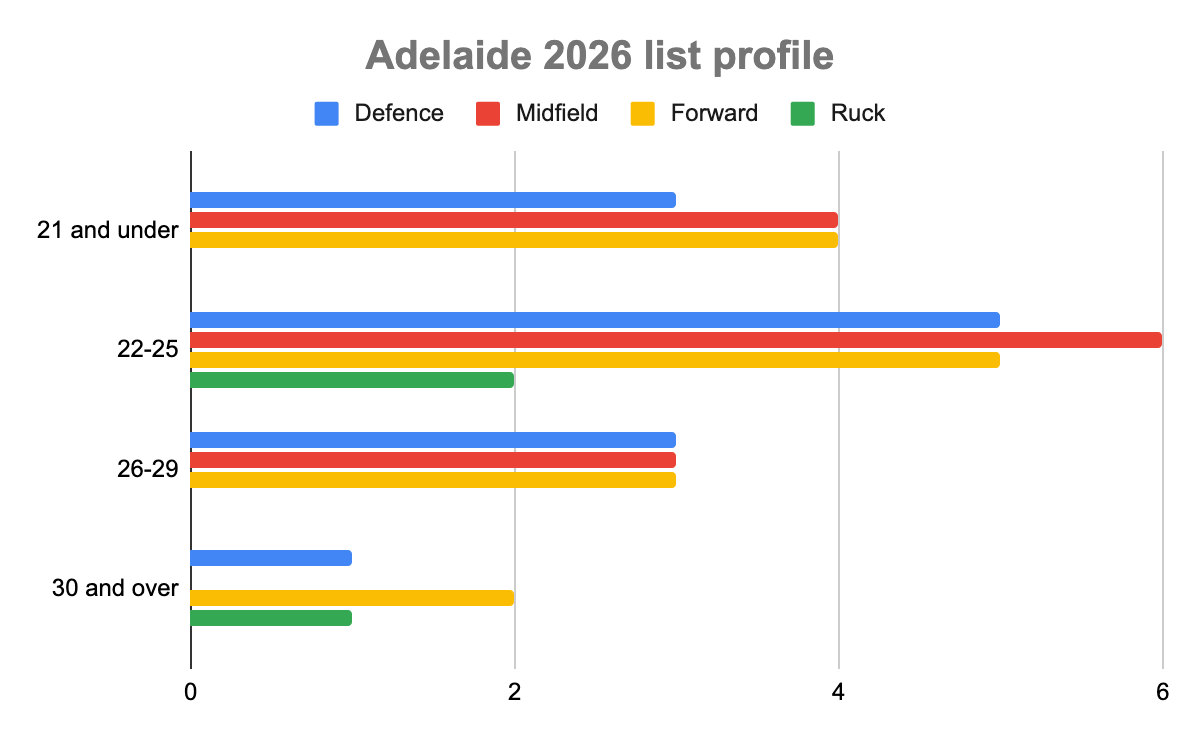
Average age at Opening Round: 24.9 (7th)
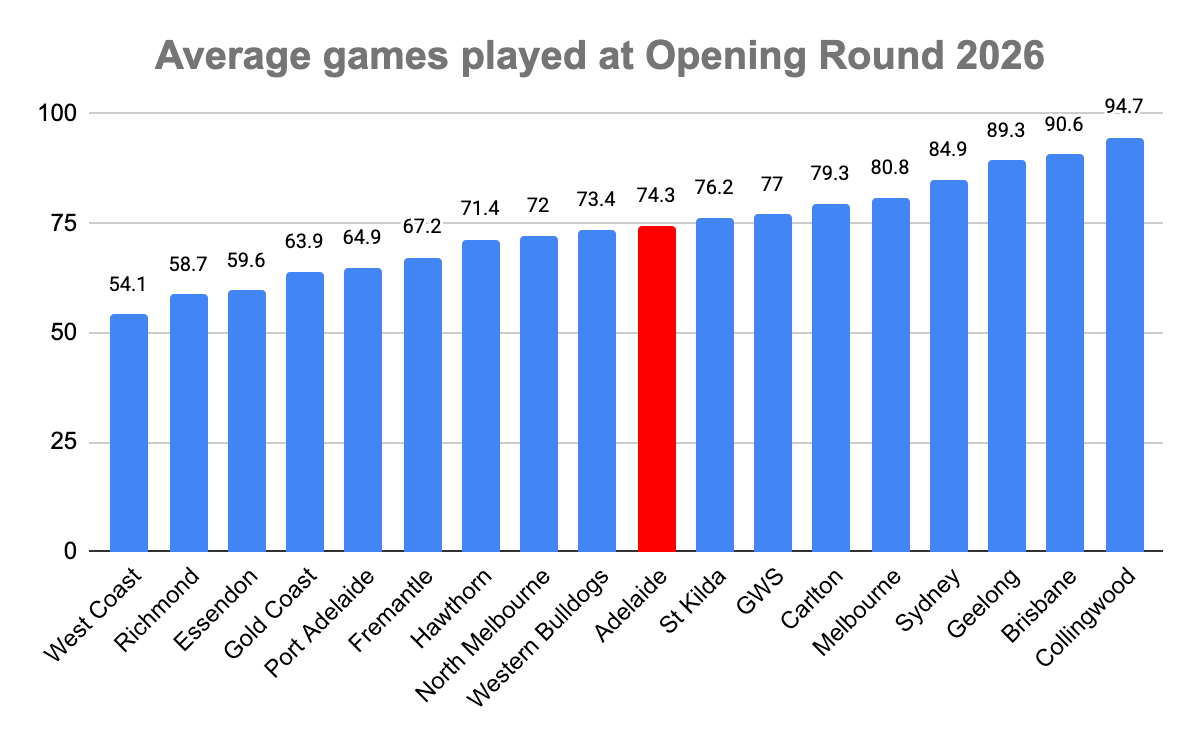
Average number of games played: 74.3 (9th)
The Crows recruited well ahead of last season, adding established quality in the form of Alex Neal-Bullen, James Peatling, and Isaac Cumming. They are precisely the honest, dependable pros that help a callow list become battle-hardened. The addition of Callum Ah Chee is motivated by similar thinking. The 28 year-old dual Premiership winner knows what it’s like to be part of winning environments. His versatility could see him line up on a wing, at half-forward, or even (in a pinch) serve as an ersatz third tall when Tex Walker’s old bones say no. The other additions are more speculative but still intriguing. Finnbar Maley is all rough edges. He can clunk. Whether he can do anything else is yet unknown. The Crows apparently beat out eight rival clubs to sign Indy Cotton. The former basketballer could apparently have been a legitimate first-round chance in last year’s draft had he not taken a few years out of the game to follow his hoop dreams. When the Crows failed to trade up the order on draft night to nab midfielder Dyson Sharp, they consoled themselves with two additions to the forward line: Mitch Marsh and Archie Ludowyke. Marsh, who impressed in South Australia’s all-conquering Under-18s carnival side, profiles as a third tall or winger with a booming left-foot kick. Ludowyke is a project, but if he can put meat on his bones, he might have a future as an AFL-level tall forward.
The footy world learnt a lot about Adelaide’s backline last season. Josh Worrell and Mark Keane went from names that elicited shrugs or furrowed brows to leading interceptors and All-Australian squad members. Rory Laird reintegrated into the defence like he’d never been away, adding a level head and ground-ball winning expertise, while Max Michalanney continued his development. The largest question marks surround the key defensive positions. Jordon Butts and Nick Murray are dependable stoppers. But neither is a creative ball user. Adelaide already struggled to move the ball from their back half (they ranked 14th for chains that went from the back half to defensive 50). Partly that was a function of not committing too many men forward and trusting their forward-half players to win 40/60 contests. But it became a liability late in the season as opposition teams pinned them back and generated repeat entries. And opposition pressing schemes have become sophisticated. I daresay that, for as long as Mark Keane is on the sidelines, coaches will instruct their forwards and wingers to sag off Murray and Butts, forcing them to either try and execute risky kicks or (more likely) send it long down the line – where Dan Curtin won’t be waiting to bail them out. If the Crows are to add another layer to their attacking game, players like Mitch Hinge, Wayne Milera and Max Michalanney will need to contribute more rebound.
The midfield is still the obvious area of weakness. Jordan Dawson is the only undisputed All-Australian calibre full-time midfielder. Rankine is his equal, but isn’t in there all the time. In his absence during the finals series, Adelaide’s opponents knew they could pay more attention to (a slightly injured) Dawson, safe in the knowledge there wasn’t another Crows midfielder who could truly hurt them. James Peatling and Jake Soligo are good contributors, particularly for what they cost, but looking at the depth and quality of midfields that other top sides are rolling out, one wonders if they’re quite at the level required. Sid Draper and Dan Curtin are the great hopes of the current list. Curtin could become the best player in the AFL, and his move inside during the pre-season (prior to his injury) generated a lot of excitement. But he’s ultimately still an unknown quality as a midfielder. Ditto for Draper, whose cameos in 2025 showed both flashes of extreme talent and why some recruiters had their doubts about his composure and disposal. He is currently struggling with groin soreness that every Crows fan will be hoping isn’t osteitis pubis.
Riley Thilthorpe’s emergence as one of the game’s best key forwards means the Crows’ forward line isn’t a concern. But there are still questions. Even if he’s not the main target, Taylor Walker is still the boss. Darcy Fogarty is usually a good foil but went missing in the finals. And, especially if Rankine and Josh Rachele both begin splitting their time between the midfield and forward line, it’s fair to ask some questions about the depth of Adelaide’s small forward stocks. It isn’t a luxury position anymore – it’s fundamental to modern footy.
Line rankings
Defence: Above Average
Midfield: Above Average
Forwards: Elite
Ruck: Average
The case for optimism
This time last year, a lot of people doubted there was enough talent on the Crows’ list to sustain an extended run at finals. Those doubts have mostly been allayed. We knew Jordan Dawson and Izak Rankine are stars. We didn’t yet know that Riley Thilthorpe, Josh Worrell, Mark Keane (!) and Dan Curtin are stars too. Regardless of the challenges facing them in 2026, Crows fans can rest somewhat safe in the knowledge that there is enough high-end talent – minus a midfielder or two – to stay in the conversation for the next few years. The defence is solid. The forward line is the equal of any in the game. The midfield is more blue-collar than blue-chip, but there are young players (Curtin, Draper, Rachele) putting pressure on the incumbents. Assuming a reasonable run with injuries, there’s no reason to expect the Crows to drop off. Of their better players, only Rory Laird and Taylor Walker are long in the tooth – and both have become important rather than essential. Rankine, Thilthorpe, Worrell, and Curtin are young. Jordan Dawson has a lot of tread left on the tyres. The floor remains high.
There’s a corollary here: the injuries that have bedeviled the Crows’ pre-season will create opportunities for others. Last season, there were several young players on Adelaide’s list who, despite encouraging form at SANFL level, weren’t able to dislodge more established players. Just as one can understand the frustration of Crows fans that more kids didn’t get a game (everyone loves the shiny new toy), one can also understand the conservative selection philosophy: the senior players who kept getting picked kept delivering results. Curtin and Keane’s absences will create opportunities for others that could ultimately work to the long-term benefit of the list. Charlie Edwards, Pick #21 from the 2023 draft, should get his chance early in the season. Max Michalanney could find himself in a new role which helps him add the attacking layer his game needs. There will almost certainly be other injuries. And although they’re unlikely to spell good things for the Crows in 2026, they could create the depth that yields dividends for the rest of the decade.
The case for pessimism
The Crows have all the characteristics of a side that regresses after a big leap up the ladder. The first two reasons are closely related. Firstly, they had a good run with injuries in 2025. Their three best players – Rankine, Dawson, and Thilthorpe – played 72 out of a possible 75 games. Other important contributors like Worrell, Ben Keays, Laird, and Keane played virtually full seasons. The Crows’ pre-season carnage, which has already seen Keane and Curtin suffer injuries that will keep them out for large chunks of the year, has shown that the swings of the variance pendulum can be cruel. Both players are important cogs in the Crows’ system. Their absences will be, pardon the pun, keenly felt. The second reason the Crows could regress is that I’m pretty sure they enjoyed a limited-time physical advantage courtesy of their now-departed High Performance Manager, Darren Burgess. In a league of large men, the Crows players were noticeably large last season. That advantage underpinned their ability to continually win contests around the ground. Melbourne fans spoke similarly about their side’s physical advantage in 2021, the year the Demons stormed to their drought-busting flag. But in the AFL, advantages tend to get eroded away. It’s very difficult to continually train at that kind of intensity and not experience either a drop-off or – as we’re already seeing – a bad run with variance. Darren Burgess is very good at his job. But, partly because of that precise fact, he doesn’t tend to stay around for too long. And so it was when Juventus came calling over the summer. Crows fans will hope Burgess left behind good handover notes.
Another reason the Crows could regress is that they really were a bit lucky when it came to in-game variance. No team overperformed their expected score by as much (+6.4 points per game) and only Greater Western Sydney overperformed their expected wins by more than Adelaide. The Crows won five games they “should” have lost based on expected score. Not always by much, but still – you can defy the underlying numbers for a while. But you can’t count on continuing to defy them.
The final reason it might be prudent to sell some of your Crows stocks is that the finals series exposed their limitations rather brutally. Yes, there were some mitigating factors – the uniquely corrosive Rankine situation being the main one. But sides very rarely have all their best players in peak physical condition for the finals. The best ones deal with it. The Crows couldn’t. Across two home finals against sides they’d beaten less than a month before, they couldn’t even win a quarter. Their chaotic style looked confused. They could not generate coherent ball movement from their back half (a chronic issue that became acute in the final two months of the season). The turnovers they’d thrived on became liabilities. Matthew Nicks couldn’t solve the tactical problems that two of the canniest coaches in the league threw at him. In short – the lights looked too bright. Adverse finals series can act as catalysts for future success. That could be the case here. But almost everything went right for the Crows last year. And it still ended in bitter disappointment. As a prologue to glory, it doesn’t inspire confidence.
Enjoying this preview and think a Crows-supporting friend might too? Share it with them!
Breakout player
Josh Rachele. Yes, it’s probably dodgy to nominate a player who kicked five goals on debut for a breakout. But Rachele was already putting together an excellent season in 2025 until it was interrupted by two separate serious injuries. He looked sharp and, crucially, better connected to his teammates. He’s trained as a midfielder throughout pre-season. He’ll probably never be a full-time mid (partly because he’s a good forward). But there’s no reason he can’t be the Crows’ version of Cam Rayner or Jordan De Goey.
Most important player
If you broke down the biggest question facing the Crows before last season – does this list have enough talent? – into its constituent parts, one of the most important would have been “what will the forward line look like post-Tex?” Riley Thilthorpe didn’t just answer that question: he obliterated it. Thilthorpe gathered up all the threads of obvious talent he’d shown in his first four years in the AFL and put them all together, gloriously. He’s big. He’s skillful. He’s fun to watch. He performs in big moments. He was one of the main reasons the Crows vaulted up the ladder. Every major success the Crows conjure in the next decade will be tied to his form and health.
Biggest question to answer
The last time the Crows played with the burden of expectation – in 2024 – they failed. This time around, the spotlight will be firmly fixed on West Lakes. How will they rebound from their catastrophic end to the season? How will Rankine rebound after he let down his teammates and himself? How will depth players who didn’t get much of a look-in last year step up to fill the absences of Keane and Curtin? (Okay, that’s three questions.)
What success looks like
Last season in this space, I wrote that the Crows had the list to win a final, but asked if they had the coach to win one. Was last season a definitive answer to that question (in the negative) or was the fallout of the Rankine saga sufficient mitigation? 2026 will supply an answer. The Crows have a tough first four games: Collingwood, the Western Bulldogs, Geelong, and Fremantle. It softens from there, but it’s not inconceivable they start 0-4. It’s a long way back from there. But, if the Crows hierarchy believes there’s a flag in this list, they need to make finals – and win one – regardless of how much adversity they might encounter.
In a nutshell
Just like the Crows weren’t really the 4th-worst team in 2024, they weren’t actually the best team last season. They were good, they were unique, and, until they shot themseleves in the foot, they were lucky. There are reasons to believe they’ll slide this season. But zoom out, and this is still a talented list with match-winning players.
Agree? Think I’m a fool who’s biased against the Crows? Share your thoughts in the comments.
Thanks this is great! I'm gonna write an essay