


Taking the 58 to Arden Street for my 12th season preview.
2025 ladder position: 16th (5 wins, 17 losses, 1 draw)
2025 best-and-fairest: Harry Sheezel/Tristan Xerri
Senior coach: Alastair Clarkson
Story of the season
I was there that Sunday. Round 2. March 23rd, 2025. The day North Melbourne beat a Melbourne side with Max Gawn, Christian Petracca, Clayton Oliver, and Jack Viney in it by almost 10 goals. The Kangaroos didn’t just beat the Demons – they bullied them, dominating in precisely the parts of the game that had been Melbourne’s domain in their era of success. I won’t quickly forget the emotions of North fans that day. Joy, disbelief, hope. Catharsis. Even a six-goal loss to the Crows at Adelaide Oval the next week didn’t dent their optimism. The Roos had been competitive against two good sides, and thrashed a side that many people still expected to be good. It seemed as though, finally, the light at the end of a very long tunnel was approaching.
But what looked like light was instead a false dawn. That euphoric win against Melbourne and respectable loss against Adelaide were followed by a trio of grim defeats – to Sydney, Gold Coast, and Carlton on Good Friday – which brutally revealed the fragility of North’s improvement and the chasm they still needed to bridge. Narrow losses to Port Adelaide and Essendon were leavened by a draw in Tasmania against eventual Premiers Brisbane that North really ought to have won. A win against Carlton six weeks later once again showed that the Roos really were capable of taking it to teams who relied on winning out of the middle. However, as dismal collapses against Hawthorn and Geelong in the run-in showed, their struggles against sides which move and win the ball at speed were as apparent as ever. North improved. But only by enough to win two more games and move up one spot on the ladder. The leap that their fans crave – that might actually make the hell of the last five years vaguely worth it – still feels a long way away.
Summary of game style
Separating intent and outcome isn’t easy when watching poor teams and consulting their statistical profile. Signal and noise blur because weaker sides are often just trying to survive. That being said, it’s possible to discern what Alastair Clarkson is attempting at North Melbourne. His work so far has prioritised the construction of a game model that minimises risk in possession while gradually layering in competitive habits and defensive discipline. Stability takes precedence over expression.
The foundation is stoppage. Clearances and first possession are the one phase of the game where North often enjoys a talent advantage, and Clarkson has leant in. The Roos hunt territory through contest wins, preferring to begin chains in the forward half rather than exit from deep defence. This is both tactical and psychological: starting higher up the ground reduces exposure and the number of decisions required in the open field. When the Roos win the ball, conservatism quickly takes over. North have been the slowest side in possession for the last two seasons, favouring short kicks and safe outlets. Their retention numbers are strong – their metres gained and threat per kick are not. The priority is not to be wrong. Chains produce volume without incision. Sound, yes, but little fury.
Squint a little and you can see the fingerprints of Clarkson’s great Hawthorn sides, which also used possession to manage territory and manipulate shape. The difference is damage. That Hawthorn side had elite kickers which pierced opposition zones. They were helped by the game being slower and less defensively sophisticated than it is today. This North group does not yet have the same technical edge, and the modern game punishes hesitation. A weapon in one era can look like a holding pattern in the next.
Safety in possession has not yet translated to a viable defensive model. North are the league’s worst side at defending turnover. Long chains stretch their shape; when possession is lost, the counterpunch is immediate despite the appearance of numbers behind the ball. This pre-season has apparently focused on teaching a new defensive set-up more centred on manning the back shoulder of opposition players instead of pushing high, which was often punished against faster sides. We shall see what transpires.
The Roos optimise for winning and keeping the ball rather than surviving without it. Even their clearance strength is a double-edged sword. North were the second-highest scoring side from centre bounces in 2025, but conceded the second-most scores from the same source. Their young midfield tries to win the ball in close, often surging numbers toward first possession. That aggression is encouraged because it’s where North’s talent advantage lies. But when clearances are lost or emerge messy, there is little protection behind the ball. The sight of opposition midfielders streaming towards goal out of a stoppage, a North player desperately trailing behind, is a familiar and unwelcome one for Roos fans.
The optimistic view is that this is a team being taught habits before being granted freedom. Risk is permitted at stoppage, where roles are clear. In open play, behaviour is tightly circumscribed and licence is given only to certain players. The pessimistic view is that conservatism reflects Clarkson’s doubt – in his players, his system, and his ability to improve either.
List changes
In:
Lachy Dovaston (2025 National Draft, Pick #16)
Blake Thredgold (2025 National Draft, Pick #26)
Hugo Mikunda (2025 National Draft, Pick #48)
Charlie Spargo (free agent – Melbourne)
Out:
Will Phillips (delisted)
Brynn Teakle (delisted)
Miller Bergman (delisted)
Kallan Dawson (delisted)
Eddie Ford (delisted)
Geordie Payne (delisted)
Darcy Tucker (delisted)
Finnbar Maley (trade – Adelaide)
List profile
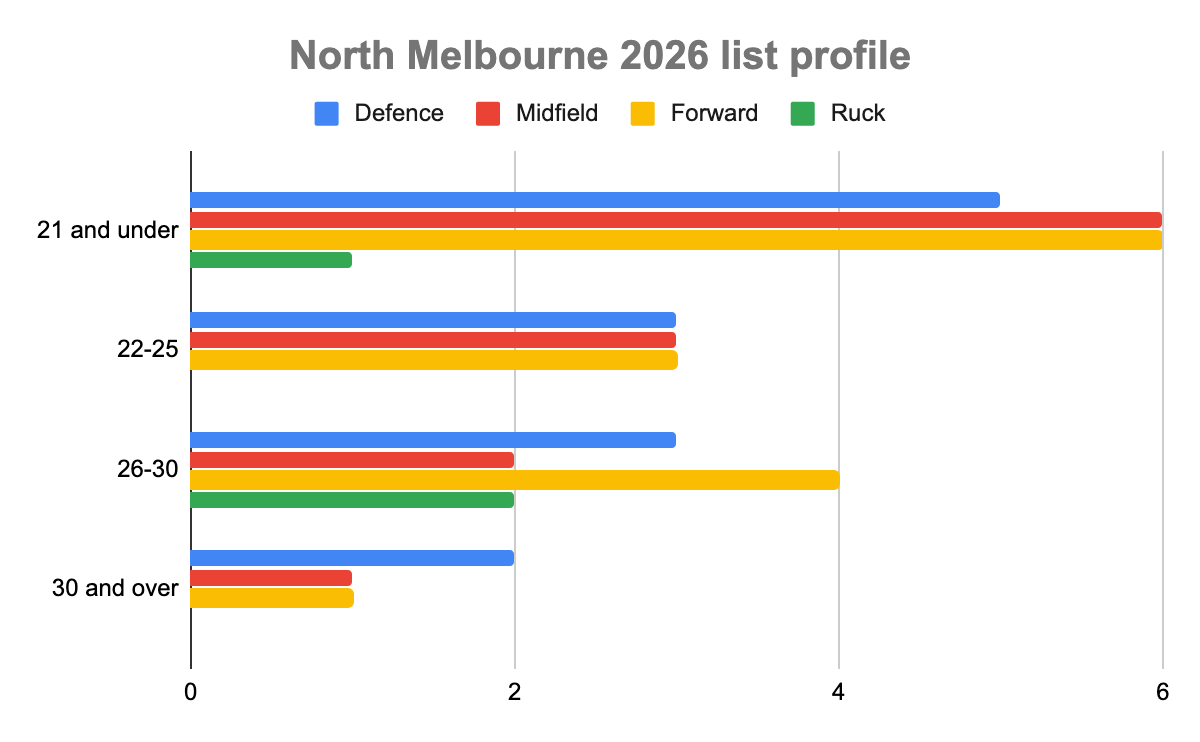
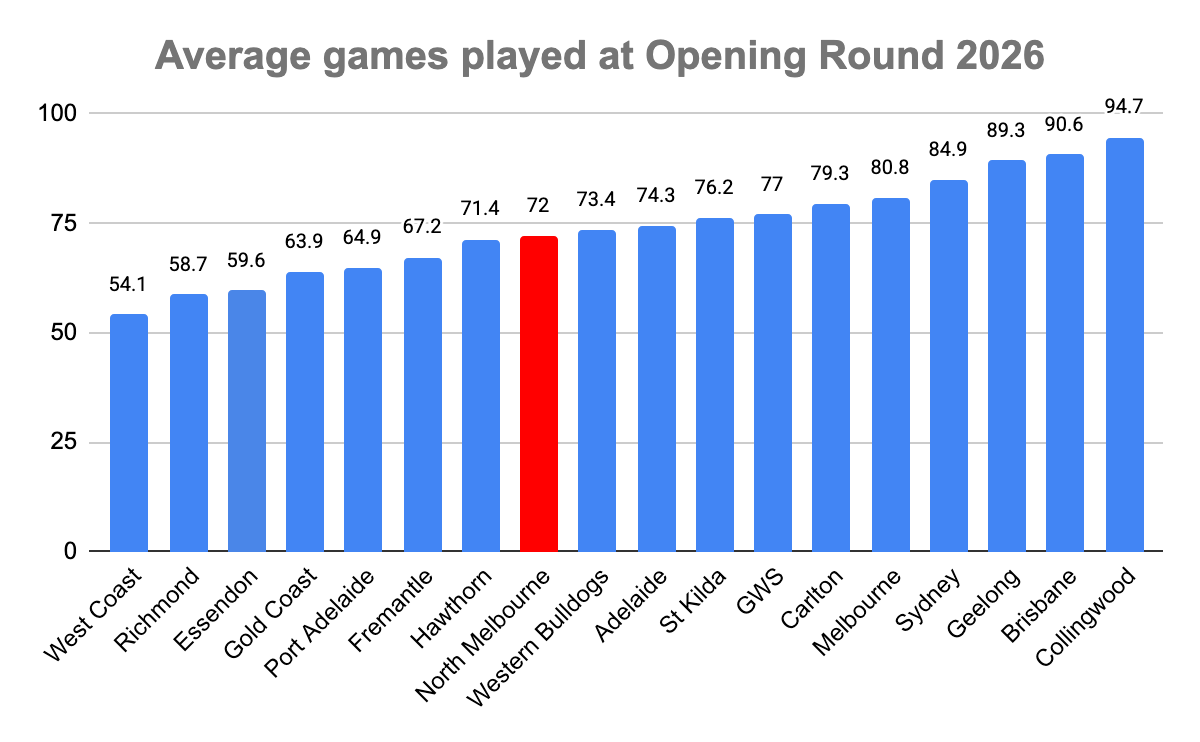
Number of top-10 draft picks: 9 (T-3rd)
Average age at Opening Round: 24.2 (14th)
Average number of games played: 72 (11th)
Lists with headline demographics like North’s – young, but not unusually inexperienced – are often ready to improve. But poor drafting and recruitment have left the Kangaroos with an uneven distribution of talent across their list, both by age and position. Recent drafts have prioritised immediate need as much as upside: Lachy Dovaston was widely regarded as the premier small forward in the 2025 pool, Blake Thredgold stood out as an intercepting defender at the under-18 championships, and Hugo Mikunda brings agility and creativity. Former Pick #3 Will Phillips and Finnbar Maley were the most notable departures.
North’s backline has been among the weakest in the league for several seasons, and things are not helped by a perennial inability to stop opponents bringing the ball their way. Charlie Comben is a rare athlete and excellent interceptor; he is also unusually susceptible one-on-one and a dodgy kick. A competent defensive system would do more to accentuate his strengths and mask his weaknesses. Toby Pink has established himself as the most dependable option down back. He is not flashy, and often gives up size, but he competes honestly. Griffin Logue, health permitting, looks set to partner him. Matt Whitlock has shown promise but is not yet physically ready for a full season in defence (or up forward). Injuries continue to undermine stability. Jackson Archer, arguably the best pure defender on the list, will miss the season after an ACL injury, while Thredgold is expected to miss most of the year with a foot stress fracture. Although it can get him into trouble, Colby McKercher provides essential speed and dare for a side that doesn’t have enough of either. Caleb Daniel remains composed, but his lack of size and speed is becoming harder to disguise.
The midfield is where most of North’s talent is concentrated. Luke Davies-Uniacke, Harry Sheezel, Tom Powell, and George Wardlaw form an intriguing core. With Finn O’Sullivan and Luke Parker rotating through, the group looks strong on paper – but it often underwhelms in practice. Wardlaw and a declining Parker aside, there is no natural defence-first midfielder in the mix, and this group is also expected to generate much of North’s attacking drive. If Wardlaw’s hamstring issues persist, Luke Urquhart deserves an opportunity; his size and defensive instincts could help restore some balance. Dylan Stephens, Bailey Scott, and captain Jy Simpkin (whose trade request was declined) will compete for wing roles.
North’s forward line illustrates how quickly list profiles can change. Entering 2025 it looked serviceable, but no more. Twelve months later, Paul Curtis has emerged as a genuine star, Cooper Trembath has offered hope as a contested partner for Nick Larkey (which makes his non-participation in recent match simulations perplexing), and Cam Zurhaar is coming off a career year. Dovaston adds further small-forward threat. Suddenly, this looks like a dangerous unit. The challenge is supply. Jack Darling remains a workhorse, but the sooner North moves past him, the better. Charlie Spargo is likely to feature early given his free-agent arrival. Zane Duursma is the major wildcard: his talent is obvious, his work rate less so. This season may determine whether he is part of North’s future or another missed opportunity.
Line rankings
Defence: Poor
Midfield: Average
Forward: Average
Ruck: Above Average
The case for optimism
Optimism is in scarce supply at Arden Street. But, heading into 2026, I can detect two sources of it: the micro case that the Roos are improving, and the macro case that stagnation would at least force a reckoning. To begin with: the Roos are getting better. Glacially, agonisingly, spasmodically – but the signs are there. Here’s proof:
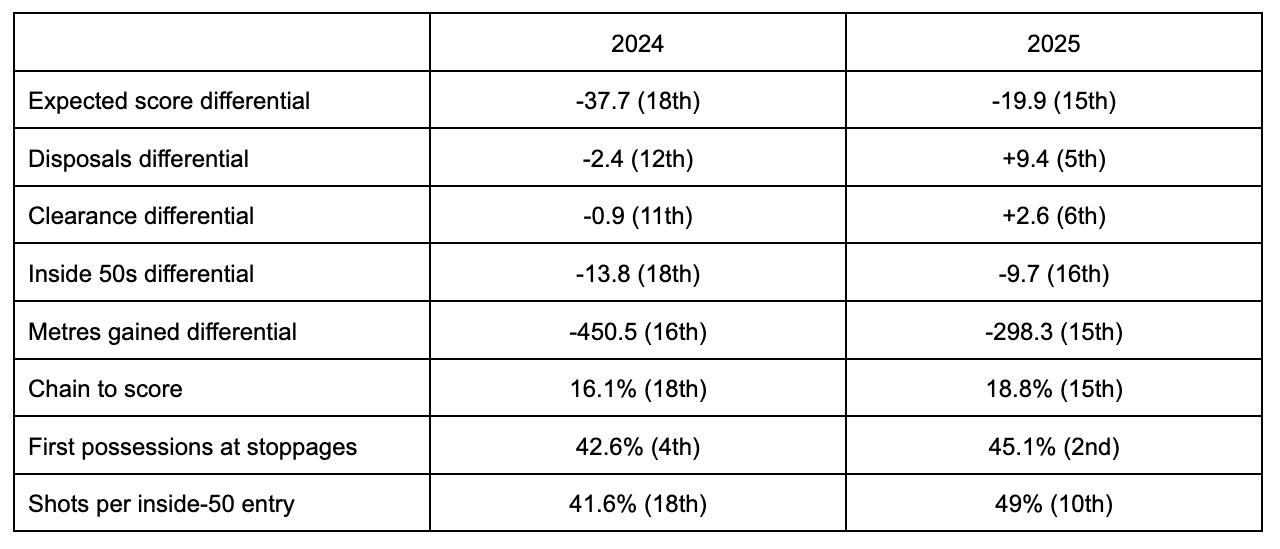
Do not confuse this for the claim that North are a good team, or even necessarily on the path to becoming one. I’m making a different claim: that, in the context of the fact that Clarkson came into a club with meagre talent, no settled system, and no corporate knowledge of success, some progress is being made. Not at the speed North Melbourne fans want, or the rate normally associated with a side that’s spent so long at the bottom. But at the margins.
Teams with fragile confidence prefer to start the season with benign draws. The Roos’ first six games are against Port Adelaide, West Coast, Essendon, Carlton, Brisbane, and Richmond. North hasn’t split its first six games of the season since 2018. In fact, since 2020, the Roos have won a cumulative total of just six of 30 games from Rounds 1 to 5. This is an excellent opportunity to build into the season, embed habits that will help against the better sides, and not extinguish the hopes of supporters before May.
The very real possibility that North’s modest improvements are being driven by the growth of young players instead of the growth of the system around them brings me to the second cause for optimism: rupture and renewal. If progress stagnates in 2026, and the suspicion that Clarkson’s style of coaching is no longer optimal for the modern game is borne out, then North Melbourne’s hierarchy might be forced into the realisation that it’s best to move on. A club in North Melbourne’s parlous state was always in danger of hiring the saviour coach. But over-committing to the wrong coaching hire is just as bad a decision as making the wrong hire in the first place. There is a glimmer of hope that, if things get bad enough under Clarkson, the board acts and replaces him with someone who can construct a modern game plan, rather than a diluted version of the one which brought glory long ago. Yes, it would bring the Roos back to the starting line. But it’s not like they’ve travelled far from that point anyway.
The case for pessimism
I strive to keep things original here at One Percenters. But I’m going to open this section by quoting the start of my pessimism section from last year’s North Melbourne preview:
North are a very bad footy team, and I think they’re still a long way from being even an average footy team. The problems are many and major. The list, despite the major surgery of the last few years, still has many players who aren’t of AFL standard. There were so many moments last season – and the season before last, and the season before that – where neither the quality of North’s attacking and defensive structures, nor the application of their players were at the level required in the AFL.
A year on, all of that remains largely true. But there is more to say. So, using that as my starting point, I’ll go layer by layer – list, system, club. Let’s begin with the list. The unavoidable fact is that it’s significantly below the standard that should be reasonably demanded of a club that’s been picking early for five years. Re-litigating recent drafts is tedious, but the fact remains that North’s seven top-four picks since 2020 do not currently look like they’ve yielded the elite core needed for sustained contention. This could still change! But right now, North don’t have enough stars. They also haven’t hit on enough picks outside of the top 10, either – the picks that should be turning into the players that make up the core of the list. Including the Rookie Draft, Mid-Season Draft and SSP window, the Roos made 33 selections outside of the top 10 between 2020 and 2024. Fewer than half, just 15, are still on the list today. Of those 15, four are established best-23 players, and only one – Paul Curtis – has obviously outperformed his pick.
Years of poor drafting and recruitment mean North have few reliable mid-career players, leaving the kids to shoulder a larger share of the burden than they would have to at other clubs. Part of North’s player acquisition problem is that they aren’t selecting for the right physical attributes. According to friend of the newsletter Emlyn Breese, North Melbourne’s 2026 list is the shortest (by median height) of any team from 2012 onwards. At a time when teams are increasingly optimising for athletic traits, this is curious, and more than a touch concerning. You don’t necessarily need to be big and fast to move the ball quickly. But it certainly helps to be big and fast when defending.
That brings me onto the second layer: the system. I summarised my view of what I think Clarkson is trying to do in the Style of Play section. As I often say, it's important to separate progress from outcome. But outcomes are what determine if clubs win finals and coaches get sacked. And, three years in (yes, I know he took indefinite leave for most of 2023), the outcomes don’t suggest that Clarkson’s system – careful in possession, volatile out of the middle, routinely exposed in transition – is generating the right outcomes. Changes to ruck rules that work against Tristan Xerri’s strengths risk taking away one of North’s current advantages. The main reason teams are bad is because their players are bad. But the quality of a team’s defensive structures should be significantly less sensitive to talent. The path from being bad to being good almost always runs through becoming hard to beat. Get scrappy. Then get good. The Roos are still far too easy to beat. That’s a talent issue – but it’s also a system issue. It’s fair to ask if Clarko’s lost his fastball.
Poor drafting and a poor system don’t happen in a vacuum. They are the products of a club that, for reasons in and out of its control, is not currently equipped with either the means to or knowledge of how to create a winning football culture. To be clear, this is not a veiled swipe about North’s success in AFLW, or the fact that the club president is (gasp) a woman. North’s issue isn’t that they aren’t focused on the problem. It’s that they’re stuck in a loop – poor performance, poor recruitment, poor development, poor performance – they can’t escape. This isn’t all in the club’s control. North doesn’t have the option of solving its drafting problems by recruiting big-name free agents. Yes, it’s unfair that the path to success – to competence – is narrower than most other clubs’. But that’s the reality. The only people who can wrench North out of its doom loop are the players, the coaching staff, and the hierarchy. None have done a good enough job so far.
Enjoying this preview and think a North-supporting friend might too? Share it with them!
Breakout player
I’ve complained a fair bit about the quality of North’s recent drafting. Riley Hardeman is exempt from that criticism. The running defender from Swan Districts has impressed in his 20 games, showing a boldness and impetuosity that stands in stark contrast to many of his teammates. North fans are hoping the ankle injury he sustained during the pre-season against Melbourne is not as serious as it first looked.
Most important player
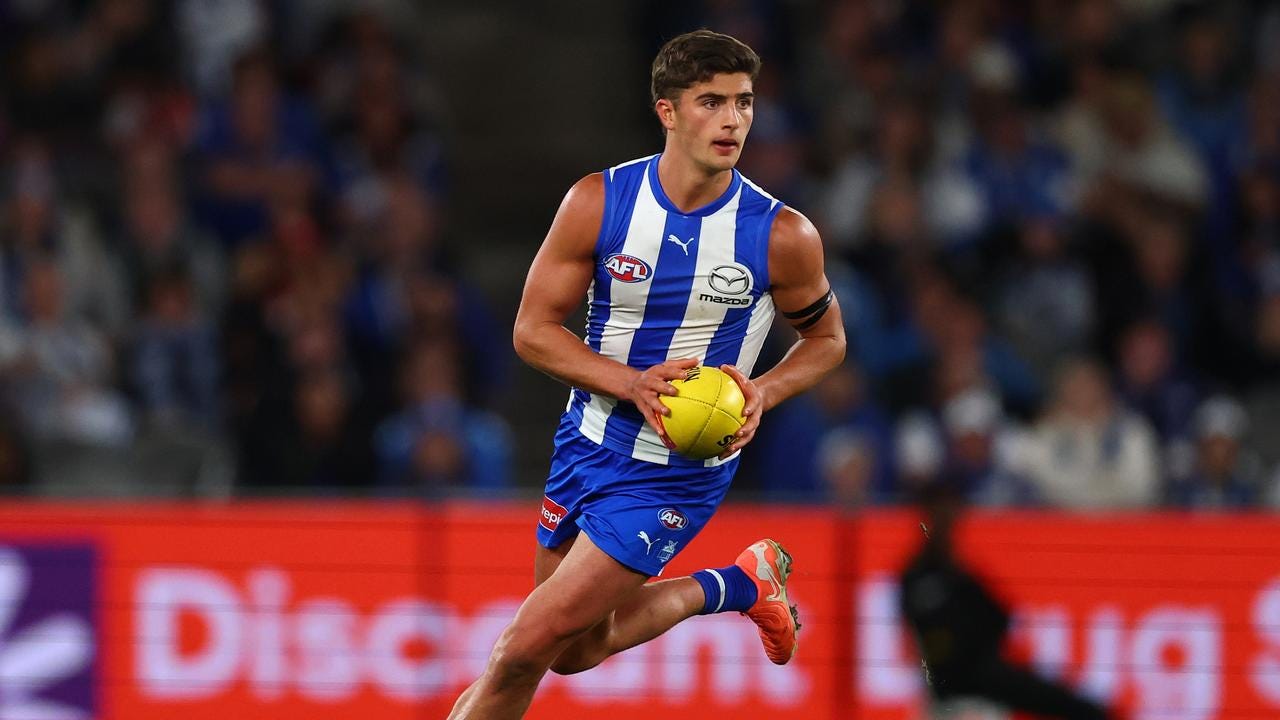
Harry Sheezel is probably North’s best player. There are two ways to view that: the first is to celebrate the development of an exquisitely talented, intelligent young guy who’s invested in the success of his club. The second is to ask how it’s happened that a player who won’t turn 22 until a month after the Grand Final – and whose third season wasn’t at the level of his first two – is asked to assume so much responsibility. The most plausible path to North escaping its current mess involves him becoming a superstar who players at other clubs are desperate to play alongside.
Biggest question to answer
What if it doesn’t get better? This is at least the second straight year where I’ve encountered a lot of suggestions online that North could contend for the finals (or at least one of the play-in positions). I can understand the impulse to optimism. If we aren’t getting unreasonably excited about footy in February, what are we doing? But, as this preview has probably made clear, I don’t think that’ll happen. I’m sceptical that the Roos will escape the bottom four. What happens if there are still only the barest signs of an AFL-level defensive system? What happens if more clubs that began their rebuilds after North did leapfrog them? What happens if supporter discontent becomes vocally directed at Alastair Clarkson? What then?
What success looks like
It’s hard to believe I’m writing this more than three years into the Clarkson Project at North, but the foundations of a game model and list that will one day yield success simply aren’t there yet. Forget about finals or the play-in game – they won’t happen. Clarkson needs to begin at the beginning: make North hard to play against. Develop habits and routines that will scale with talent. And give the talent every opportunity to flourish. North’s next good team won’t have Jack Darling in it. But it might have Cooper Trembath in it.
In a nutshell
North Melbourne has precious little progress to show for its five years at the bottom of the footy ecosystem. Improvement in 2026 must be found in talented young players taking the next step and implementing a system that can withstand the rigours of modern footy. Failure to improve should spell the end of Alastair Clarkson.
I feel both depressed and validated. Best North preview I’ve read this year, although I do think the summary view that there is precious little progress to show for the last five years does down play where North was at in all areas of the club five years ago.