


I’m tentatively seeking sponsors for the newsletter. If you, or someone you know, is involved in a business – no gambling or crypto, please – that would like its name in front of a four-figure readership with long attention spans, get in touch. My email is hello@onepercenters.net.au.
Kayo rolled out a new interface between the conception and publication of this piece. My own experience has somewhat improved, while those of others has worsened. The timing isn’t perfect, but I don’t think it materially changes anything I’ve written here.
The scene: the start of the final quarter of the increasingly riveting Brisbane vs. Western Bulldogs game in Opening Round. Tim English had just kicked a goal, and the Dogs were wrestling back the momentum it appeared the Lions had definitively seized midway through the third term. Were they about to answer their critics – those who reckon they can’t get it done against the best – in the most spectacular way possible, or would the Premiers reassert control? It was footy at its most tense and electrifying.
The situation: my wife retires to bed. There’s no expectation that I join; she knows perfectly well how hopelessly addicted I am to footy.
The compromise: I’ll watch the end on my phone.
The twist: the Kayo mobile app totally fails me. All it displayed was an error message which suggested, tersely, the problem was probably my internet connection. I checked some other apps. They all worked, of course. It was only Kayo that didn’t. Attempting to watch through my mobile browser didn’t work either. A brilliant game continued elsewhere – at the Gabba, on TV, on radio – yet I wasn’t part of it.
The last resort of the powerless: I fired off an intemperate (by my very mild standards) tweet.
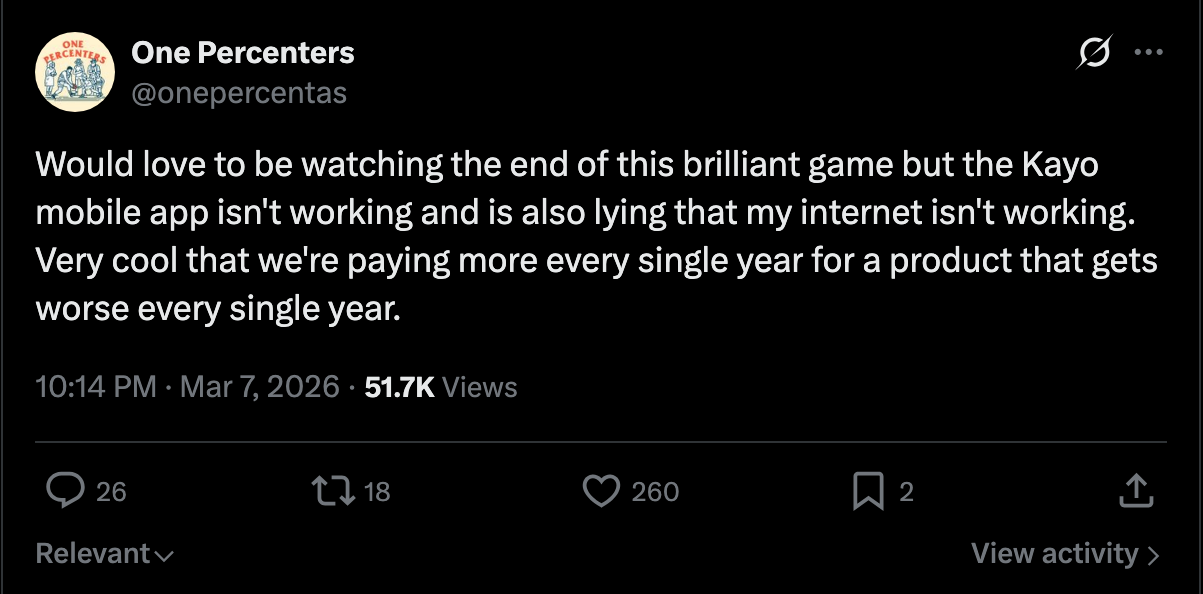
I put my phone away – OK, I scrolled until I was too tired to scroll anymore – and went to sleep. I awoke to dozens of replies. Many reported the same issue: Kayo failing in the last quarter. I noted that a few of those people had usernames or display pictures which clearly signalled an allegiance to the Dogs. They were denied the chance to see a special win as it happened. Other replies empathised in a more general sense: their version of Kayo malfunctions regularly, and usually at the worst possible moment. Stirred by righteous indignation, I posted a follow-up tweet. It was a resolution to write about Kayo – and a request for followers to share their horror stories. Step aside, Jacqui Felgate: citizen journalism has come to One Percenters.
I expected replies. You’ve probably gathered by now, given the state of the world, that populism tends to play well online. I experienced this in a very modest way with my last post. I didn’t expect to receive over a hundred. A handful were positive – noble attempts at introducing balance to the conversation. (My favourite, by far, was one user who reported a seamless experience on their Hubbl set-top box. Hamish and Andy knew!) The vast majority of the messages I received, however, were complaints.
Beyond the sheer volume of complaints, what struck me most was their breadth. They didn’t cluster around just one part of the product. They spanned almost every layer of the experience: buffering streams, blurry video, casting errors, connections, login loops, confusing menus, inexplicable ads, and customer support that insists your internet connection is actually the problem. Not a single part of the stack is immune. It turns out that for a hell of a lot of people, even a “good” Kayo experience - i.e. one not marred by technical errors – skews mediocre. I’ve gotten this far without even mentioning the rapidly rising cost of subscription, which was cited in many complaints and was at least implicitly present in all. Kayo was $25 per month when it launched in 2018. As of February, the “premium” offering costs $46 per month.
As a streaming service, its performance is abysmal. Every single game has lagged, stuttered, paused and buffered multiple times, almost every few minutes, yet somehow the adverts play smooth as butter. It’s just shameless and stupidly expensive. I hate that I have to use it.
But there’s one category of experience I keep coming back to, because it feels so egregious: the times people have been robbed of the chance to see memorable moments as they happen. Jack (not his real name) wrote to tell me how Kayo’s technical issues cost him the chance to see the end of two games decided after the siren. The first was the Sydney vs. Port Adelaide game in early 2023, when Ollie Florent had a kick to win it after the siren. “While the ball was mid air and looking like a goal,” Jack wrote, “my stream froze, buffered for a while and then a technical issue message popped up.” Jack had no idea that Aliir Aliir had spoiled the ball before it crossed the goal line – he had to look up the final result. Three months later, Jack was also denied the chance to savour, in real time, Dan Houston’s goal after the siren to beat Essendon at the MCG. “It was an epic finish to the game – if only I’d been able to see it”, he wrote. “My stream froze in the same way as the Sydney game, so another exciting finish was lost.”
Jack’s example of being deprived of the chance to see special moments as they happened was the most dramatic – but by no means the only one. People complained about entire matches being unwatchable, replays skipping to the end, even missing golden points (there’s no wrong door here at One Percenters!). A recurring sentiment that added to people’s frustration was that Kayo really is in a class of its own: other streaming apps – even those that cost a third of the price – seem to work just fine. Out of all of this emerges one key question: why is Kayo so terrible?
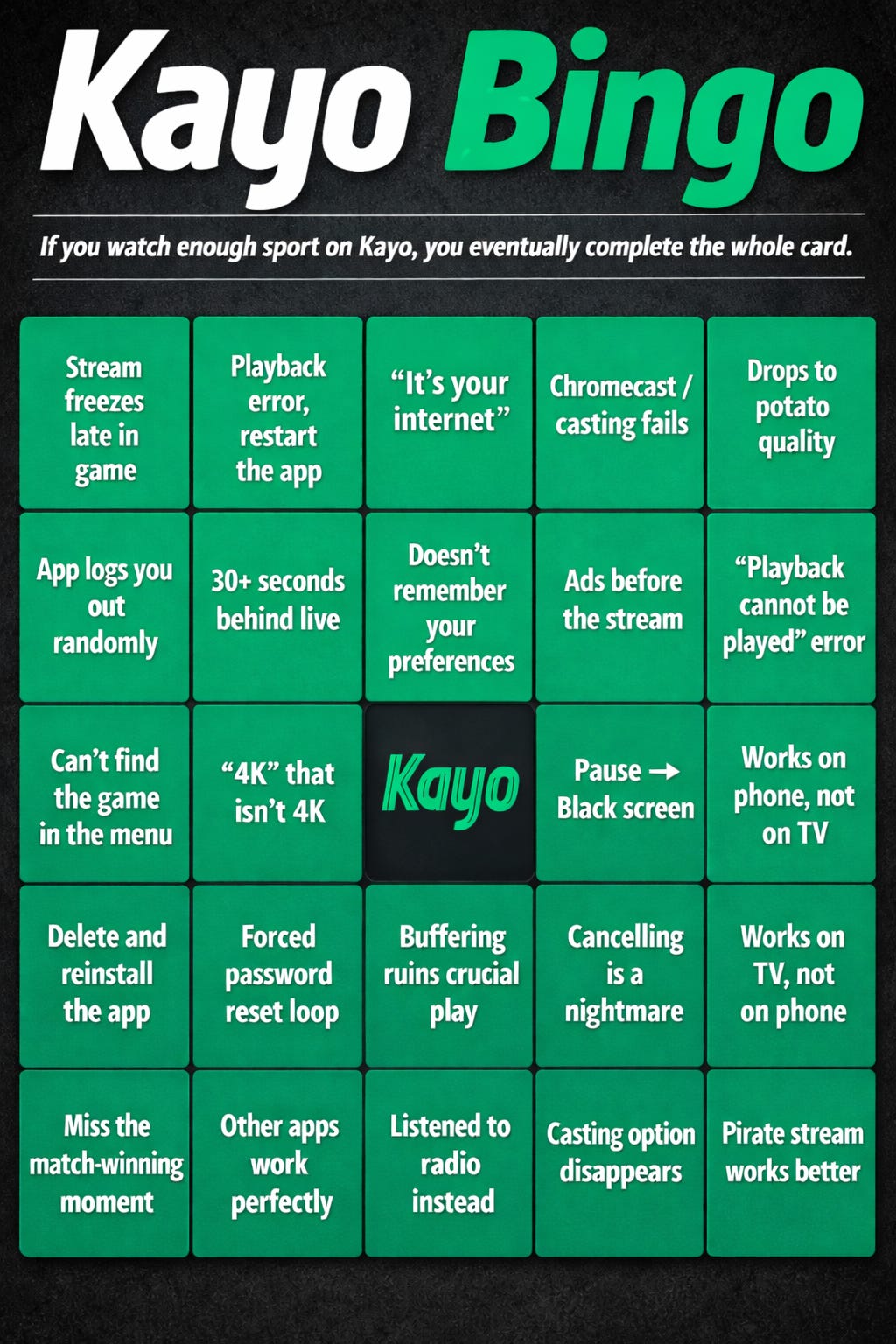
Part of the reason why Kayo fails so often and why its failures drive us up the wall the way they do is that sport occupies unique psychosocial terrain. Most forms of entertainment are abundant. Sport – and the ancillary “content” it generates – is by no means scarce. But the moments it creates and feelings it provokes are rare (or at least should be). A match exists only once. The post-siren goal, the golden point try, the wild momentum swings late in a game are fleeting events. They can’t be recreated later without losing the thing that made them meaningful in the first place. Sport is also a collective ritual. That’s most obvious when you’re at the stadium. It’s a bit embarrassing to admit, but I almost welled up before the first bounce of the Collingwood vs. Adelaide game; the majesty of the MCG, the crowd’s anticipation, the smell of beer and fried food – it’s a heady brew. But you can feel something similar at the pub and even, in an attenuated sense, when you’re watching alone, because you know others are strapped into the same emotional rollercoaster. When Kayo crashes during moments like Dan Houston’s shot after the siren, or the last quarter of the Brisbane vs. Dogs game, the frustration is existential: the moment is gone. A replay is a poor facsimile.
Kayo refused to stream when I was in Dawesville, a suburb of Mandurah. The reason? Kayo is not available in “remote Australia”…
Live sport is a shared collective experience that only the most hyped Netflix finales can compare to. That has social and psychological implications. It also has technical ones. Streaming live sport – this is probably the closest I’ll come to sympathising with Kayo in this piece – is hard. In a fragmented, post-monoculture media environment, live sport is one of the few things that still pulls thousands, sometimes millions, of people into the same moment. That creates a very different problem to the one Netflix is solving. Netflix has to solve for how to best distribute demand across time. When you open Netflix, you’re accessing a vast library of pre-existing content. The experience is asynchronous: people watch at different times. If a server is under strain, the platform can route you elsewhere, buffer slightly, or downgrade quality. Live sport doesn’t have those luxuries. Kayo has to handle everyone watching at once. That creates demand spikes that are semi-predictable but can’t be forecast with absolute precision. A close game entering the final quarter pulls in neutrals and casuals whose footy group chats are suddenly popping off.
Delivering that experience means handling enormous bursts of concurrent requests, pushing high-bitrate video with low latency across a network that’s subject to congestion. Content Delivery Networks and extra server capacity help, but the core problem remains. Traditional TV broadcasts solve this problem differently. A signal goes up, and (theoretically) anyone with a receiver can access it. The marginal cost of an additional viewer is effectively zero. Streaming doesn’t work like that. It scales with the audience. Every additional viewer is another stream, another load, another potential point of failure. None of this excuses poor performance. Many services seem to have more or less figured it out. But it does explain the central frustration: the moments you most want Kayo to work – the biggest games, the highest stakes – are exactly when it’s under the most strain.
Kayo texted me a $1 per month offer as they tend to do. I clicked the link, paid, was charged $25. The live chat refused to do a thing about it, they just hit me with the “we don’t do refunds for change of mind”. Immediately tried to cancel and they offered me six months at half price. There’s zero on their end suggesting that the discount will actually be activated, so it might be round two of this sh*tshow this week when it’s renewal time.
If you thought delivering video streams was tough, then doing it both well and profitably is tougher still. Live sport is the last truly scarce, time-sensitive content left. You can watch Stranger Things tomorrow. The only people who watch the game tomorrow are nuffs, analysts, and those with the discipline to avoid spoilers. Scarcity drives prices. So does demand. Live sport has both. The result is that its value to broadcasters has skyrocketed.
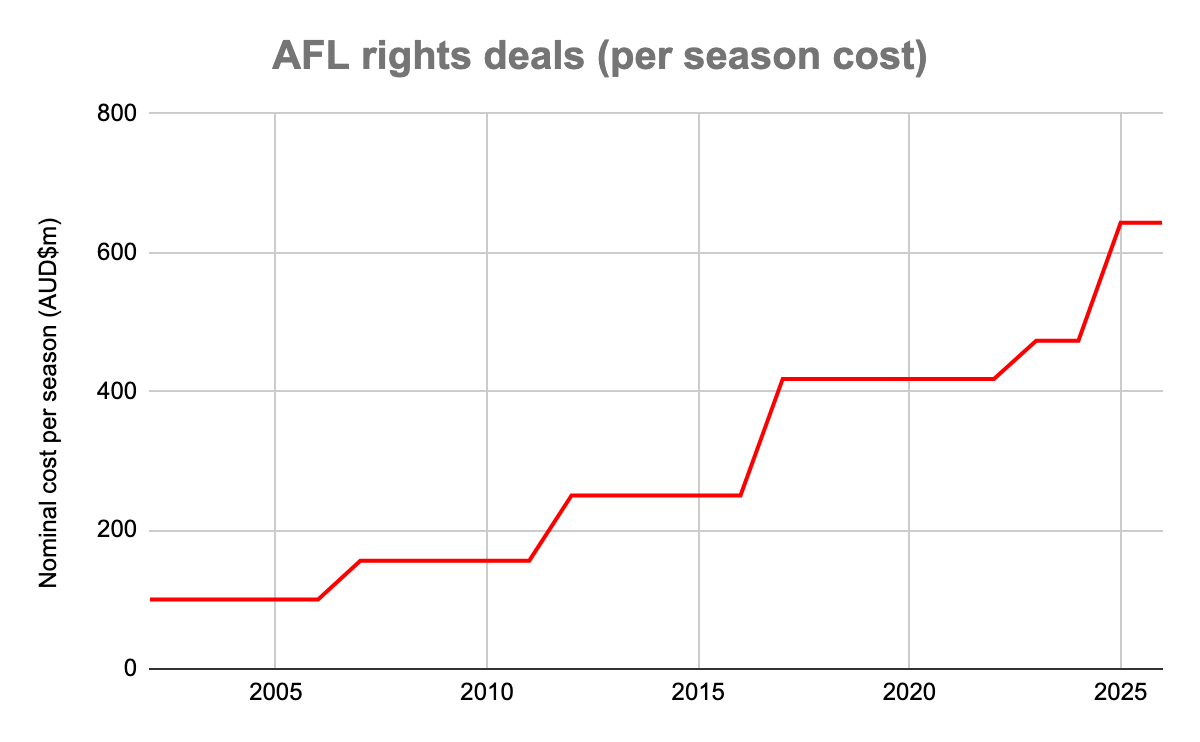
You could write a book about the information conveyed in this graph. The headline is simple enough: broadcasters have gone from paying the AFL about $100 million per season in the early 2000s to more than $640 million today (not adjusted for inflation). That’s the price of the one thing that still reliably draws mass audiences. Beyond that, there’s also a broader story about professionalisation, technological change, and rising consumer spending power. You can even see the effects of Covid. Each rights cycle sets a higher floor. The product hasn’t fundamentally changed, but its strategic importance has.
Where this bites for streaming providers is cost distribution. Under the old model, that cost was spread widely. Foxtel bundles worked because people who didn’t care about footy (they do exist!) still paid for it. Sport was subsidised by lifestyle channels, documentaries, and reruns of The Simpsons. You didn’t need every footy fan to turn a profit. Streaming breaks that logic. There’s no bundle, no cross-subsidy. If you want sport, you pay for it. Which means the full cost of those ever-more expensive rights deals is borne by the relatively small group of fans engaged enough (who have what economists call a “relatively inelastic demand function”) to eat the monthly cost.
Kayo refuses to learn my actual preferences in presenting links to live sport, e.g. properly prioritise showing me AFLW and NRLW games ahead of motorsports or golf or UFC which I have never, ever shown any interest in.
Kayo has about 1.7 million subscribers. That looks like a lot, but not when those subscribers are helping underwrite Fox’s share of the $4.5 billion footy rights deal. The subscriber base is narrow. It’s also unstable. Subscriptions are cyclical: fans sign up in March and cancel after the season; others drift away when their team drops off; others cancel (ironically) in disgust at Kayo’s price and performance. There’s lots of churn. Again, the contrast with Netflix is instructive. Its value proposition is continuous. Older content retains value. Sport doesn’t. Like a new car the moment you drive it off the lot, its value decays almost immediately. The result is a very imperfect storm: rising rights costs are concentrated onto a smaller group of customers. Infrastructure costs scale with demand. The AFL wants more money. Customers want to pay less – or at least feel like they’re getting more. Platforms like Kayo sit in the middle, assailed from all sides.
I haven’t even addressed the elephant in the room, hovering conspicuously above all this. Foxtel, Kayo’s parent company, used to sit inside the most traditional Australian media ownership structure imaginable. News Corp was the majority owner, Telstra was the minority partner. But as of last April, Foxtel and Kayo are owned by DAZN (this is apparently pronounced “da zone”). DAZN is not a traditional broadcaster. It’s a privately-owned sports streaming platform, backed by the British-American-Russian investor and philanthropist, Len Blavatnik (technically, DAZN is owned by Access Industries, which Blavatnik owns). Two months before DAZN bought Foxtel, it secured a reported USD$1 billion investment from the “SURJ Sports Investment” group. SURJ – which, amusingly enough, is run by Danny Townsend, who briefly and rather ingloriously “ran” the A-League – is owned by Saudi Arabia’s Public Investment Fund, the Saudi state’s vehicle to launder its reputation (and counter Qatari soft power) through strategic investments. I don’t know about you, but I don’t much like the idea that a slice of my increasingly hefty Kayo subscription is finding its way into the bloody pockets of Mohammed Bin Salman.
WatchAFL, the product you cannot access in Australia and is for expats only, is fifty times better and probably staffed by one person and a dog.
DAZN has spent big over the past few years, hoovering up access to football (both soccer and American ), boxing and other combat sports, Formula 1, and ice hockey in multiple markets. Those bets have been motivated by the same underlying logic: acquire enough rights and enough fans, in enough places, would subscribe. Brute force blitz-scaling.
The results have been… mixed. DAZN’s way of doing business is expensive. The company has been dogged by reports of multi-billion dollar losses for years, as rights costs have outrun subscriber growth and churn has remained stubbornly high. In response, DAZN has shifted to something that looks more like consolidation. Less than a month after being acquired by DAZN, Foxtel announced around 100 job losses, concentrated in marketing and engineering functions. Barely two months after that, Kayo cut a handful of “digital content production” staff. Those moves – some of the first under the new DAZN leadership – reflected the group’s shift to a more streamlined operation. DAZN technically isn’t private equity. But it waddles and quacks in a way that’s startlingly reminiscent.
Kayo is no longer a local streaming service navigating the quaint Australian market. It’s now part of a massive, concerted, ethically dubious platform that’s under significant pressure to prove that sports streaming, at scale, can actually work as a business. That context casts the two recent price increases – in February 2025, two months before the acquisition, and February 2026 – in a different light. The experience we get as (long-suffering) Kayo subscribers increasingly reflects business decisions made outside of Australia. There’s a worryingly high probability that the person who now runs the numbers on behalf of Kayo does not know about Rodney Eade’s legendary Will Minson spray.
This is all explicable on a commercial level. Capital exerts its own logic. But it doesn’t mean we have to like it. There is a trendy term for what’s happening here: enshittification. The idea, popularised by Cory Doctorow, is that apps and websites tend to follow a predictable pattern. To begin, they’re good to users. Prices are low and features are generous. The goal is growth. Once users are locked in, the focus shifts to being good to partners – advertisers, rights holders, and investors. Prices go up. Costs are cut. Consumer surplus is methodically converted into producer surplus. Anyone who’s used Uber in the last 2-3 years understands what I’m talking about.
Why can’t you now cast to a screen off the app on your phone? When the heck did that happen?
It’s easy to forget now, but Kayo really did feel like a genuine innovation in the early days. It was much cheaper than Foxtel and also solved a real problem: how to pay for sport without paying for anything else. Unfortunately, it now looks like it’s careening down the same one-way road. I’ve already discussed the manifold technical problems. Prices keep on going up. Ads have slowly infiltrated the experience. The small frictions – the extra click, the few seconds of delay, the sense that the product is worse than it used to be, and worse than it should be – keep adding up.
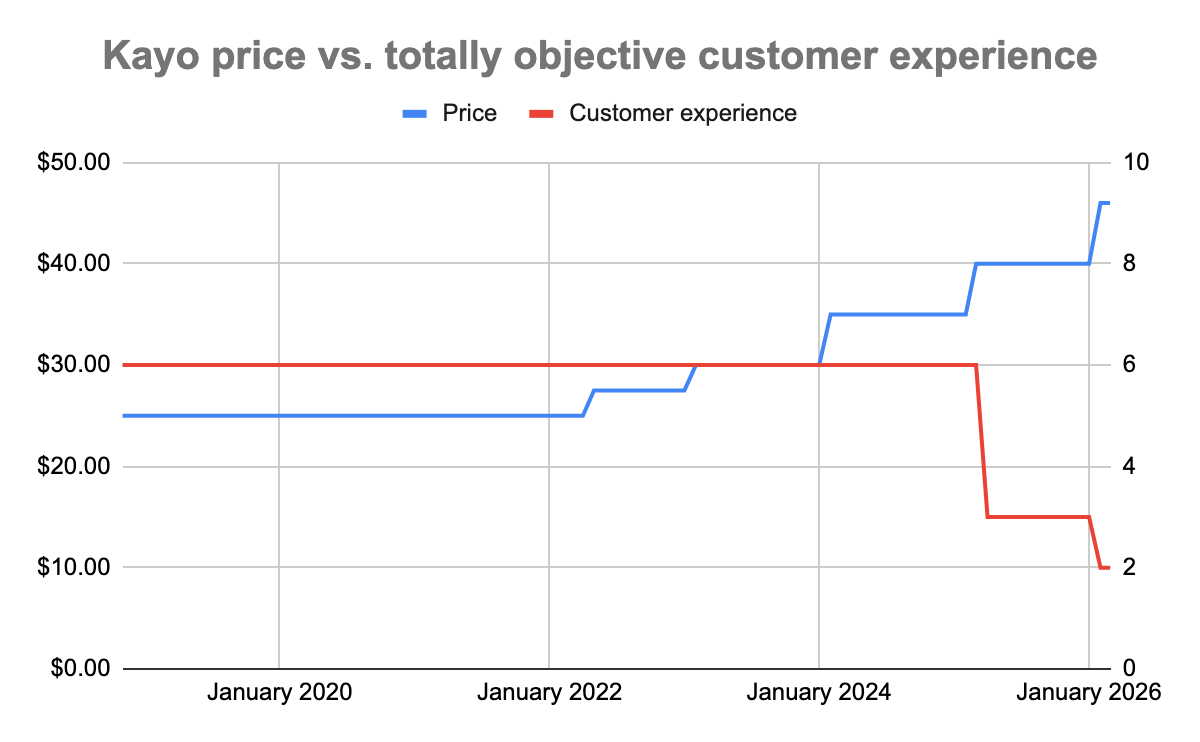
Kayo is getting more expensive while the service it provides – and, of course, customer satisfaction is partly a function of value for money – seems to be getting worse. This isn’t aberrant. It’s how businesses like these turn the screws when it’s time to pay the money men. Growth gives way to monetisation and priorities shift accordingly.
Enshittification and the vague feeling that you’re locked into an ecosystem where enshittification is the point creates resentment. Obviously, negative feelings and sport aren’t strangers. Sport is, as many a wit has observed, mostly an elaborate mechanism to feel sad (unless you support Geelong, Hawthorn, Brisbane, the New England Patriots, etc.). But we’re used to those feelings. Sadness, envy that your rival club’s fresh draftee looks better than your own, anger that your idiot bald fraud of a coach has selected Fringe Player X over Fringe Player Y – to a meaningful extent, we invite those feelings. And, for all but the most emotionally maladapted among us, those feelings are self-contained. We feel anxious before the first bounce, excited/angry/happy/sad during the game, revel in the glow of victory or stew in defeat, and then move on (only to repeat the cycle the following weekend).
Frustration with Kayo feels different, and much harder to justify. I don’t want to know or care about the technical or geopolitical details of the app I use to mainline footy for 15 hours a week. To be perfectly honest, I’d rather not have needed to write this piece. But I’ve been forced to, because negative feelings – that we typically use sport to escape – have infiltrated not just watching our team, but accessing the product itself. Instead of asking normal footy questions like, “are we good?”, “why aren’t we good?”, “why are our hated rivals good?”, we’re asking questions like, “why doesn’t Kayo work properly?”, “if the AFL is making billions from this deal, shouldn’t the viewing experience actually work?”, and “how do I feel about subsidising Mohammed Bin Salman’s bonesaw fund?” Those aren’t questions about sport. They’re questions about power, fairness, and ethics. In other words, they’re questions about politics.
Enjoying my Kayo deep dive? Share it with a friend.
It took me some time to realise that the common element underpinning the replies I received to my prompt was that they were all political. Not in the Labor vs. Liberal sense, but in the sense of customers expressing their frustration and powerlessness against corporate actors that don’t prioritise their interests over those of investors. The sense that they’re getting ripped off – and, short of denying themselves access to the sport that usually soothes the injuries inflicted by real life, they can’t do much about it. Every final quarter glitch, every unfulfilling customer service interaction, every price increase then becomes part of a broader narrative: this thing that is supposed to make me feel better is instead getting worse. I’m not saying there’s a straight line from Kayo-related irritations to the surge in support for One Nation. But I am saying that people are entitled to feel annoyed that an experience which should be a distraction from the messiness and meanness of real life has instead become another part of it.
I’ve got the premium version so that my grandparents can watch at their place. They’re in their late nineties, so not tech savvy at all but I set it up for them and they can watch their footy and basketball happily. Every now and then, it asks for a confirmation of the account, where you scan a QR code or put a generated code into the Kayo website and authorise use. They can’t scan a QR code, and they have no idea how to get to the website and enter the code manually before the code refreshes (you have about a minute to do it and that’s just not going to happen).
So once a month or so they call me to ‘fix’ Kayo, and I enter it on the website at my end. Takes 30 seconds, easy done. However now that they’ve sent the mass reset email out, we’ve signed them up for their own basic Kayo. My fear now is, which is something Kayo will never have considered, if I login in to theirs on my phone explicitly for the purpose of authorising them, it’ll trigger a two IP address at once thing and start the whole password reset process again. Zero chance Kayo has considered that some people who like sport can’t actually manage their own Kayo account due to being born in the Depression.
The AFL has never had more money, political power, or cultural influence. At the same time, the people who run it have rarely faced greater disillusionment. Some of that frustration is reasonable: the rule changes, the fixture, Opening Round, the state of the draft and equalisation. Some of it is less so: umpiring, or the vague sense the game has “gone woke”. But I’m convinced a meaningful share of it – and yes, I know the AFL doesn’t operate Kayo – comes from a much more mundane and protean place: people are paying more for a viewing experience that feels more fragile than ever (all while there’s no longer a free-to-air game on Saturdays). The Foxtel era was expensive, but reliable. Early Kayo was cheap and relatively reliable. The post-DAZN era feels both expensive and unreliable. Layer that on top of broader cost-of-living pressures and declining reliability across other parts of life, and the sour mood is easy to understand. We look at the buffering wheel and we think about Andrew Dillon, or the other products in our lives that don’t work as well as they should.
I kept up with the final quarter of that Brisbane vs. Western Bulldogs game on Twitter. It was fun. I’m lucky enough to have built a small following there, and between the excitement of the game and the laments of others whose Kayo let them down, there was plenty to entertain me. I experienced a different kind of moment. But it wasn’t the one I really wanted. It wasn’t the one I pay $46 every month to experience.
For most of the modern history of televised sport, watching a game was simple. You turned on the TV and a soothing, avuncular presence explained what was happening. The technology was complicated, but invisible. You could just fret about the footy. Streaming promised something sleeker and smarter. Instead, it has sometimes turned the basic act of watching a game – the collective ritual that shapes our lives, in ways little and large – into a software problem. When the software fails, the moment disappears. The after-the-siren kick, the golden point try, the final surge in a close match – the things that make sport memorable – happen somewhere else, while you stare at a buffering wheel, and Len Blavatnik and Mohammed Bin Salman sit in their gilded towers, grinning.
So timely.Thank you. As a pensioner I find paying for Kayo an extravagance but here I am. Last round it started playing up in the 3rd Q of the Dockers/Melb game with the commentary about 2 minutes *ahead* of the play. I thought it might be fixed by the final quarter but no. I could not see what I was hearing and I was anticipating goals that I had heard were coming. It all felt very weird and definitely not good enough. I watched without sound after that. This glitch spoilt the whole experience. I wondered if it was our TV but your analysis has pointed to Kayo. If it was any other product we'd have some consumer rights. I really appreciate this post. Thank you. We are being taken for a ride.
Would you believe I actually got Kayo customer service to admit fault about something last year (I forget what bothered me enough to waste my time engaging with them). They offered to add an extra week or two onto my current billing period. They went to add it, saw I had already cancelled and told me they can't add anything to a cancelled sub and that was it.
On your Netflix point, they technically offer live sport with WWE and I think I saw something about baseball coming soon in a recent email. In my experience, whenever I've chucked on live WWE it's worked much better than Kayo and Stan.