


A small item of housekeeping to start. I’m tentatively seeking sponsors for the newsletter. If you, or someone you know, is involved in a business – no gambling or crypto, please – that would like its name in front of a four-figure readership with long attention spans, get in touch. My email is hello@onepercenters.net.au.
This edition is a day late because I’ve been playing Slay the Spire 2. If you don’t know what that is, keep it that way – you will save hundreds, possibly thousands of hours that could objectively be allocated to more sensible and practical purposes. If you do know what that is, then you might understand what I mean when I say that the experience of playing it has prompted me to think a lot about balance.
Slay the Spire 2 is, in essence, a game where you play combinations of cards, as different characters, to defeat a sequence of enemies. It is combinatorial – no two runs are the same. And it is deeply choice-driven. When you lose – which I do, a lot – it rarely feels like bad luck. You can almost always trace the loss back to a set of decisions that, in hindsight, could have been better.
Like its predecessor, Slay the Spire 2 works so well because it achieves a very particular kind of balance. Asymmetric balance. (I promise this will be about footy very soon.) Balance, in this context, doesn’t mean sameness. It means something closer to equilibrium: a system in which multiple, fundamentally different approaches can all plausibly succeed. The best-designed games manage this trick. They don’t funnel you toward a single optimal strategy. They create space for different approaches and hold them in tension. No one approach dominates for long – and if it does, it gets patched out. Game developers understand that maintaining that balance is what keeps a system alive.
I valued the idea of asymmetric balance in footy even before I had a name for it. It felt in keeping with the egalitarianism Australians like to claim, and the equalisation the AFL likes to promise. In short: it felt fair. And for most of the time I’ve followed footy, it has felt like that balance existed. Different sides, built on different principles, rose and fell. Sometimes the teams that beat them looked like refined versions of the same idea. Other times, they felt like repudiations of it. Yes, sides sometimes stacked talent and tactical advantages for long enough to become dynasties – but it still felt like there were multiple ways to build a good team and multiple ways to win: slower, territorial control; fast, transition-heavy attack; corridor aggression; boundary accumulation; contest and territory; turnover and surge.
To put it plainly: there should be different, approximately equally viable ways of winning. That balance is worth preserving. It’s also – as any game designer will tell you – extremely precarious.
I am increasingly worried (inasmuch as one can be about anything in footy) that the AFL’s new rule changes, especially when layered on top of those introduced over the past decade, have broken that balance. This isn’t preservation of equilibrium or cultivation of viable competing strategies; it’s a shove in a narrower, more homogeneous direction – one that aligns with a particular style and a particular vision of what the sport should look like.
If you think about the AFL as a system, then the last decade – and especially this off-season – looks a lot like a series of balance patches. Except, instead of improving balance, they’re all pushing in the same direction. Tightening the stand rule. The last-disposal out of bounds free kick. Rucks no longer being allowed to wrestle. The reduction in kick-in time from 12 seconds to 8. Immediate restarts for around-the-ground stoppages. Individually, most of these can be justified. Collectively, they represent a clear preference for more speed, less friction, and fewer opportunities to slow the game down, reset, or absorb pressure. More transition. More turnover. In game design terms, it’s a systematic buff to one style of play – fast, transition-heavy footy – and a corresponding nerf to others.
This tweet, by friend of the newsletter Vams, comparing Opening Round and Round 1 in 2026 to the corresponding period from last season, tells the story well.

Styles change and metas shift. More than I probably give credence to, meta shifts in professional sport tend to be downstream of rule changes. To pick just one example: the short-passing game in elite soccer was made more viable by the introduction of the rule that allowed defenders to stand in their own penalty area to receive passes from their goalkeeper. Beyond this, there is the sample size effect: there have only been 14 games of footy played so far this season. But those numbers reinforce something I and many others are feeling: the beginning of 2026 has seen a dramatic intensification of incumbent trends that’s knocked things off-kilter.
The problem isn’t that the game is becoming faster or more open. It’s that this outcome is being engineered by a governing body that has unilaterally decided what “good” footy should look like, and is now putting its thumb on the scale. I don’t like that. It means we’re no longer watching a game that evolves on its own terms. We’re watching one that is being steered toward a preferred aesthetic that aligns with broadcast imperatives, but not necessarily with the long-term competitive health of the sport, the interests of clubs, or, frankly, the preferences of many supporters who are already feeling disillusioned with the current AFL administration.
Here are some design principles I would prefer the AFL follow in order to maximise the space for competing approaches:
Plurality: there should be multiple different ways to win. AFL House shouldn’t elevate one over the other. If speed is to win, let it win on its own terms. Instead, the AFL should strive to sustain a system in which different approaches can co-exist.
Freedom: every rule change removes a set of viable responses. Some constraints, as I’ve written above, are necessary. But layer enough of them together and the game begins to homogenise into something blander – not because coaches lack imagination, but because the system no longer rewards or, in some cases, even allows it.
Organic evolution: the most interesting versions of footy are the ones that resist being solved. Where strategies rise and fall, where innovations are discovered and countered, where no single approach holds the field for long. As far as possible, we should not interfere with that process.
Call it footy libertarianism. This isn’t a call to abolish rule-making, or a claim that the game has ever evolved in a vacuum. Footy has always been governed. And don’t worry – I’m not actually a libertarian. But I do think there’s a meaningful difference between establishing the basic parameters of a system – goals are worth six points, don’t concuss blokes, etc. – and steering it toward a preferred outcome.
But that is what the recent suite of rule changes do – in outcome even if not necessarily intent. Each change trims away a little bit of optionality and quite a lot of the equalisation that’s already under threat in other domains. The result is a game that increasingly pulls teams toward the same solution: move the ball quickly, embrace transition, maximise turnover scoring. If that’s what your list is built to do, you’re advantaged. If it isn’t, bad luck – especially if you’ve spent years investing in a style that’s no longer viable (or, if like Reilly O’Brien, your AFL career has been ended virtually overnight).
No rule quite raises my footy libertarian hackles like 6-6-6. Introduced in 2019 – explicitly to combat flooding and increase scoring – 6-6-6 mandates that at every centre bounce, each team must position exactly six players inside both their forward and defensive 50-metre arcs, with the remaining six, including two wingers, in the midfield zone. On paper, it was a tweak. On grass, it removed one of the few levers struggling teams have to correct course in-game. If you’re getting beaten at the contest, you can’t hedge. You can’t overload inside defensive 50. You can’t flood the stoppage and buy yourself time to reset behind the ball. You just have to cop it.
That cuts directly against another one of my beliefs – that weaker teams should have more options, not fewer. The fewer tools you give a side, the more you entrench existing advantages. The new rule changes confer benefits on the sides that need them the least. To be maximally provocative: we’re stealing from the poor to give to the rich. The teams that aren’t are deprived of the few mechanisms they have to resist, or at least stem the bleeding. Bad teams should be allowed to flood. It’s not pretty, but I’d argue it’s a viable response to a problem – and that broadcaster imperatives aren’t a strong enough reason to override it.
You could see this dynamic play out across Round 1. Again and again, struggling sides were getting beaten at centre bounce, which led directly to repeat scores. They had no recourse to slow things down. I’ll show a few examples in this week’s Video Room. Before I do: yes, that happened before this season. And yes, the buck ultimately stops with players and coaches. They need to execute better. Brad Scott’s failure to implement a coherent defensive system isn’t the fault of 6-6-6. But coaches of struggling sides should have more tools at their disposal. Instead, the AFL has taken many of those tools away.
If you take those principles seriously, they shouldn’t just apply to what happens on the field. They extend to the broader architecture of the competition. The AFL talks a lot about equalisation. It’s one of the organising ideas of the competition, manifested in the salary cap and the reverse-order draft (remember that?). At the highest level of abstraction, equalisation is about maximising the number of viable ways sides can compete. That idea is under significant stress across the game – and the recent rule changes have exacerbated it on the field. When you reward speed above all other methods, you’re not just making the game “faster”. You’re also making it harder for certain types of teams to compete.
What could a more “libertarian” approach look like in practice? It might mean loosening some of those constraints, on field and off. Why have constraints on list sizes? Why not instead move to a model where clubs are judged on per-player payments instead of a largely rigid salary cap floor? Why shouldn’t West Coast be allowed to have 60 players on its list? More churn, more chance of turning up a diamond in the rough. I’m not seriously advocating for these ideas in particular, but I am arguing for the principle that we should let clubs and coaches get weird.
Some experiments would fail. That’s fine. The goal isn’t any particular outcome: it’s the curation of a pluralistic space in which different approaches, different systems, and different philosophies can co-exist in healthy tension. Our reward will be a game that’s richer, less predictable, and harder to solve – a game where the question of how best to win is more open than it feels like it’s becoming.
It might sound a bit pompous to frame it this way (if you’re allergic to me being a wanker, sorry), but there’s a kind of “good life” question embedded in all of this. These latest rule changes have shaped the game to be faster, more open, more transitional. That’s a preference. And I’m not convinced the AFL should have the right to impose that preference, especially when it narrows the pathways through which weaker or differently constructed teams can compete.
Balance is precious and precarious. Game developers can issue balance patches at will. Slay the Spire 2 is currently in Early Access; the game will change as bugs are squashed and over- or underpowered strategies are corrected. The AFL doesn’t have that luxury. The task is harder: acting as custodian of the game while managing competing stakeholder interests. Clubs, players, broadcasters, and supporters don’t always want the same things. But that doesn’t change the fact that a core part of the AFL’s basic bargain – be smart enough, for long enough, and you could win – is eroding.
The Video Room
I’ve made a set of philosophical claims above. I think they show up in the numbers. Now let’s see how they show up on tape: what does this narrowing of options actually look like in practice? This week’s clips all focus on the same subject: teams piling on consecutive goals in quick succession against opponents that – for reasons both within and beyond their control – were powerless to stop the bleeding. Some of these goals have to do with the constraints imposed by 6-6-6. Others are more about the progressive tightening of the stand rule, and how hard teams are finding it to break opposition uncontested possession chains. To be clear, I’m not blaming the ruleset for systemic defensive failures, nor do I want to downplay excellent attacking footy. I’m interested in something narrower: the relative paucity of defensive Plan Bs available to coaches when Plan A isn’t working.
The first clip comes from the MCG on Friday night, where Hawthorn mauled an abject Essendon side that looked every bit as defensively permeable as it has for the past few years. These three goals, part of a run of five in the last 10 minutes of the half, had nothing to do with the 6-6-6 rule and everything to do with the chasm in how effectively these sides defend, generate, and exploit turnovers.
The first goal was effectively the result of Nate Caddy missing a handball to Jye Caldwell. Dylan Moore dished a lateral handball to Josh Ward on the overlap. Ward did the right thing: he looked inboard and found Moore with a forward handball before Moore repeated the trick. That’s how Jack Ginnivan – who you’d think would be hard to miss with the peroxide blonde – found himself in acres of space on the attacking side of the centre square. It was good transition by Hawthorn; they “leap-frogged” the Bombers by hand, drawing in defenders to distort defensive shape. Nick Watson did the rest.
The second goal was the product of good forward pressure. The Hawks’ forwards forced a dumped defensive exit kick. Jack Scrimshaw gathered and found Massimo D’Ambrosio. The issue here is that three Essendon players were drawn to Scrimshaw but none actually corralled or impeded him in any meaningful way. Archie Perkins half-committed to corralling and ended up in no man’s land. D’Ambrosio supplied the finish against his old side.
The third goal showed how Hawthorn uses aerial superiority to convert turnovers into scores. Tom Barrass followed up his intercept mark with a conservative kick to Jarman Impey, who opted for territory by kicking long down the line. Even here, in a seemingly innocuous position, Essendon’s system broke down – why was Andrew McGrath forced to contest in the air against Mabior Chol? The result was predictable. Similarly, there was no way Jai Newcombe should have been in so much space. One kick meant nine Essendon players were unable to impact the play. Newcombe found Ward, Ward found Gunston, Gunston found the goals.
The second clip comes from the Western Bulldogs vs. GWS game on Saturday afternoon. The game was probably already beyond the Giants at half-time, but conceding four goals in fewer than five minutes to open the second half wouldn’t have done anything to brighten Adam Kingsley’s mood.
These goals are quite different to the ones Hawthorn piled on in their run against Essendon. Although technically only Aaron Naughton’s goals in this sequence came from centre bounce, Sam Darcy’s (technically a forward-50 turnover) effectively did too. The goals are representative of the Dogs’ power at stoppages and the Giants’ weakness in the same phase (it’s not just because of Tom Green’s absence, either – they conceded the most points from centre bounce in 2025). They’re also illustrative of how quickly the new ruck rules have privileged the leapers – like Tim English – over the grapplers, like Kieren Briggs.
For Naughton’s first goal, Ed Richards did brilliantly to prevent Clayton Oliver’s handball to Finn Callaghan, Marcus Bontempelli allowed the momentum of Briggs’ tackle to spin him around so he can offload to Tom Liberatore, and all of a sudden the Dogs were out. The Giants had been sucked into the contest and had no one on the defensive side of the centre circle. For the third goal in the sequence, Briggs – who struggled all day – gave away a ruck free and the split-second of hesitation as he and Toby Greene expected play to stop was enough for Bontempelli to gather and fire out a long forward handball to Richards, who steadied and found Naughton with a beautiful kick. The common element here, quite aside from the Dogs’ positional discipline, is that Kingsley didn’t have any tactical tools to stem the tide. He couldn’t drop a forward back into the hole in front of Naughton. He could only cross his fingers.
The final clip comes from Sunday afternoon at Marvel Stadium, where North Melbourne franked their early dominance against Port with three goals in fewer than three minutes to end the half.
Charlie Comben’s goal happened because Mitch Georgiades didn’t stand when called by the umpire. It was a great kick by Comben, who was best on ground. More performances like that and he could yet become the aerial interceptor North desperately needs him to become. The second goal is technically a turnover but happened in the immediate aftermath of the centre bounce. I really like how Finn O’Sullivan waited an extra split-second for Kane Farrell and Zak Butters to approach him before dishing off to Cam Zurhaar. The burly half-forward then found Colby McKercher, who had a hand in affecting the initial turnover, zooming past. He duly finished. The third goal in the sequence ended up being a scrappy affair but was created by Harry Sheezel’s pressure on Port captain Connor Rozee, Luke Davies-Uniacke strong surge forward, and some leap-frogging handballs that, had they been a fraction cleaner, would have created another shot for McKercher. Duursma’s finish was a good reward for effective forward-half team pressure. That’s not a sentence one has been able to write often about North Melbourne in the past half-decade!
By my rough count, there was an average of about 1.64 sequences of one side kicking three or more goals within 5-6 minutes across Opening Round and Round 1 this season, compared to about 1.5 for the corresponding period in 2025. So the differences aren’t huge. They’re probably not statistically significant. But they’re illustrative of an important reality of modern footy: teams can get a run on, especially out of the middle, and opponents have fewer and fewer strategies to stop them. Things can get ugly, fast.
Straight from the chart
One of the most fundamental (and easily attainable) pieces of evidence for the hypothesis that footy is getting faster is what’s happening with handballs. There’s a simple reason for that: they don’t offer the option of stopping play the way a mark does, and (unless something’s going wrong) a player receiving a handball is not stationary. Teams aren’t actually handballing more: so far in 2026 there are fewer than five more handballs per game than in 2021 (although zoom out and the picture does change slightly: there were an average of 170.1 handballs – almost 20 more than this season – in 2016). What they’re doing is handballing forwards at unprecedented rates.
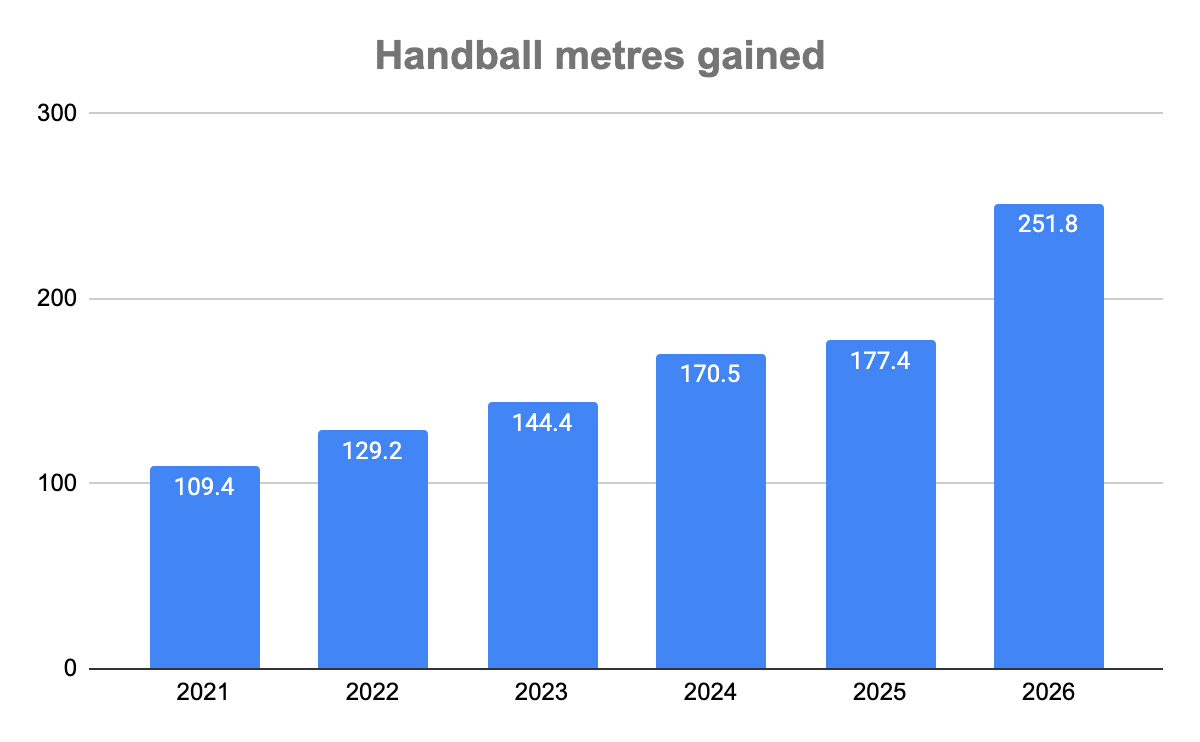
The difference in handball metres gained was already noticeable between 2021 and 2025. However, 14 games into the 2026 season – where a small sample size is an issue – handball metres gained have gone through the roof. As I wrote above, the new rule changes are all pushing in the same direction: speed. That, combined with the increasing sophistication of defensive zones, has seen the forward handball become a powerful weapon.
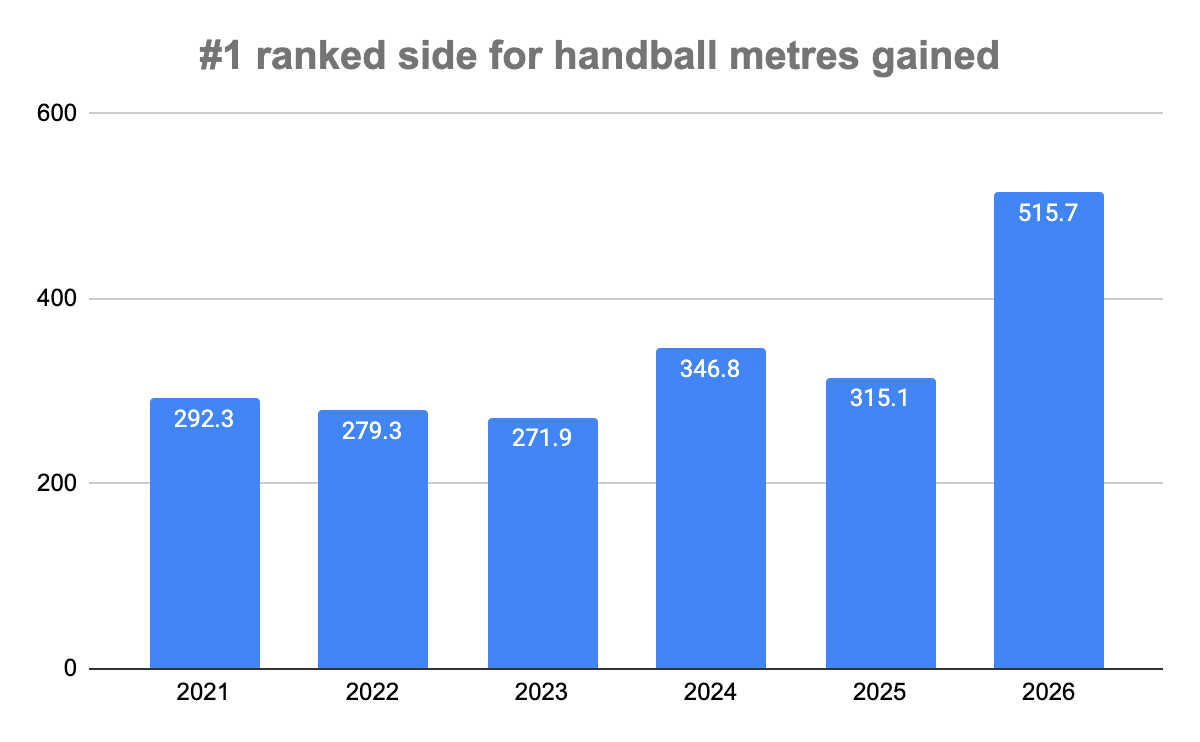
The graph above shows the average metres gained by hand of the #1 ranked side in that statistics across the seasons. A lollipop for the reader (assuming anyone has come this far) who can tell me – in the comments – the common factor shared by the 2021, 2022, and 2026 leaders for handball metres gained.
Turning our attention to broader matters – let’s look at how each side fared in Round 1 when it came to generating possession chains. Remember that there are three ways to win possession: win a clearance, win a turnover, or have your opponents kick a point. More chains are generally but not always better: Hawthorn, the Western Bulldogs, and North Melbourne all generated fewer chains than Brisbane, but theirs ended because they kicked goals.
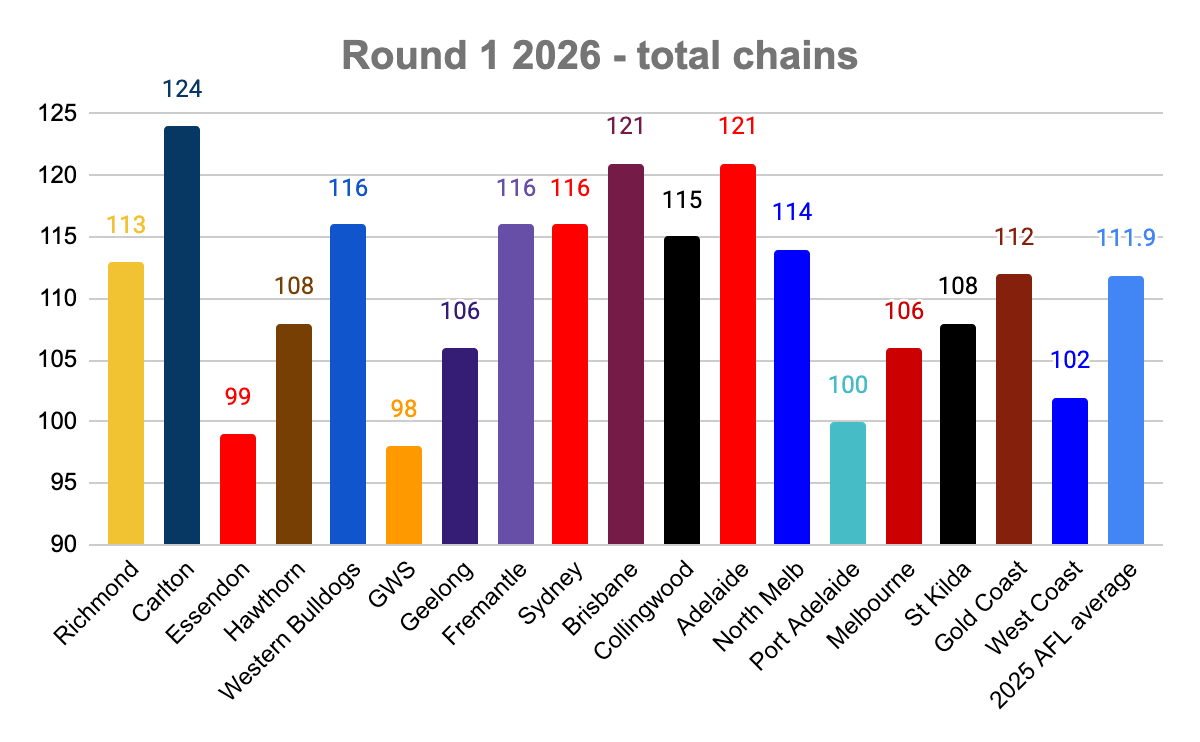
Going from left to right, a few things jump out. The first is that Carlton are good at winning the ball. By my rough count, only Gold Coast currently averages more possession chains per game (yes, yes, sample size). The bulk of the Blues’ issues stem from their incompetence with the ball – especially their short kicking. The second is that Brisbane and Fremantle can feel reasonably satisfied despite two otherwise disappointing defeats. They are beginning with the ball. Not necessarily in ideal spots, and not well enough to win, but their clearance and turnover engine is functioning. The third is that Melbourne and St Kilda, despite scoring an aggregate 227 points, combined for just 214 possession chains. The arithmetic reason is that neither side could affect turnovers with any regularity. Just 108 intercept possessions and 188 marks tells the story: this was a very low-pressure game. We’re used to seeing that from St Kilda under Ross Lyon. We’re rather less used to seeing that from Melbourne. But of course, there’s a new King in town.
Winning the ball is half the battle. The other half is doing damage in possession. To understand how effectively teams did that across Round 1, let’s look at the below graph.
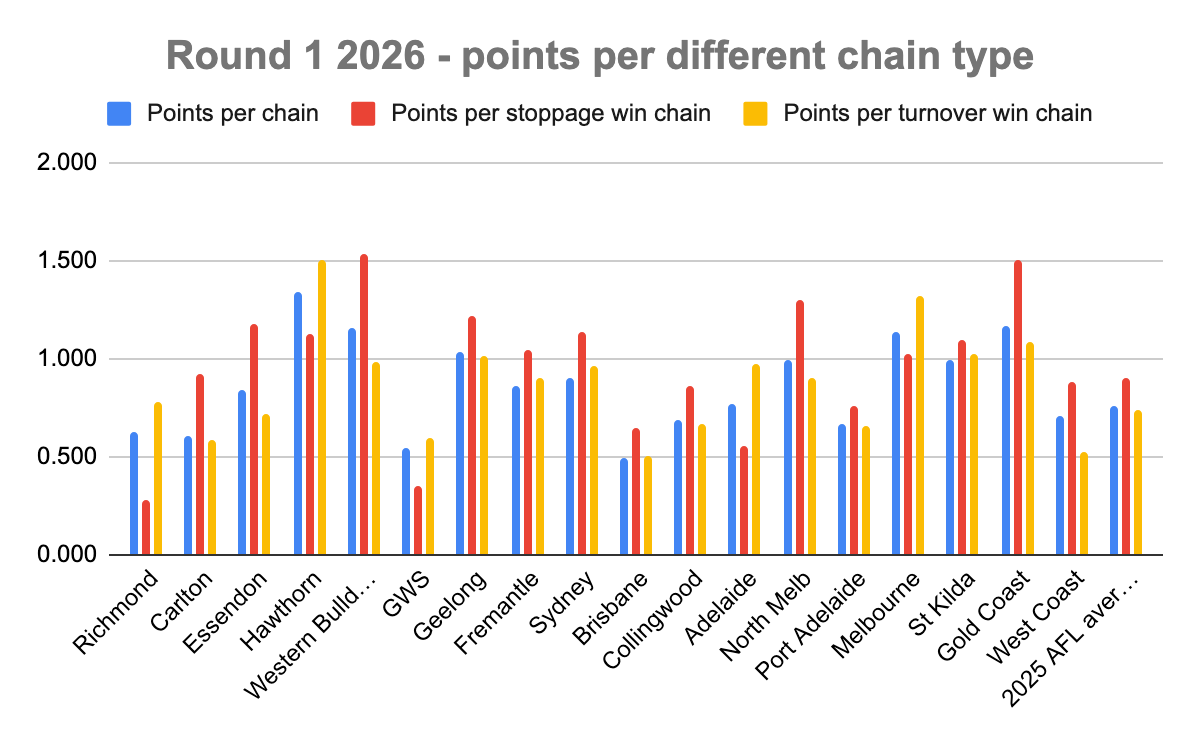
I appreciate a graph like this might not be immediately intuitive. But one of the things I like about it is how it can serve as numerical validation of our feelings about certain games. Did you think that Richmond vs. Carlton, despite the inherent excitement of a close finish, was a slightly stodgy affair? On the other hand, did the Essendon vs. Hawthorn game feel like a glorified training drill? The numbers will back you up on both. Somewhere between teams huffing and puffing, and sides walking it in unopposed, there’s a Goldilocks zone. The Geelong vs. Freo and Collingwood vs. Adelaide games felt like that: fair contests between bat (offence) and ball (defence). A shout-out to North Melbourne, too. I was there almost exactly a year ago when they belted Melbourne by 10 goals under the Marvel lid. Sunday’s defeat of Port felt different: slightly less the product of running red-hot from stoppage wins (although there was that!), and slightly more the product of a side finally beginning to resemble a modern footy team. Caveat: we don’t know how bad Port will be this season.
Enjoying my polemic about how the AFL might have broken footy? Share it with a friend.
Footnotes
A good one from yet another friend of the newsletter, Emlyn Breese: the St Kilda vs. Melbourne game had a combined 34 uncontested forward-50 marks (17 each). That’s the highest combined total of any game from 2021 onwards. Basketball with a Sherrin.
Christian Petracca watch: following his game against West Coast on Sunday night, two of Petracca’s three highest-rated games ever have come at the Suns. Not bad given he’s played, uh, two games for them. The case for Gold Coast being proper flag contenders in 2026 revolved around Petracca getting back somewhere near his peak, not scaling a new one. It’s almost as though Damien Hardwick knows what to do with explosive goal-kicking midfielders. (Playing West Coast – who were better than most expected – also helped.)
Centre bounce scoring watch: sides scored an average of 12 points from centre bounces in Round 1, virtually indistinguishable from the 2025 average of 11.4 points from the middle. The mean disguised a big standard deviation: two sides (Richmond and Collingwood) didn’t score a single point, while the Western Bulldogs (32) and Gold Coast (28) ran up the score.
Despite the chatter about how the new ruck rules would unlock centre bounce scoring, raw clearance wins have arguably never been less predictive of winning games of footy. Sydney won the fewest clearances of any side in Round 1 (23), while Brisbane won the equal-most (45). Fremantle and St Kilda both won the lion’s share of clearances – and points from that source – in their Round 1 games, but didn’t win the four points. Clearance stats are fuzzy because good teams tend to be better than their opponents at most things, including… winning clearances. Winning clearances can serve as statistical indicators of dominance. It is increasingly rare that teams rely on them as their primary means of winning footy games.
One of the points I tried to convey in my Adelaide season preview is the striking extent to which its game plan is defined by post-clearance contest wins. An interesting manifestation of that profile is that the Crows are simultaneously mediocre at moving the ball yet devastating at scoring from their back half. Against Collingwood, Adelaide advanced from its defensive 50 to forward 50 just 15.7 percent of the time but scored 52 points – level with Melbourne for the highest return of the round. In case you’re spooked by such a minuscule sample size, the Crows were 12th for D50 to F50 transition success rate last season. It’s a bug and a feature. The Crows lack the run and class half-back disposal of most other good sides, but their one-on-one superiority allows them to win secondary contests (think breaking tackles and taking contested marks) at a higher clip than almost anyone, without over-committing numbers. Winning 25 more contested possessions against Collingwood suggests the Crows mean to pick up where they left off last season.
Recommended reading
So many friends of the newsletter!
Martin McKenzie-Murray considers the prospects of his beloved Dockers in this piece for The Saturday Paper. Don’t let the soft paywall stop you.
I’m not the only one getting polemical. Mim has taken a stinging broadside at Opening Round over at her excellent Substack.
Toby takes stock of Richmond’s rebuild and how the Tigers might fare in 2026 over at his Jousting Sticks newsletter.
Another great new indie footy Substack alert! This one is also (mostly) about Fremantle! Seb Morrison looks at what the Dockers need to improve to go a few steps further this season.
Over at Jumper Punches, Nick Rynne gathers his thoughts about the two West Australian clubs starting the season off with different types of defeats.
The Vulture Street Journal, a new Brisbane Lions-themed Substack, reviews the Premiers’ disappointing defeat at the SCG.
bang on. I do wonder if the new ruck rules will mean that young rucks that have been given a four or so year leash to develop, will instead be utilised a bit more at centre bounce due to their athleticism, and in turn whether players like Mac Andrew and Thilthorpe might provide outsized advantages here. Also, I haven't been paying attention, but I assume they are still protecting Adam Goodes's knees and making them run from within the circle? which seems counter to the jumping part.. (note, no slight on Adam Goodes and the stain on the game/country that was his unfortunate burden, just a slight on the AFL for their changes made based on one injury)
Thanks for the mention Mateo! To hop on board the bandwagon of people pessimistic on these rule changes, I'm fearful we will be getting less close games in 2026 as a direct result of these points you've raised. According to the AFL, there were 52 games decided by 10 points or less last year.
That’s about 24% of games.
However this was less than 2023 and 2024.
Seems like that's going to go down again this year.
Early data shows it is down to about 22% so far this year. Again - early sample size, but could be another negative result of this push towards higher scoring, less contested footy.