


I’m still tentatively seeking sponsors for the newsletter. If you, or someone you know, is involved in a business – no gambling or crypto, please – that would like its name in front of a four-figure readership with long attention spans, get in touch. My email is hello@onepercenters.net.au.
More housekeeping: now that I’m satisfied I’ve rediscovered a good writing rhythm, I’m going to turn paid subscriptions back on. I’m not planning to put up a paywall, but if you think my work is worth supporting, a paid subscription – only $6 a month – is greatly appreciated.
My polemic last week about the AFL’s choice to iteratively engineer a faster game style through rule changes generated more discourse than I’d anticipated. It was even cited by Xander McGuire – yes, Eddie’s son – on the most recent episode of the “Dan Does Footy” podcast. I tried to make a more nuanced argument than simply “game’s gone”, acknowledging that most seasons start off quite frisky in terms of overall scoring before cold weather, hard grounds, and adaptive coaches increase stoppages and decrease scoring. Instead, I advanced the claim that the AFL’s rule changes were undermining a more organic evolution of styles and evenly-matched competition between different styles.
One thing I didn’t account for in that piece was the potential effect of an ever-faster game on soft-tissue injuries. That looks like an important omission given that the seven games of Round 1 yielded nine separate hamstring injuries: Callum Ah Chee, Tom Liberatore, Christian Petracca, Tom Lynch, Toby Nankervis, Anthony Caminiti, Connor Rozee, Griffin Logue, and Milan Murdock all pulled up lame. That doesn’t even include other soft-tissue injuries like those sustained by Rory Laird and Josh Worrell, or the bevy of soft-tissue injuries sustained over earlier rounds and pre-season.
The medical literature is clear: hamstring injuries are strongly associated with high-speed running and the specific biomechanical demands of, say, picking up a footy at pace – hip flexion, knee extension, and full stretch under load. If you were trying to design an injury that tracks changes in the speed of the game, you would probably end up with something that looks like this. It’s a slightly macabre index, to be sure, but an effective one.
Anomalous results of any kind tend to generate lots of discourse in a footy media that most closely resembles a dog chasing after a car. Still, nine hamstrings in a single round is an arresting number, and certainly suggestive of something real. But does it meet the threshold of statistical significance? I thought I’d try to answer that question. Rather than fixating on Round 2 in isolation, I tracked the cumulative number of hamstring injuries that were recorded prior to or in Opening Round, Round 1, and Round 2, across the past three seasons (in other words, for as long as Opening Round has existed). This task was only possible – or at least, less than infuriatingly fiddly – because the AFL publishes weekly league-wide injury reports. My digging yielded the following:
2024: 23 new hamstring injuries (through 21 games)
2025: 25 (19 games)
2026: 33 (21 games)
Caveat: it’s eminently possible that there were hamstring injuries which weren’t included in these reports, or that I accidentally under- or over-counted somewhere. And it’s dangerous to extrapolate from what are ultimately still small sample sizes. But it’s still possible to make some provisional comments. There’s a small increase from 2024 to 2025, but well within the range you’d expect from early-season noise. 2026, meanwhile, saw a 20 percent jump in hamstring injuries per game from 2025 (1.31 to 1.57).
Some history can help us put these numbers into a broader context. Here’s something I didn’t know: the AFL publishes injury reports for full seasons. They’re supposedly “annual”, although I couldn’t find a more recent report than the one covering the 2023 AFL and AFLW seasons, published in September 2024. That gripe aside, they’re interesting reading, and provide a long-run baseline for comparison. Unsurprisingly, hamstring injuries are the most common cause of missed games. Across recent seasons, clubs average roughly five hamstring injuries per year. Multiply that across 18 clubs and you land in the vicinity of 85-95 hamstring injuries league-wide in a typical season. The exact number moves around the margins (there were 4.94 hamstring injuries per club in 2021, 5.19 in 2022, 4.71 in 2023), but is generally stable. Interestingly, there were fewer injuries in the 2023 AFL season than in any of the previous 10 years.
2026 looks rather different so far. Through 21 games, barely 10 percent of the Home & Away season, the season has already produced roughly a third, perhaps a bit more, of a typical full-season total of hamstring injuries. That isn’t a perfect comparison: we shouldn’t necessarily expect soft-tissue injuries to be evenly distributed throughout the season. Early rounds tend to see more of them as players ramp up from pre-season. However, even if we assume that something like 20 percent of all hamstring injuries occur by Round 2, and there haven’t been any exogenous shocks which might systematically increase the incidence of soft-tissue injuries, you’d still expect something more like 20. 33 is, well, quite a lot more than 20.
What might it mean? That probably depends on which model you think best describes injury accumulation in the AFL. We can probably discard the simplest model: naive extrapolation. That would imply there’ll be more than 300 hamstring injuries over the course of the season. A more realistic view is that, like scoring, hamstring injuries spike early and then settle. On that reading, the current trajectory might point to something more like 140-60 hamstring injuries across 2026. That’s still close to twice the average implied by the most recent AFL Annual Injury Report. A more conservative model would assume that the current spike in hamstring injuries really is anomalous, and that by season’s end, there’ll have been somewhere in the order of 90-100 of them. A slight elevation from past seasons, perhaps, but no great cause for alarm.
Of course, as I alluded to a couple of paragraphs above, just looking at the numbers is only half the story. 2026 has already produced about a third of a typical season’s worth of hamstring injuries. Well, what if footy isn’t typical anymore? What if there’s been a structural shift – say, in the speed of the game or the length of pre-season – that meaningfully increases the fatigue that makes hamstring injuries more likely to happen. Is there a magic whole-season hamstring injury number that should make the AFL (and the AFL Players’ Association) sit up and take notice? What about 110-120? What about other benchmarks, like severity (minimising the incidence of ultra-severe hamstring injuries like that suffered by Connor Rozee seems like a worthy goal!) or timing? Either way, when the time comes, I sincerely hope the AFL publishes an Injury Report covering season 2026 – for the men and women.
There’s an understandable temptation to draw a line from “the game is getting faster” to “players are twanging hamstrings more often”. The early-season data suggests there’s signal. But – and this could just be my natural scepticism – I’m not wholly convinced we can make that conclusion just yet. Early-season samples are volatile, and one or two anomalous rounds can skew the picture.
Instead, I think we can make a more modest claim: the early running from 2026 shows a materially higher incidence through Opening Round, Round 1, and Round 2 than the corresponding periods of 2024, and above what long-run trendlines would suggest. These injuries appear to be clustered, and they’re of a type that’s most closely associated with repeat high-intensity sprints. It doesn’t prove that footy is too fast for the human body. It does, however, suggest that something – it could be increased speed, it could be a shortened pre-season, it could, as certain critics claim, be related to a reduction in contact hours – has shifted enough to show up in the data. The next few weeks will tell us more. If, after that, the numbers look unequivocal, the focus should shift to solutions.
The Video Room
Two of the most intriguing tactical questions coming into 2026 were how would opposition coaches counter Adelaide’s ultra-contested style now that the Crows had established themselves as a semi-serious team, and how would the Western Bulldogs try to cover up the systemic and personnel-based defensive weaknesses that plagued them last season. Their enthralling game on Friday night provided valuable information about both.
One of the Dogs’ persistent issues last season was that their territorial superiority, coupled with an aggressive high press, created significant space for opponents to transition when they beat the first layer. That exposed the Dogs’ relatively weak defensive personnel to repeated one-on-ones. Remember how Port Adelaide, in the Late Hinkley Era, would regularly be opened up in defensive transition? It was like that. Luke Beveridge has responded by largely eschewing the forward press and instructing his side to drop deeper when out of possession.
The early numbers are stark. In 2025, the Dogs allowed an average of 75.9 uncontested marks – the sixth-fewest in the league. Through three games of this season, they’re conceding 111. Only Essendon are conceding more uncontested marks than the Dogs, and the Bombers aren’t doing it on purpose. There was a stat on one of the few interesting panel shows (I think it might have been First Crack) which, in the aftermath of the Dogs’ defeat of GWS in Round 1, stated that no side is applying less pressure between the 50-metre arcs. In soccer parlance, what the Dogs are employing is usually called a mid-block. It’s an antidote to more aggressive pressing schemes which seek to win possession close to the attacking goal. Let’s see some vision of what that looked like in practice on Friday night.
This passage of play was actually one of the few times, at least in the first half, where Adelaide solved the puzzle of progressing from their back half into forward 50 – but it’s still illustrative of the Dogs’ approach. Rory Laird took an uncontested mark on the half-back flank. This was already good for the Dogs. Laird is a fine player but a conservative kick. As soon as he went behind the mark, a Dogs player – I think it may have been Joel Freijah, but it’s not totally clear from the broadcast – sprinted across the Toyota logo to cut off the inboard kick. Dogs compressed space to deny Wayne Milera space on the defensive side of the centre square (this was a consistent theme of the night). Eventually, Laird (who, it should be said, was nursing a calf injury), kicked it laterally to Chayce Jones, who did the same to Nick Murray, and onto Josh Worrell. The Crows generated three uncontested marks, all of which the Dogs were perfectly happy to concede, but didn’t advance the ball.
Later in the same chain, there was an example of what the Crows simply didn’t do enough of until they had no other option, late in the game. When Jordan Dawson, who dropped deep to try and initiate some positive play from the back half, marked the ball, he was confronted with the Dogs’ mid-block. Brayden Cook’s short lead towards Dawson should have been the trigger for Chayce Jones, who’d drifted to the back of the centre square, to move in the direction of the centre circle, creating a lane Dawson would have fancied his chances of finding. That didn’t happen, so instead Dawson just chipped it back to Murray. As I said, the Crows eventually made it inside 50 (this time). But it was a problem they struggled to solve all night.
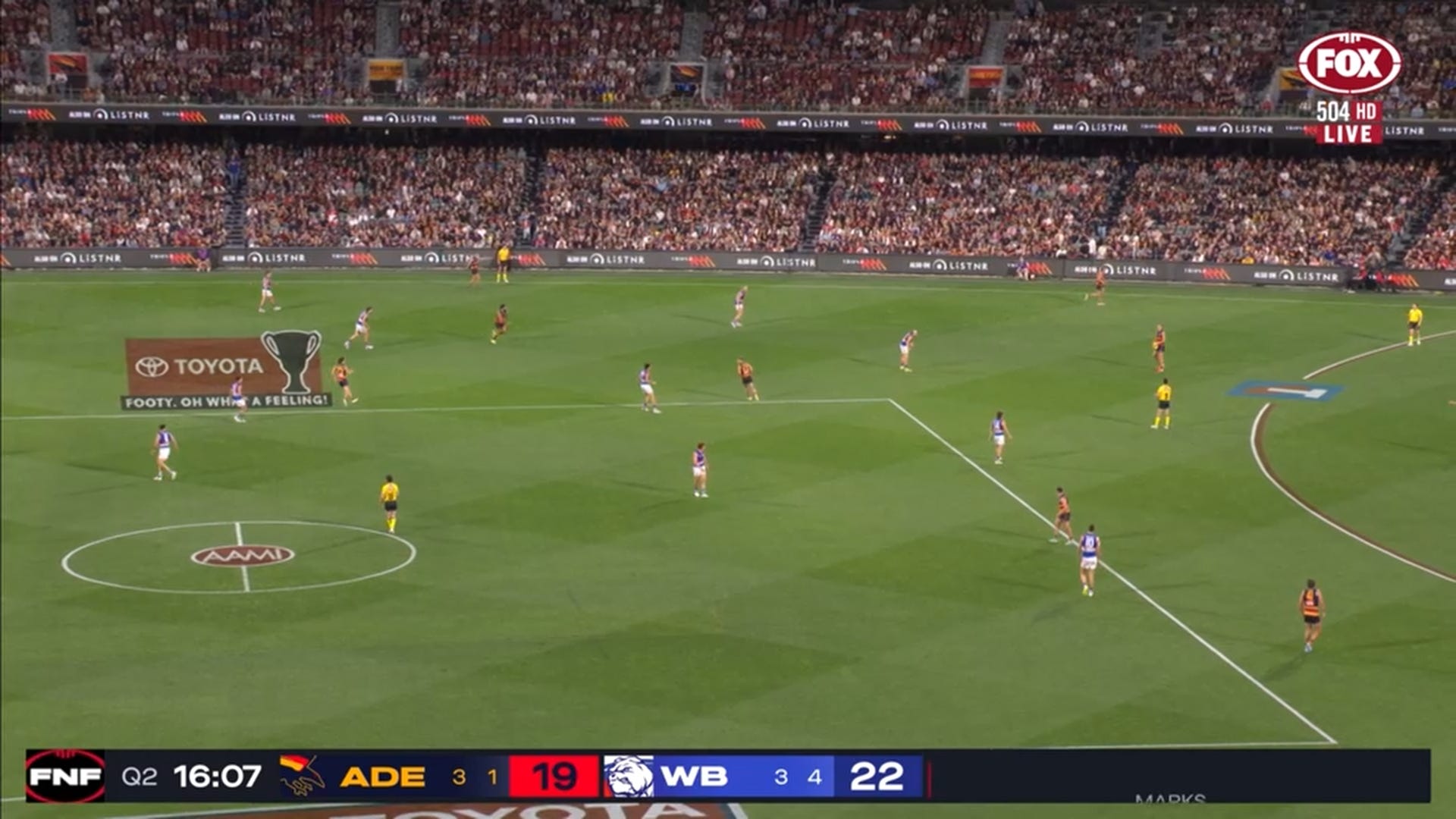
It’s worth pausing here and commenting on the quality of the Dogs’ defensive structures, and the discipline required to make it work as well as they did. Here’s a still of that situation where Dawson had the ball at half-back. Yes, the Crows should have been much more proactive in creating a lane. But at the same time, they were deterred by how precisely the Dogs guarded space. Look at that kite shape on the right-hand side of the centre square. If Ed Richards (who’s at the bottom of it) was two metres closer to Dawson, Jones might have gambled on running forward and calling for the ball. Understanding teasing distances and the optimal distances between teammates are the fundamental ingredients of effective zones. The Dogs did that very well.
Here’s one final clip from the second quarter. The ball began in the hands of Murray. He actually executed a bold forward kick to Laird. Laird then made a small error which results in Adelaide once again being pinned back in its own defensive half. He immediately kicked it laterally to Izak Rankine. Rankine is a better kick than Laird – but he was in a worse position to do something productive with the ball. What probably should have happened instead is Max Michalanney becoming more active and making himself available for the overlap handball instead of remaining inactive. In the end, the Crows manufactured a decent switch across the ground to the broadcast wing. But their slowness was not without cost. The guy who ended up sending it long inside 50, from just past the centre circle? Jordon Butts. A fine stopper, but not a precision kicker.
This tweet, which I posted at half-time, summarised my thoughts on why, if Luke Beveridge does indeed choose to adopt a less aggressive forward press as a default stance, I think it’s such a great fit.

Most of the Dogs’ best players are attackers and attacking midfielders. Most of their weakest are defenders. The mid-block thus solves two problems at once. By slowing opposition transition and sending more players closer to D50, it makes it easier to crowd out opposition entries and apply effective defensive pressure. It also creates space further up the ground for the Dogs to run, find space, and generate one-on-one contests in the event of a turnover.
The Dogs’ strategy was an interesting contrast to this clip from the Sunday Footy Show, where Rory Sloane shows the benefits of Hawthorn’s forward press against Sydney on Thursday night. Sloane rightly identified the Hawks’ ability to force loopy handballs that created cascading pressure as an important factor in stemming the Swans’ ability to transition with handball. The risks involved with that kind of pressing scheme is that it only needs one player to miss their trigger to open a big hole in a defensive zone (see: Carlton in Opening Round vs. Sydney). By snapping into a mid-block as quickly as they did, the Dogs prevented that space from being created in the first place.
A few more specific comments on why this worked so well against the Crows (and it did – Adelaide scored with less than five percent of its D50 chains on Friday, compared to a 2025 league average of 10.1 percent). The Dogs were happy to sag off Murray and Butts because they weren’t afraid of what they could do with the ball. But they were vigilant in staying close to Wayne Milera, whose disposal and run was instrumental to the Crows defeating Collingwood in Round 1. Without Mark Keane’s creative, occasionally hare-brained disposal, and Dan Curtin’s contested power, the Crows are currently too easy to hem in like this.
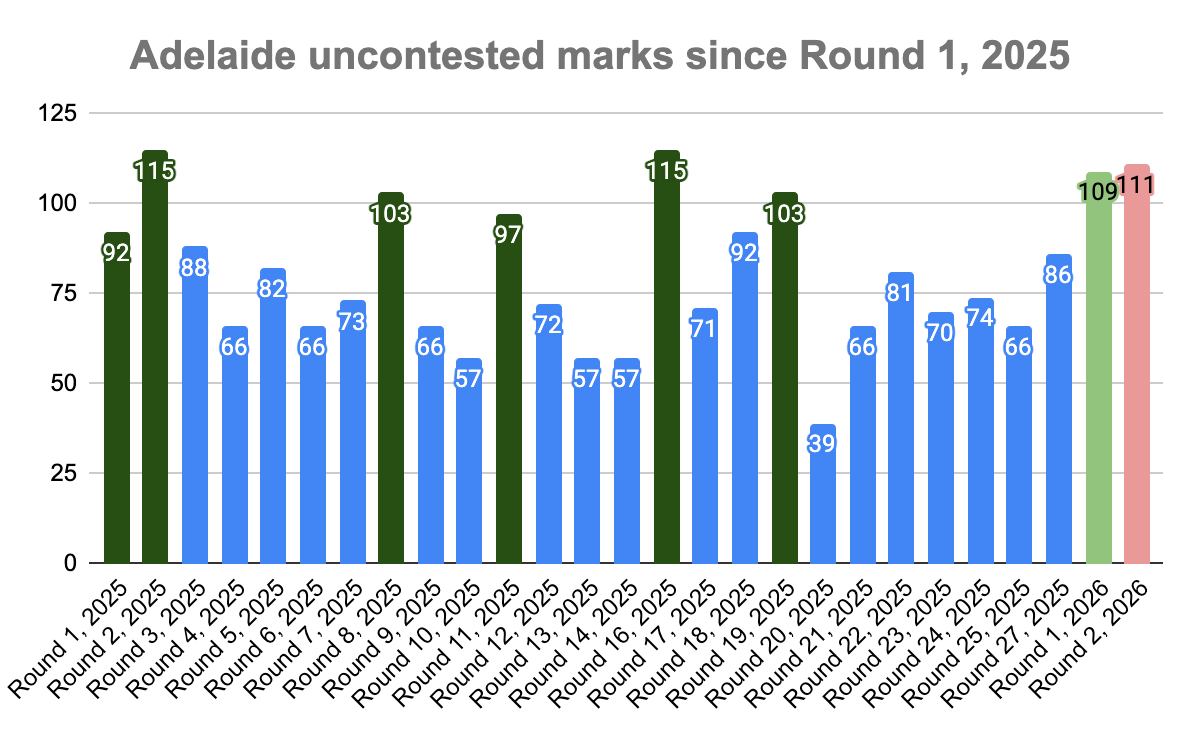
The Crows have taken 90 or more uncontested marks in eight games dating back to the start of last season. They won all of the first six (all last season, shaded dark green) by 10 or more goals. They’ve taken 109 and 111 uncontested marks in their first two games of 2026, for a 14-point win and Friday’s six-point defeat. Given this is a recurring issue for them – and an easily foreseeable one, I discussed it in my season preview – and that Keane won’t be back for months, I suspect any short-term improvement needs to be driven by players like Michalanney and Josh Worrell becoming more willing to carry the ball out of defensive 50.
Adelaide played on just 13.1 percent of the time after a mark or free-kick in the second quarter. When there was no other choice but to go for it, in the fourth term, the Crows played on 47.4 percent of the time. They’re pretty conservative in general, especially in the back half (only Fremantle played on less often in 2025), partly because they have fewer good users in their defence than other sides of their stature. Simply dialling up the risk might not be the answer. It’s easy to look at the fourth quarter of Friday’s game – when the Crows staged a stirring, near-successful comeback, enabled by more risk – and conclude that’s how they should have been playing the whole time. But that ignores the reality that playing like that, especially if it meant more onus on Murray and Butts to make progressive kicks, could have seen the Crows go into the three-quarter break much further behind. These trade-offs aren’t as simple as the outcomes make them appear.
But full credit should go to the Dogs. They won’t always find an opposition as perfectly fitted for the mid-block zone. And part of their defensive improvement is down to the quality of individual performances (Buku Khamis has never looked more comfortable at AFL level) as much as it is a new defensive set-up. But it’s worked well so far. Three weeks into the season, Beveridge might have done something his critics believed he wasn’t capable of: improved his side’s defensive output without sacrificing scoring power. Old dogs, new tricks.
Straight from the chart
Here’s a logical proposition: if footy is getting faster, as per the current discourse topic du jour, then you would logically expect at least part of that to be reflected in how often teams play on from marks or free kicks. That data is available, and if you ask nicely, technically savvy friends like Emlyn Breese will dig it up for you.
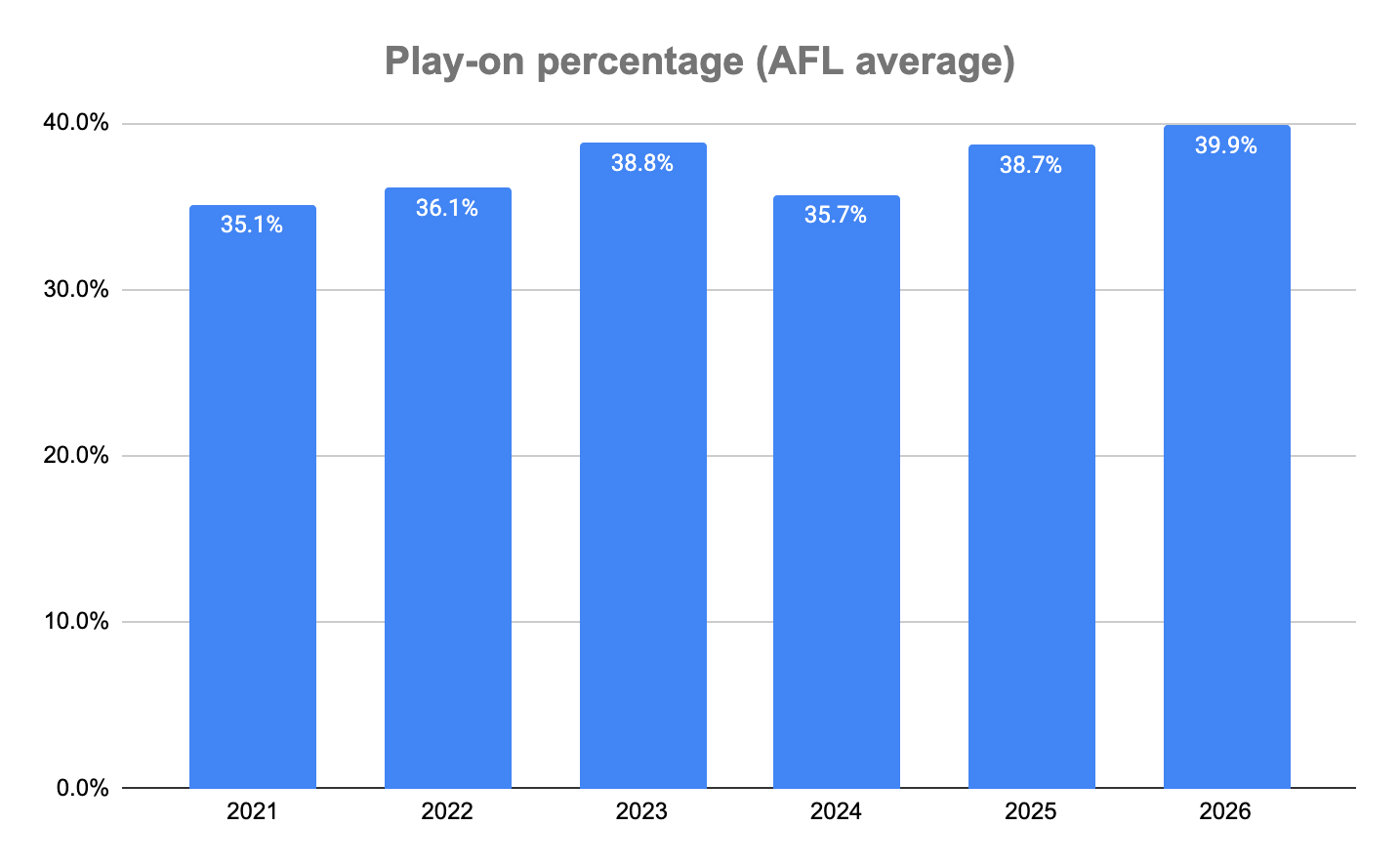
The small uptick masks a big standard deviation. Some teams, for better and for worse, are playing on a lot. Others, meanwhile, aren’t. Per team play-on percentage is one of those statistics where it’s important to separate intent from outcome. Of the four sides currently playing on less than 35 percent of the time, only one – Fremantle – played on less often last season, when they did so just 31.6 percent of the time (the lowest rate, by miles, in the AFL).
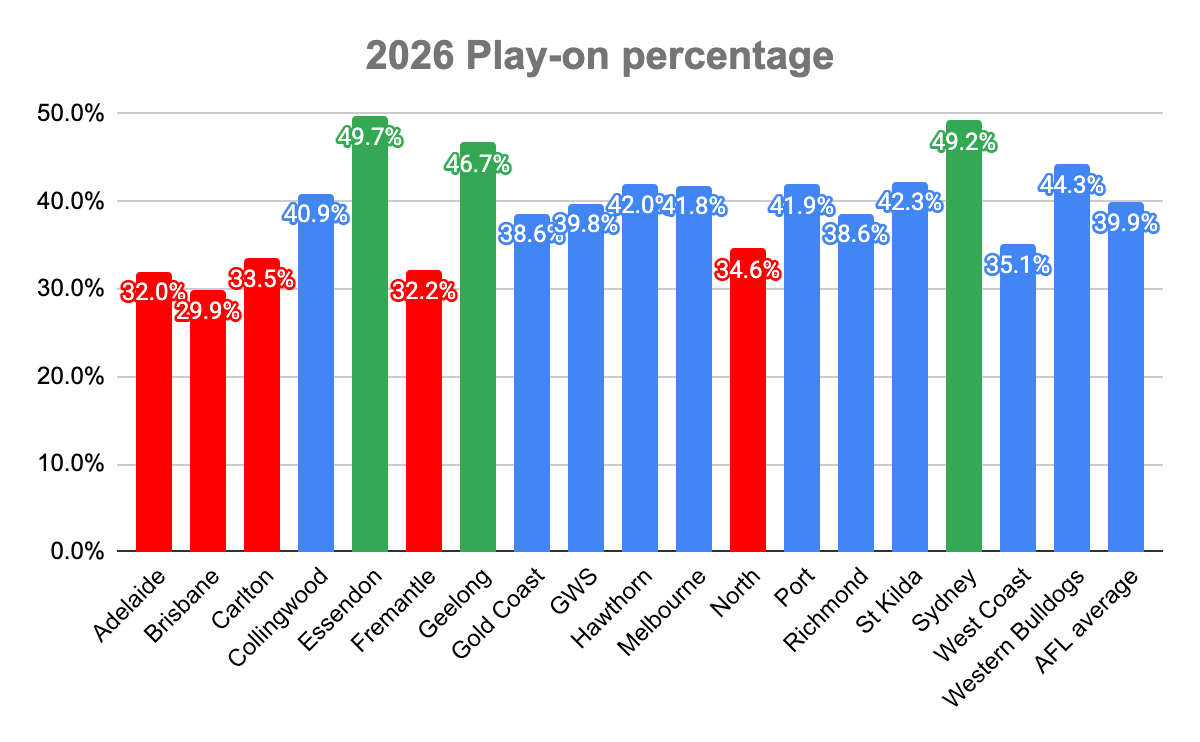
Three sides are currently electing to play on more than 45 percent of the time. Essendon is a cautionary tale in what that can look like when done badly: turnovers when players caught upfield in anticipation of a handball chain that never eventuated, opposition players in space, and blown coverages. Geelong, befitting their status as the fastest team in footy, played on second-most often last season and have taken another step in that direction so far in 2026. The real riser is Sydney. Last season, they played on just 35.9 percent of the time – fewer than all but three sides. This season, they’re currently going at a breakneck 49.2 percent. Errol Gulden wasn’t kidding when he said the Swans would play a faster brand in 2026.
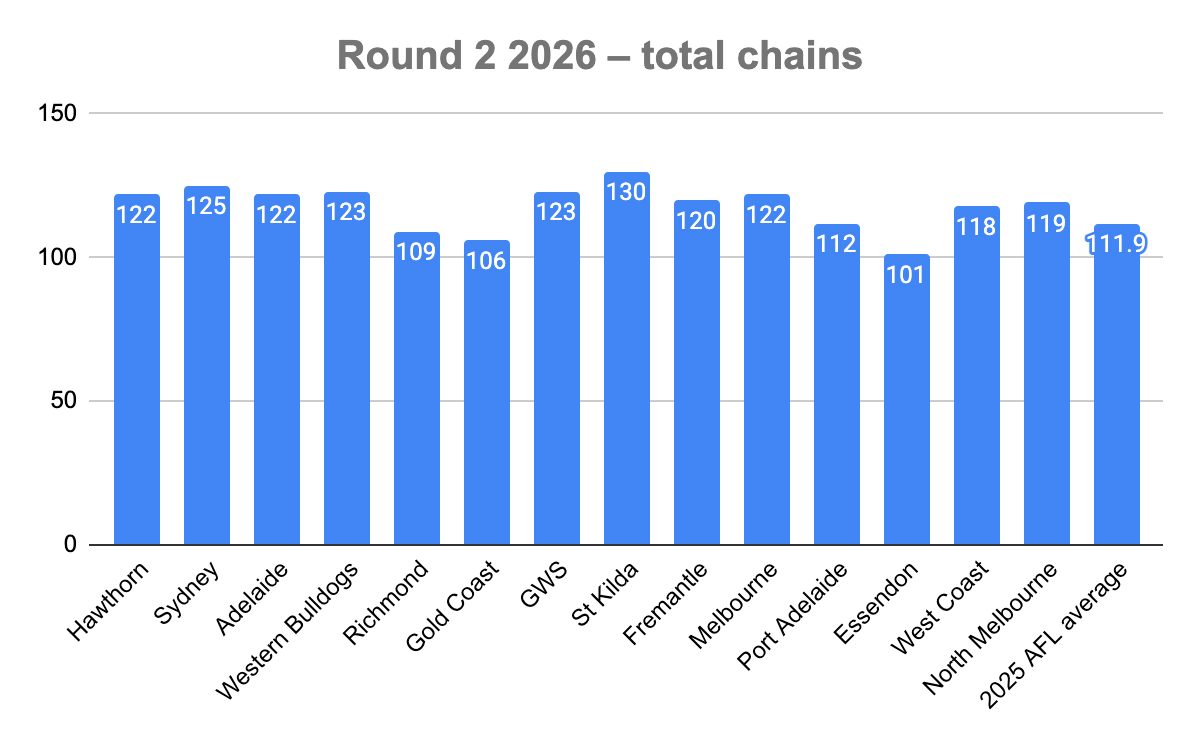
Let’s look at one of the regular charts – total chains. I think the main story from Round 2 was compression: only the Port vs. Essendon game featured a big discrepancy in how often sides began with the ball in the same game. The other is probably that – and this could very well be an artefact of fast early-season footy – only three sides created fewer possession chains than the 2025 season average. Over the course of the round, sides averaged 118 chains. Frothy.
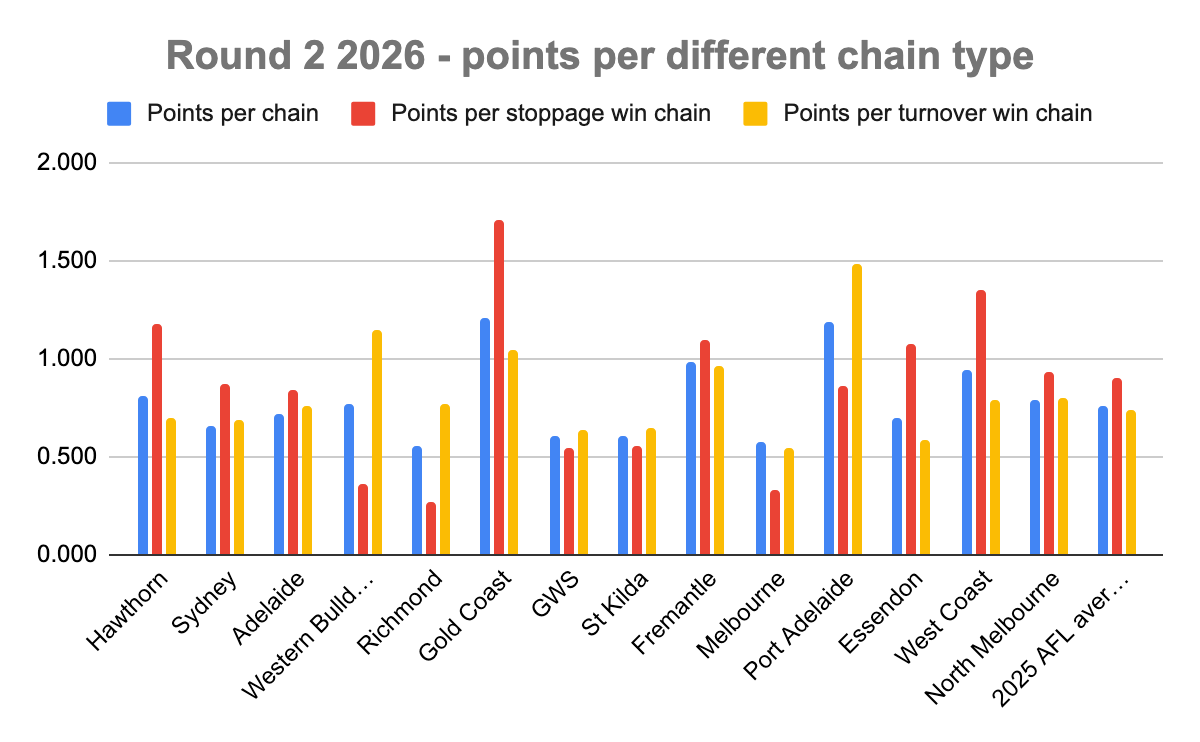
Again, what’s probably even more interesting than how many sides begin with the ball is how effectively they score from different chain types. The Round 2 data is skewed by three outliers: Gold Coast’s frankly absurd 1.7 points per stoppage win chain, Port’s 1.48 points per turnover win chain (checks out), and West Coast’s 1.35 points per stoppage win chain. Wait – what? Polar bear in Arlington, Texas, etc. The Eagles were -9 for overall clearances, but +7 in scores from stoppages. Power, positioning, and – crucially – the ability to force stoppages in their own front half. The shorter the route to goal, the better.
Enjoying my weekly review? Share it with a friend.
Footnotes
Fremantle’s win over Melbourne meant that, for about 21 hours, the AFL team that has gone the longest since its last loss was North Melbourne. The baton has now been passed to the Western Bulldogs.
Essendon crisis stats watch: the Bombers conceded their highest ever mark tally (157) to Hawthorn in Round 1. On Sunday, they fared even worse, conceding 165 marks to Port Adelaide, including 25 inside-50 – their worst tally on this particular metric since 2016. It’s been a demoralising start to the season at Windy Hill.
West Coast didn’t just stop a run of 14 consecutive defeats when they beat North Melbourne in a banger on Sunday. It was the largest quarter-time deficit (24 points) they’ve overhauled to win a game in Western Australia… this century. The Eagles might not be flying high yet. But at least they’re off the ground.
A good one from AFL journo Riley Beveridge, shared in the aftermath of Charlie Curnow’s one-handball second half against Hawthorn and the discourse that followed: since the start of 2025, Charlie Curnow has kicked 18.16 in first quarters. That stacks up pretty well against the top three in last year’s Coleman Medal count – Jeremy Cameron (17.9), Ben King (25.12), and Jack Gunston (17.11). However, in quarters two through four, Curnow has kicked just 19.16. Compare that to 74.38 for Cameron, 62.12 for King, and 69.32 for Gunston. Cause or effect of Carlton’s fadeouts?
Centre bounce scoring watch: after Round 2, teams are currently scoring an average of 10.9 points per game from centre bounce chains. That’s…. less than any full season since 2021, when teams could only muster 10.4 points from that source. It’s still very early, there’s lots of volatility with small numbers, but perhaps footy isn’t broken beyond repair after all.
Recommended reading
My good friend and self-admitted one-eyed Port Adelaide fan, Patrick McCabe, laments the banana republic status of the South Australian clubs that leaves ordinary members like him without a real say in how their club is run.
Lincoln Tracy writes that everyone needs to calm down about Collingwood (spoiler: they won’t).
Another new Footy Substack alert! Leigh Eustace, at Footy Analysis, makes the sensible assumption that a 20th AFL club will follow the 19th. He sees two outstanding candidates for where that club should be based.
The Vulture Street Journal have used the Lions’ first bye of the season to re-evaluate the 0-2 start and what they need to do to finish in the top four.
Over at Jumper Punches, Nick Rynne reflects on a very satisfying weekend for the West Australian sides.
Rohan Connolly takes a playful swipe at the “young men yelling at clouds” (I appreciate the implication I’m young) in this piece, which suggests that the angst about the current state of the game might be misdirected.