


I’m tentatively seeking sponsors for the newsletter. If you, or someone you know, is involved in a business – no gambling or crypto, please – that would like its name in front of a four-figure readership with long attention spans, get in touch. My email is hello@onepercenters.net.au.
On last week’s episode of Footy Classified, journalist Cal Twomey reported what most people inside the game had already been expecting: big changes are coming to father-son and academy bidding at the draft. The graphic below provides a summary.
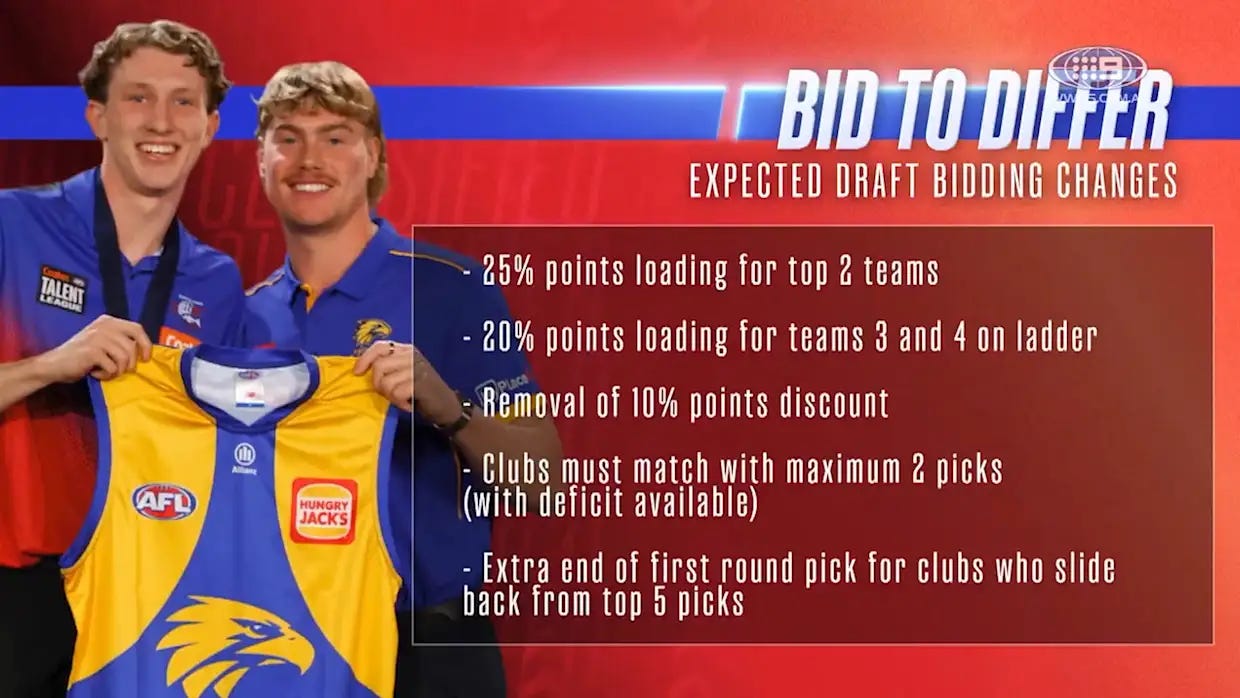
Clubs which finish in the top four will be forced to pay a premium when matching a bid on their star kids. They’ll only be allowed to use a maximum of two picks to match. The current 10 percent matching discount will be abolished. And, most intriguingly, clubs that see their natural top five pick pushed back as a result of bids will be compensated with an additional end of first round pick. The AFL Commission apparently committed to changes following its competitive balance review, and Twomey’s reporting – which, as anyone who follows the draft closely knows, is not so much speculation as it is advance notice – makes their implementation for this year’s draft a near-certainty. The AFL’s choice to soft launch the changes via Twomey’s spot on an insider-y late night footy show suggests both a knowledge that the changes, like any to the draft, would be hotly debated and (perhaps) a desire to gauge public sentiment before they’re made official.
The nominal intent of the changes is to make it harder for already-strong sides to cheaply match bids on their tied talent, thereby directing more of the best kids in the draft to sides at the bottom of the ladder. Equalisation, in other words. That’s a laudable goal. But the changes certainly aren’t perfect. I worry about the potential for sides to collude by bidding on each other’s father-son and academy talent to effectively manufacture extra picks. I’m not convinced the gap between fourth and fifth-placed sides – often only percentage – is wide enough to warrant penalising the former but not the latter. Yes, one plays a qualifying final and the other an elimination final. But those teams are often equally strong. And I’m hardly the first to comment on the seeming peculiarity of the timing: pulling up the drawbridge the year after Gold Coast has secured its windfall of academy talent, that will sustain a long period of flag contention, for cents on the dollar.
But the biggest problem isn’t with the new bidding rules per se. It’s the fact that, despite being a gesture towards equalisation, they’re better understood as yet another distortion to what’s become a highly compromised draft system. The AFL, caught hopelessly between its ardent desire to grow the game in new markets, its ardent desire to preserve the sentimentality of the game, and its apparent desire for equalisation, has added layer upon layer of rules, fudges, and fixes to the draft to mollify different stakeholder interests.
The result is that the draft – notionally the engine of equalisation – has lost much of its equalising power. Alastair Clarkson believes clubs will never willingly bottom out again. St Kilda has complained bitterly and pivoted to a new list management strategy. The data bears this out structurally. In the 15 seasons between 1996 and 2010, an average of 1.73 sides which featured in the previous season’s top four stayed there the following season. In the 15 seasons since, that number has increased to 2.13. The bottom of the ladder is just as sticky. Between 1996 and 2010, 1.6 sides from the previous year’s bottom four stayed there. In the ensuing 15 seasons, despite most of that covering an expanded 18-team competition, an average of two sides per season have remained rooted in the bottom four. Economic mobility, especially for the least well-off clubs, is declining in the AFL.
The success of sides like Hawthorn and Fremantle – both now genuine flag contenders with virtually no father-son or even academy players to speak of (apologies to the promising Calsher Dear) – is sometimes cited as evidence that the effects of the father-son rule are overstated. Their experiences don’t prove that the advantage of the father-son rule isn’t real. The clubs that have benefited most from the father-son rule didn’t need it to be competitive either. But they were granted a margin for error that most clubs today do not have.
If footy is like chess – a game played according to mutually understood rules, where coaches begin with a given set of pieces and attempt to win by outthinking their opponents – then list management is the art of optimising the value of your starting pieces. It’s the meta-game. And although the meta-game doesn’t determine the outcome of any individual contest, it tilts the scales before the contest begins.
The reverse-order draft is meant to address that asymmetry. The dividend of being the worst side, one with an unhealthy number of pawns, is first dibs on the prospect that’s most likely to become a king one day. The draft was never meant to legislate equality of outcome. It was meant to guarantee something like equality of opportunity. By conceding that it’s OK for some clubs, often precisely those which have better starting pieces, to jump the queue because their father played for them, the father-son rule cuts against that idea. The new bidding rules are the AFL’s attempt to tax that advantage more punitively without removing it. But both the rule and the rule that’s been made in response to the rule ultimately concede the same thing: the starting position isn’t equal, and hasn’t been for a long time.
The father-son rule was introduced in 1949 to fulfil a sentimental request: sons should be able to play for their fathers’ clubs. It’s widely believed the VFL introduced it following successful lobbying by the Melbourne Football Club, which wanted the young Ron Barassi to follow in the footsteps of his father, who’d been killed in action in World War II. The rule is an emotional recognition of footy’s deep emotional roots and rich tribal continuities. The game is, among other things, about lineage and belonging. You can understand the romantic impulse. Many fans, typically those who support clubs that have been net beneficiaries, love the rule and believe it’s one of the things that sets our game apart from other codes.
That’s all true and important. But I also think it’s reasonable to ask if the AFL owes a higher duty to romance or to fairness. Perhaps you think I’ve loaded the dice there. It’s true that the father-son rule is procedurally fair, in the sense that the distribution of talented father-sons among established clubs should be largely random. It doesn’t really have anything to do with how well a club has managed anything other than its relationship with past players and its admin. But randomness doesn’t produce fairness. And, in the case of the father-son rule, it hasn’t produced either.
There’s another romance that defenders of the father-son rule rarely talk about. That’s the romance that belongs to supporters of clubs that have spent years in the wilderness, have watched flags go to the regular suspects, year after year, and been told that the draft will eventually give them their turn. That hope isn’t just a core part of the footy fan experience – it’s key to the functioning of the entire footy-industrial complex. The Essendon fans that are still subjecting themselves to the weekly horrors are doing so in the belief that it’ll amplify the satisfaction of the good times. By contributing to the increasing ossification of the ladder, the father-son rule subsidises the romance of certain supporter groups over others. It concentrates the experience of glory at one end of the ladder and rations it elsewhere. Not enough people make what seems to me an obviously true argument: meritocracy, properly realised, is romantic. The open draft represents the idea the best players find the clubs that need them most, where merit rather than lineage determines who gets a shot at glory. All 16 clubs made a prelim between 1998 and 2006. In the last nine years, just 13 of 18 have. Perhaps you don't believe that's a big difference. I do.
Despite being theoretically open to all clubs, the father-son rule has in practice produced highly skewed results. Of the – by my count, which is likely to be a bit off – 120 father-son selections made since the introduction of the reverse-order draft in 1986, 15 (12.5 percent) have been made by Collingwood. That includes some fairly handy names – the Daicos brothers and Darcy Moore come to mind – and some answers to pub trivia questions. Geelong have had fewer but made them count: Gary Ablett Jr., Tom Hawkins, and Matthew Scarlett formed the backbone of the Cats’ dynasty era of the late 2000s and early 2010s.
St Kilda, meanwhile, is an example of the pendulum of variance swinging the other way. In the pre-bidding era, David Sierakowski – son of 1966 premiership player Brian – played 93 games for the club before being traded to West Coast as part of the deal that brought Fraser Gehrig to Moorabbin. In the modern bidding era, Bailey Rice (son of Dean) played 11 games. Two other selections never managed a senior game. The club’s situation became sufficiently acute that, last year, it launched a formal father-son and father-daughter academy, reasoning that it needed to manufacture what other clubs had accumulated by accident. Funny how the least successful clubs are also the unluckiest.
About two-thirds of Premiership sides this century have featured a father-son player in a meaningful, best-22 role. Dustin Fletcher anchored Essendon’s defence in 2000. Jonathan Brown was the spearhead of three consecutive Brisbane flags. Gary Ablett Jr. and Matthew Scarlett were central to Geelong’s dynasty, while Tom Hawkins extended it into 2022. Travis Cloke and Heath Shaw were key pieces of Collingwood’s 2010 flag. Tom Liberatore, son of Tony, drove the Western Bulldogs’ miraculous 2016 flag through the middle. And in 2023, Collingwood became the first premiership team to field three father-son players in key roles – Moore as the captain and defensive lynchpin, Josh Daicos as the flying winger (and eventual Best & Fairest winner), and Nick Daicos as, well, Nick Daicos. Will Ashcroft has already won two Norm Smith Medals. The clubs that have accumulated the most father-son talent are, almost without exception, the clubs that have won the most. They’re the best and the luckiest. Good for them.
The strongest back-up for these claims comes from an unlikely source: the AFL itself. In 2014/15, the league’s football operations department undertook a review of the father-son and club academy rules ahead of the introduction of the Draft Value Index. I’m not sure if the AFL knows this, but the review document still lives on its servers. You can read it right here. Two lines jump out. They’re delivered matter-of-factly. But they’re actually admissions that the AFL has been perfectly aware for years about the distortions produced by the father-son and academy provisions. The first is the recognition that, despite the theoretical equality of father-son access, the winner-takes-all structure of the competition has created effects that greatly favour some clubs over others:
“The competition cannot tolerate a disproportionate advantage being given to one team over the rest: the “swings and roundabouts” actually play out in premierships, finals appearances and wooden spoons. A key issue is that these anomalies are only set to arise more frequently in future years as the Club Academies begin to regularly produce players.”
The second is the report’s (breezily evidence-free) assertion that, despite its acknowledged anti-competitive effects, the father-son rule is still worth it:
“The F/S Rule is very popular with fans and an important and unique tradition of our game. Despite the fact that it compromises the purity of the draft, the AFL believes the rule should be retained.”
The governing body knew what it was doing, knew the cost, and chose romance over competitive integrity. A decade on, it’s tightened the rules, but is still making the same fundamental choice in an era where the divide between the haves and have-nots feels more pronounced than perhaps ever before.
Let’s consider some first principles. In his magnum opus, A Theory of Justice, the liberal political philosopher (and baseball tragic) John Rawls proposed a thought experiment for evaluating the justice of a system: design it from behind a veil of ignorance, without knowing which position within it you’ll occupy. From that position, Rawls argued, you’d choose to design the system according to principles that protect the least advantaged – because you might be one of those least advantaged.
Apply this to the draft. Behind the veil, you don’t know which club you support. You don’t know whether your club has an elite father-son prospect incoming or hasn’t had one worth getting excited about in 30 years. You don’t know whether your club is more likely to finish in the top four or the bottom four, whether it has the corporate knowledge to exploit the new bidding rules, or whether its list was built for the style of football the AFL’s on-field rules currently reward. From that position, would you design the father-son rule? It allocates a scarce, valuable, randomly distributed asset on the basis of sheer dumb luck. It bears no relationship to competitive merit, list management quality, or draft strategy. A rational agent behind the veil would reject it.
Rawls articulated another test to measure justice. He called it the difference principle. The difference principle states that “social and economic inequalities are to be arranged so that they are to the greatest benefit of the least advantaged.” I’m sure I’m not the only one who was immediately struck by the similarity between Rawls’ difference principle and Kane Cornes’ recent assertion on SEN Fireball that “every decision the AFL make from here on in has to be with the end goal in mind to make the competition as even as possible.” Pass the father-son rule through that test. Cui bono? Clubs with historical depth – most typically, the oldest, most established ones that have had more prominent fathers playing in earlier eras. Not, in other words, the clubs one immediately thinks of as needing extra help. The father-son rule fails the difference principle.
Practically, what might recent footy have looked like had the father-son rule never existed, or had clubs been forced to pay fair costs for their prospects? Perhaps Geelong would have had to choose between one or two of Ablett Jr., Hawkins, and Scarlett. St Kilda would probably have won at least one flag. The broader balance of power across the late 2000s and early 2010s might have been different. Ultimately, it’s impossible to say – counterfactuals are slippery. But I’m confident that whatever was lost in romance and tradition would have been more than offset by the thing the AFL claims to prize above all else: a fair contest. And nothing would have actually prevented Geelong, or Collingwood, or the Western Bulldogs from going after the sons of their club greats. They’d have had to back their judgement in the open draft – to decide, without a safety net, that this particular kid was worth that particular pick. That seems like a more honest test of a football club than the one the old system provided and the new one still. And if Gary Ablett Jr. had gone to Geelong with Pick 7, or 8, or 23, instead of going for a song at Pick 40, wouldn’t the story still have been just as good? Josh Dunkley is a Premiership hero at two clubs his dad didn't play for.
The trade-off between tradition, growth in new markets, and competitive integrity is hardly a new one. Fans have been grumbling about it since before non-Victorian sides joined the league. Things are different now, of course. The ruleset which enabled Geelong to draft Tom Hawkins with Pick 41 in the 2006 draft no longer exists. Nor, soon, will the rules that enabled Collingwood to match Gold Coast’s bid on Nick Daicos using Picks 38, 40, 42, 44. But I suspect the longevity and familiarity of the father-son rule has blinded people to its actual effects. The influence of a gun father-son pick (or three of them at once, as in Geelong’s case) can be felt for years. The Geelong trio, Daicos, Darcy, and the Ashcroft brothers help their sides stay good for longer. They make a difference on the field, and players at other clubs want to run out alongside them.
A quick word on what I’m not arguing. The Northern Academies and the Next Generation Academies have each come with their (frequently changing) own bidding mechanics, their own exceptions, and their own patches. Each has contributed to the draft’s disfigurement. But they rest on different moral foundations. The Northern Academies exist to grow the game (both commercially and in participation) in New South Wales and Queensland. The Next Generation Academies were introduced to create pathways for players from culturally and linguistically diverse communities, and for Indigenous players that the elite talent pipeline has bypassed. Although both distort the draft, neither distort it in the same way or for the same reasons as the father-son rule, which has principally benefited the oldest, most established Victorian clubs – the ones that needed the least help. Whether broadening participation and incentivising clubs to develop local talent are worthier goals than preservation of tradition is a debate for another day.
In a piece a few weeks ago, I argued for what I tentatively called ‘footy libertarianism’ – not a call to abolish rule-making, but a meaningful distinction between establishing the basic parameters of a system and steering it toward a preferred outcome. I mostly applied footy libertarianism to the AFL’s most recent set of rule changes. But the concept applies equally to the meta-game – the game which determines what chess pieces you begin the game with.
The architecture of the draft should preserve plurality. It should create conditions in which different list-building philosophies can coexist and compete. The father-son rule distorts that pluralism. Two clubs with similar draft positions, similarly effective salary cap management, and similarly effective development programs will have systematically different list compositions if one happens to have more prominent alumni with football-playing sons. I don’t know about you. But I prefer my governing body to remain neutral on the question of which style of play is most viable, and to establish principles that, where possible, minimise the effects of luck.
The proposed father-son bidding changes aren’t really a remedy. They’re the latest fudge on top of a series of fudges that have come before. But there is a way to overcome the tyranny of the Empire of the Son. Not reform. Not another patch on the patch. Full abolition, on the grounds that no one standing behind the veil of ignorance would design it, that it fails the difference principle, that it violates the footy libertarian commitment to plurality and organic evolution, and that every attempt to correct its distortions has produced new distortions that inevitably require further correction down the line.
The counterargument is emotionally powerful. Lineage matters in our tribal game. There’s genuine romance in the idea of a Daicos or a Ricciuto or a Pavlich pulling on the same colours as their father – and real horror in the idea of them in navy, or teal, or blue and gold. Perhaps cold competitive logic shouldn’t be the only principle by which football is governed. But abolishing the father-son rule wouldn’t prevent any of those stories from happening. It would just stop the AFL from subsidising them. A club that truly believes in a young player can take him in the open draft, back its judgement, and pay the full cost. That’s a more honest expression of loyalty, and a better test of some of the things clubs should be tested on (talent evaluation and asset management) than a rule which compels the rest of the competition to underwrite the sentiment. Tradition isn’t enough to excuse inequality; not when it helps determine which teams win flags and which win wooden spoons, and not when the AFL itself knows the cost and chooses to pay it anyway. Andrew Dillon has a chance to actually do something meaningful during his tenure. He should revolt against the Empire of the Son.
Straight from the chart
Over the past month, I’ve approached the subject of the increasing speed of the game from a few different angles: full polemic and more granular looks at the changing shape of the handball game, score sources, and centre bounce attendance concentration. This week’s charts continue on in that latter vein and ask what’s happening to uncontested possessions?
The best place to begin is to look at the share of contested vs. uncontested possessions. I’d expected a shift away from contested possessions, reflecting the fact that a faster game strongly implies a more uncontested one – but I hadn’t expected such a big shift through four rounds.
I suspect these numbers will moderate over the course of the season. Not because 36 games isn’t a representative sample, but because – due to weather conditions and team’s systems not quite having clicked yet – March and April aren’t always representative of the rest of the season. The cold will come, the ground will soften, the run will slow.
If the share of contested possessions is going down then at least one of three things is happening: there are fewer contested possessions, more uncontested possessions, or both at once. Turns out it’s the third thing. Contested possessions are declining in absolute numbers, but not by very much: games in 2026 are currently averaging 127.1, compared to 130.5 in 2025. The bigger change is in the number of uncontested possessions per game. The current competition average (227.9) is the highest since 2018, when there was an average of 228.8 uncontested possessions per game.
Uncontested marks are following the same trend, to an even more exaggerated degree. 85.6 uncontested marks per game is the highest on record (or the highest that Wheelo Ratings, which goes back to 2012, can find – which is basically the same thing). Teams are moving the ball faster and players are running faster and further. Footy is becoming a more cardio-intensive sport.
Round 4 yielded some mildly interesting results when it came to how often teams started with the ball. Brisbane having 18 more possession chains than Collingwood wasn’t a surprise. Adelaide having more chains than any other side across the entire round probably was. Sydney “only” had 117 chains because 45 of them – 38.6 percent! – ended in shots. Hawthorn generating eight more chains than Geelong was statistical confirmation of the eye test: they were the better side for most of that titanic Easter Monday clash.
An early-season trend I want to explore in greater depth in next week’s review is how heavily teams are scoring from clearance wins. Only Fremantle, West Coast (just – and not that it particularly mattered), and Sydney scored at higher rate from turnover wins than clearance wins in Round 4. Perhaps that’s expected: stoppages are rarer, set-ups are more sophisticated, and the type of player that attends them is changing (think more Kysaiah Pickett, less George Hewett). But it still jumps off the page.
Enjoying my weekly review? Share it with a friend.
Footnotes
Some interesting league-wide trends shared by Champion Data’s Daniel Hoyne on his most recent appearance on SEN Sportsday: scoring is at its highest in a decade, ball movement is the fastest on record (by more than 10 percent), inside-50 entries per game are at their highest rate in 27 years, scores per inside-50 are the highest they’ve been for 10 years, and the number of marks is the second-highest for 18 years. As a result? Pressure is the lowest on record through four rounds of the season.
Courtesy of Cal Twomey: “The numbers say the best players are, on the whole, spending more time off the ground this year. Of the top ranked 49 players in the competition according to AFL Player Ratings, 36 had lower time on ground in the opening month than last year.” (Note: this doesn’t include Round 4.)
The 10 youngest players in the West Coast vs. Sydney game on Saturday night all wore blue and gold guernseys. It doesn’t justify the result. But it partly explains it.
There have been six games with 128-point margins in VFL/AFL history. Jamie Cripps has played in two of the last three – for different clubs, and on different ends of the result.
Recommended reading
If you don’t already, make sure you’re doing the Friday Footy Quiz. Test yourself, your friends, family, neighbours – anyone who’ll listen. It’s always good fun.
Friend of the newsletter, Mimi Birch, writes that we should have sympathy for the Saints – they’re just doing the rational thing in the face of a broken draft system.
Toby, author of the always thoughtful Jousting Sticks substack, doesn’t like the way the footy media talks about money.
Jonathan Horn on the scourge of goal songs and the general cacophony of noise at footy games these days (writing that made me feel so old).
The Vulture Street Journal is feeling good about Brisbane’s big win over Collingwood last Thursday night.
Over at Jumper Punches, Nick Rynne reviews Round 4 from the perspective of the WA clubs (spoiler: good, then bad).
Brilliant, really enjoyed this. Great writing 👍👍
No, the counter-argument to abolishing the F/S rule is one of the arguments you made precisely for abolishing it:
"The influence of a gun father-son pick (or three of them at once, as in Geelong’s case) can be felt for years. The Geelong trio, Daicos, Darcy, and the Ashcroft brothers help their sides stay good for longer.”
The veil of ignorance is a metaphysical fantasy. Wonderful in principle, impossible in fact — for the simple reason that nothing is ever built from scratch. It is always built in the midst of a world that is already structured by inequalities (etc.). Abolish the F/S rule — notwithstanding its apparently superior fairness — and all you do is entrench the inequalities created by the F/S rule for another 10, 15 plus years. You’re saying: yep, in hindsight that wasn’t a good idea; guess we’ll just have to live with the consequences until Nick Daicos and the Ashcrofts retire. Too bad for all those clubs that never got to benefit from it, and now never will.
Solutions to the problem that the F/S rule causes have to include ways to redress the existing inequalities it brought about, otherwise they are only contributing to the problems that the F/S rule has caused. I’m not sure there is any solution to this situation other than implementing an accounting system incorporating retroactive application. Rawls would probably roll in his grave, but we are not talking about the state here. It's just a football competition.
As hilarious as it would be to force all existing F/S’s to nominate for the next draft, I’m sure there are other options. Surely it can’t be too hard to draw up a points system to use as currency for bidding on F/S <b>and</b> Academy draftees. Factoring in current age and whatever else anyone thinks is significant, points would be deducted from those teams who already have F/S, etc.. A clubs stock of points would then be replenished pro rata as the respective players retire. (Trade maybe, might need another tweak to avoid double recompense, but probably not worth it.)