


I’m looking for a sponsor. Click for more information.
We are now into the third week of the mid-season byes. The week off provides players with a chance to rest weary bodies and coaches with virtually their only real opportunity to make substantial changes to their game plan. As the byes unfold, I want to consider how each club is travelling – not just relative to pre-season expectations, but also what’s the likely range of outcomes for the rest of the season. Thankfully, I won’t be doing it alone. I’ve asked supporters of each club – all friends of the newsletter – to share their thoughts about how their sides are going and how it’s changed their belief about what’s possible in 2026. I’ll then respond with my own thoughts.
There’s lots of meat in this third installment: two genuine flag contenders, a Carlton side that has won four consecutive games under caretaker Josh Fraser and is suddenly a chance of making the Wildcard Round, and a Collingwood side that looks well short of the top sides. Subplots and storylines abound. How will Fremantle’s players – and supporters – deal with the pressure of expectations? Can Hawthorn bridge the small but significant gap to the very best? What will the Carlton hierarchy do if Fraser keeps on winning? And how will Collingwood respond to being at the crossroads? Let’s get into it.
Carlton
Win-loss: 5-8
Ladder position: 13th
Next four games: GWS (A), West Coast (H), Richmond (A), Hawthorn (H)
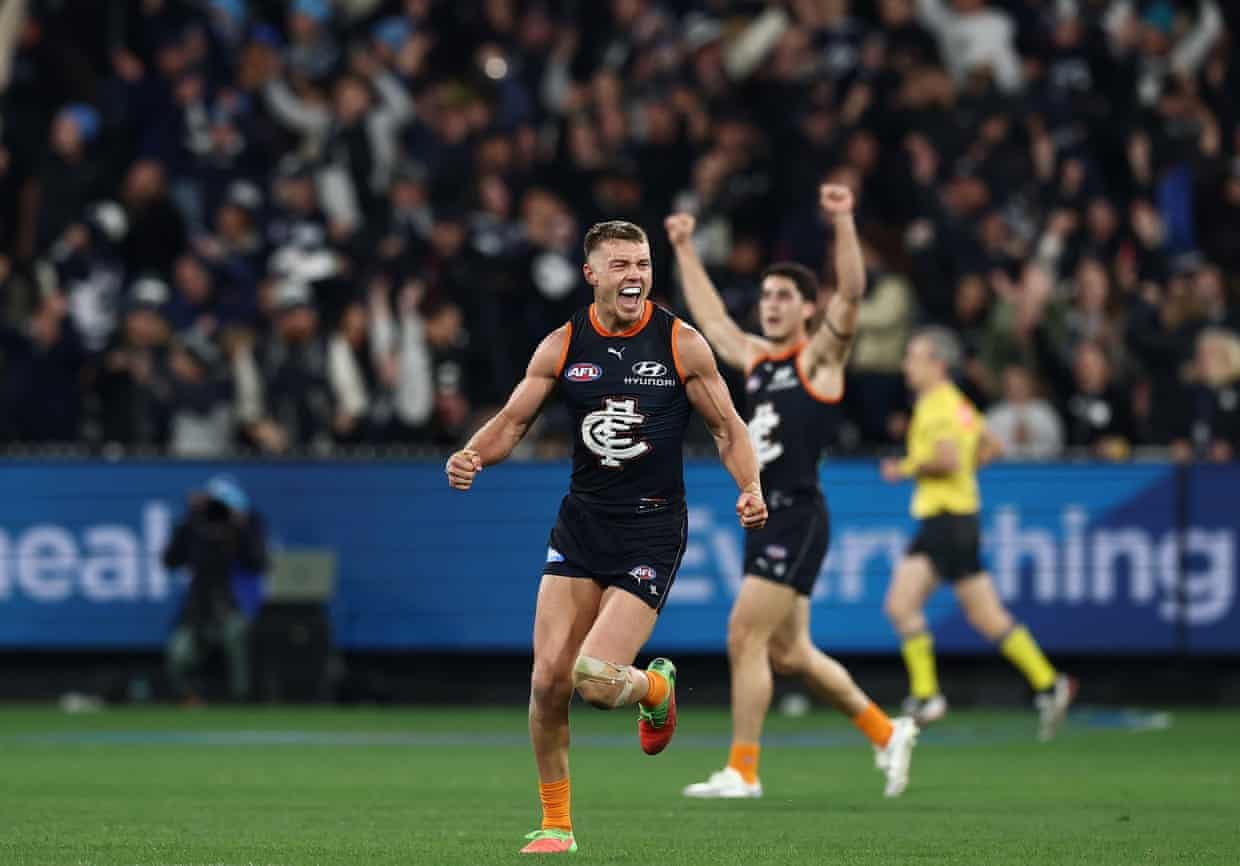
Jono Baruch from The Gardiner Stand Substack
Carlton has packed a full season’s worth of drama and emotions into the first half of 2026. Major upheaval in the off-season was followed by a disastrous 1-8 start, the resignation [Mateo: “resignation”] of coach Michael Voss, the sad Elijah Hollands situation, and now – improbably – four consecutive wins heading into the mid-season bye. Remarkably, the flame on Carlton’s season is still flickering.
The first half of 2026 has felt like two completely different seasons. The opening nine rounds were a continuation of the frustrations that had followed Carlton for much of the previous 18 months. Slow ball movement, an overreliance on contest and clearance, and an inability to stop momentum swings led to games repeatedly slipping away. It was like watching Groundhog Day without the happy ending.
The coaching change has undoubtedly altered the mood and direction of the season. Under Josh Fraser, Carlton looks more composed with the ball, more willing to control tempo and, perhaps most importantly, more confident in its identity.
Fraser’s remarkable start to coaching life has vindicated scepticism of his predecessor and yielded more information about the list. Carlton entered 2026 with the sixth-oldest list in the competition and an increasingly urgent need to determine whether the next generation was ready to become more than supporting acts around the club’s established stars. The answer, encouragingly, appears to be yes.
Harry Dean and Jagga Smith have both earned Rising Star nominations and look capable of becoming long-term pillars. Lachie Cowan has continued his development after some worrying moments of stagnation, while Jack Ison and Billy Wilson have arrived at AFL level looking more comfortable than many would have expected. Talor Byrne has shown glimpses and, before his unfortunate ACL injury, Matt Carroll was producing the best football of his career and looked well on the way to becoming a set-and-forget on the wing.
For a club that has often been criticised for its inability to develop depth beyond its top-end talent, the emergence of that group may prove one of the most significant developments of the season. There remain holes to fill and difficult decisions to make. A significant number of players remain out of contract, and the incoming senior coach – whether it’s Fraser or not – will inherit a list that is still undergoing renovation rather than one ready for immediate contention. But the outlook is healthier than it appeared a month ago.
The reality is Carlton should never have been 1-8. They led at half-time in six of those first nine games. Equally, four wins don’t suddenly erase every concern. The truth likely sits somewhere in the middle.
As the Blues head into the bye at 5-8, finals remain unlikely. Making the Wildcard Round would probably require winning seven of their last 10 games. But for the first time in a long time, the conversation feels less about what Carlton lacks and more about what it might become.
Jono’s grade: C-
My thoughts
Jono nailed it when he wrote that the first half of Carlton’s season has felt like two entirely different seasons. The first was miserable: excruciating proof that refreshing the list while retaining Michael Voss was the wrong call. Losing is never fun. Losing in more-or-less the same way each week, allowing opposition supporters to draw from a bottomless reservoir of schadenfreude, really is the worst. The second quarter of Carlton’s season – or, if you want to be pedantic, the last month – has been revelatory: Josh Fraser has won four straight games while also exposing young players like Jack Ison, Billy Wilson, Talor Byrne, and Matt Carroll to senior footy.
Carlton’s statistical profile under Fraser belies the claim that the side’s major impediment was the list. Over the last five games, the Blues are second for D50 to F50 transition success rate, fourth for chain to score, second for time in possession, and third for inside-50 retention rate. There’s other stats I could quote, but the point is abundantly clear: Fraser has turned a group of players that, under Voss, resembled the Titanic – huge, slow, destined for disaster – and, with a few subtle tweaks, got them playing something resembling modern footy. Across that five-game stretch (which encompasses Voss’s final game), the Blues played Brisbane, the Bulldogs, West Coast, Port Adelaide, and Geelong – perhaps a very slightly easier than average draw but certainly not so soft that it renders the numbers meaningless.
The questions now are what does Carlton’s form in the last month mean for the club’s short, medium, and long term. Specifically, what can the club salvage from this season, how will its resurgence affect its strategy for this year’s draft, and how will it affect the club hierarchy’s beliefs about what’s possible in the next five years?
It’s still unlikely that Carlton will qualify for the Wildcard Round. For what it’s worth, Andrew Whelan of Wheelo Ratings (someone who actually understands probability) thinks there’s only a 27.9% chance the Blues finish in the top 10. But that chance would have been less than 5% a month ago. If Carlton are genuinely a different side, they could make it. Their next month will tell us more. Win four, perhaps even three of those games, and they could make a run at it.
Regarding the draft: if you’re reading this, then you probably know both that a) Carlton has a very promising father-son prospect in this year’s draft; and that b) the AFL has increased the cost of matching bids on club-tied talent. At the time of writing, it’s still regarded as a fait accompli that a club will bid on Cody Walker in the top two of the draft. That’s both good for Carlton (because it will indicate that he is highly rated among recruiters) and bad for Carlton (because the cost to acquire him will be steep). The debate about tanking for draft picks, the importance of establishing a “winning culture” is contested and won’t be resolved by what I write here. The facts are clear enough: with each win, Carlton will need to pay a higher price for a prospect the club has publicly committed to. Doing so will reduce how much else the Blues can achieve in this year’s draft.
As for the long term, I think a prudently-run club would avoid significantly changing its priors based on one month of footy. Carlton has not always been prudently run. But Graeme Wright was appointed CEO for exactly this reason: to create a sound process around important questions such as: what do we do if we keep winning? How does it change our next 2-3 years of list building? How should our form inform our coaching search? Just as important as the answers is the process used to derive them. This will be the most important storyline to follow for the rest of Carlton’s season.
My grade: C
Collingwood
Win-loss: 5-7-1
Ladder position: 11th
Next four games: Port Adelaide (H), Richmond (H), Gold Coast (A), North (H)
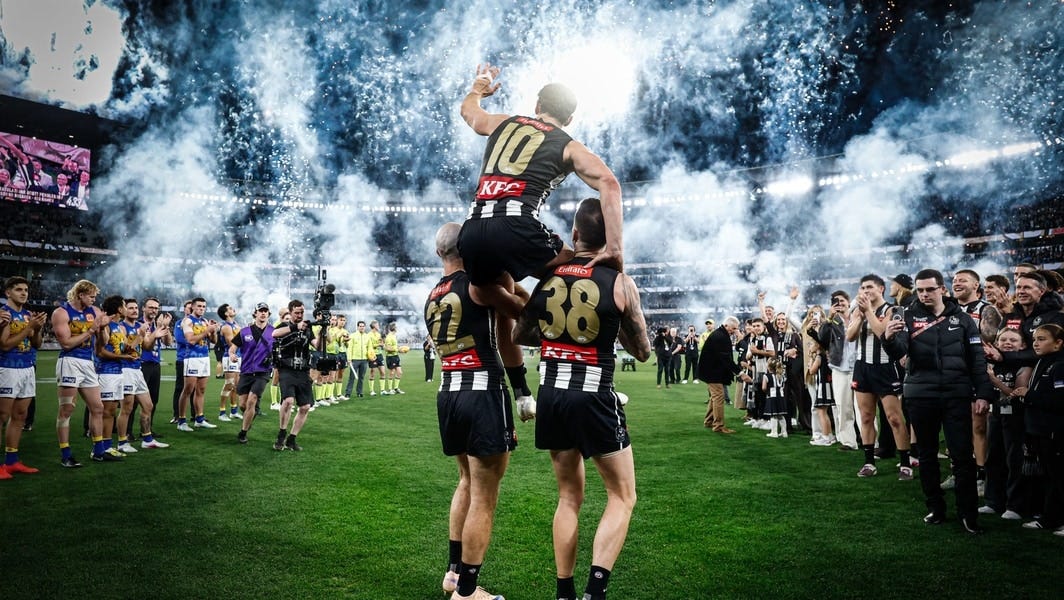
Leigh Eustace, author of the Get Serious Substack
Collingwood’s contradictory 2025 season blurred fan expectations entering 2026, and despite sitting 11th at the bye, the reality of where they actually are feels unclear.
Last year, the Pies were two and a half games clear on top before famously stumbling into fourth. Yet they still led the eventual Premiers at half-time of a Preliminary Final. So, what to make of it all?
Many questions remain unanswered halfway through 2026. On one hand, the red flags are well publicised: forward-half issues, questions over talent, and an ageing list. Yet despite all that, other than being torched by Brisbane on Easter Thursday, Collingwood have been competitive throughout. Even against Geelong, only Collingwood’s inaccurate goalkicking prevented them being right in the contest at three-quarter time before the margin blew out late.
In 2023, Collingwood went 8-1 in games decided by less than 10 points. This year, however, they’re 1-1-4. Who knows, with some 2023 pixie dust, this team, for all its flaws and foibles, could easily be sitting on the edge of the top four (and perceived quite differently).
Returning from the bye, the Pies face Richmond and Port Adelaide. Win both and they will be 7-7-1 with eight games to play. With 10th now effectively the new 8th, who knows?
Is there another September chapter to be written? Nick Daicos is probably leading the Brownlow [Mateo: not sure I agree but I’m leaving it in!], Jordan De Goey is having his best home-and-away season in years, and Harry Perryman, Billy Frampton and Lachie Schultz amongst others all enjoying strong seasons too.
Craig McRae’s coaching gives Collingwood a chance every week. Defensively, the system is holding up. Offense though, it persists as the elephant in the room. Some weeks they generate enough entries but are wasteful. Other weeks they struggle to generate entries at all, rendering any discussion about efficiency redundant.
Collingwood have tried multiple forward options (Dan McStay, Jack Buller, Tim Membrey, Charlie West), yet none has yet taken their chance. The pseudo no.1 key forward has instead remained the 177cm Jamie Elliott. After a slow start to the season, Elliott had rediscovered form, kicking 12 in his last six games. His season-ending knee injury, sustained in the last minute of Scott Pendlebury’s milestone 433rd game, was a brutal blow that lowers the ceiling on what the Pies can achieve this season.
If McRae can keep Collingwood competitive while giving extended opportunities to Ed Allan, Angus Anderson, Harvey Harrison, Will Hayes, West and Buller, and hopefully debuts to Liam Puncher, Sam Swadling and Joel Cochran, then a “walk and chew gum” approach may be the most appealing outcome for supporters.
If it leads to a wildcard spot and the Pies play with house money in September, terrific. If not, a clearer picture of life after the veterans and a list positioned for an aggressive offseason with an “impatient” list strategy may be the next best thing. Unrewarding, ultimately, but acceptable.
Leigh’s grade: C
My thoughts
I wrote about Collingwood’s predicament in my post last week. My basic conclusion was that the Pies’ apparent desire to continue supplementing its list with mature-aged talent, trades, and free agents to extend its contention window across Nick Daicos’s prime is probably the correct one. Keeping the floor high isn’t without risk – there is no meaningful zero-risk option available! – but the range of outcomes is narrower than committing to a three-year build through the draft which might theoretically “raise the ceiling” but is just as likely to not yield the high-end talent Collingwood needs.
The reality is, that despite results being poorer than most Pies supporters would have expected, ninth and 10th now being “finals” spots means that the season is still live. Wheelo gives Collingwood a 40% chance of finishing in the top 10. They will start favourites in their next four games. Being without Darcy Moore, Brayden Maynard and Jamie Elliott hurts, but the first two names could yet play a role in the back-end of the season. A factor which works in Collingwood’s favour is that, as Leigh wrote, they’re not far off it. The floor is high and the defensive system is intact. Despite the close game magic having worn off, Collingwood’s craftiness keeps them in games. It’s not hard to see a couple of close losses turn into close wins, a September berth, and an Elimination Final.
Beyond this season, there is also cause for optimism. Should Collingwood’s season peter out, the Pies will finally be able to do something they’ve not done since 2021: have a properly early pick in the draft. The consensus seems to be that the biggest gaps on the list are a running mate for Daicos and a true key forward. Both types are likely to be available around Collingwood’s natural first-round pick. Both types are also likely to be available during Trade Week. Media reports currently suggest Collingwood is leading the pack for Lachie Neale. They are keen on Jed Walter. I have little doubt the club hierarchy has inquired about the availability and willingness of the likes of Ben King, Zak Butters, Max Gruzewski, Charlie Ballard, Darcy Wilson, Bailey Humphrey, and Zac Bailey. The Pies won’t get all of them. Just getting two of them could vault a healthy Collingwood back into contention, or something close to it, in 2027.
That’s the optimistic case. The pessimistic story is the one told by reality: Collingwood are losing ground to the best teams in the comp, and a list management strategy that revolves around topping up with low-ceiling types and competing in a sellers’ trade market will only see that gap widen. It’s not just the distance between them and the best (although they could well have beaten Fremantle in Gather Round), it’s the number of sides that appear clearly better than McRae’s side. Getting important players back from injury and acquiring some key trade targets will undoubtedly make Collingwood better. But it’s now been a year since the Pies looked close to being the best side in footy. And a year means a lot for the oldest team in footy.
I wonder: in a world where tanking didn’t elicit penalties and senior club officials spoke candidly about their intentions, what would Collingwood do for the rest of this season? Would the club acknowledge that a flag is a remote possibility and instead make choices geared toward the long-term, including maximising the value of its hand in the last uncompromised draft before Tasmania enters the league? The club’s recent list management decisions suggest not. But I’d argue 2026 is a different type of opportunity. Success looks further away and the cliff looks closer. Wouldn’t getting a top-eight pick, securing some coveted trade and free agency targets, and reloading for another tilt next season be better? I suspect we’ll never know. Instead, the Pies will probably do what they’ve been doing all year: stick close to good teams, trust their system, and run everything through their talisman #35.
My grade: C-
Fremantle
Win-loss: 12-1
Ladder position: 1st
Next four games: Geelong (H), Gold Coast (H), GWS (A), Sydney (H)
Mim Birch, author of Mim’s Substack
There has been no overhaul by the Fremantle Dockers. This is basically the same team playing basically the same defence-first game plan. Improvement has largely been demographic: young, inexperienced players are one year older, and one year wiser. They win more physical contests, and have less stupid turnovers.
The throughline of Freo’s 2026 is that this side simply does not let its opponents kick a winning score. Coach Justin Longmuir has made it his mission to prevent the stand rule’s intended outcome, a free-flowing game. Freo have conceded the lowest points against by adding the following layers to its already solid defensive game:
Freo’s previously zoned defence has become tighter. The Dockers do not want the opposition to have an easy option, even laterally. This is a much needed fix to kick-mark vulnerabilities in 2025.
Players have been instructed to sprint over to man the mark, ensuring they’re inside the zone when ‘stand’ is called, preventing opposition play on.
Freo is relentless in preventing a run-past handball receive. (The Dockers boast the lowest opposition average for handball receives – by a significant margin.) Any dashing half-backs or zippy outside mids are forced to confront a direct opponent running with, bumping, and scragging them.
This is a lot of hard running baked into the gameplan before any Freo player even touches the ball. Effectiveness hinges on not only this aerobic effort, but also unerring attention to direct opponents, communication for hand-overs. (These high demands help explain some in-game lapses.)
While in possession, Freo denies turnovers in dangerous positions. If the Dockers succeed in generating overlap or a man out, they back the skills and speed of Murphy Reid, Shai Bolton, Michael Frederick, etc. Without a clean option, defenders switch, sometimes multiple times. Nothing forthcoming, Freo take the neutral long-down-the-line to their reliable talls (usually resulting in a stoppage) over a 60-40 kick that could result in a fatal corridor turnover.
This side enjoys a stoppage. The midfield bats deep (attested to by the recent win over Brisbane without Caleb Serong or Hayden Young). Longmuir’s side is second in scores from stoppage differential in 2026 – a significant improvement from 9th in 2025. So far in 2026, the Jackson/Some Big Goober Playing 55% time on ground combo is second for Hitout to Advantage differential, behind only Hawthorn.
Freo’s tall forward line is a proof of concept for the much-maligned concept of organic improvement. Treacy, Amiss, Voss are a year closer to the age that AFL key forwards ought to be. More contested marks stick, more physical contests go Freo’s way. Patrick Voss is first in the AFL for inside-50 tackles among players who’ve played more than five games. He’s more than just a meme.
After an uninterrupted pre-season learning inside midfield running patterns, Shai Bolton has been revelatory. His chaotic brilliance is no longer fighting against structure, but utilising space created by teammates. There’s also been big improvement in Fremantle’s bottom six players. Karl Worner is getting the ball five times more per game this season compared to last. Matthew Johnson and Neil Erasmus are now mature bodies with cool heads. Isaiah Dudley’s improved fitness has transformed him into a genuine pressure forward.
My primary concern for Freo is the close wins against quality opposition. A gameplan predicated on reducing in-game variance can, paradoxically, increase it. Smaller margins increase exposure to luck: umpire decisions, skill errors, moments of individual brilliance from the opposition, in-game injuries.
The bad scenario is that Freo’s perilous habit of letting good opponents back in proves costly. The side picks up injuries to players that they cannot afford to lose, misses the top two, then youth and finals inexperience hobbles them away. The good scenario? Well… I’m daring to dream.
Mim’s grade: A
My thoughts
The only reason I’ve not awarded Freo an A+ for its first half of the season is because of that fade-out loss to Geelong in Round 1. There’s a world very similar to this one where the Dockers are 13-0. How have they done it? Simply put: Justin Longmuir, the architect of the process, has trusted the process. He and list manager David Wells have built the foundations. It took years. It stirred discontent among fans who wanted the Dockers to rise up the ladder sooner, or Longmuir to be more charismatic in front of the media. But they persisted. And now, helped by the subtle tweaks Mim outlined in her superb review, they’re building the cathedral.
Longmuir’s most distinctive trait as head coach is his stubbornness. That can often manifest in ways which tick supporters off: conservative selection, deadpan press conferences, and a refusal to adopt a semi-mythical “Plan B”. But the reality is that most coaches believe the best way to win is to optimise Plan A, not invest time in Plan B and end up with half-baked versions of both. That’s what Longmuir has done. As most of the rest of the league has rushed to embrace the forward handball, his Dockers have remained circumspect; they are gaining precisely 53 more metres via handball this season compared to last. This Fremantle side prefers gaining territory by foot. The main change in possession (Mim has described the main out-of-possession changes) has been that the Dockers are taking riskier kicks. They were midtable for expected threat per kick last season – a product of playing on too rarely and being forced to kick down the line. Many coaches in today’s AFL talk about earning permission to take risks. Fremantle in 2026 is a great example of that philosophy: it’s because of the trust the coaches and players have in the side’s defensive robustness, and the confidence they have in their ability to win post-clearance contests, that enables them to bite off kicks they weren’t attempting in past seasons. That risk is the product of trust and continuity. Learn your footy. Learn your role. Learn your responsibilities. Earn the right. It’s not flashy. But it’s working.
The Dockers are genuine contenders. They concede the fewest points (more than 10 fewer than the second-best side) and the fewest shots. And although I’d have them as a good rather than great attacking side (they’re fifth for expected score), they’re ranked first for chain to score leaguewide. So what, besides the anxious palpitations of a success-starved fan base, can bring them undone? The first reason is banal. Although they’re very good, I’m not yet convinced they’re clearly better than the other three occupants of the top four ladder positions. The second is structural: the sort of variance-reducing conservatism that Longmuir practices can become a liability in key moments. The Dockers are fourth in scores from turnover in 2026. But the three sides above them are the sides they’re most likely to be competing with for the flag in late September. They’re also only 13th for D50 to F50 transition success rate (while still being second for back-half scores). Adelaide had a very similar profile last season – a low success rate and a high scoring rate that was the result of kicking to contests rather than manufacturing elaborate uncontested chains. That’s fine when you’re winning contests. But winning contests in September, when all your best guys are sore (Freo have used just 30 players this season, the fewest of any side), can be fickle. The Crows came undone. The Dockers bat deeper, especially in the midfield. It’s unlikely one of their best players will get himself suspended in such an ignominious way. If there’s a flaw, that’s where it is. But it’s hidden behind what looks like an increasingly impermeable suit of armour.
My grade: A
Enjoying this mid-season report card? Share it with a friend?
Hawthorn
Win-loss: 8-4-1
Ladder position: 3rd
Next four games: Gold Coast (A), GWS (H), Melbourne (H), Carlton (A)
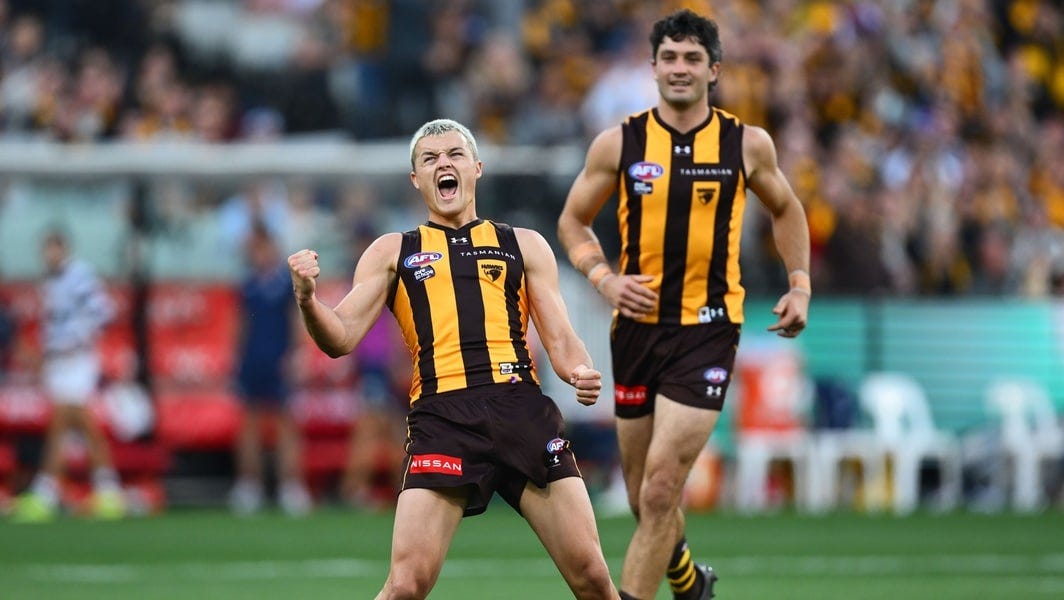
Nat Martin, contributor to the Hawks Insiders Substack
If you’d told me before the season started that, at the bye, Hawthorn would sit third with a record of 8-4-1, I would’ve been quite content. The Hawks have played 10 of the current top 12, and haven’t played West Coast, Richmond, North Melbourne or Carlton yet. On paper, this seems like a good launching pad from which to attack the rest of the season. However, there is a tinge of frustration.
Since this unusually constructed side began its rise in 2024, I have been looking for a sign from this group to truly believe we were good enough to win the flag. The 2024 season was so joyful and felt like simply we were playing with house money – whatever we achieved was a bonus. Despite making a preliminary final last year, I still felt as though we were a rung below the very best.
The thing that has frustrated me about Hawthorn this year is that there have been times this year, both visually and in the data, where I have actually believed our best is good enough. The last quarter dismantling of Gold Coast in Tassie to go 6-1, finally being on the right side of Easter Monday, leading the red-hot Freo at Optus by 3 goals with 7 mins left, and putting 29 scoring shots on the Swans – admittedly a Swans side missing Heeney and Gulden – all suggests Hawthorn, at its best, has what it takes to compete in 2026.
That’s what makes the draw with Collingwood, getting run over by the Dockers and the unfathomable loss to the Bulldogs (where we kicked 9.17) all the more irritating. The Bulldogs loss was especially jarring – leading a side we’ve had the better of in recent meetings by 27 points at half-time. A win would have given Hawthorn a game-and-a-half advantage over third. The club’s GM of Football, Rob McCartney, said at our Hawks Insiders pre-season live event words to the effect of “there will be times this year where you think we can win the flag, and times where you think we are still a way off”. He wasn’t wrong.
What has made me believe more this year is a clear change in our ball movement, and our stoppage clearance game. Hawthorn’s default mode in 2024 and 2025 was to make the ground as big as possible by using long, diagonal kicks out of D50 and using our half-forwards to overload key areas. Opposition teams cottoned onto this, and understood that defending our outside shoulder as a starting position and forcing us back into the corridor took us out of our comfort zone. As a result, the Hawks were only the 11th best offensive side in 2025 – not the profile of a Premiership-winning side.
In 2026, Sam Mitchell has been much more willing to use the corridor and move the ball faster by either forward-handballing or kicking shorter to keep the ball in constant motion. As a result, Hawthorn is first in the competition for defensive half to inside 50 transition success rate and second for points from turnover. We are more dangerous. Our stoppage game has also improved – currently second in the competition for stoppage clearances, after being 10th in 2025, allowing us the chance to control more territory.
This has seen Jack Gunston once again defy father time to kick 35 goals from nine games, using the ‘disconnected forward’ role to full advantage. Nick Watson is the 10th rated player in the entire comp; frankly ridiculous for a 21-year-old small forward. Jarman Impey would be top 3 in our B&F, getting the balance between brave, bold defending and attacking drive right, and Jai Newcombe has once again been a colossus.
This all sounds good. However, the same frailties that have plagued us for a few years still remain. Despite being second in the comp for stoppage clearance wins, Hawthorn is a lowly 13th for points from stoppage. Our centre bounce game (vital in 2026 football) has been poor, ranking 15th for points from this source, 16th for opposition points against and 11th for centre clearance differential. It doesn’t need to be the best in the comp for us to give the flag a shake, but it needs to improve.
In addition, our reliance on Gunston has been a worrying trend, with teams (Collingwood, Melbourne and the Bulldogs) successfully being able to get numbers behind the ball to clog up leading lanes and space to force us into poor entries. Losing Tom Barrass for the last four games made us uncomfortably vulnerable in the air. This is less than ideal given one of those players is 34 and the other is nearly 31. The form of Dylan Moore has been a concern. He hasn’t been able to get near his 2024 All-Australian level. Lloyd Meek has suffered significantly with the advent of the new ruck rules and Karl Amon has been slightly down on a top-three B&F placing in 2025.
Can we win it? Yes, but a lot has to go right. I believe we will still finish in the top four. Our best is good enough. But the question is can we produce it for long enough when it’s needed? I need some more convincing.
Nat’s grade: B
My thoughts
One of the throughlines of my Hawthorn season preview was a recognition of the quality of the system that Sam Mitchell has built alongside a nagging doubt that there was quite enough star quality to break through against the very best. The Hawks’ rise up the ladder was swift; they only had four top 10 draft picks between 2020 and 2023, and one of them – Denver Grainger-Barras washed out of the AFL system in four years. Although they drafted very well outside of the first round and did a superb job acquiring best-23 talent for bargain prices (Impey, Amon, Ginnivan, D’Ambrosio), I wasn’t totally convinced that the growth curve of the club’s most promising younger players lined up well enough with the timeline of important older players like James Sicily, Jack Gunston, and Tom Barrass. It’s safe to say that Nick Watson’s ludicrous breakout season has allayed many of those concerns. Contrary to the claims made by people who cited his inaccurate early goalkicking as proof that he had a tough start to AFL life, Watson has been good from day one. But he’s made a gigantic leap this season. He’s probably Hawthorn’s best player and almost certainly a top-20 player in the league. The choice now looks like being the game’s best small forward – and perhaps the best ever – for the next 10 years, or be an elite midfielder, or some optimal combination of the two. He is cocky, and annoying, and outrageously brilliant.
Hawthorn has a strong claim to be the best “post-clearance” side in the league. As Nat explained, Mitchell has sharpened his side’s ball movement scheme while remaining defensively solid (the Hawks are fourth for chain to score and second for opposition chain to score – a winning combination). The vulnerabilities arise in three distinct phases of the game. The first is stoppages; specifically, Hawthorn’s inability to punish and contain. The Hawks are 14th for scores from stoppage differential, and 17th across the last five games. Perhaps more concerningly – although it is still very early in his latest return from injury – two of those five games have featured Will Day.
Hawthorn’s second potential weakness is the one Nat identified: despite Watson’s brilliance, the Hawks can be easy to blunt without Jack Gunston in the side. Gunston’s gravity stretches opposition defences vertically and distorts their spacing inside D50. if he doesn’t get you (and this season, he almost always has), then the space his presence creates will generate opportunities for other forwards. It looks a lot less dangerous when he’s not there or if Hawthorn’s opposition can disrupt their forward entries. Hawthorn are second in the AFL for marks on the lead (a proxy for clean entries) but only just above league-average for marks inside 50. Finals footy is much more contested, and clean leading lanes much scarcer, than in the Home & Away season. Do the Hawks know how to win dirty?
The third vulnerability is at ground level inside Hawthorn’s defensive 50. Tom Barrass is an excellent defender and a true double threat – he can intercept or lock down. He also looks like an old man when attempting to bend down to gather a ground ball. One of Sam Mitchell’s tactical innovations since being appointed coach is his preference for hybrid-sized defenders who can impact aerially or on the ground (think Weddle, Battle, Scrimshaw, Hardwick, even Impey). That sounds great – and it has largely worked – but it can create an uneasy balance between being slightly too small to intercept mark and slightly too large to compete effectively at ground level. When Barrass is there, it usually looks fine. His weakness is offset in the aggregate and his strengths can shine. When he isn’t, as he hasn’t been for the last four and a half games, it can look fragile.
None of these are necessarily fatal weaknesses. Hawthorn has the system and I’m more confident they have the elite talent than before the season began. But I think I ultimately share Nat’s concerns: there are questions that don’t have answers just yet. The good news is that, once Barrass and Gunston come back into the fold, the Hawks will be healthy. A dividend of a very tough fixture to start the season means they have a soft run from here until September. They should do something they’ve not yet done under Mitchell: finish in the top four. From there, they have a chance. And, in The Wizard, they have a player who can make all those question marks disappear.
My grade: B+
I’ll be back later this week, or early next, with thoughts on how Brisbane, Sydney, Essendon, and West Coast
are going so far.