


This “Dingley”… it’s a real place, you say?
2025 ladder position: 7th (15 wins, 8 losses – eliminated at Preliminary Final stage)
2025 best-and-fairest: Jack Gunston
Senior coach: Sam Mitchell
Story of the season
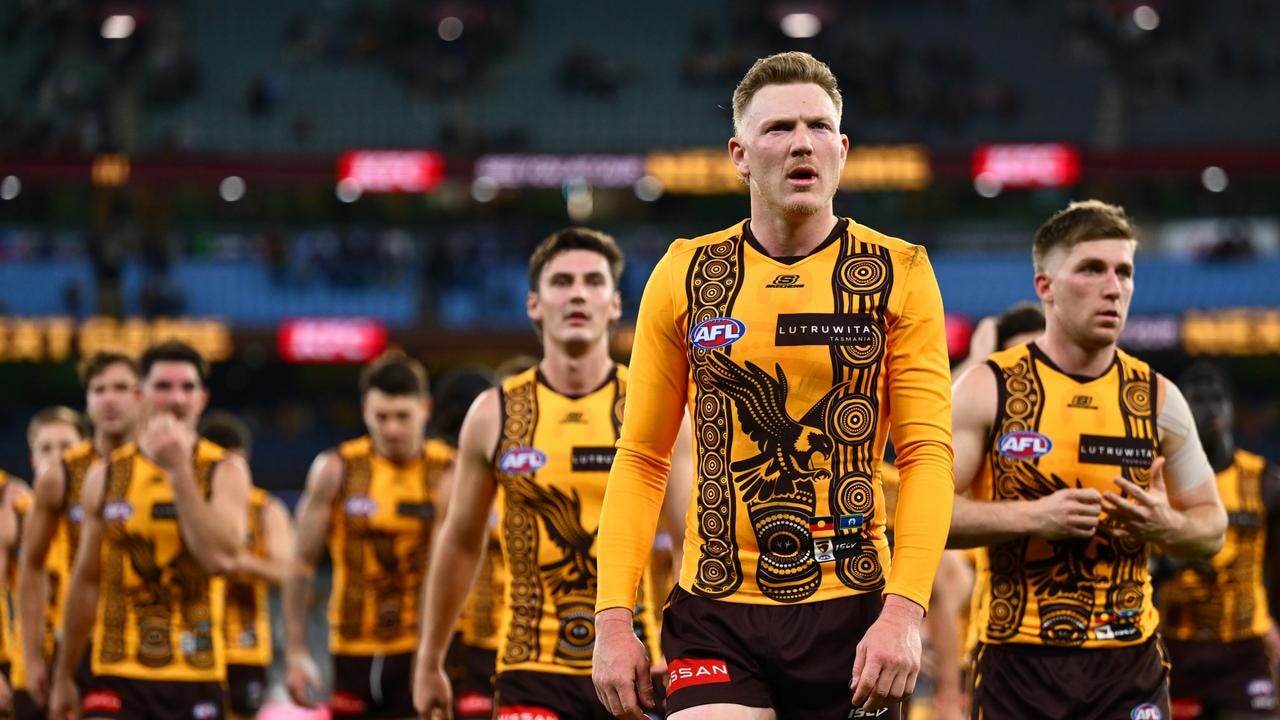
Fresh from a stellar 2024 that saw them fall agonisingly short of a prelim, Sam Mitchell’s men won their first four games of 2025 before a disappointing loss to their new nemesis, Port Adelaide, in a rematch AFL House had been salivating over for six months. Easy wins against three of the eventual bottom five set up the Hawks well for a season-defining five-game stretch against Gold Coast, Brisbane, Collingwood, the Western Bulldogs, and Adelaide. That sequence both showed that the Hawks had consolidated their progress from 2024 and that there was a small but discernible gap to the competition’s very best sides. They ran the Suns closer than anyone else had in Darwin, beat the Crows in an arm-wrestle in Launceston, and out-thought the Dogs. But the Lions and a red-hot Pies side had their measure. Undeterred, the Hawks kept on banking wins, including a stunning 64-point demolition job of the Pies in the return fixture in Round 22, to finish 15-8 – only enough for seventh spot on an extremely crowded ladder.
Hawthorn’s reward was a trip to face the Giants in Sydney in an elimination final. Despite almost allowing the Giants back into the game, Mitchell’s men led virtually all day and were good value for their 19-point win. The Hawks then easily dispatched an unnerved and outclassed Adelaide side that, still demoralised from the self-inflicted loss of Izak Rankine, had no answer to Hawthorn’s midfield dominance. That win meant the Hawks returned to the stage they always believed they belonged: a prelim, at the MCG, against old foes Geelong. For a quarter, it was going very well. At half-time, the margin was still only a point. But then, Patrick Dangerfield did what only players of his calibre can do: he took the game away. A bravura 31-disposal, 20-contested possession, three-goal game was too much for the spirited Hawks. Progress? Yes, definitely – especially considering how much of it was made without Will Day. But also, not a definitive rejection of the idea that they’re not quite at the level of the very best sides. That was effectively confirmed by the club’s pursuit of Essendon captain Zach Merrett during the Trade Period. The player wanted the move, but the Bombers couldn’t sanction the idea of their captain donning brown and gold. On and off the field, the Hawks kept stirring the pot in 2025.
Summary of game style
Sam Mitchell and his AI model of choice have built one of the AFL’s most coherent and adaptable game models, grounded in a resilient defensive structure, pressure, and spatial control. With the ball, the Hawks play with urgency but without recklessness. They move the ball quickly without giving up width or optionality, often advancing through the half-spaces to create angles that allow them to threaten on both the inside and outside. Handball is used to generate separation and draw in defenders before releasing in-bound kicks that stretch defensive structures. The result is a quick but methodical possession game that values choice over control.
This emphasis on optionality – making sure there’s always a viable outlet – helps explain the risks Hawthorn do take with the ball. The Hawks lead the AFL in kick threat rating differential. In plain English: their structure enables them to attempt damaging kicks and prevents their opposition from doing the same. Risk is tolerable because it is protected by post-clearance strength and defensive integrity.
Crucially, Mitchell’s game plan doesn’t need first possession to function. The Hawks were 16th for clearance differential in 2025 (although they scored heavily when winning them). Instead, turnovers are their gold standard – only Adelaide forced more in 2025. Players like Conor Nash and Jai Newcombe allow for rapid counterpressing in the first layer, supported by a disciplined second layer – often anchored by Tom Barrass – that chokes opposition ball movement, forcing slow exits, over-possession and (eventually) errors. This dual structure, made possible by a handful of versatile hybrids equally comfortable in the air and on the ground (Josh Battle, Josh Weddle, James Sicily, Blake Hardwick, Jack Scrimshaw) has helped Hawthorn to become one of the best defensive teams in the game.
The decisive moment of turnover is the catalyst for rapid offensive spread. Powerful runners like Newcombe and Weddle break lines, while clever half-forwards like Dylan Moore and Connor Macdonald hold width and stay high to ensure availability of good options. Inside 50, the Hawks balance structure with adaptability. While they briefly experimented with four tall targets throughout 2025, the preferred configuration remains a three-tall system (made viable by Jack Gunston’s resurgence to All-Australian form) supported by dynamic smalls. Nick Watson, Dylan Moore, and Jack Ginnivan function as pressure engines, connectors, and opportunistic finishers, enabling the Hawks to capitalise on the good work done upfield to drag opposition defenders out of position.
After four years of building under Mitchell, Hawthorn’s identity is now clear. This is a high-tempo, width-aware, pressure-supported game built on territorial control and calculated risk. The Hawks want the ball in the front half, with opponents stretched laterally and defensive systems constantly recalibrating. When it clicks, the model generates intelligent attacks that are difficult to repel.
List changes
In:
Cameron Nairn (2025 National Draft, Pick #20)
Aidan Schubert (2025 National Draft, Pick #23)
Jack Dalton (2025 National Draft, Pick #34)
Matthew LeRay (2025 National Draft, Pick #56)
Ollie Greeves (2025 Rookie Draft)
Out:
Sam Frost (delisted)
Seamus Mitchell (delisted)
Jasper Scaife (delisted)
Luke Breust (retired)
Changkuoth Jiath (trade –Melbourne)
Jai Serong (trade – Sydney)
James Worpel (free agent – Geelong)
List profile
Number of top-10 draft picks: four (T-13th)
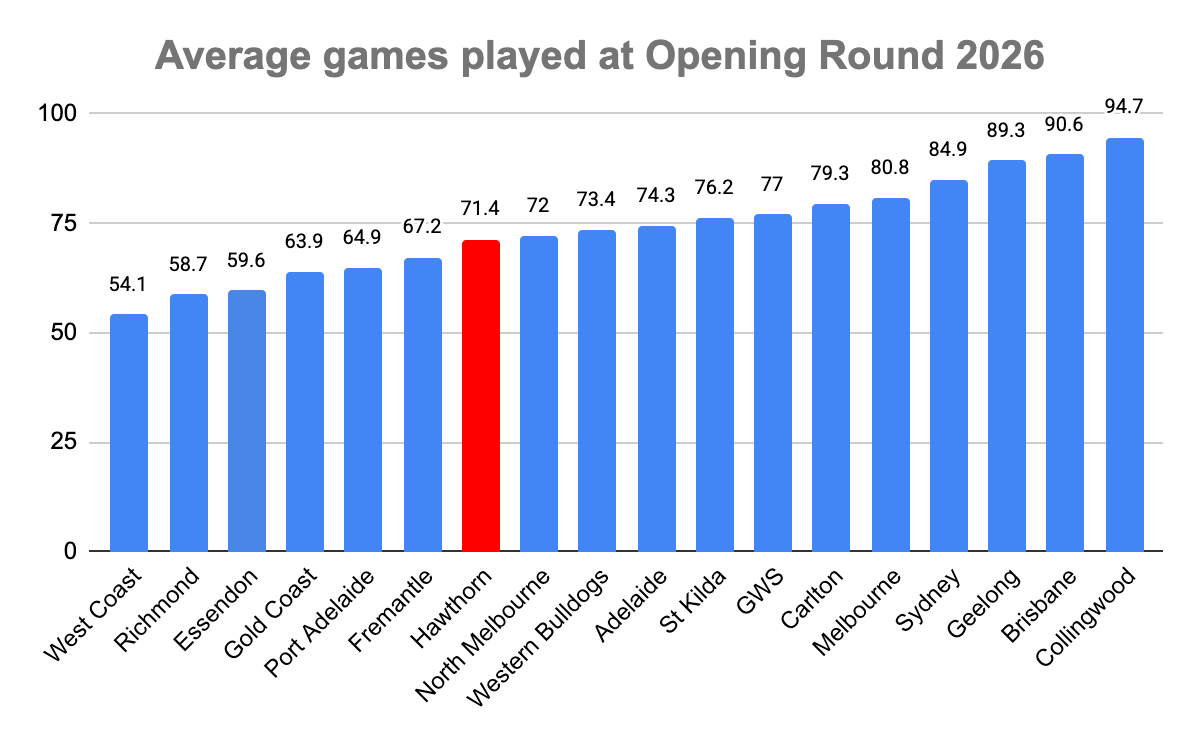
Average age at Opening Round: 24.4 (13th)
Average number of games played: 71.4 (12th)
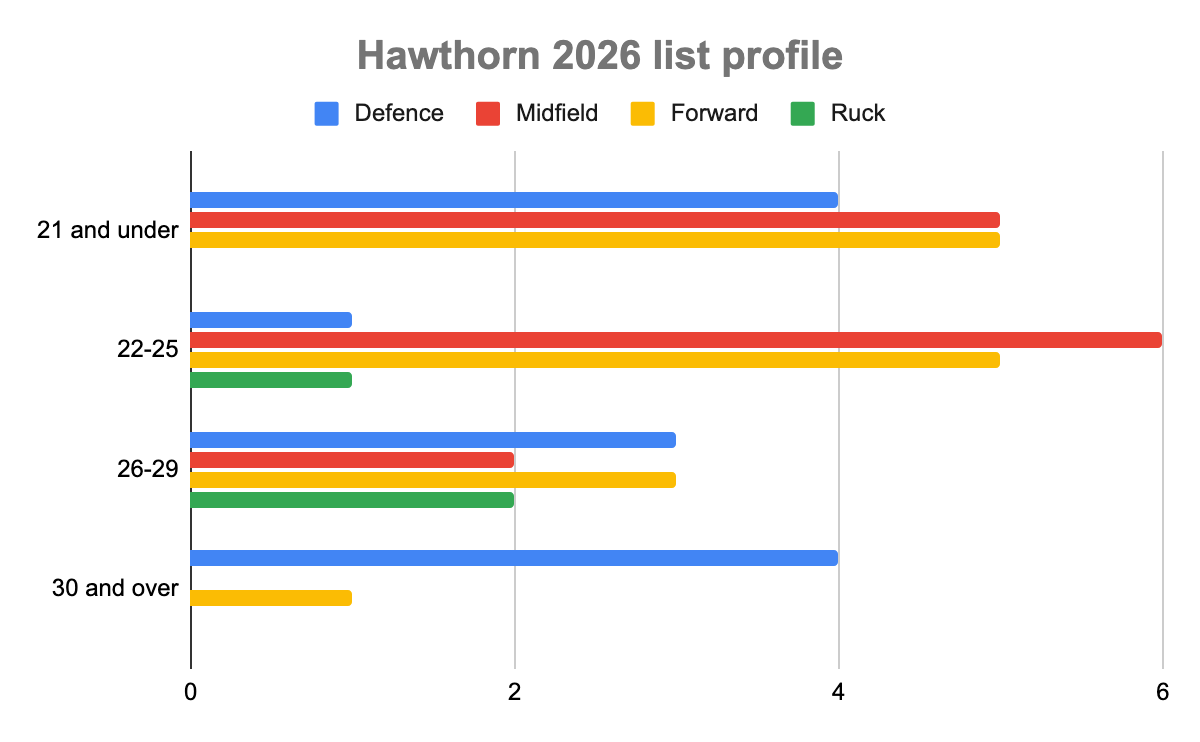
Here’s a proposition many readers will instinctively recoil from: you have to hand it to Hawthorn. Sam Mitchell and National List and Recruiting Manager Mark McKenzie have constructed a flexible, competitive list at modest cost in an era when most of the best sides are studded with father-son and academy picks. It’s true that key pieces like James Sicily, Will Day, Jai Newcombe and Dylan Moore were already on the list when Mitchell took over (caveat: Mitchell was coaching Box Hill when Newcombe emerged), but important contributors like Jack Ginnivan, Karl Amon, Lloyd Meek, Mabior Chol and Jack Scrimshaw were acquired cheaply.
Recent drafting has been strong. Weddle looks on a superstar trajectory, Watson isn’t far behind, and Ward and Cam Mackenzie could yet get there. Regularly hitting on later picks like Mitch Lewis and Calsher Dear doesn’t hurt either – and let’s not forget that 55 players were taken before Sicily in 2013.
The Hawks rejected the consensus that 2025 was a weak draft, taking five players while also executing live trades that netted two 2026 second-rounders – assets that could again be deployed in pursuit of Zach Merrett. Three of the draftees were teammates at Central Districts and part of South Australia’s Under-18 Championship side. Cameron Nairn projects as a clever medium forward/wing, Aidan Schubert as a rangy key tall, and Matt LeRay as an outside runner. Jack Dalton, the fastest at the combine over two kilometres, adds inside depth, while Ollie Greeves – once touted as a top-10 pick – cost little after sliding.
The new additions won’t strengthen the backline – nor will they need to. Josh Battle and especially Tom Barrass give Hawthorn a reliable defensive fallback if the turnover machine misfires. What stands out in this part of the list is versatility. Blake Hardwick can be thrown forward. James Sicily can do a job there too. Jack Scrimshaw plays tall or small. Weddle begins in defence but impacts all three lines and will see more midfield time in 2026. Jarman Impey and Karl Amon drive rebound with hard running and precise kicking. Noah Mraz, impressive at VFL level, has earned a two-year extension through 2028.
The midfield is better than most people think – raw clearance numbers are a bad proxy for midfield quality! – but a shade below the best. Will Day and Jai Newcombe are the stars. Day is the lithe thoroughbred whose long stride lets him escape traffic and do damage by foot, while Newcombe prefers to use his power and balance to burst through stoppages. Irishman Conor Nash is there to destroy and set screens for his more talented teammates. Given Day’s persistent and concerning injury concerns – more on that in the pessimism section – Hawthorn probably need one of Josh Ward or Cam Mackenzie to become a star to truly contend with its current list. Of the two, Ward is closer. His running ability and disposal make him an important element of Hawthorn’s transition game. The next stage of his development is adding damage: three goals from 25 games was a poor return for a player of his talent (Day, admittedly in a more attacking role, kicked six in six). The departure of James Worpel and versatility of Hawthorn’s list means that, especially as Day recovers from shoulder surgery in the first half of the season, you’d expect several different players to roll through there. Mitchell has teased the prospect of real midfield minutes for Nick Watson, Josh Weddle, and Connor Macdonald. Those are three very different players, so it’ll be interesting to see how the pieces fit. The other noteworthy potential personnel change to report is that the new ruck rules (which discourage wrestling) appear to have put Ned Reeves back in the frame for senior selection. The 210 centimetre (!) behemoth doesn’t provide the same quality of contest work around the ground as Lloyd Meek, but if taps to genuine advantage become a viable tactic again, Hawthorn could decide the benefits outweigh the risks. There’s even talk that Mitchell will do something that’s become rare in the modern game: playing them both.
The Hawks are at the leading edge of the league-wide tactical shift to small forwards. Some people laughed when they took Nick Watson with Pick 5 in the 2023 draft. They’re not laughing anymore. His partners in crime inside 50 are Dylan Moore (perhaps more of a small medium forward than a “true” small) and Jack Ginnivan, whose top five finish in Hawthorn’s Best & Fairest in his second season vindicated the decision to trade him in from Collingwood. If Ginnivan and Watson are the young punks, then Jack Gunston is the old(er) man with a second lease on life. It’s hard to think of a late-career renaissance quite like his. He looked done at Brisbane. Two years later, he’s an All-Australian and Hawthorn’s Best & Fairest. Is it a risk to have so much scoring output resting on the shoulders of a 34 year-old? Perhaps. But it’s also an amazing story. Mabior Chol, Mitch Lewis, and Calsher Dear are the first-choice key forwards. All are useful – and Dear is very promising – but there is a gap to the best key forward cohorts in the league. Injury limited Dear to only nine games and Lewis to eight (sadly, injury and Lewis aren’t strangers) in 2025. Because of their dangerous smalls, Hawthorn rely more on bringing the ball to ground inside 50 more than most sides – so the health of Lewis and particularly Dear looms large in assessing how far they can go in 2026.
Line rankings
Defence: Elite
Midfield: Above Average
Forwards: Above Average
Ruck: Above Average
The case for optimism
Hawthorn has successfully navigated the first and most treacherous step of a rebuild: it has progressed from the bottom rung of the ladder to near the top. Not the summit (yet), but close. The Hawks have a talented young list, a game model that ensures a high floor, and the status and recent success to ensure they’ll remain an attractive destination for, say, out-of-contract superstar Port Adelaide midfielders or disgruntled Essendon captains. Concerns about not having drafted enough elite talent can be easily allayed by recruiting it instead (that, after all, is the model pursued by Hawthorn’s great rival, Geelong). Their road to success from their current point is short. All of which is to say, Hawthorn are in a position that most other clubs would envy.
There’s also a viable path to further improvement. The first is internal. Of the 10 non-ruck (sorry, Lloyd) Hawthorn players with the highest player rating over their last 20 games, six – Newcombe, Day, Ward, Ginnivan, Weddle, and Watson – are all still in the first half of their careers. Even if you think Newcombe is near his ceiling, and worry that injury will prevent Day from fulfilling his potential, the latter four names are still in the phase of their development where you’d expect real improvement. Other young players like Calsher Dear, Cam Mackenzie, and Massimo D’Ambrosio still have room to grow, too. If the older part of the core maintains their output for another couple of seasons, then the Hawks will get better. That won’t be lost on players who are contemplating their future at other clubs. The fact that Hawthorn couldn’t bring Essendon to the negotiating table for Merrett shouldn’t blind us to the fact that they recruited Tom Barrass and Josh Battle just a year earlier. Players, especially if they’re the age where the success of the Clarkson Era left an impression on them, want to join the Hawks. That’s a bullish sign for sustained competitiveness.
The case for pessimism
The Hawks are good. But they need Will Day to make them great. And, although we know he’s a star, unfortunately, we don’t know whether his body can withstand the rigours of AFL footy. Two separate foot injuries limited him to just six AFL games in 2025. That was after a stress fracture in his navicular bone delayed his start to 2024 and a collarbone injury ended it early. Which made it especially cruel that, just a week after his return to full training, a dislocated shoulder is likely to rule him out until around Hawthorn’s mid-season bye. It’s a devastating blow for Day and a disappointment for fans who enjoy seeing the competition’s best players. It also materially lowers Hawthorn’s ceiling. The Hawks are trying to thread the eye of the needle: to win a flag before Gunston, Sicily, and Barrass age out. No Will Day makes that task immensely more difficult. I hope all these injuries are just repeated coincidences. But it’s getting harder to make that case. And, past a certain point, it doesn’t matter much. Day was drafted in 2019. Six and a half years later, he’s played just 76 AFL games.
His extended absence speaks to a broader point: the Hawks have lots of good to very good players. It’s a testament to the quality and resourcefulness of their list build. But they don’t have as many A-graders as other Premiership contenders. Day is one – but he lacks the most important ability of all: availability. Newcombe, Sicily, Barrass and Gunston are excellent AFL players. And, as I’ve written above, Hawks fans should feel confident that Weddle and Watson are on the path to the elite. But – and I appreciate how crude a measure this is – if you were to draw up a fair list of top 50 AFL players, how many would be Hawthorn players? And how many would be Brisbane, Sydney, Gold Coast, and Western Bulldogs players? This isn’t disqualifying. The Dogs are a good reminder that an abundance of elite talent isn’t a silver bullet, especially if it isn’t complemented by a good supporting cast and an effective defensive system. Hawthorn has the role players and the system. But elite talent is still the fundamental constraint in the AFL.
I suspect the club believes something similar – hence its hard pursuit of Zach Merrett in last year’s Trade Period. The Hawks will try again this year, and might get their man. But even if they do, they will probably be walking a tightrope. Merrett will be 31 at the start of next season. So will Tom Barrass. James Sicily will be 32. Jack Gunston will be 35. Hawthorn can win a flag in the next three years. But more things would need to go right for that to happen than for most other contenders. In a way, it’s a testament to the quality of this rebuild – and Sam Mitchell’s coaching – that the difficulty of winning a Premiership is being cited as a cause for pessimism. Plenty of rebuilds don’t get this far. But getting good before you’ve drafted all your key pillars can prevent a team from ever becoming great.
Enjoying this preview and think a Hawks-supporting friend might too? Share it with them!
Breakout player
Weddle and Watson are overqualified. Josh Ward probably is too, although his style and demeanour doesn’t demand attention in quite the same way. As I wrote above, if Hawthorn are to obtain the internal improvement required to become first-rung flag contenders, they probably need at least one of Ward or Cam Mackenzie to blossom. Mackenzie has shown flashes of sublime talent and decision-making. If he can go from neat to damaging, the Hawks might have the next midfield star they crave.
Most important player
Because of his impact when he’s playing and when he isn’t – Will Day. The Hawks did an admirable job of covering for his absences in 2025. But the South Australian can do things no one else on their list can. When he plays, he drives that 1-2 percent of improvement that is often enough to decide prelim finals. When he isn’t, Hawthorn look organised, capable – and ever so slightly talent-deficient compared to their fellow contenders.
Biggest question to answer
If the Hawks can’t rely on Will Day in 2026, where is the improvement – either in personnel or system – that pushes them into real contention coming from? Right now, they’re tantalisingly close. They’re well-coached, resilient, and flexible. But the margins at the top are so fine that you could plausibly point to four or five teams better than them. Winning four finals (likely, given the amount of time Day will miss) is not an easy way to win a Premiership.
What success looks like
Hawthorn have won finals in each of the last two seasons despite not finishing in the top four. Logically, this suggests that success looks like taking the next step during the Home & Away season, in order to sustain a real tilt at the flag. But the loss of Day for the first three months of the year, coupled with the expected improvement of other contenders, makes that feel difficult. Given that, it’s probably fairer to temper expectations: get Day healthy, finish in the top six, win an Elimination Final, see what happens from there – and then push the boat out for the sort of player who helps you go from fifth or sixth-best side to top two.
In a nutshell
The Hawks have built a system that ensures competitiveness and a list that can sustain it. If Will Day gets healthy and one of their young midfielders breaks through, a flag is realistic. If not, they risk remaining a very good team in a competition that rewards great ones.
Excellent article (coming from a Bomber supporter).
I can't wait for the Bomber analysis