


Rather than writing a CTA each week for sponsorship, I’ve created a deck and added it to a new page on my website. Check it out here.
Social preview photo courtesy of the Adelaide website.
At some point during Brisbane’s imperious victory over Adelaide on Sunday afternoon – probably when Will Ashcroft strolled into an open goal to make the margin 41 points midway through the third quarter – I posted a tweet that might have passed for a disinterested observation, but was actually the frustrated lament of a disappointed supporter.
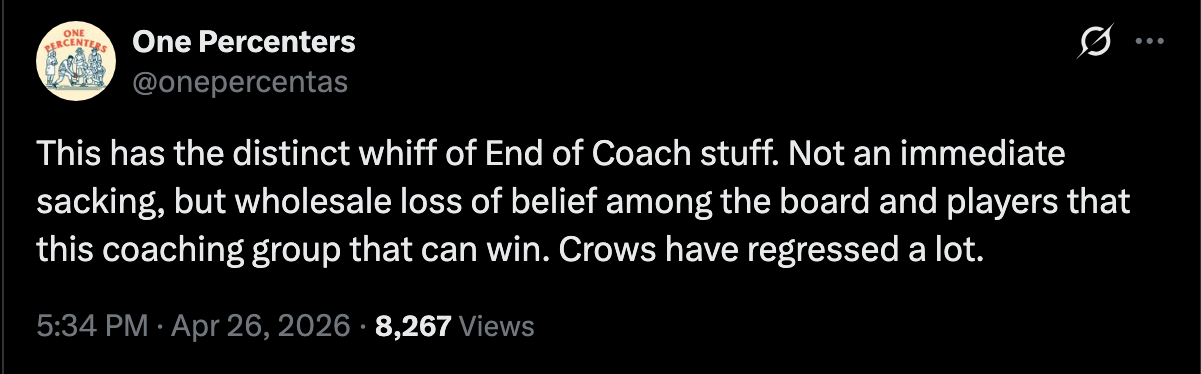
It’s very possible that this is overstating things. Being 3-4 after an opening run of fixtures that included games against Brisbane, Fremantle, the Western Bulldogs (when they still had fit players), and Geelong isn’t terminal. There’s lots of runway left in the season and the Crows have some good players to come back. But the trend is clear: they currently look a very long way from the confident, powerful side that finished a game clear on top of the ladder last season (ignore what happened after that!). They have regressed – possibly past the mean. I think it’s worth understanding why, what it says about how fine the margins are in today’s AFL, and the value of different coaching skillsets at different points in a club’s cycle.
The naive form of Crows pessimism is to point at the win-loss record. It doesn’t make for great reading, particularly when paired with the ignominious finals failures. That naive form of Crows optimism is to point out that all four of this season’s defeats have come against good sides (but then, aren’t the Crows meant to be a good side?). The slightly more sophisticated form of pessimism involves looking under the hood and recognising that the side’s regression is most apparent in the areas that enabled their surprising rise up the ladder last season.
Here is what I wrote about Adelaide’s style of play in my 2026 season preview:
Few sides could match Adelaide’s array of one-on-one weapons. Dan Curtin, Jordan Dawson, Riley Thilthorpe, Josh Worrell, and Izak Rankine gave the Crows elite aerial, ground-level and hybrid contest capability across the ground. Adelaide ranked top-three for offensive one-on-ones because they actively sought them out. Rather than stretching defences laterally, they compressed them vertically and trusted their athletes to win contests in high-value parts of the field. This helps to explain the apparent contradiction at the heart of their numbers. Adelaide were a great contested team without being good at winning clearances. Their dominance came in secondary and tertiary contests, where pressure, physicality, and endurance compounded. The Crows coaches tracked tackles laid and tackles broken during the game because it was a proxy for physical superiority. In my preview ahead of last season, I borrowed the concept “low block” from soccer to explain the Crows’ willingness to adopt conservative defensive positioning to facilitate counterattacks. In 2025, the trendy soccer term that best explained what the Crows were cooking was “duels” (i.e. direct one-on-one contests). The Crows sought them and won them at a league-leading clip.
Last season, the Crows depended on their superior post-clearance contest winning ability, not sophisticated overlap and handball receive patterns, to generate transition. That made them hard to get a handle on but, because contested footy is so sensitive to form and fitness, was always going to be difficult to maintain. Regression was likely – especially for a side that, while not especially young, had little institutional memory of finals success. Over the first seven games of this season, the Crows’ weaknesses have remained. They still bleed clearances and, as a result, concede territory. That’s compounded by their recurrent struggles to move the ball from defensive 50 – a problem itself exacerbated by the absences of Mark Keane and Mitch Hinge. Their kick-heavy ball movement patterns have become predictable and easy to plan for. While the rest of the AFL has zigged towards gaining territory via handball, the Crows have zagged. That isn’t necessarily a problem. There’s merit in tactical contrarianism. What’s more concerning for Matthew Nicks is that his side’s traditional strengths have gone missing. Adelaide’s press has lost its bite. While the Crows remain steadfast inside defensive 50, they have frequently looked too open on defensive transition. Their opponents are gaining too much territory without needing to incur the sorts of risks they were last season.
As I wrote above, it’s possible that the Crows’ fortunes will change enough to make my anxieties seem premature. The additions of Curtin, Keane, and Hinge could add the contested marking and back-half drive they’ve been missing. Variance could swing in their favour. But three pieces of evidence point towards 2026 being a more accurate reflection of the Crows than 2025. The first is that all their best players played the vast majority of games last season. Between them, Jordan Dawson, Riley Thilthorpe, and Izak Rankine played 72 of a possible 75 games. Eight of the Crows’ 10 highest-rated players last season played virtually complete seasons. That was unlikely to repeat. Second is that variance was already in their favour in 2025. Only GWS overperformed their “expected wins” by more than Adelaide did. The Crows won five games where they generated a lower expected score than their opponent. They could have been as healthy to start 2026 and normal variance would have made them a worse side. The third piece of evidence which suggests this season was always going to be trickier is that the AFL’s recent rule changes, designed to accelerate the pace of the game and create more uncontested possessions, work against what the Crows are trying to do. Matthew Nicks wants more of the game to be in dispute. The AFL wants faster, more free-flowing footy. The house tends to win. You might not think that tightening the stand rule and awarding a free kick for last disposal would disrupt a side. But when the margins are fine, marginal changes matter.
The Crows finishing top last season was the product of a set of circumstances that were always unlikely to repeat. I don’t think that means it was a fluke. They were genuinely good! But Sunday’s loss to Brisbane revealed a real gap to the best sides. Perhaps suggesting, as I did in my tweet, that it was the kind of loss which fatally undermines the belief needed to sustain a flag tilt, was overdoing it. Instead, a fairer question is: what is the evidence that Matthew Nicks can become a Premiership coach? Extrapolated more broadly: how do decision-makers at clubs form and act on beliefs about senior coaches? I touched on some of these ideas in a series of tweets from earlier this month, when Michael Voss Discourse was at its peak. Clubs often publicly talk about the importance of giving a coach time. Often that’s because it’s the easiest thing to say in public. Usually it’s because they sincerely believe the incumbent is the right guy or that they don’t think they have enough data to form an opinion yet. What you don’t hear about as much is the opportunity cost of giving that time – a very scarce resource for any club – to the wrong coach.
The evidence is almost never as clear-cut as it is with Voss. Carlton – perhaps partly out of a desire to challenge the perception that they sack coaches too quickly – have given him far more time than his output has merited, especially as Carlton’s list was entering what, demographically, ought to have been its peak years. Nicks is an example of a different, largely under-explored dilemma: how much political capital should a coach receive for steering a club through a rebuild when the evidence they can deliver a Premiership is thin? Regular readers of this newsletter will know that I believe list strength is the principal factor in team success. But I also believe that coaching talent is real. The challenging thing is that ‘coaching talent’ is a slippery thing. Coaches are evaluated for different skills at different points of a club’s cycle. When you’re in the open ocean of a rebuild, the job is broad and remedial: developing a resilient game model, establishing healthy cultural norms, optimising for player development. In other words, it’s about creating the conditions for flourishing. That part of the job accounts for 90% of the progress. The closer you get to success, the more the KPIs change. Coaches of contending sides are judged on their ability to effect in-game changes, to adapt game plans when opposition coaches devise bespoke plans, to identify the individual players who can drive improvement – to traverse the last mile. Coaches of rebuilding sides who fail at the first part don’t get a chance to show if they’re any good at the second bit.
Only Matthew Nicks’ sternest critics would deny that he was good at the first part of the job. He inherited a club in disarray. Less than two months before Nicks was appointed, Mark Ricciuto was forced to apologise after suggesting that fans who didn’t like the decisions the Adelaide Football Club was making should consider taking their support elsewhere. Nicks made the Crows competitive. His navigation of challenging political problems like Taylor Walker’s racist slur wasn’t to everyone’s liking, but it helped keep a brittle club together. The Crows appear united. He added attacking layers when the talent permitted it. It’s the second part of the job – a shorter distance, but a rockier path – where he’s failed to convince. The rigidity of the game plan despite rapid tactical evolution elsewhere. Conservatism in selection. Persistent struggles in close games. Continuity is an asset when you’re rebuilding. It can be a liability when you’re trying to win. The thing that got you here won’t necessarily get you there.
The counterargument, of course, is that despite the difficulty of finding a coach that can do both parts of the job, there are clubs that manage it. Cast your eye across the coaching record of the 21st century and apply a simple filter: coaches who survived at least two consecutive seasons finishing in the bottom six of the ladder. Under that definition, the genuine rebuild architects of the modern era are: Alastair Clarkson, who finished 14th and 11th in his first two seasons at Hawthorn before winning four flags; Damien Hardwick at Richmond, who finished 15th and 12th before constructing a dynasty; Chris Fagan at Brisbane, who spent 2017 and 2018 in the bottom six before shooting up the ladder and staying there; Ken Hinkley at Port Adelaide, who inherited a club that had finished 16th and 14th in consecutive seasons and turned them into perennial finalists; Alan Richardson at St Kilda, who oversaw three consecutive bottom-six finishes, never made the finals across seven seasons, and was sacked in 2019; Brendon Bolton at Carlton, who oversaw four consecutive bottom-six finishes before being sacked; Stuart Dew at Gold Coast, who never made finals across six seasons; and Matthew Nicks, who finished 18th, 15th, and 14th in his first three seasons at West Lakes. A further category worth acknowledging separately is coaches who did the hard yakka of the rebuild but handed over, not always voluntarily, before the window opened. This cohort includes Brendan McCartney at the Bulldogs, who finished 15th, 15th, and 14th before resigning at the end of the 2014 (Luke Beveridge famously won the flag two seasons later), and Paul Roos at Melbourne, who finished 17th and 13th before leaving Simon Goodwin with an improving club. These cases are instructive in their own right: the opportunity cost of misjudging the handover cuts both ways.
Of the eight coaches who satisfy the threshold and stayed long enough to be judged on it, three – Clarkson, Hardwick, and Fagan – have won flags. Dew, Bolton, and Richardson never made finals. That leaves Hinkley and Nicks. Hinkley is perhaps the canonical example in modern footy of a coach who was very good at the first part of the job and not good enough at the second. He got Port into the conversation. But in 13 years, he couldn’t even get Port to the final Saturday in September. There is a version of this story in which Adelaide, having avoided the Bolton/Dew/Richardson worst-case outcome, is instead heading for the Hinkley outcome: a decade of competitiveness without genuine contention.
The truth is that the base rate is low. Three out of eight coaches who met that threshold and stayed to be tested won flags. It’s hard to reason cleanly from a sample that small. Looking at finals performances doesn’t entirely clarify things, either. Clarkson and Hardwick got their sides competitive in finals almost immediately – Clarkson’s Hawthorn lost a preliminary final in its third season and won the flag in its fourth; Hardwick’s Richmond were competitive in every final they played before finally breaking the drought in 2017, the year after the club agonised over whether to sack him or not. Fagan is a more complicated case: he won just one of his first five finals, a run that included two straight sets exits. But Brisbane’s early finals losses were close – they lost the 2019 Semi Final by three points and the corresponding fixture in 2021 by one. They looked like a team that belonged and was learning. Adelaide’s 2025 finals campaign – two home games, cumulative losing margin of 58 points, zero quarters won – told a different story. Those were not the margins of a team on the cusp of glory. They were the margins of a side found wanting when it mattered most. Brisbane didn’t blink after slumping to 1-3 in 2021. The question for Adelaide is whether the 2025 finals calamity represents the same kind of instructive setback or something more diagnostic. Nicks’ supporters would argue he deserves the chance to find out.
It’s not simple. That’s why the Adelaide hierarchy has observed the correct process – it’s asked for more data. The club signed Nicks to a two-year extension on the eve of what was ultimately a hugely disappointing 2024. It extended him until the end of 2027 last December. These are the moves of a club hierarchy that clearly isn’t fully convinced that he’s the guy, but believes giving him the opportunity to prove it is the most prudent choice. You can disagree with that choice. (Many, many Crows fans do.) But it’s harder to fault the logic – and irresponsible, I think, to pretend the choice is obvious. You don’t get counterfactuals in footy. Clubs can’t run A/B trials to see which choice – keep the coach vs. sack the coach – yields better returns. What sort of “proof” does Adelaide’s finals failure constitute? If it’s not enough, how much more proof is required? Nicks’ critics argue that, given the 2025 finals performances and the club’s start to 2026, the burden of proof belongs to those who believe he can deliver that long-awaited flag — not the other way around.
The risk is clear and the risk is real: some clubs systematically underweight the evidence that the coach isn’t the guy because they are too eager to reward them for steering them out of the wilderness. They choose the known over the unknown. One of the main reasons underperforming clubs underperform is by conflating that loyalty – that gratitude – with confidence in the coach’s ability to finish the job. That conflation can close Premiership windows. Carlton with Voss is the prime example. Hinkley and Brad Scott (at North Melbourne) are others. The point of this essay isn’t to call for Nicks’ head, despite my growing suspicions (in my private capacity as an Adelaide supporter) that he’s not the guy. It’s to recognise that the datasets clubs use to reason from are thin, while the decisions they make are tremendously impactful. Punters on Bigfooty can afford to make assertions without evidence – it doesn’t matter. CEOs and club presidents can’t. But what counts as evidence in this game isn’t always clear.
Straight from the chart
As footy becomes faster, a side’s ability to move the ball and prevent its opposition from doing the same has become increasingly predictive of winning. Good sides need to move it quickly enough to avoid becoming trapped in their defensive half, patiently enough to structure up behind the ball, and precisely enough to avoid conceding devastating turnovers.
Seven games in, it is becoming clear which sides are handling this challenge most effectively. The graph below shows the differential of how well sides move the ball from defensive 50 to attacking 50 (basically: transition vs. denial of transition). Everything here is a percentage.
To repeat what I write here each week: it’s not perfect or definitive. This chart doesn’t account for fixture strength or capture the overall amount of in-game transition allowed by a side. Three sides – Adelaide, Fremantle, and Richmond – have a sum of D50 to F50 transition rate (their own success rate plus success rate allowed) below 40%. Six sides, meanwhile, have a total transition success rate of more than 50%. It is, however, an unorthodox measure of quality of structure. Transition and transition denial is one of the sternest and purest tests of coaching there is. Zones and pressing schemes are so sophisticated these days that you don’t luck into being good at it. All of which is to say: Sydney, Gold Coast, GWS, and Port (!) supporters should be very happy, Geelong, Hawthorn, and Brisbane supporters should be confident there’s room for improvement, and Carlton, West Coast, and Essendon fans… well.
Just as understanding how effectively teams generate and deny transition (and how much they embrace it in the first place) provides an insight into how teams play, so does looking at the distribution of their scoring.
Again, caveats: for reasons of convenience, this chart looks only at goals, not total scores, so it is influenced by finishing variance. And the borders between player types are porous. I’ve used the classifications found on Wheelo Ratings, but made some captain’s calls – e.g. including players like Josh Rachele and Sam Lalor as “mid-forwards” rather than midfielders. Kysaiah Pickett is classified as a pure midfielder (as he should be given his centre ball-up attendances) but spends most of time forward of centre. I’ve also excluded key defenders because the chart was becoming too noisy.
However, I still think this has real explanatory value. Melbourne’s midfielders are making massive contributions to their side’s scoring. St Kilda and Collingwood’s key forwards could be doing more. Brisbane’s brigade of small and medium forwards continue to present asymmetric threats for opposition defenders. Does it match the eye test for your side?
Round 7 was one of the first weekends of footy this season where sides generated fewer possession chains than the 2025 season average. Given that every game across the weekend was played in more-or-less perfect conditions (all else being equal, weather-affected games are choppier), this could be evidence that coaches are beginning to adjust their defensive systems to the increased speed of the game. Or it could be variance!
I think these numbers should provide a small measure of comfort to West Coast and (particularly) Richmond supporters. Your sides are generating chains with reasonable efficiency. The problems are concentrated elsewhere. Next week, I’ll look at how many possession chains each side fashioned over the first eight rounds of the season, and consider how closely correlated that is with success.
In a tweet previewing the Anzac Eve clash between Melbourne and Richmond, I highlighted both sides’ fragility at defending clearance losses. I’ll claim vindication on that front merely because it doesn’t happen very often. Elsewhere in Round 7, Collingwood and St Kilda’s ability to punish their opposition’s turnovers was a significant factor in their big wins, while North Melbourne’s inability to do the same in Canberra on Sunday night was probably the key reason they couldn’t quite get over the line.
Enjoying my weekly review? Share it with a friend.
Footnotes
From Useless AFL Stats: this Saturday’s game between West Coast (55.8%) v Richmond (54.2%) will be the first time since Round 19, 2013 that two sides with a percentage below 60% will face off.
Inspired by another Useless AFL Stats post, which showed that the Western Bulldogs have registered the most posters since 2021, Tom O’Neil has run the numbers (courtesy of Wheelo Ratings) and confirmed that, yes, even controlling for shots, the Dogs hit the post more often than any other side – 5.13 times per 100 shots. Richmond hit the post the least – just 3.98 times per 100 shots.
Scores from centre bounce were very frisky over the four completed rounds of April. All four rounds saw centre bounce scoring exceed the 2025 season average, often by a lot. It means that, overall, teams are scoring 12.8 points from centre bounce per game compared to 11.4 last season. Not big, but real. Here are the April numbers:
Round 4: 265 points, 16.56 per team
Round 5: 221 points, 12.27 per team
Round 6: 265 points, 14.72 per team
Round 7: 255 points, 14.16 per team
Recommended reading
Jonathan Walsh checks in with how his beloved Essendon is travelling over at Don the Stat.
I enjoyed the section in this piece on the Fox Sports website by Courtney Walsh (!) about how wily old forwards like Jack Gunston and Taylor Walker are enjoying Indian summers.
Seb Morrison, over at his great new Changing Angles substack, writes about Fremantle’s start to the season.
Nat Martin dives into the nuts and bolts of how Sam Mitchell has added speed to Hawthorn’s ball movement, which has had the effect of making them a much more dangerous attacking force. This one’s behind a paywall, so your best bet is to subscribe or ask Nat very nicely for access.
For the Crows I don’t know if it’s the belief that they can compete in the biggest games of the year. I think it’s having that belief at the bottom end that the mental side never goes too low. The start of the year was always going to be tough with the draw and then so many interrupted pre-seasons. Having that level of belief to fall back on that we’re still there despite things going against us is probably something you only get when you’ve had sustained success.
The mental distractions always come to the Crows and while consciously it’s not affecting you subconsciously I think it is affecting the Crows.
Something noticeable on the weekend is when Dawson kicked his goal, 12 of the next 13 went the Lions way. I think it shows a mental toll that affected the players and probably something similar happened in the finals last year with Rankine. I don’t know how you can overcome that but I hope Nicks can find a way to.