


I’m still tentatively seeking sponsors for the newsletter. If you, or someone you know, is involved in a business – no gambling or crypto, please – that would like its name in front of a four-figure readership with long attention spans, get in touch. My email is hello@onepercenters.net.au.
Another reminder that I’ve turned paid subscriptions back on. I’m not planning to put up a paywall, but if you think my work is worth supporting, a paid subscription – just $6 a month – is greatly appreciated.
Carlton second half fade-outs. Adelaide being on the wrong end of a call in a close loss. West Coast beating Port by a kick at the Adelaide Oval. Tagging back in vogue. A player accused of making a homophobic remark. Grand Final timing discourse. Essendon discourse. We didn’t start the fi––nope, not going there. You know how The Force Awakens, the first film in the most recent (mostly terrible) Star Wars trilogy, used virtually the same story beats as A New Hope? That’s what Round 3 of the 2026 season felt like. Footy doesn’t repeat. But there are times it rhymes.
I’ll get three of those topics out of the way in short order. Yes, Zac Taylor should have been awarded a free kick for incorrect disposal. But Matthew Nicks was right: it didn’t affect the result. I can’t summon strong feelings about when the Grand Final should be played, although, like all people in their mid-thirties, I am increasingly perplexed by the AFL’s ceaseless drive for unnecessary change. And Essendon’s plight is almost certainly the most tedious recurring subject in footy media. I know why it’s so persistent: Big Vics get clicks, and talking about the sins of the past is easier than analysing the games of the present. But it’s so much sound and fury, signifying nothing (I’m sure when Shakespeare wrote those words he was thinking about the fact that many pundits are pretending to not understand that Essendon are rebuilding because senior figures at the club haven’t used the literal word). Essendon are bad because most of their players are bad. That failure has many fathers – poor drafting, poor development, internal dysfunction. But one underrated cause of Essendon’s current plight is that they didn’t bottom out sooner. Instead, they made decisions which kept them in the worst part of the ladder: the bottom of the middle third. That’s the worst of all words. It’s harder to draft elite talent, and harder to turn the heads of elite free agents. Winning while trying to win is great. Losing while trying to lose is good. Losing while sort of trying to win? Not advisable!
Essendon’s plight is a neat enough segue for me to discuss what I think is probably the most misunderstood subject in footy and (hyperbole klaxon) broader society – opportunity cost. Simply put, the opportunity cost of an action is the potential benefit foregone when that action is taken over another. Opportunity costs compound hundreds of times across every club’s list build process. The opportunity cost of using a first round pick on an established player is that you forgo the chance to use that pick in the draft. The opportunity cost of your list manager only offering your skilled but defensively flakey half-back/winger a one-year deal is that Sam Mitchell might swoop in and pluck him away. The opportunity cost of delisting a talented but wayward third tall forward is that he’ll learn what it takes to make it in the big time, go West, and become part of one of the most feared attacking tridents in the game. Opportunity cost, then, is a framework for better understanding the consequences, both within games and across seasons, of the decisions that footy clubs make all the time.
Opportunity cost – one of the few things I still remember from my economics degree – is where my mind always goes when the subject of tagging comes up, which it does two to three times a season and has popped up again in the aftermath of Finn O’Sullivan’s “tag” on Zach Merrett and Koltyn Tholstrup’s brief to stay close to Patrick Cripps on Sunday afternoon at the MCG. I want to advance a proposition. Tagging can be situationally effective. But the median footy fan – this excludes you, discerning reader – doesn’t always fully comprehend the opportunity cost of tagging. Instead, they (not necessarily unreasonably) think that tagging is shorthand for “nullifying the opposition’s best player” and effectively playing 17 vs. 17. This makes sense if you believe that all that happens when you apply a tag on an opposition star is that the output of a high-value player is nullified by a lower-value tagging player. But there are opportunity costs many people don’t consider.
This piece from last season, written by Cody Atkinson and Sean Lawson (the doyens of smart footy writing) lays out the trade-offs very well. As with all of Cody and Sean’s work, the piece is well worth reading, especially in how it lays out the stress that carrying a hard tag on an opposition star can place on a side’s own structures. But perhaps the most interesting part of it is the insights the authors got from different senior coaches. I especially appreciated Dean Cox’s comments on the flexibility that James Jordon brings to his tagging role. “The great thing about James is the balance that he does have between ‘OK, I need to restrict’ but also ‘I need to impact when I get the chance as well,’” Cox said. Reading that, and then seeing friend of the newsletter Ricky Mangidis’s excellent breakdown of Finn O’Sullivan’s work on Saturday night, makes me think that our mental model of what constitutes a tag in 2026 probably needs updating. Perhaps there’s still a niche for the strictly defensive “hard tag”. But perhaps the modern tagger needs to bring a blend of defensive accountability and attacking threat – in other words, they need to be a good player on their own merits.
Opportunity costs probably aren’t the first thing which comes to mind when considering why Carlton keep fading out so spectacularly in second halves of footy games. Despair and mirth, depending on one’s allegiance, would be higher up the list for most people. But it’s still a useful lens to apply – because, almost every week, the Blues demonstrate the opportunity costs of over-investing in a brand of football that is becoming increasingly obsolete. Diagnosing Carlton’s second half fade-outs has become its own cottage industry. I’ve read all kinds of purported explanations. The two I find least convincing are that the players don’t want it enough (except, apparently, early in games) and that they get tired (harder to sustain given the game against Melbourne came after a 17-day break). The one I find most persuasive is that the Blues have over-indexed on contested footy. This graph tells its own story.
Since Round 1, 2022 – Michael Voss’s first game in charge as Carlton coach – no side has been more dependent on stoppage wins to generate its scoring. Only four clubs have scored more than 42% of their points from stoppages over this period. Two of those four have been historically bad. One is studded with dynamic midfield talent. And the other is Carlton. That’s a problem for a few reasons. Firstly, stoppage setups are easy for smart midfield coaches to counter – say, at half-time. Second, stoppages are harder to win when your players are tired. And thirdly, as I’ve written in these pages before, the AFL has introduced a series of rule changes to encourage speed and deter stoppages. Combine it all and Carlton’s dependence on winning stoppages looks increasingly anachronistic. Across the first month of the 2026 season, the Blues have generated a whopping 61.4% of their scores from stoppage wins. Next best? West Coast at 47.47%.
That statistic rather flies in the face of pre-season talk that Carlton would look to re-balance its game plan (and, by implication, rely less on contested footy). But this isn’t just a 2026 problem. The Blues are feeling the pinch of years of decisions – player acquisitions, personnel appointments – that have deepened their dependency on an increasingly outmoded and unsustainable style. They appointed a coach who preaches a bash-and-crash style, who was himself the blue chip version of a bash-and-crash archetype, and have loaded up on key position players and big, slow inside midfielders. As regular readers know, I believe the characteristics of a playing list are a major and often underplayed constraint on everything that happens on the field. Carlton have chosen to keep adding hammers, even though they already had plenty of them, at the same time as the AFL has systematically reduced their value. No wonder everything looks like a nail at Princes Park. That’s opportunity cost in action.
Opportunity cost is usually presented as a negative. The word ‘cost’ can be scary. But it’s neutral in theory and often value-positive in practice. Consider West Coast’s stirring win at the Adelaide Oval on Sunday. Much has been written – justly – about how exciting the Eagles’ young players suddenly look. It’s certainly nice for Eagles fans to rediscover some joy after a grim few years. But, early in a rebuild, even the best kids need the guidance and protection offered by senior players. I’m old enough to remember the meltdown triggered on the West Coast part of the internet by the club’s choice to trade Pick 3 in the 2024 draft to Carlton in eventual exchange for Liam Baker, Bo Allan, and Matt Owies. Why are we passing up the chance to draft an elite midfielder, went the consensus, in favour of a utility and a more speculative prospect? The rage and misery was in especially abundant supply after the player Carlton turned that early pick into, Jagga Smith, found a lot of the footy in his first games in navy blue.
A few weeks on, however, and that decision by West Coast suddenly doesn’t look as short-sighted as it might have appeared. Allan was the Eagles’ fourth-highest rated player on Sunday. Mark Ricciuto (perhaps not the font of all footy truth) called his first goal Chris Judd-like. Several other baby Eagles ran amok. And, in the background, quietly doing the less fashionable work which enabled them to shine… was Liam Baker. Baker had a good if not particularly memorable game. But his influence goes well beyond last Sunday. He’s the third-highest rated Eagles player across the last 20 games (second if you exclude Milan Murdock, which – as exciting as his start to AFL life has been – you should). Beyond that, there’s the fact that the argument for the Baker signing rested on a conception of value that was harder for traditional metrics to capture: off-ball defensive work that allows more talented teammates to flourish, and an on-field lieutenant that helps translate a new coach’s instructions to a young team.
The correct conclusion to make about the Baker trade, beyond the fact it’s still too early to reach a definitive one, is that it’s always important to factor in opportunity costs. Most Eagles fans – most footy fans, full stop – considered Jagga Smith to be an unacceptably high cost for securing the services of Liam Baker, Bo Allan, and Matt Owies. A year and a half later, it’s beginning to look like the Blues and Eagles are travelling in opposite directions. I wrote in my West Coast season preview that rather than wins, Andrew McQualter would instead be better served by looking for improvements across three key performance indicators: scores from forward half, turnovers forced, and post-clearance contested possessions. The Eagles were 16th, 11th, and 16th respectively in those categories last season. Through three games of 2026, they’re 13th, 13th, and 5th. It’s still a work in progress. But, all of a sudden, there are green shoots everywhere. If you consider just the second halves of games, the Eagles are currently +35 for contested possessions. They’re beginning to cook. Having an experienced Baker helps.
The Video Room
I’ll keep this week’s video section (relatively) short and sweet, given how prolix I’ve been elsewhere. As we all know by now, handball is the new meta. Every club, except, apparently, Adelaide, is embracing the forward handball and increased overlap run as a means of breaking down opposition defensive structures that are becoming increasingly good at repelling kicks. That action naturally prompts an equal and opposite reaction, namely: how are sides responding defensively to prevent opposition territory gain by hand? In last week’s review, I posted a clip of Rory Sloane explaining Hawthorn’s intricate cascading forward press that slowed Sydney’s handball exits. Today, I want to take a look at how Collingwood smothered Greater Western Sydney’s handball game on Friday at [checks notes] Marvel Stadium???
The Giants were 1st in the AFL for handball metres gained in 2025 and, although they’ve slipped in both absolute and relative terms thus far this season, it’s clear from watching them that overlap handball remains the cornerstone of their ball movement. The Giants use handball in all key phases: to initiate chains from half-back, access the corridor, and to create better inside-50 launch points.
Friday night was no exception. The Giants had more handballs than any other side in Round 3, and – at a glance – kicked at the lowest rate. That’s how they wanted it. That was also how Collingwood wanted it. The Magpies didn’t strictly set out to restrict the Giants’ handballing. Doing that would have incurred an opportunity cost of space out the back that, watching at the ground, it was clear McRae’s men didn’t want to concede. Instead, they set out to minimise the amount of space that Giants players had to do anything productive once they got the ball in their back half. Here’s some vision of how they did it.
In this first clip, Lachie Ash – who will feature prominently – began with the ball on half-back, as he so often does for the Giants. He carried the ball far enough to prompt Jordan De Goey up to press him. De Goey’s choice to press immediately made Scott Pendlebury, about 15 metres further up the field, realise he also needed to press up to prevent Lachie Whitfield from receiving in space. He timed his press perfectly and also – here’s where having played 428 AFL games helps – knew to stick out a hand to disrupt Whitfield’s attempted handball. Tim Membrey picked up the pieces and Dan McStay ended up walking the ball in for a goal. De Goey’s press which forced a loopy handball, Pendlebury’s realisation it was his turn to press up, and the hand in – three small, compounding pieces of experience that created a turnover goal.
The second clip, from late in the first quarter, didn’t actually involve a handball – but it demonstrated how well Collingwood was able to anticipate the Giants’ preferred ball movement patterns. Lachie Ash received the ball at centre half-back and saw this:
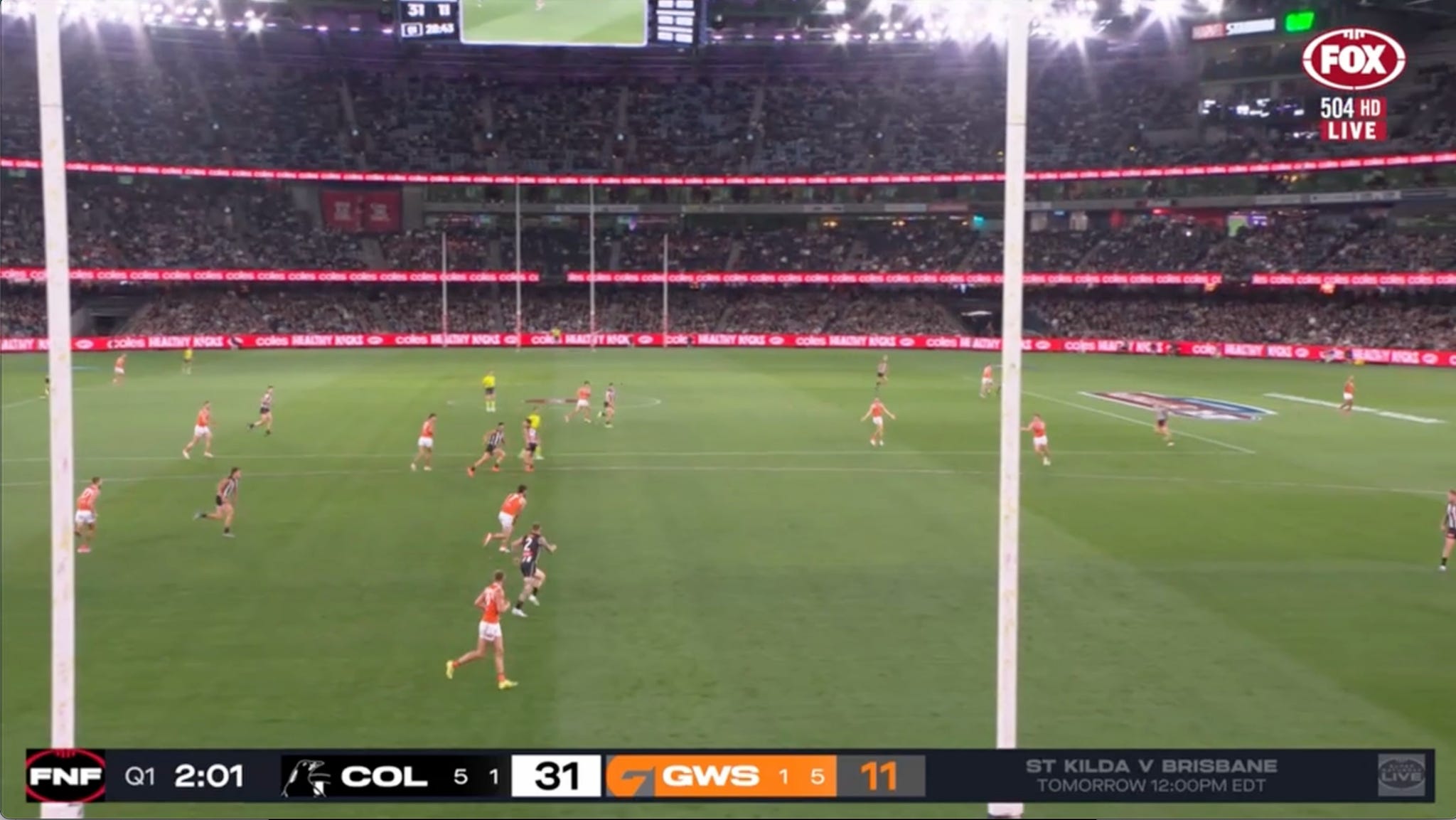
He made the prudent choice of honouring Lachie Whitfield’s short lead on defensive 50. But what’s also visible is that, despite needing to shuffle its zone across to account for the switch, Collingwood had already set up with five players across the full width of the centre square.
Here’s the rest of the play. What Whitfield ought to have done, and indeed what GWS focused more on doing to get back into the game, was kick it to Callum Brown, who was waiting in space on the broadcast wing. Instead, Whitfield couldn’t resist the temptation: he kicked it to Oliver Hannaford. But Brayden Maynard had already anticipated that and was able to affect an unorthodox turnover (and avoid conceding a front-on contact free kick) by turning his back at the last second and diverting the ball to Isaac Quaynor.
The remaining clips – these are all demonstrations of the value of effective oppo analysis as much as anything else – highlight how well Collingwood understood how GWS would accelerate when needing to chase the game.
Stephen Coniglio marked the ball on defensive 50. He immediately made a mistake by dishing off to an overlapping Ash, who shouldn’t have called for the ball because Tim Membrey was still in the vicinity, tracking another runner. Nick Daicos quickly twigged what was going on and directed Membrey to press up on Ash before Coniglio even handballed it to him. As a result, Ash had no space to continue to chain and ended up kicking a poor grubber in the vague direction of Whitfield. Collingwood mopped up the loose ball and eventually kicked it to a waiting Membrey.
The next clip didn’t end in a direct turnover, but it might as well have. Once again, our hero Lachie Ash (that man again!) was involved. Corralled by two Collingwood forwards, he dished out a long handball to the waiting Joe Fonti.
If you stop the clip at the moment Fonti received the ball, you can see he probably could have kicked it towards the corridor. It would have been the better choice given the game state. Instead, probably partly because of his own inexperience, and partly because of Collingwood’s success in affecting turnovers, Fonti immediately looked boundary-side and sent a handball to Harvey Thomas. Thomas tried to do the right thing – immediately send another handball inboard to Stephen Coniglio – but by this point, Collingwood’s players knew they’d effectively removed all other options and were able to swarm the former captain. The chain eventually ended in a boundary throw-in.
The final clip shows how desperation can worsen decision-making. Whitfield handballed it off to Fonti. You can see Fonti ignore his pleading teammate on the wing – Collingwood were happy to concede a mark that wide – to instead try and burst past Membrey and Lachie Schultz. He made a decent fist of it but, knowing that Fonti would probably be forced to handball, Dan Houston had made the correct decision to push up and block the next link in the chain. Steele Sidebottom mopped up the ground ball and Harry Perryman found Membrey alone in the pocket.
None of this was rocket science, exactly. Nor was it ultra-aggressive pressing. It was good coaching that correctly anticipated the preferred ball movement patterns of the opposition and good, experienced players who executed and exploited the Giants’ predictability. The proof of Collingwood’s success is evident from looking at the shot map of Friday’s game. The Giants took 24 shots on goal; only slightly below their season average of 26.4. But the real difference was in the quality of shots they manufactured. Those 24 shots were only worth an average of 2.62 expected points each – a staggeringly low value. For reference, Richmond took the hardest shots on goal in 2025, averaging 3.09 expected points per shot. The shots the Giants were forced into taking on Friday night were significantly more difficult than that!
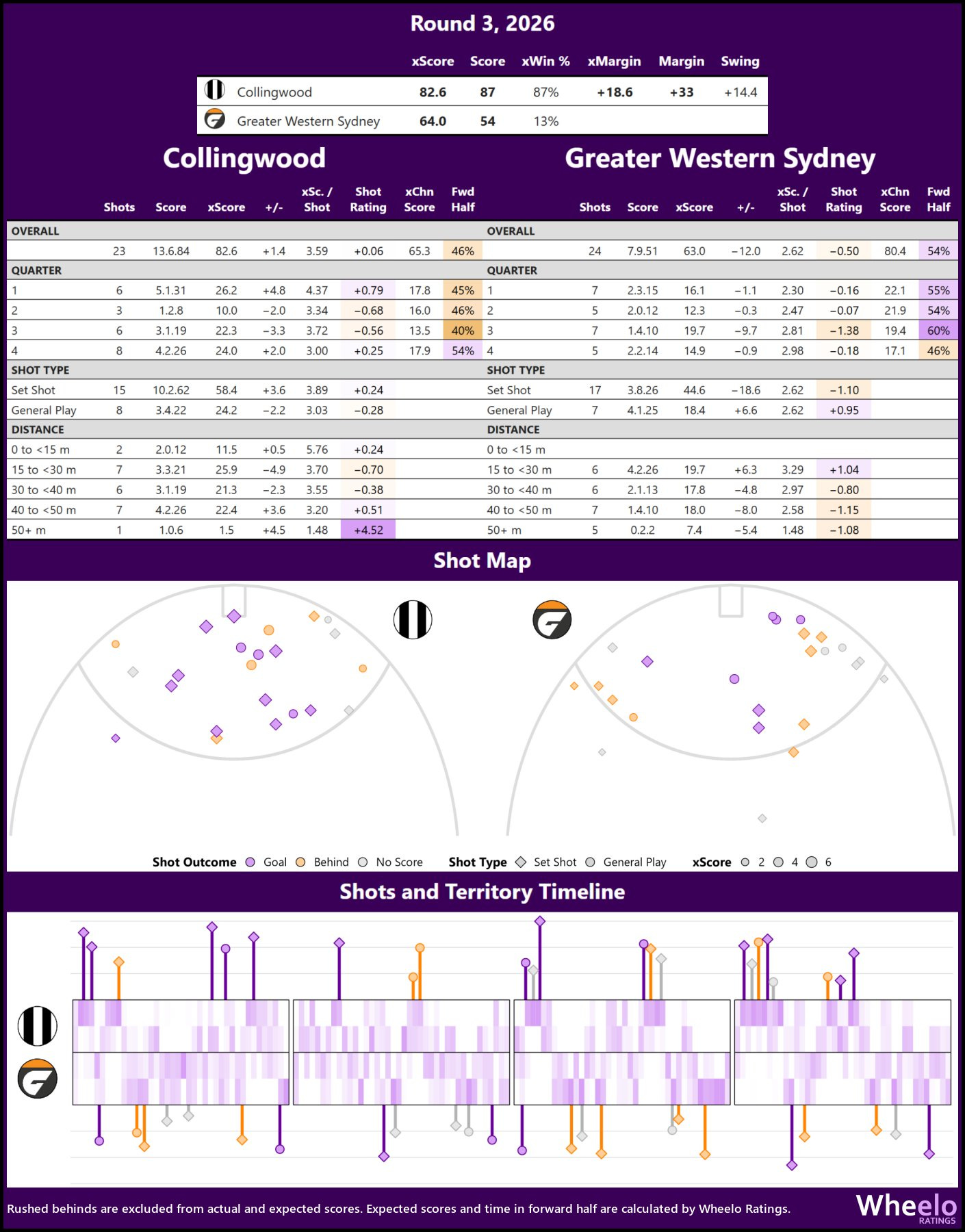
There’s a clear lesson here: as advancing the ball upfield by hand becomes a more dominant ball movement strategy, coaches will dedicate more time to countering that strategy. Not every response will look the same, and there will be counter-responses. It’s an interesting and rapidly evolving branch of footy tactics. If anyone from Champion Data is reading this: please start tracking handball turnovers!
Straight from the chart
DFS Australia is a great resource. Although it’s primarily used by and for SuperCoach types – of which, I admit, I am not one – it’s the best single source for centre bounce attendance statistics. I like CBA stats because not only do they tell rich stories about the fortunes of individual players, but they tell you how different sides approach one of the fundamental parts of the game. So I thought I’d look at the distribution of player usage at centre bounces for each club since 2023.
I decided to represent the data using the Herfindahl-Hirschman Index, a standard measure of market concentration calculated by squaring the percentage share of each firm in a market (in this case, players in at centre bounce) and summing those squares, resulting in a number from near-zero to 10,000. The bigger the HHI number, the more that a club’s centre bounce attendances are concentrated among a small set of players (theoretically, 100% of centre bounces across a season could be attended by just four players – the primary ruck and three on-ballers).
What I like most about these results is how they show there are many different paths to success. Brisbane have regularly had a highly concentrated centre bounce mix over a period where they’ve made three straight Grand Finals. The Bulldogs are similar. Collingwood’s centre bounce concentration is middle of the pack; a reflection of Nick Daicos’s primacy, the emergence of the likes of Beau McCreery and Ned Long, and Craig McRae’s clever rotation of his older players. Then there’s Geelong. The Cats recorded the least concentrated/most dispersed centre bounce attendance mix across the entire sample period in 2024. Unlike sides like North Melbourne in 2023 or West Coast in 2025, Geelong wasn’t rebuilding (it never is!). Instead, Chris Scott opted for a full horses-for-courses approach. 23 Geelong players – fully half the list – attended a centre bounce in 2024. Does it mean Scott is indifferent to the result of centre bounces? I’d say it’s more likely to be evidence of his pragmatism – his willingness to adapt whatever tactic is most likely to yield success.
In my introductory essay above, I showed a graph of how all 18 clubs have generated their scores by chain type since the start of 2022. 70-odd games of data have created convergence. Even Carlton, the side most reliant on stoppage wins for scoring, generates “only” 11% more scores from that source than Richmond, which has relied the least on clearances. Unsurprisingly, the data for the 2026 season is far more volatile.
The leaguewide average is close to the 2022-2026 average (stoppage scoring is a little down), but that masks some significant disparities. Richmond and Carlton are still the bookends; the Tigers are highly reliant on turnovers for scoring (Dimma DNA), while the Blues still need to win clearances to score (Voss DNA). Of course, a caveat applies: this graph doesn’t say anything about volume of scoring. Essendon and Fremantle have similar scoring profiles. But it doesn’t mean they’re similarly good.
This week’s chain data showcases one of footy’s more enduring truisms: wet weather games contain lots of possession chains. That’s because the conditions force lots of turnovers and lots of stoppages. The other noteworthy result here is how broken/choppy the St Kilda vs. Brisbane game really was. That result certainly aligns with the impression I got from watching the game (and all St Kilda’s games this season). The Saints conceded and forced the second-fewest turnovers in 2025. It’s early days, but they’re closer to mid-table for both thus far this season. I suspect that’s a symptom of trying to play a more adventurous style (and not entirely succeeding).
Turning our attention to how teams actually capitalised on their possession chains and, as with much else in Round 3, the most interesting things here came out of the two Sunday games. The Eagles scored an average of exactly one point from each stoppage win chain against Port Adelaide, continuing a productive run of scoring from this source (and underlining concerns about Port’s defensive frailties). But it was the game at the MCG which provided the most eye-popping results. Both Carlton and Melbourne scored (and conceded) prolifically from their clearance wins. But the outcome ultimately hinged on what each side was able to do when it forced turnovers. The Demons weren’t especially dangerous. But the Blues were positively impotent.
Enjoying my weekly review? Share it with a friend.
Footnotes
Collingwood scored 29 points from stoppages against GWS on Friday night at Marvel Stadium. 27 of them – 93% – were from the centre bounce, surely a record. How about that Oscar Steene debut? The early-season bye appears to have come at a good time for a bedraggled looking Giants side.
One from former Carlton captain and potential future friend of the newsletter, Sam Docherty: when the Blues win the contested possession count in a game under Michael Voss, they win about 70% of the time. When they lose contested possessions, that win rate drops to about… 7%. Yikes!
More evidence for the Western Bulldogs’ defensive improvement and more reason for their fans to feel bullish: Luke Beveridge’s side has improved its defensive-50 ground ball gets ranking from 17th last year to sixth through three games of 2026, and gone from 18th to eighth for defensive-50 intercepts.
Recommended reading
The most disappointing news of the nascent footy season, at least for me, is that Ricky Mangidis’s many professional commitments will give him less time to write over at his own blog, The Shinboner. As the name suggests, Ricky’s a North Melbourne fan. Thankfully, he’s still finding time to write in-depth reviews of North’s games throughout the season. His write up of the game against Essendon included thoughts on how both sides moved the ball, some of North’s positional shifts, and the cost of putting the cue on the rack so early. Essential reading, regardless of one’s allegiances.
I don’t promote This Week in Football enough here. Each week, some of the sharpest minds in indie footy writing apply their gifts to different subjects they’ve been thinking about. Last week’s edition featured Jeremiah Brown on the changing composition of marking, Lincoln Tracy on why the early-season spike in scoring isn’t as big as we think, Emlyn Breese on what GPS tracking can tell us about early-season hamstring injuries, and Joe Cordy on Hawthorn and Sydney’s different set-ups in their Round 2 game at the MCG. Read, enjoy, and subscribe.
Jonathan Horn, very much a friend of One Percenters, writes in The Guardian about how Carlton’s choice to back in Michael Voss is admirable – but for the fact that Voss isn’t the right man (and perhaps never was). Jonathan’s weekly columns are always a delight.
Cody Atkinson and Sean Lawson ask a provocative question: has Queensland become the second footy state?
Over on his Substack, Lincoln Tracy writes about an under-appreciated element of the Western Bulldogs’ early-season defensive strength: good spoiling.
I’m sounding the New Footy Substack klaxon again! Franco Greco, a clinical and counselling psychologist, writes on his belief that Carlon’s fade-outs are a stress response more than they are a deficit of fitness or talent.