


I’m looking for a sponsor. Click for more information.
Social preview photo courtesy of the (marvellous) The Honest Broker.
Mmmm, standin’ at the crossroad, I tried to flag a ride
According to legend, guitarist Robert Johnson acquired his supernatural ability by selling his soul to the devil at a Mississippi crossroads. When he died – at 27, the inaugural member of that infamous club – he left behind the founding canon of the Delta Blues. Johnson probably didn’t literally sell his soul to the devil. But the legend captures something real about making choices from which there’s no going back.
St Kilda and Collingwood are standing at the same crossroads, facing opposite directions. The Saints are facing east. Their sun is rising. The Magpies, meanwhile, are staring west, raging against the dying of the light. To be perfectly honest, I’m not sure who out of Craig McRae, Nick Daicos, Ross Lyon or Nasiah Wanganeen-Milera is the Robert Johnson, and who’s the devil in this analogy. A diligent editor would ask me to tighten up the analogy or, better yet, discard it. But I don’t have one of those.
Both clubs have won five of their first 13 games this season. Neither is in crisis, exactly – but it’s also fair to say that neither is where they hoped they would be. They have arrived at the crossroads from very different origin points: Collingwood have made at least a prelim final in three of McRae’s seasons at the helm. In the same year the Pies won the flag, 2023, the Saints made the finals for just the second time since 2011. They haven’t featured in September since. Yet despite those differences, both clubs are united by the same tension: the presence of a player whose influence is so profound that he fundamentally changes the trajectory of the club’s decision-making.
Only 12 times in VFL/AFL history has a player averaged 30 disposals and a goal across a season. Gary Ablett Jr., inducted into footy’s Hall of Fame this season, accounts for five of those instances. Nick Daicos is currently on track to equal that dazzling statline. He is, by most reasonable measures, one of the five best players in the game. His commercial and spiritual value to Collingwood is as great as what he does with the footy. Collingwood’s problem is not Nick Daicos. Except it sort of is. Because his brilliance, and the immense fear created by the prospect of him leaving, or his prime years going to waste, has driven a list management approach that most clubs in Collingwood’s demographic position would avoid. The Pies have the oldest list in the AFL. Beyond Daicos, a concerning amount of heavy lifting is done by players in their mid-30s. With respect to promising but still speculative prospects like Charlie West and Ed Allan, most clubs would rate their youth over Collingwood’s. That’s hardly a surprise: this is a club that has recently won a flag while publicly signalling its preference for permanent contention over the uncertainty of a trip down to the lower rungs of the ladder. If anything, it’s the way things are supposed to go.
Collingwood opting to win now while they have Daicos, Scott Pendlebury, Steele Sidebottom, Darcy Moore, and Jordan De Goey is defensible. But that competitiveness has created a deficiency of the young talent that’s typically considered essential for a sustained tilt at Premierships. And the senior core, partly because of injury, and partly because of the depredations of age, isn’t pulling as much weight as it used to.
It’s by no means a perfect measure, but the Pies currently have just one top 20-rated player in the competition – Daicos, who else? – and only three in the top 100. Topping up with mature-aged players and free agents has yielded some success. Harry Perryman has been a good addition. Angus Anderson, Roan Steele and Oscar Steene all look as though they’ll generate more value than what should be expected from the speculative picks used to draft them. Other moves – Dan Houston’s mediocre first 18 months in black and white come to mind – haven’t helped as much as the Magpie Army would have hoped.
Winning flags requires elite talent. It also requires elite depth. One of the things which makes sustained contention so hard is that playing longer seasons and having weaker draft hands year after year means you’re usually replenishing solid role players with paler imitations. It’s extraordinarily hard to keep up with the Joneses when, most of the time, you’re shopping from the clearance aisle. The evidence, halfway into the 2026 season, is that diminishing returns are beginning to bite.
Collingwood’s approach is governed by big-club hubris and shaped by Daicos. The club’s football department thinks the club has a better shot at winning the belt by throwing their best punch every year – even if it’s a weak one – than by throwing in the towel and getting back in the gym. There are some important details that make me lean their way. The first is that Collingwood’s glamour, the prospect of playing in front of huge crowds in marquee games, and the prospect of playing with Daicos, will make them an attractive destination for free agents. If the Pies land Ben King and Lachie Neale this summer without using a draft pick, they could well bounce back into the top four in 2027. The second is that rebuilding through the draft is hard and getting harder. Tasmania will enjoy significant draft concessions as it enters the league. The AFL is determined for the 19th side to become competitive quicker than the 17th and 18th. The late 2020s will be a rough time to rely on the draft. More attention will shift to trades, picks later in the draft, and alternative talent development pathways. Collingwood has reasonable form in this area.
St Kilda’s dilemma is different but recognisable. The fan base is not becalmed by a recent flag. The club is not a Mecca for free agents. But it does orbit around a superstar. Nasiah Wanganeen-Milera is one of the most electrifying players in the game. His ascension to superstar status and eventual decision to re-sign with the club in late 2025 was the most cathartic storyline of the season. But the softly-spoken South Australian’s choice to only extend through to the end of 2027 sent a loud message: you have two years to show me what you’ve got. That contract situation hangs over everything the Saints do. It makes every setback in Max King’s attempt to escape from injury hell even more painful. The aggressive trade period last year felt like a move made by a club which believes it must show progress on a timeline set not by the football department, or the natural growth of a young core, but by a contract offer.
There are several other factors which complicate the easy narrative that Nasiah is calling the shots at Moorabbin. The first is that, much like Collingwood’s public declaration of its desire to maximise its contention window (McRae spoke this week about being “impatient” to bring in talent – not the words of a coach eagerly contemplating a rebuild), St Kilda has openly expressed a belief that rebuilding through the draft is no longer a viable means of improvement. Club president Andrew Bassat said so when he criticised the Northern Academies and bemoaned Josh Battle’s choice to depart to Hawthorn in free agency. The slow start to AFL life for St Kilda’s two top 10 picks in that 2024 “super draft” – Tobie Travaglia and Alix Tauru – shows that good picks aren’t a cure-all. Liam Ryan and Jack Silvagni have been the best of the new recruits. Tom De Koning has helped them become better, although his individual output hasn’t moved the needle as much as a player on his purported salary probably should. Sam Flanders lasted less than half the season in the midfield before being moved to half-back. His Achilles tendon injury has robbed him of the chance to prove he was worth what the Saints paid to get him. In a flash of irony, Flanders was pushed out of the midfield rotations by two players who herald a bright future and have been key to St Kilda’s real statistical improvement this season – Hugo Garcia and Max Hall. Combined, the two players cost virtually nothing: Pick 50 in the 2023 draft and Pick 4 in the 2024 mid-season draft. Both have added skill and speed to the Saints’ midfield, which is currently ranked 2nd in the AFL for clearance differential.
That improvement, along with the rise of Darcy Wilson – this season’s unwelcome contract saga – has ameliorated but not fully solved the Saints’ dilemma: the moves they’ve made to drive short-term improvement are in tension with the goal of long-term competitiveness. The list genuinely looks better than this time last season. Improvement hasn’t shown up in the place it matters most – the win-loss ledger – but it has shown up virtually everywhere else.
The Saints are currently 7th for quarters won, and have won the most first quarters of any side. They’re 7th for expected score after being 12th in 2025. But they’re still 12th on, you know, the ladder. I’m sure Wanganeen-Milera has noticed the improvement. He seems to enjoy life at the club. But have the Saints improved by enough to convince him that’s where his long-term future lies? Trying to be just one thing at once is hard enough in footy, especially for the league’s most snake-bitten club. Trying to do two things at once – win now and win later – is playing footy on permadeath mode.
When a club possesses a player of the ability of Daicos or Wanganeen-Milera, decisions are filtered through a simple question: does doing X help us be good while he is here? It can seem obvious. Of course you want to maximise the time you spend being competitive with your best player available. But there’s actually competitive [Lionel Hutz smiling face] and technically competitive [Lionel Hutz frowning face]. Footy isn’t like basketball, where one guy is 20 percent of the team. You need stars and you need depth. It’s hard to find enough of either if you finish around the middle. No club has won a flag while paying a guy $2 million a year. I’m not sure a club has won a flag with a list management strategy geared around retrofitting contention around a single superstar. Stars need planets. The trap that both the Pies and the Saints are in danger of falling into is that optimising for the short-term often means you make decisions which appear locally rational but are irrational in the aggregate. Each free agent signing is defensible (hey, they only cost salary!). Each traded pick feels like a price worth paying. Until, that is, you’re left with a list with one superstar and a bunch of guys that bring to mind the more obscure Wu-Tang Clan associates. That’s Collingwood’s dilemma. I think they’re probably making the right choice, given the fact that the alternative is freighted with all sorts of danger beyond the mere danger of the unknown. But it’s by no means guaranteed to work.
St Kilda is trying to build sustainably and build urgently. Losing Wanganeen-Milera, a superstar all their own, would be a hammer blow. It would destroy supporter morale and there’s no way that, in a draft environment compromised by the entry of Tasmania, the club could be fairly compensated for his departure. So again – what looks like recklessness might actually be their best bet. But on the other hand, maybe the task is, instead of compromising the future and hoping it persuades him to say, perhaps the thing to do – difficult as it is – is to craft a list that is worth playing for regardless. Either choice feels like a gamble. Saints supporters should feel a measure of comfort that their side appears to be on the right trajectory. The problem is not knowing where it ultimately leads. When you’re at the crossroads, you usually don’t get to choose your destination. You take the road that’s being offered, and you figure out where it goes.
The Video Room
The volume and diversity of close finishes in Round 13 is the perfect opportunity for the (long overdue!) return of The Video Room. The clips I’m reviewing this week – spanning four of the close games – each tell stories about how many decisions players and coaches need to make in crucial moments.
To begin, I’ll consider two clips from the end of last Thursday’s epic, rain-lashed game at Adelaide Oval between the Crows and the Cats. The first begins with the ball in the hands of debutant Hugo Hall-Kahan, who’d just won a holding the ball free kick.
Before I get properly into it, a quick explanatory note: a source of consternation among many Adelaide supporters is the side’s tendency, in late-game situations, to seek contests instead of retaining possession. The cue for the Crows to enter their particular kill-the-game mode is this sign:
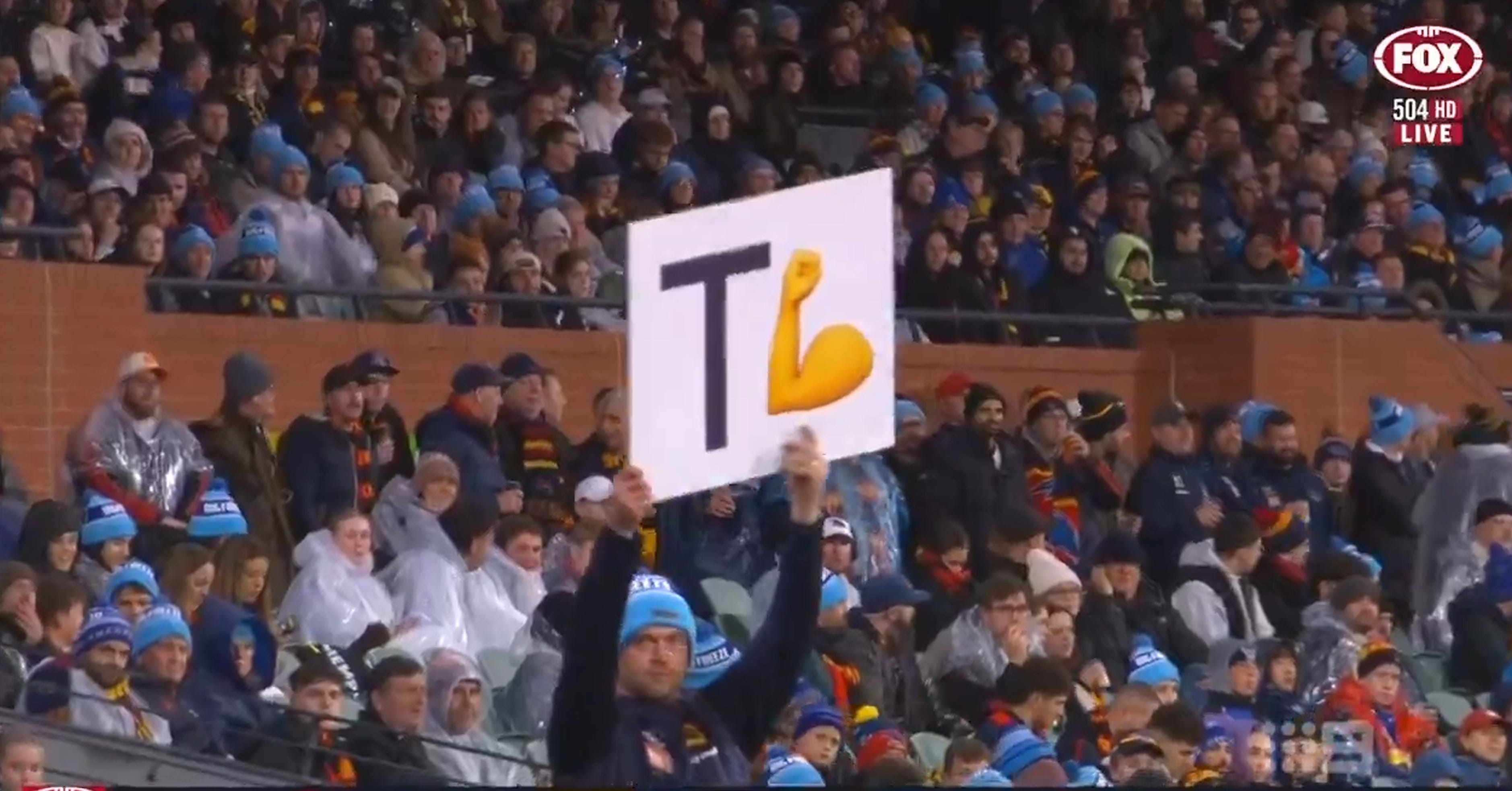
I think it refers to protecting the defensive “T” – the area encompassing the corridor and the half-back zone – while seeking to keep the ball in contested, congested situations (the simpler, still plausible explanation is that the T just means “time”). It’s understandable in the context of Adelaide’s main strength being its contested work and its main weakness being its foot skills. But the way it’s deployed has arguably allowed opposition sides to come back into the game, safe in the knowledge that the Crows are more interesting in containing than scoring.
All of this, together with some good one-on-one checking by Geelong, serves to explain why Hall-Kahan didn’t have any teammates presenting for the short kick. Instead, he sent it long down the line.
Geelong are a chameleonic side under Chris Scott. But one constant is his desire to maintain numerical superiority behind the ball to leverage his defensive unit’s excellent intercept marking. The Cats will go to often-absurd lengths to preserve a defensive +1. They outnumbered the Crows at this aerial contest.
The next thing worth noticing is Taylor Walker’s split-second recognition that, because Geelong didn’t want a stoppage, he was free to instead gain some territory and push the ball into space. The eventual result was another stoppage, just what the Crows were craving. Not many players would have taken the extra beat in that situation.
Let’s fast-forward to the second stoppage at Adelaide’s attacking 50-metre line. Walker and Darcy Fogarty were both up at the stoppage. In a normal game state, at least one would have stayed deeper, a quick kick ahead of the ball. Here, their brief was simple: help contain Geelong. If you pause at the minute mark, you can see that each Adelaide player was content to have his direct opponent control the inside “bubble”, so long as they remained close enough to apply physical pressure. The Cats wanted to get the ball to the outside. The Crows wanted to prevent it. And they might have, had Josh Rachele not lost touch on Oisin Mullin and allowed him to squeeze a kick out of the congestion.
From here, Patrick Dangerfield and Max Holmes were good enough to get to the outside. Adelaide, however, had some insurance in the form of Dan Curtin, whose size and intercepting made him the ideal response to Scott’s choice to push Mark Blicavs forward to mark or bring the ball to ground. It’s great to have a two-metre tall unicorn to neutralise your opponent’s two-metre tall unicorn.
That wasn’t quite the end of things. The second clip resumes with a ball-up on the central wing with just 11 seconds left in the game. Darcy Fogarty was positioned as a spare on the defensive side of the stoppage. His job was to try and stop Dangerfield should the Geelong champion take the ball and run through the contest.
That didn’t happen, however Lachie McAndrew’s handball out of bounds meant they came up with the clearance regardless. Bailey Smith bombed it to half-forward, where Jeremy Cameron was in the box seat to mark in front of Max Michalanney. The ball bounced off Shannon Neale’s big paw and spilled to Tom Stewart, whose progress was impeded by Michalanney just enough to run out of time. Another 10 seconds and the Cats might have done it.
Let’s move to Friday night’s game at the MCG, which saw the Western Bulldogs overcome a profligate Hawthorn side. In this clip, the Hawks were a goal down – but had a forward-50 stoppage.
Every side chasing the game in this situation wants the same thing: to clear space behind the ruck contest, on the goal side of the stoppage. Hawthorn manufactured it with an excellent left-handed, over-the-shoulder tap by Lloyd Meek, Conor Nash creating a lane for Will Day by blocking Aaron Naughton from the contest, and Day giving his direct opponent Joel Freijah the slip. You don’t want to be too critical of young players, but Freijah made a couple of errors here: he gave up the goalside position too easily, lost touch with Day too easily, and was slow to react to the situation. The one advantage was that Day was on his wrong side, and couldn’t generate enough power with his right-foot snap. Rory Lobb, serving as the sweeper, marked in the goal square.
The next event in the game was Rory Lobb’s exit kick and the ensuing contest.
This clip is a small but neat illustration of a central trade-off that sides protecting leads late in games must confront: congesting defensive 50 often leaves the defending side outnumbered at the landing zone of the exiting kick. Hawthorn had numerical superiority at the drop of the ball here. The Bulldogs’ buffer was that even had they conceded a clean intercept mark, Hawthorn would have been too far out from goal to score directly – and the Dogs would have had enough numbers behind the ball to probably neutralise the ensuing contest.
Still with me? Good, there’s still a way to go. The third clip from Friday night’s game shows another stoppage in Hawthorn’s attacking 50. As with the first clip I showed from the Adelaide vs. Geelong game, the Dogs’ objective was straightforward: deny the Hawks’ most dangerous players the ability to get into space. But straightforward isn’t the same thing as easy.
The fact that neither ruck decisively won a hit-out actually created a dangerous situation for the Dogs because it meant that half a dozen players instinctively collapsed towards the ball, creating space on the outside of the contest. Mabior Chol and Connor Macdonald were quick to realise this, and had their positions swapped, the Dogs might have punished for a brief lapse in positional discipline.
The final clip from this game illustrates the split-second decisions that players must make under physical and psychological pressure. There were barely 20 seconds left in the game. The Dogs, once again, were kicking out from D50. Jordan Croft did really well to halve an aerial contest. A second later, he gathered a loose ball.
What do you think he should have done in this situation?
Croft could have held the ball in. He effectively would have been challenging the umpire to penalise him for holding the ball. That was probably a small risk – but a real one. So instead, he chose to gain territory with a kick. The problem was, that because of his body position and the shape of the contest (i.e. Hawthorn’s strength on the boundary side of the secondary contest), his only valid choice was to kick into the corridor – into a nest of waiting Hawks. He didn’t protect the T. All of a sudden, Jack Ginnivan had possession level with the centre circle. What he didn’t have was enough time to launch a deep ball. Time ran out for Hawthorn.
What would you have done in Croft’s position?
Sunday night saw Carlton beat Essendon in a game that felt distinctly like a Round 24 contest between two tired sides that know they won’t be playing finals. It was bad, but also sort of fun. Seeing as other outlets and pundits have already covered the controversial choice to allow Harry McKay the full 30 seconds to kick for goal from 65 metres out, I thought I’d just focus on the final centre square ball-up. According to Channel 7’s clock, the Bombers had just nine seconds to manufacture a goal.
Pause at the five-second mark of this clip, which shows the stoppage set-up. What do you see? I think a few things stand out. The first is that Carlton didn’t put a sweeper on the defensive side, although as the contest contracted, Patrick Cripps (matched up against the impressive Sullivan Robey) became a de facto sweeper. The second thing to notice is that Zach Merrett didn’t physically engage in the contest whatsoever. He wanted to act as a half-back, running from deep on the outside to receive and send it forward. That positioning probably confused George Hewett, who’s used to having a direct opponent in those situations. With Hewett trailing a metre behind, a clean gather from Merrett would have created the inside-50 kick the Bombers needed to stand a chance of snatching this game. Alas.
We’re into the home straight – just one game and three clips to go. Let’s go to the SCG. The first of the clips I’ll show from this instant classic begins at the point Marcus Windhager thought he took a mark inside 50 that was adjudged to have not travelled the required 15 metres. Rushed – and possibly pushed in the back – Windhager turns the ball over with his kick. But it’s what Callum Mills and the Swans did next that’s important.
One of the main reasons the Saints so nearly won this game was how well they denied Sydney corridor access. The first thing any decent opposition analyst will identify about Dean Cox’s side in 2026 is the priority they assign to getting to the middle band of the ground, and how it unlocks their ball movement. In this respect, the Saints coaches nailed it.
But in the final two minutes of the game, the Swans exploited St Kilda shifting its defensive shell back (a natural tactical and psychological response to being up by less than a goal with so little time left) to repeatedly access the corridor. The key moment in this first clip is Brodie Grundy’s recognition of the movement and ability to override his natural instinct to handball to James Jordon on the wing and instead look inboard, where Jake Lloyd had continued his run. The ruckman’s handball was perfect, and created a concertina effect where the next Saints player had to push up, eventually freeing Isaac Heeney, whose kick found Chad Warner. Warner found the lizard – Nick Blakey – in his natural element: alone, on the fat side, on the attacking side of centre. He got past Mason Wood rather easily and, had he made slightly better contact, could well have kicked the go-ahead goal.
The second clip shows the forward-50 stoppage which did result in the winning goal. Again, consider what Sydney wants to achieve here – space outside “the bubble”, either side of goal, but ideally on the goal side. Then consider what resources St Kilda had to counteract that.
Before discussing Heeney’s role in the goal, I want to discuss the role of Ryan Byrnes, St Kilda’s spare on the defensive side of the stoppage. He’s the guy standing between Rowan Marshall and Nasiah Wanganeen-Milera. As the ball gets thrown up, he takes two steps to the boundary side, effectively depriving himself of the ability to disrupt Jai Serong’s kick for goal. But he didn’t take those steps for no reason. He could see that Chad Warner had shaken the attention of Hugo Garcia, and that a decisive forward tap by Grundy could have released Warner on goal.
Byrnes’ choice to attend that spot-fire created a small pocket that Grundy and Heeney exploited to perfection. Grundy’s goldilocks tap – just strong enough to escape congestion, just soft enough to land in between three Saints – allowed Heeney to gather. The Sydney player was well-corralled by Darcy Wilson, but had the presence of mind to shift hands and handball with his left hand, which created a tiny amount of extra space that was enough to prevent Wilson from getting a hand in. Serong, alone 30 metres in front of goal, did the rest. The trade-off between guarding the inside and the outside of the contest is not always easy to solve.
There’s just one more clip – the final centre square ball-up. There were just 14 seconds left in the game, and tables had turned. Suddenly, the Swans snapped into lockdown mode, and the Saints had to win the game. Of course, St Kilda has (relatively) recent experience of winning the game with a Hail Mary centre clearance – just ask Melbourne supporters. That clearance was made possible by a really unusual spatial configuration and quick thinking by Nasiah and friends to create space inside 50. I suspect this last set-up on Sunday was motivated by similar reasoning: Nasiah is the guy we want to get on the move, and we want to manipulate it so he can receive the ball running forward.
Pause the clip at four seconds, just as the umpire is preparing to throw the ball up. There is, uh, something unusual here: each side has a player “missing”. Instead of four separate one-on-ones, only three are actually visible on the screen. James Jordon was briefly visible before the shot tightened, but there was no one particularly close to him. The reasoning for this wide spacing was clear – the Saints wanted variance. Losing the clearance wouldn’t have hurt them, they just needed to win it. Tom De Koning did his job – he won the tap decisively and hit the ball into space. Wanganeen-Milera did his job, too: he was ahead of James Rowbottom.
The role I don’t understand here is the one played by Marcus Windhager, normally St Kilda’s defensive midfielder/tagger. He came into the shot only when Jordon, who had gathered the loose ball from De Koning’s hit-out, was kicking the ball forward to ice the game. I’m not a coach, nor any sort of expert in stoppage set-ups. I presume there was a reason here – Windhager laying a block to clear Wanganeen-Milera’s path to goal, perhaps – rather than just a dropped coverage. If anyone at St Kilda is reading this, please get in touch. Whatever the intention, the result wasn’t the one the Saints were after.
There you have it: 10 clips. Each, hopefully, revealing something about the dozens of choices and actions that players and coaches are forced to make in the dying stages of the game. Often there are no perfect solutions, only different flavours of trade-off. Good thing we’re just watching on TV, eh?
Enjoying my (mostly) weekly review? Share it with a friend.
Straight from the chart
Instead of becoming the juggernaut that I and others expected, Gold Coast have instead had a stuttering first half of the season. To a significant extent, that decline in form has been driven by a drastic deterioration in the Suns’ clearance game. The numbers illustrated in this week’s first chart are rather stark.
Across the entire 2025 season, Gold Coast had a cumulative clearance differential of +77. Through the first 12 games of this season, they’re -82. Scores from clearances tell a similar story: +230 for the whole of 2025, just +21 so far this season.
Rowell, Anderson, and Petracca looks like a formidable midfield trio on paper. But that’s not where the game is played. Damien Hardwick and his coaches are no doubt searching for a better balance.
Readers with long memories will remember my promise to do something slightly more ambitious with the possession chain data I present most weeks. I believe I specifically said I’d look at the correlation between chain volume and ladder position (or win-loss record), but what’s a small difference between friends? Instead, now that we’ve ticked over the halfway point of the season, it’d be worth looking at how many possession chains sides are generating compared to last season.
Some of the differences are marginal. Sydney’s is gargantuan. Others are smaller but still meaningful – Collingwood, St Kilda, Geelong, West Coast. It’s not quite as simple as “more chains = better”. It depends where the increase comes from, and how it correlates to a side’s preferred style. If you want to play quickly, creating more intercepts is good. Winning clearances – which implies stoppages – may not be so good. And taking more kick-ins (the third component of possession chains) is probably bad, because it means you’re conceding more shots on goal.
Still, they work as a rough proxy for team improvement. And, in the case of Sydney, St Kilda, and West Coast, that improvement is real.
Zooming in, we can consider how many possession chains each side created during Round 13. Unsurprisingly, given both the conditions and the fact that these two sides are both in the top three for total chains, there were a heap of them in the Adelaide-Geelong game. Part of why watching Crows games is so stressful as a supporter, beyond the close finishes and the bonehead errors, is how choppy they are. There are lots of intercepts and lots of stoppages. It’s an intense experience.
The smaller volume of chains in the North Melbourne-Fremantle game is quite typical for a blow-out result: North couldn’t generate chains because they couldn’t win the ball, while the Dockers didn’t generate that many because they tended to kick goals on their first attempt (kicking a goal ends a chain). The low number of chains in the Essendon-Carlton game, meanwhile, is also another common feature of games between poor sides: low on pressure, low on stoppages, and relatively low on intercepts.
Turning our attention to how efficiently each side converted clearance and turnover wins into scores and… what is there to say, really? The Dockers scored an average of 2.03 points for each clearance win, and 1.42 points for each interception. I’m sure North supporters didn’t need another way of seeing how badly their side was beaten.
The other noteworthy statistic is how bipolar the Bulldogs’ scoring distribution was: almost completely impotent from intercepts, deadly from stoppages. That says something about their opponents, too: Hawthorn are fourth in the AFL for preventing opposition scores from turnover, but below league average in preventing opposition scores from stoppages.
Footnotes
Some stats that would encourage Andrew McQualter and West Coast Eagles supporters. Over the last month, the Eagles are: 1st for forward-half differential, 1st for opposition D50 to F50 transition success rate, 2nd for inside-50 differential, 2nd for forward-half intercepts and points from that source, 3rd for pressure, and 4th for points against. That is precisely the sort of growth – in the metrics which underpin McQualter’s style – that suggests things are finally on the right track. (H/T this tweet, which shows an image from Footy Classified)
Collingwood’s record under Craig McRae in games decided by 10 points or fewer: 9-3 in 2022, 8-1 in the 2023 flag year, 6-2-1 in 2024, 3-4 in 2025, and currently 1-1-4 in 2026. The line between contention and decline can be very thin. (H/T Footy on Nine)
Teams are 5-0 when scoring exactly 92 points in 2026. They are 4-0 when scoring 99 points. They are 5-0 when scoring 103 points. They are 6-0 when scoring 104 points. But when a side scores 102 points? 0-4. (H/T AFL Live Ladder)
Round 13, 2026 stands alone as the VFL/AFL round with the lowest-average winning margin despite including a 100+ point margin The average margin over the weekend was 22.88 points. Take away the Bunbury Massacre and the average margin drops to 8.43. You’ll never sing that. (H/T Sirswampthing)
Recommended reading
The Gardiner Stand and friends consider Carlton’s topsy-turvy first half of the season.
Sean Ross does something similar, only solo and with fewer wins to celebrate.
It’s six days old, but This Week In Football’s Round 12 newsletter is a cracking read.
Great point about the fact Collingwood needs to maintain the big / competitive club thing in order to attract potential FAs. I went pretty hard on SP433 personally: https://drwilliamfox.substack.com/p/i-hated-it?r=2rblfg - but you can see how hyping up that kind of game might attract someone like Neale.
The one thing that surprised me in the fateful Swans:Saints stoppage was that Windhager stood on the "wrong" side of Heeney, putting it all on Wilson. Given that Heeney got 30 and 2 he didn't do a great job in a game that overall was probably the best by Saints so far this year.