


Footy’s back. And earlier than ever. I shouldn’t complain – it’s more grist for the mill – but I’m not sure I’ll ever quite get used to real games in the first week of March. Playing for points this early clearly imposes physical demands on players. Stated plainly: a lot of guys were gassed during Opening Round. That was one of the throughlines of an absorbing set of games that reinforced some narratives, confounded others, and raised plenty of questions.
Before diving in, a quick bit of housecleaning. I never quite nailed the format of these weekly reviews last season. One Percenters has always tried to occupy a different lane – slower, longer, more deliberate – and reacting to nine games by Tuesday doesn’t always come naturally. Over summer (in the moments where I wasn’t writing season previews) I thought about how to structure these posts better. For now, I’m trying something simple:
The Video Room: clips from one or two games that tell an interesting tactical story.
Straight from the Chart: graphs inspired by the weekend’s action.
Footnotes: statistical curiosities to share with your friends to prove you know ball.
By design, these posts are meant to be provisional inquiries rather than grand pronouncements. They’re things I noticed and thought were worth writing about, not the definitive record of what matters. If you ever catch me writing something that reads like “Team X did Y, therefore Z will be true forever”, please pull me up. Footy shifts quickly, especially early in the season as sides shake off cobwebs and adjust to new players and new rules.
That sense of adjustment was everywhere during Opening Round. Much of the pre-season discussion focused on how the rule changes – the removal of the sub, the last-disposal free kick rule, tweaks to the stand rule, and the reversion to the old ruck contest rules – might change the shape of games. One theory was that allowing rucks to use their greater momentum would expand the tap radius at centre bounces, turning stoppages into looser one-on-one contests that favour speed over brute strength.
That idea makes sense qualitatively. But, with one notable exception, it didn’t really show up in the numbers this weekend. There was actually less scoring from centre bounces than in last year’s (admittedly truncated) Opening Round. Still, coaches clearly spent the weekend experimenting. Some sides played two rucks; others opted for an extra runner. Rotation patterns looked different. Time-on-ground for key players varied significantly. The search for marginal gains never ends.
But we can tentatively suggest two things. First, as speed and turnover scoring become more central, the trade-off of playing two genuine rucks – as Carlton did on Thursday night – becomes more pronounced. Second, coaches are actively exploring how to manipulate rotations to maximise the influence of their best players. We’ll see if those ideas hold. It’s very early – eight teams haven’t even played yet! – and nothing is settled for long. But if Opening Round hinted at anything, it’s that the game’s long march toward speed probably isn’t slowing down.
Let’s look at a game where that dynamic was particularly visible.
Before I do, a modest tribute to Dennis Cometti: watching footy as a kid in the 1990s was one of the ways I learnt to be Australian. The idiomatic slang, the demonstration of the traits – the comradery, the courage, the vigour – we are told are quintessentially Australian, the identification with a sporting tribe; I learnt all those things from the footy. Dennis and Bruce gave voice to those experiences. So I’ll join my voice to all the others who lauded Dennis’ wit, passion, knowledge of the game and the craft of commentary, and add one more encomium: thank you for being a part of my childhood.
The Video Room
A few minutes before the start of play on Thursday night, I posted this tweet:
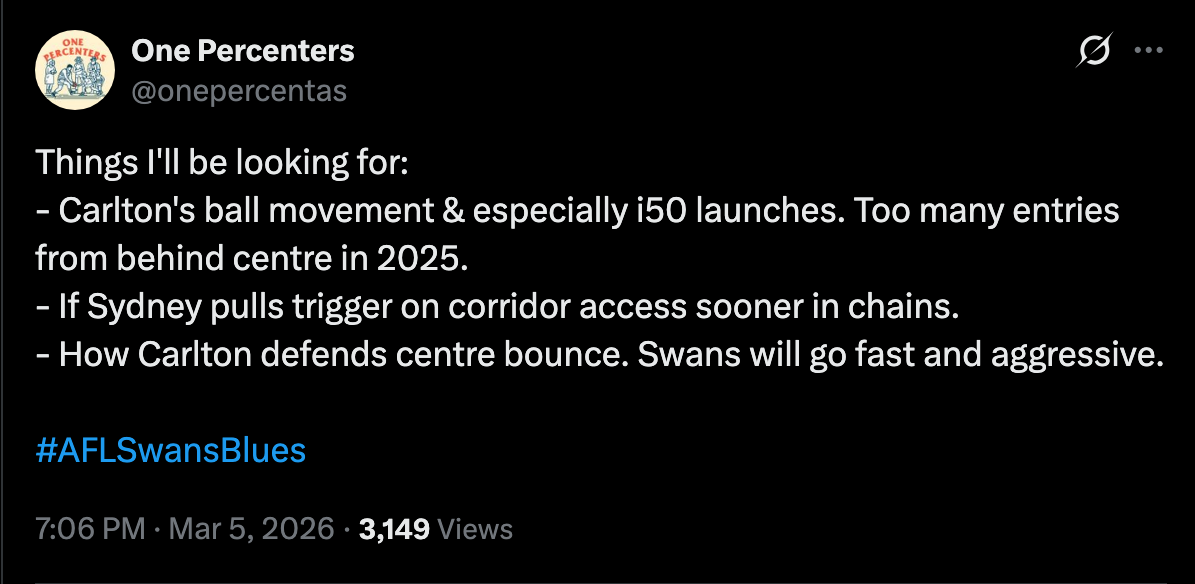
All three were in evidence throughout the game. Carlton really did try to change the way they moved the ball. You could see concerted efforts to find a teammate in a better position with a release handball or short kick. The Blues gained 375 metres via handball, a significant increase from their 2025 average of 160.5. Their first goal of the night, kicked by Brodie Kemp, was a proof of concept. It wasn’t pretty (Tom McCartin should have intercepted Jagga Smith’s kick), but it reflected a newfound determination to link up by hand and access the corridor.
It’s no coincidence that three of Carlton’s new players – Smith, Ollie Florent, and Ben Ainsworth – were all involved in the build-up to that first goal. For most of the first half, the Blues combined that modestly improved ball movement with contested superiority (they went +21 in contested possessions through the first half) to dominate territory. A 10-point lead was less than Carlton’s statistical superiority should have merited.
But the thing about good early intent is that it has a habit of falling back into old habits when subjected to real pressure. The reason I never get too excited about isolated clips of sides generating overlap handball in pre-season is that opposition teams rarely care enough to try and stop it. So while Carlton did genuinely show a different intent in the first half – more link-up by hand, more corridor access, better launch points – in key moments, that boldness disappeared. To some extent, that will improve. If you drill new habits for long enough, they will supersede old ones. Carlton’s first goal of the second half, a lovely flowing move that again rested on Ainsworth’s willingness to look inboard and ability to execute the kick, showed that the intent was there.
But Carlton will face a hard constraint on playing faster, handball-dominant footy: the physical attributes of its list. Fundamentally, I’m not sure you can turn Patrick Cripps, George Hewett, and Cooper Lord into players who hurt opponents with run-and-carry overlap. Carlton’s list is optimised to overwhelm opponents with territory. There isn’t enough pace and agility in the side, particularly in midfield and behind the ball.
Sydney’s list has been constructed very differently. The Swans are teeming with dynamic runners who gain significant territory and distort opposition defensive structures with carry and twist the knife by damaging disposal by foot. The first and second halves of Thursday night’s game were an ideal case study in how those approaches – contest, pressure and volume vs. speed and efficiency – manifest, and which tends to win out in the current footy paradigm. Sydney were poor in the first half. They looked nervous, not quite sure of the trigger points for their ball movement, and were spooked by Carlton’s contest dominance into rushed territory gains.
That all changed in the third term, when the Swans piled on the ninth-biggest single quarter score in V/AFL history to effectively take the game away from Carlton. It has a lot to do with the second and third points in my tweet above: corridor access and aggression at centre bounce. But I think it also has a lot to do with how Sydney’s list profile is fundamentally better-suited for the style of footy the AFL wants to engineer in 2026. The Swans turned a -22 contested possession discrepancy in the first half into a +10 advantage in the third term. There were a few reasons why. Sydney got better at reading Carlton’s preferred contest exit method and getting a hand in. Carlton’s big midfielders (and Marc Pittonet) began to tire, which allowed Sydney’s to win first possession more often and distribute to players on the outside of the contest. And, as fatigue began to set in among Carlton’s inside players, the Swans got rolling. Justin McInerney’s second goal is a great example of how Sydney were eventually able to generate situations Carlton couldn’t stop.
There are two things I’d like to focus on in this clip. The first is Errol Gulden’s influence. The Swans like leaving Gulden in space half a kick ahead of stoppage, because the expected pay-off of him gaining uncontested possession in Sydney’s attacking half is big. But I really liked his starting position here. He was already moving at speed when he received the handball – immediately creating uncertainty among Carlton’s opponents. The second is that Sydney’s zone when Gulden received the ball was unusually skinny and biased to the defensive side of the centre square. When the camera zoomed out, you could see why: by clustering the way they did, they created a huge amount of open space on the attacking side of the square. McInerney didn’t have a single teammate within 30 metres of goal-side when he received Gulden’s long handball. Even the top of attacking 50 had been cleared out to create more space for him. A move like this is the effect of coaching: realising how subtle changes to spacing can create overloads which your superior runners can exploit. (A caveat: Adam Saad’s injury meant Carlton were a man down in this play.)
Sydney repeatedly exploited this same play throughout the third quarter: they used their superior speed to break away from their tiring opponents (exploiting Carlton’s poor stoppage discipline; a common ingredient in games where the Blues get overrun is their players collapsing to the inside and losing contain), constantly shifted the ball to the outside, and vacated attacking central areas to gain territory through run and carry. Charlie Curnow’s first goal in red and white is a good example.
Chad Warner and Malcolm Rosas both rolled back to the contest, while Curnow stayed high, creating a band of open space which Carlton’s players also chose to leave vacant (some of Carlton’s problems could have been offset by shifting to a more zonal defensive structure – i.e. leaving a man on the defensive side of the centre square). The Swans affected the turnover, released Warner into space, and no Carlton player stood a hope of catching him before he delivered a short kick to an onrushing Curnow.
Why did Carlton’s players get tired? Partly, as discussed, it’s because of the investment the club has made into a bash-and-crash list optimised for bash-and-crash footy. Partly it was the humidity of an early March night in Sydney. Michael Voss couldn’t have done anything about that. But he didn’t help himself with his team selection. Two genuine rucks and four tall defenders (Jacob Weitering, Lewis Young, Harry Dean, and Mitch McGovern) meant that not only did the Blues have fewer runners – the runners they did have each had to work a bit harder. Injuries to Saad and Lachie Fogarty didn’t help matters on that front. By the end of the game, Sydney players had recorded 282 sprints to Carlton’s 246.
Isaac Heeney’s second goal of the third term combined all these factors with one other: the centre bounce. I wrote in the preamble to this week’s review that the notional extra space afforded at centre bounces didn’t really show up in the Opening Round numbers. The one significant exception was in the third quarter of this game. The Swans kicked three goals directly from centre bounce clearance win chains, all in the third term, and all the product of confidence, aggressive positioning, clever spatial manipulation, and opponents who couldn’t keep up. Rowbottom took Pittonet out of the play, Lord got sucked into the contest, Walsh was caught in no-man’s land, and a tired Cripps chased his direct opponent in vain. Blues fans have seen this movie before.
In half an hour of footy, Sydney opened the flood gates and subsumed their opponents. It was an unusually vivid example of how individually small factors – discrepancies in conditioning, stoppage adjustments, team selection, rule changes – can compound. By my rough count, 43.5 percent (10/23) of the Swans’ inside-50 entries in the first half landed outside of the width of the centre square. In the second half, just 17.7 percent (8/45) were. They didn’t just increase the volume of their attacks – they also dramatically increased their danger.
Did this game tell us anything we didn’t already know about these two sides? Despite the shock of the third quarter, I’m not sure it did. Carlton are closer to another rebuild than contention. While the Swans, helped along by rule changes which are beneficial to their style of play, should be good in precisely the way they showed in the second half.
Straight from the chart
If, after watching Sunday night’s game (where Collingwood mustered 23 fewer inside-50 entries than St Kilda but still won), you’re left with a hunch that Craig McRae’s Pies are the masters of winning games despite a territory disadvantage – you’re onto something. Take a look.

McRae has coached exactly 100 games at Collingwood. Those 100 games have yielded 68 wins, 30 defeats, and two draws. The Pies have had more inside-50s than their opponents in 52 of those games – and won 39 (75 percent). It’s their record in the 46 games where they’ve had fewer inside-50s where the quality of their defensive work shines through. McRae’s Pies have won 28 of those 46 games – a win rate of more than 60 percent. Somewhat astonishingly, that win rate even holds up in games where Collingwood’s opponents have had 20+ more entries – the Pies are 6 from 10 in those games. That includes their win against St Kilda on Sunday night.
After Carlton got slaughtered out of stoppages on Thursday night, the Blues’ midfield mix has once again come under scrutiny. Every variant of Carlton midfield discourse is a variant of the same basic complaint – it’s too big and too slow, increasingly obsolete in an era where speed is king – and every variant involves Patrick Cripps. The Blues’ captain is emblematic of his side’s midfield struggles: he’s great at winning first possession (and territory), but less capable when it comes to both converting that possession into scores and defending when possession is lost. I thought I’d look at his individual player ratings and see what they revealed.

There’s a lot this graph doesn’t capture. It doesn’t show that Cripps’ opponents are becoming increasingly adept at causing damage by running off him, or that they’re running off him more often. Nor does it show any obvious correlation with Cripps’ performance and Carlton’s results beyond their slow starts to 2025. It isn’t even a slam-dunk that Cripps’ performances are declining, although he’s currently a long way from the extraordinary peak of his second Brownlow-winning season.
However, the graph is illustrative of two things: the first is that the Herculean performances that dragged Carlton across the line in big moments are becoming rarer. The second is that Cripps, especially when used alongside other similar types of player like George Hewett, poses a specific tactical problem that Michael Voss hasn’t yet figured out. If Cripps’ opponents are causing increasing amounts of damage running off him, one solution involves him spending less time in the midfield. But on the evidence of what we’ve seen, he’s not a natural forward, and I certainly wouldn’t send him to half-back. I think we saw Voss’ attempted solution late last season: use Cripps as an occasional second ruck at around-the-ground stoppages. It drew derision, but it could be worth revisiting: Cripps is better than any traditional ruck at ground level, and he can use that advantage to either directly gain territory or try and find a teammate on the outside.
As I wrote above, Carlton were punished by Sydney in stoppages on Thursday night. Sydney’s ability to turn stoppage wins into points was the obvious outlier from Opening Round. As I showed in the clips above, the Swans wreaked havoc whenever they succeeded in getting it to the outside. The Giants (turnover win chains) and Western Bulldogs (stoppage win chains) also had supreme efficiency to thank for their respective Opening Round victories.

The final three clusters of columns on the right-hand side compare how well sides converted possession wins into scores across this season’s Opening Round, last season’s (when, remember, there were only two games!), and 2025 as a whole. What jumps out is that… nothing really jumps out. Points per chain were slightly up this weekend compared to last season, but not in any way which makes me believe it was anything beyond finishing variance and the ease of playing fast footy in the first week of March.
If you’re after evidence that this season’s Opening Round marked another step change in the speed and freneticism of our game – which appears to be the sentiment among many pundits – you need to look at how many possession chains each side actually generated. Let’s do that.

This is probably the first indication that something real might be happening. Each team in this year’s Opening Round had more possession chains (remember, they’re the sum of clearance wins, forced turnovers, and kick-ins) than the 2025 season average. They averaged almost 10 more possession chains than last season. The difference? Turnovers. Opening Round had an average of 49.4 kick-in plus turnover win chains, compared to 48.4 for the 2025 season as a whole. But there was an average of 8.6 more turnovers forced per team. That’s something I’ll be keeping my eye on.
Enjoying my first weekly review of the 2026 AFL season? Share it with a friend.
Footnotes
Christian Petracca’s 213th career game and first as a Gold Coast player was also the highest-rated game he’s ever had. As if that wasn’t already enough to prompt chagrin among some Melbourne supporters, it was also – by almost 30 percent – his best-ever ball use game. 34 disposals, 15 contested possessions, 10 inside-50s, and three goals straight will do that. This version of Petracca makes Gold Coast very, very scary.
The house always wins and variance always regresses to the mean. Hold on, I’m being handed a note. The injury-ravaged Giants overshot their expected score by an outrageous 32.6 points in their victory against Hawthorn on Saturday. This comes after Adam Kingsley’s men were second in the AFL for xScore overperformance in 2024 and third in 2025. They can’t keep defying gravity… can they?
The Western Bulldogs went to the Lions’ den and won. And they did it while conceding an expected score of 120 – more than in any game since expected score record-keeping began in 2021 (yes, they conceded a higher xScore than the 2021 Grand Final!). It made me think back to this sentence I wrote in my season preview: the Dogs’ most viable path to success might not involve material defensive improvement – it could just be becoming a historically great attacking side.
There were 104 stoppages on Saturday night when the Western Bulldogs took down the reigning Premiers in a heart-stopper. Meanwhile, there were just 71 on Sunday night as Collingwood withstood the new-look, old-school Saints. But ask most people which game they found more exciting. The AFL shouldn’t be scared of stoppages.
Still reading? Great. I could use your help. After technical mishaps prevented me from watching the last quarter of the Brisbane vs. Bulldogs game, I’ve decided to finally write about Kayo. Do you have a horror story you’d like to share with me? Then reply in the comments, send me a private message, or email me at hello@onepercenters.net.au.
Love your work Mateo. You referencedto Carlton's list management makes me wonder if you have published any analysis specifically on list management. Ie. a critical review of the list managers (Silvani and others) over time? I'd love to read that.
Great stuff. I like the inclusion of the short clips to illustrate the plays you’re discussing. Also, I was happy to see One Percenters name-checked in The Saturday Paper by Martin Mackenzie-Murray- my two favourite sports writers!