


I’m looking for a sponsor. Click for more information.
We are now into the fourth week of the mid-season byes. The bye provides players with a chance to rest weary bodies and coaches with virtually their only real opportunity to make substantial changes to their game plan. As the byes unfold, I want to consider how each club is travelling – not just relative to pre-season expectations, but also what’s the likely range of outcomes for the rest of the season. Thankfully, I won’t be doing it alone. I’ve asked supporters of each club – all friends of the newsletter – to share their thoughts about how their sides are going and how it’s changed their belief about what’s possible in 2026. I’ll then respond with my own thoughts.
This installment, with apologies to Essendon and West Coast supporters, resembles the Three-Headed Dragon meme (except there’s an extra dragon). There are two beasts and then two derpy ones. But just because the Bombers and Eagles won’t figure in the season’s denouement doesn’t mean the storylines surrounding them are any less intriguing. They are playing for pride in 2026, and real table stakes in the upcoming years. One appears to be on the verge of climbing out of the basement. The other might just be beginning its stay. Then there’s Brisbane, the wounded champs, and Sydney, the side with so much Grand Final-related trauma. It is an intriguing set of teams that sat out Round 15. Let’s get into it.
Brisbane
Win-loss: 8-6
Ladder position: 8th
Next four games: Sydney (H), Geelong (A), Essendon (H), West Coast (A)
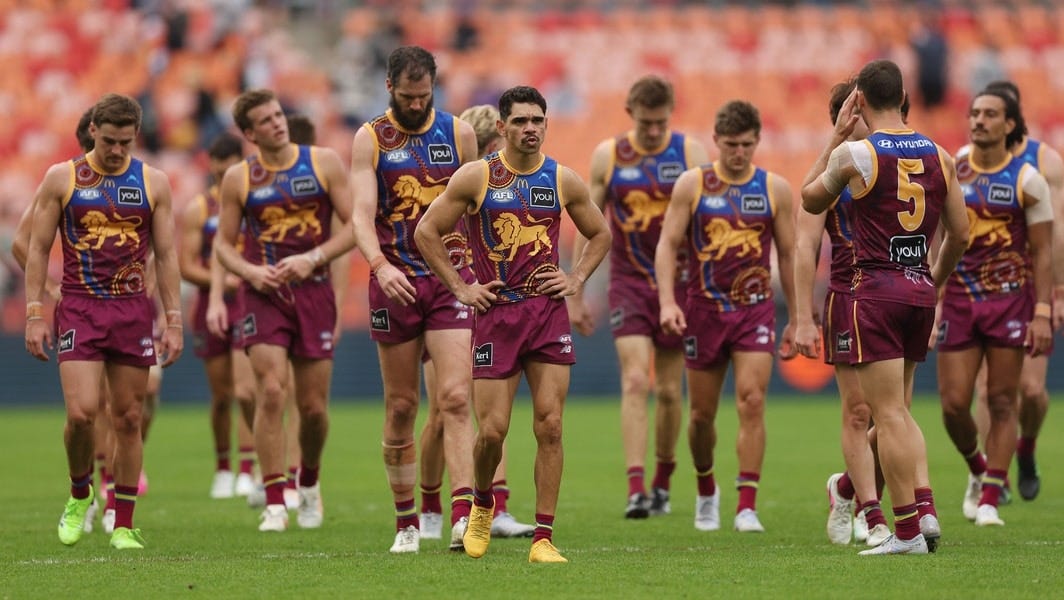
Perri, friend of the newsletter
The Lions’s season has been very up and down. Big wins against St Kilda, Collingwood, Adelaide and Gold Coast have been offset by close losses to Melbourne and the Western Bulldogs, and less close defeats to Fremantle, Sydney, Geelong, and GWS.
The fluctuation in competitiveness has been driven mostly by one of the longest injury lists in the AFL. At one point, the Lions just had six available players for selection outside the best 23.
As a result, there has been significant doubt from footy fans, members, and the media that Brisbane can achieve its second-ever threepeat.
The first half of the season has been worse than expected. But injuries have created opportunities for depth players. Despite the additions of Oscar Allen and Sam Draper pushing him further down the depth chart, Brisbane supporters have seen first-hand this season how good Ty Gallop can be as a backman. Much like Captain Harris Andrews who began life as a forward before becoming a defender, Gallop has shown how young players can quickly change positions while still benefiting the team in the long term.
Speaking of Draper, given his injury history at Essendon, it was fair to question what sort of contribution he’d be able to make. Instead, he’s quickly become Brisbane’s #1 ruck. Draper has been a big beneficiary of both the new ruck rules and tapping the ball down to a more capable midfield unit – his rate of hit outs to advantage has increased from 21.4% in 2025 to 34.6% in 2026, helping give his midfielders first use (the Lions are 1st in the AFL – by a lot – for first possessions at stoppages).
Given the side’s underwhelming start, it’s only natural that not every player has performed at their best. While he is often touted as a future Captain at the Lions, Fletcher has had a mediocre start to the season. Playing out of position as a defender doesn’t help him, but the Lions will need him at his best if they are to achieve the fabled threepeat. The biggest culprits, however, have been the players who make up the midfield unit. It’s partly understandable: several of them had interrupted pre-seasons and are playing through niggles. But the fact remains that they have majorly struggled, especially against the midfields of the other flag contenders. The Lions’ 25-point loss against Fremantle in Round 12 was a jarring example of how the midfield has struggled against the best in the league this season. According to Champion Data, Josh Dunkley, Hugh McCluggage, and Will Ashcroft’s output has declined significantly in the first half of the season compared to 2025. Dunkley has gone from being the 46th-rated player to the 188th, McCluggage has dropped from 12th to 180th, and Ashcroft has declined from the 38th highest-rated to the 235th. Going from an All-Australian squad member last year to being in and out of the side because of a persistent calf injury, Dunkley’s decrease in form has been the most stark of any Lions midfield player. If Brisbane are to feature in finals, the entire midfield group must lift, and the injury list must shorten.
Although missing finals from here is unlikely, this side currently looks a long way from contention. The Lions will have to dance on ice again if they’re to return to the final Saturday in September.
Perri’s grade: C
My thoughts
I’ll start with the good news: Brisbane are generating the second-highest expected score of any side, and over nine points more than last season. The attack is functioning well. Logan Morris has continued his development into one of the game’s deadliest marking forwards. Kai Lohmann has bounced back after a disappointing 2025 and Charlie Cameron has wound back the clock, silencing his critics in the process. Now to the bad news: defending is half of the game, and Brisbane’s defensive numbers have clearly deteriorated.
The Lions are currently conceding 87.7 expected points per game; 13th in the AFL. Compare that to 2025 (76.5 expected points – 8th) or 2024 (71.5 – 2nd) and the picture of a side that has lost its ability to prevent damage becomes clear. So what’s changed? Perri has identified the decline in output from the side’s champion midfield, the anchor of its era of success. But although there are semi-extenuating individual explanations (niggling injuries, an ebbing of desire after back-to-back Premierships, etc.), I always prefer finding a structural explanation. Many of the fundamentals of Brisbane’s game have remained intact: they still lead the league for marks differential and clearance differential. Few sides are as good at winning the ball and keeping it. The problem is that opposition sides have become more efficient at creating situations where the ball is in dispute, and vastly more damaging when forcing turnovers.
The Lions were 1st for time in possession in 2024 and 2nd in the same stat in 2025. This season, that’s dropped to 5th. It’s modest but meaningful. Brisbane’s distinctive kick-mark game is its first layer of defence. As the Lions’ time in possession has decreased, the opposition’s ability to punish in transition has increased. Brisbane are currently the second-worst side in the AFL, better than only Essendon, at denying its opposition from taking the ball from D50 to F50. In fact, the Lions are in the bottom three for all the major transition denial stats and – unsurprisingly – 17th for opposition scores from the back half. Rather than a single smoking gun culprit, it’s an accumulation of several different factors: the decline in time in possession, a modest decline in the Lions’ ability to win contests around the ground, and injuries. There’s also the basic fact that the Lions are the hunted. Opposition coaches have been thinking about how to unpick their game plan for two years. The evidence thus far is that they are making progress.
None of this should frighten Brisbane supporters too much. Their side copped the occasional anomalous Home & Away result even during its Premiership years. The Lions have, from time to time, given the impression they’re playing beneath their true level from March to August. This side has won a flag from outside the top four before. Hell, they’ve won a flag from 44 points down midway through the third quarter of a Semi Final before. No one will believe this side is done until it’s actually done. But it does feel slightly different this time – as though Brisbane’s players are more sated (and more injured), and their opponents more determined.
My grade: C+
Essendon
Win-loss: 1-13
Ladder position: 18th
Next four games: North Melbourne (A), St Kilda (H), Brisbane (A), GWS (H)
Anth Proc, author of the Bombers Blog
What a 12 months it has been to be part of the red and black army. Only once since Round 11 last year have Essendon supporters seen the Bombers fly up, up. The reality of the rebuild that had been discussed, and for some, not announced loudly enough, quickly became impossible to ignore.
Having watched much of Essendon’s summer training, I wasn’t alone in thinking another evolution in ball movement was coming in 2026. Across Brad Scott’s first two seasons, Essendon largely relied on a kick-mark game style, recording a handball percentage of 41.6% across 2023 and 2024 (the Bombers were 15th for kick percentage in 2024, and 18th last season). By Round 11 last year, before injuries truly began to take hold, that figure had climbed to 44.5% as the Bombers increasingly looked to support the contest with extra numbers and then link up by hand to generate possession chains.
At that stage of last season, no side in the competition was averaging anywhere near Essendon’s 145 handball receives. For context, Sydney currently leads the AFL in this metric in 2026 – with 145. The problem was that this style often invited pressure at the source, produced very little territory, and made opposition turnover scoring far too easy.
Watching summer training created optimism that another adjustment was coming. There appeared to be a greater emphasis on territory, quicker ball movement and backing in teammates ahead of the ball, resembling much of what Fremantle has shown this season: kick long to a contest, trust the forwards to either win it in the air or bring it to ground, and be predictable for teammates arriving to support at ground level.
Unfortunately, that is not what unfolded once the season began. Three games in, Essendon was once again overusing handball, with 47.6% of its disposals coming by hand.
The long kick to contest that appeared to be such a focus over summer vanished almost immediately, leaving the forwards looking up the ground in bewilderment while Essendon gained the fewest metres via kicking in the AFL, and by a significant margin.
Then there were the defensive issues. After three rounds, Essendon was allowing 146 uncontested marks per game, including 123 in transition through the back two-thirds of the ground, numbers that would have been setting off alarm bells. In Round 4, the Bulldogs had opened a nine-goal lead by half-time, setting up a significant challenge at the main break.
After the restart, Essendon abandoned the handball-heavy approach and returned to a more controlled style. The Bombers took 48 uncontested marks, working methodically up the ground and, in doing so, defending far more effectively behind the ball.
With confidence regained after returning to a previous version of themselves, Essendon headed to Gather Round, where the control method continued. Against Melbourne, the Bombers finished +57 in uncontested marks and +99 in uncontested possessions, snapping an equal club-record 17-game losing streak with a 45-point victory. It was Essendon’s biggest win since Round 11, 2023.
Yet for all the positives, it is not a style I believe will deliver reliable long-term success.
In my view, Essendon’s two best performances of the season came against Gold Coast and GWS. Those two prefer to move the ball through handball and run, creating more chaos. Significantly, they remain the only two games this season where Essendon’s opponents were forced to win more ground balls than marks [Mateo: the ratio of ground ball gets to marks is a useful rule of thumb for “control” vs. “chaos”].
Compare that to Brisbane, Collingwood, Hawthorn and Port Adelaide – the AFL’s top four uncontested marking sides – and it is no coincidence those matches produced Essendon’s four heaviest defeats of the season.
The challenge for Essendon in 2026 has been finding a game model that is both competitive now and capable of developing the next generation at the same time. Unfortunately, the second-youngest and second-least experienced side in the competition has been unable to find consistency in most facets of the modern game.
While there have been occasional signs of improvement, the fundamentals haven’t improved enough for long enough. Eventually, after a disappointing second consecutive loss to Richmond, the club reached a conclusion many had seen coming. Brad Scott’s tenure came to an end.
From my perspective, the decision itself was justified. Many of the defensive metrics I track had trended in the wrong direction over his final 46 games, including opposition transition from defensive 50 to inside 50, opposition scores per inside 50, intercepts per opposition possession and points conceded from turnovers (the list goes on).
While most associated with the club appeared aligned on what would be required to compete with the best sides in the competition long term, turning that vision into high-level performance proved a different challenge altogether. It was fair for stakeholders to question whether Scott was the coach capable of delivering it, and not unreasonable that they decided he wasn’t.
What remains more debatable is the timing. With only three games remaining before the mid-season bye, the decision inevitably left those remaining to pick up the pieces scrambling to manage both coaching changes and on-field priorities simultaneously. The same decision could have been made with much less disruption three weeks later.
The coaching search itself will dominate discussion throughout the second half of the year. I could write thousands of words on potential candidates, club politics, media speculation and Essendon’s history of football department appointments, but that discussion misses the bigger point: whoever gets the role needs to be the best available coach. More importantly, they need to be surrounded by the best people possible.
For all the disappointment of 2026, the brightest moments have almost exclusively come from the younger brigade. Sullivan Robey has helped transform Essendon’s stoppage profile. After four rounds, the Bombers sat at a cumulative clearance differential of -53. Since his introduction, that number has improved to +33. His contested work pre-clearance has also been a significant factor, with Essendon going from -40 to +32 in that area over the same period.
Dyson Sharp immediately translated his under-18 traits to AFL level when given greater midfield responsibility against GWS in Round 9. Before injury cut his afternoon short, Sharp had 17 possessions, 10 contested, seven at pre-clearance, and converted four of his five first possessions into effective clearances in only 40 minutes of football.
Behind the ball, Jacob Farrow and Archie Roberts have shown enough to suggest both can become important pieces of the future. A system that better rewards their vision and kicking skills should allow them to play with greater confidence and aggression.
Further forward, there are also genuine reasons for optimism.
Nate Caddy ranks 15th in the AFL for marks inside 50 and ninth for shots at goal despite Essendon sitting 17th for inside 50s. Archer May is already inside the top 10 forwards for front-half contested marks, while Isaac Kako finished the first half of the season in the AFL’s top 15 for post-clearance inside-50 groundball.
There is talent. The challenge now is creating an environment where it can flourish. While wins would provide a welcome reward after an extremely difficult season, development must remain the primary focus.
Anth’s grade: D-
My thoughts
Part of what Anth’s review correctly identifies is that Essendon’s current ladder position makes the win-loss record a poor measure of success. Realistically, the Bombers are unlikely to win more than one game for the remainder of the season. If it doesn’t happen in the next four fixtures, it probably won’t happen. There will probably be more heavy defeats. Supporters should acquaint themselves with this year’s draft cohort.
Results can’t be the measuring stick. Instead, as Anth suggested, Essendon supporters – those brave enough, or masochistic enough, to keep watching – should focus on improvement in defensive metrics and the development of what suddenly looks like an exciting crop of youngsters. Essendon’s defensive numbers across the last five games have modestly improved. In that time, the Bombers are 14th for opposition chain to score, 15th for opposition D50 to F50, and 6th for opposition expected score. The softness of the fixture across that time (Essendon has played Carlton, Richmond, and West Coast in the last five) makes me sceptical that it’s anything other than a biased sample.
The reality is that, although one can quibble the exact timing, sacking Brad Scott was the right call. His Essendon side was shockingly poor defensively, to an extent I don’t believe can be wholly attributed to injuries. The Bombers played in small spaces while allowing their opponents to play in large spaces. Sure, it may have looked comical – the desperate act of a desperate club. But footy clubs can’t allow themselves to become hostages of the past or of public opinion.
The challenge will be whether Essendon is a mature enough club, with a sufficiently robust decision-making framework, to make better decisions from here. The early evidence is not encouraging. Dean Solomon was a curious choice of interim coach given his culpability for the side’s defensive woes (he was appointed as the assistant in charge of the backline and team defence, after serving on the club’s Board of Directors in 2025). The apparent chase for James Hird… well, there’s little point in me re-prosecuting arguments that have already been made hundreds of times in both directions. It’s possible Hird is a good coach who has kept up with the vanguard of modern tactics. I think the more likely explanation is that he believes he still has unfinished business at the club where he remains enormously popular with fans and influential with coteries. Regardless of the identity of Essendon’s next coach, the long-term mission remains the same: develop the young players, retain enough mature bodies that the floor doesn’t fall even lower, hit the draft heavily, and gradually rebuild the prestige of this fallen old club. There are no shortcuts, only a long road. It will involve a fair amount more pain.
My grade: D
Sydney
Win-loss: 12-2
Ladder position: 2nd
Next four games: Brisbane (A), Western Bulldogs (H), Fremantle (A), Adelaide (H)
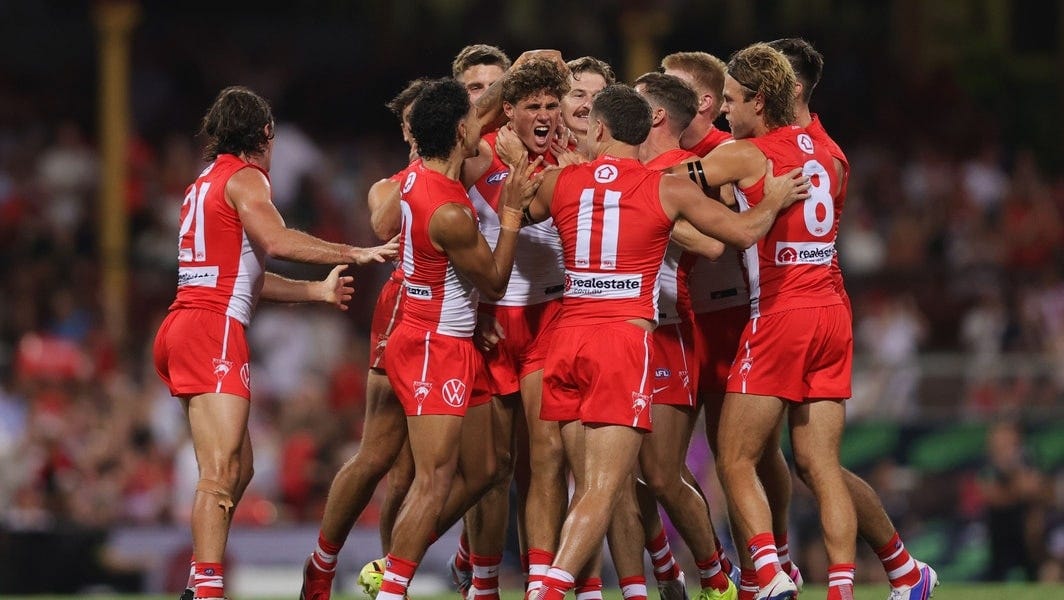
Joe Cordy, This Week in Football contributor
Losing consecutive Grand Final appearances, particularly four, can really warp your relationship to success. I don’t know if the dynamic switched after the second, third or fourth loss, but at some point the potential of going to another big dance became more ominous than exciting. “Could we do it?” gave way to “I can’t do this again.”
I’m aware of how this looks to opposition fans and I appreciate the offers for ever-smaller violins providing ever-sadder soundtracks, but like I said, it warps your relationship to success.
Unfortunately that’s about where Swans are 14 games in: 12-2, entrenched in the top two, and aside from a couple of long-term injuries, everything going about as well as you could reasonably expect. To my eye, there are three key factors that have gotten us here and make me quietly confident (and uneasy) about playing in the last game of September.
The first is the integration of the new blood, both from within and without the club. I’ve told anyone who will listen that I’m not sure how I’m meant to explain to my currently eight-month-old son that I was once something called a “Charlie Curnow defender”. His goal contributions, both direct and indirect through the space he’s created for players like Amartey, have been awesome but expected; what I will admit I was reserving judgement for was his off- and ground-ball work, both of which have been impeccable. Jai Serong and Will Edwards have brought the depth of big-bodied defenders we’ve been crying out for since the loss of Paddy McCartin and end of the Will Gould experiment, and Malcolm Rosas Jnr. has been a genuine revelation.
The second is how much more mature we are off-the-ball and defensively, particularly when the run of play is going against us. The 2022 and 2024 teams were like bad window washers – streaky. They looked like Showtime Lakers going one direction but the worries about their porous defence, need for clean ball movement and tendency to fall behind at the start of games were fully realised in both Grand Finals. The current iteration have sacrificed some of that liquid ball movement and high-volume scoring but are overall so much stronger in defence because of it. Part of it is just having more talented players on the field. But a lot of it is how much the rest defence has been helped by the pivot from precision kicking to forward handballs and overlapping runs to break through the middle of the field. When it doesn’t come off, we’re already right in the opponent’s face to win it back.
The third is the pending return of Errol Gulden for the run-in. He’s the key to everything. Heeney’s athletic ability and nous make him our clear best player but Errol is arguably our most important. The way he coordinates the rest of the side particularly around stoppages is only paralleled by Callum Mills, and his vision for how the game is about to unfold is peerless within the side. This isn’t to say that his eye-catching highlight reel stuff isn’t more impactful, direct actions always are, but where that can be recreated in the aggregate by the rest of the team, his indirect work is irreplaceable. When he went down, the hope was just to be in touch with the top four so that we could mount a charge for a double chance upon his return, so to be in a position where we can cruise (relatively) comfortably to top two just from breaking even in the remaining fixtures is an immeasurable boon. It takes the mental pressure off of each result and provides room to experiment with lineups and tactics ahead of the finals.
The ceiling on this team’s potential performances week to week is as high as it’s ever been, and the floor hasn’t been so high in a decade. Cox has a plan, it works, and it can survive losing key players. There’s every reason to believe we can go deep into finals, again.
I cannot overstate how stressed I am.
Joe’s grade: A+
My thoughts
Across pre-season, Errol Gulden spoke about how the Swans wanted to put more speed on the ball in 2026. In my season preview, I hypothesised that that greater speed would most likely manifest as less time spent at half-back and more decisive corridor release but probably wouldn’t see the Swans become more frantic with the ball. Well, I was correct enough on the first two, but very wrong on the third! The Swans have executed the boldest in-possession changes of any side in the AFL. Consider this: last season, the Swans were 8th for marks and 5th for kicks as a share of disposals. This season, they are 18th for marks and 18th for kicks as a share of disposals. They are also 1st for handballs and handball receives and, as has been widely remarked upon, they top the league for handball metres gained. The increase is extraordinary. Last season, Sydney gained an average of 177.7 metres by hand per game. This season – 695.2. They have gone from being conventional to being an outlier.
Thus far, it’s been a smart gamble. Sport is replete with examples of sides that have leveraged short-term tactical advantages to their benefit. I suspect embracing such an extreme change in game style has been responsible for a large amount of Sydney’s return to the top reaches of the ladder (I pity the poor opposition analysts who had to report on Sydney’s game plan in the first month of this season). As Joe alluded to, it’s plausible that the pivot will make Sydney more robust when the whips are cracking in September. The 2024 Swans were too reliant on clean ball to function. That side was 14th for forward-50 ground ball gets. This side is top for the same statistic. Defensively, too, prior Sydney sides, even those that made Grand Finals, tended to be clever but brittle, and relied too heavily on dominating possession to prevent opposition scores. This one – admittedly, only halfway into the season – looks more robust. The Swans are currently 3rd for opposition shots per inside-50 entry (they were 14th in 2024).
This side has also not been cruelled by injury to the same extent. Gulden, captain Callum Mills, and Logan McDonald all missed significant time in 2025. This season, McDonald no longer needs to shoulder the burden of being the main forward, and the side was able to string together good results and performances despite Gulden’s absence. He is almost certain to return this week against Brisbane.
These Swans are good. They play an unusual and unusually explosive brand of football. I suspect pundits are probably overindexing on the fragility of past Sydney sides that have failed on the biggest stage. But it’s true that this version hasn’t truly been stress-tested yet. The next four weeks, which includes games against Brisbane, Fremantle, and Adelaide, will teach us much more about them. I’m not yet convinced that they’re better than the rest of what currently looks like a very even top four. But I’m equally unconvinced they’re any worse. The Swans have the talent. They have the game. What remains to be seen is whether they have the mettle.
My grade: A
Enjoying this mid-season report card? Share it with a friend?
West Coast
Win-loss: 4-10
Ladder position: 16th
Next four games: Carlton (A), Adelaide (H), Western Bulldogs (A), Brisbane (H)
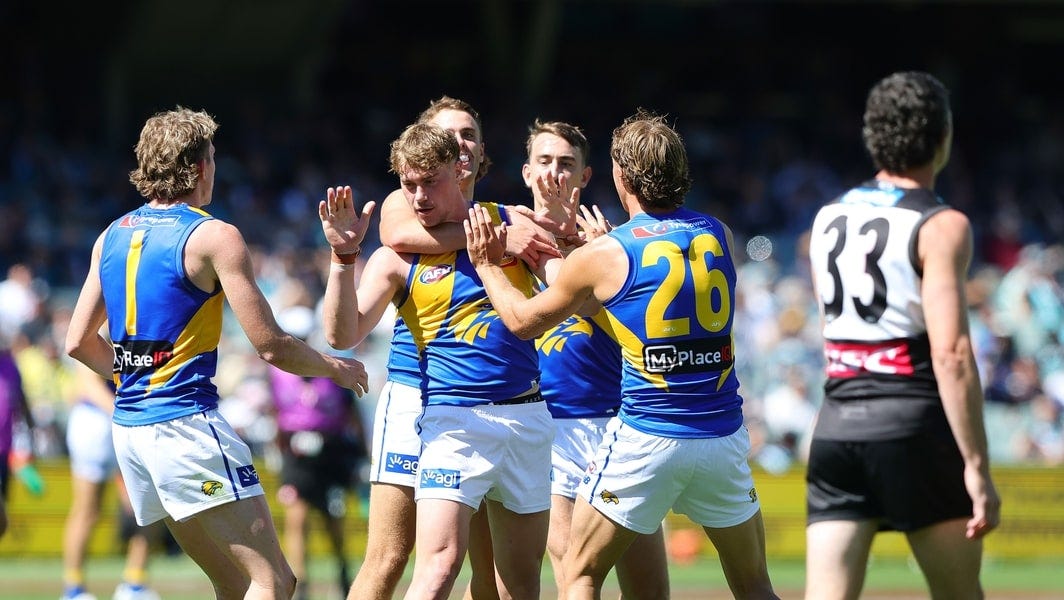
Man Seeking Merry Hell, This Week In Football contributor and newly-minted footy substacker
2025 always felt like something of a ‘Year Zero’ for Andrew McQualter. He arrived at a club undergoing one of the deepest clean outs in recent history, promising a game plan seemingly designed to be the polar opposite to his predecessor.
What was already one of the youngest teams in football became further unrecognisable by the time West Coast’s bye rolled around, thanks to the in-season retirements of Jeremy McGovern and Dom Sheed, and trade speculation looming over captain Oscar Allen. Things quickly became an exercise in getting minutes into the legs of a few key pillars, then holding on for dear life.
Flash forward to bye week 2026, and the Eagles have taken some big strides, moving from ‘historically bad’ to ‘still not great but having an honest dip’. Crucially, the gameplan we were promised upon McQualter’s arrival is showing genuine signs of life, built around taking field position and building pressure through repeat inside 50s.
While definitely more interested in process than results, I had five wins as an indicative pass mark for the season. With four under the belt, West Coast is well on its way. The year thus far can be divided into three. The opening three rounds, where a 2-1 record led by a raft of highly drafted kids and the unearthing of Milan Murdock had fans rubbing their eyes in disbelief.
Then came a 21-goal home defeat to Sydney. There were still moments to savour, such as Willem Duursma and Jobe Shanahan joining a growing list of reasons to be excited about the future, but the loss of defensive anchors Jack Graham and Dev Robertson left the Eagles far too brittle against the league’s best (…and St Kilda) [Mateo: aggrieved Saints fans, take it up with MSMH].
From the day the fixture was announced, the period on which to judge McQualter and his Eagles was Round 8 until the bye. It started as poorly as imaginable, throwing away a home game in grim fashion to a previously winless Richmond – the clear low point of 2026 despite the two 100+ point defeats.
However, from Round 9 onwards, West Coast has suddenly looked like a real team, consistently playing the game on their terms for the first time in years. Over the last five weeks, the Eagles rank #1 in the league for time in forward half, with a defence rated #1 in D50 transition, and #2 in metres gained.
While the majority of list improvement is still predicated on patience, it’s been a breath of fresh air to see healthy veterans own their roles. In addition to the biggest find of the season, the aforementioned Murdock, Eagles fans have enjoyed Bailey Williams taking full advantage of the new ruck rules, and the renaissance of Tim Kelly. We’ve also seen our fair share of interesting magnet moves (see: Brady Hough reinforcing the midfield in a tagging role, and lifelong defender Tom Cole’s redeployment as a goal-kicking pressure small forward).
There’s still no team in footy more reliant on one player than West Coast and Harley Reid [Mateo: Port and Zak Butters??], whose strong pre-season and growing in-game maturity (yes, I’m serious) has taken his output to a new level while revealing him as a surprise mentor among the club’s youngest players.
It can’t be ignored that most of the improved performances have come against teams ranging from wildcard hopefuls to outright bottom-two fodder. But equally, recent losses by 10, 6, and 1 mean that, with a bit of luck, the Eagles could be wildly over-performing on the ladder.
There’s still plenty to be solved; we’ve seen no reliable method of scoring from D50, and Reuben Ginbey’s season ending quad injury compounds Harry Edwards’ highly uncertain future. The club is likely to search for a key defender during the trade and draft period.
A poor run home will see tensions return but, for now, it seems as though West Coast has set itself up for a period of natural growth. Steal one or two wins before the offseason and it cements what we’re starting to suspect; the Eagles are finally stirring from their long slumber.
MSMH’s grade: B-
My thoughts
The Eagles have lost two games this season by more than 100 points. They have lost to Richmond – at home. And yet, I think things are looking up and that, furthermore, that’s a fairly widely held view among West Coast’s supporters. I wrote in my 2026 season preview that Andrew McQualter would be looking for progress in key indicators of his game model: scores from forward half, turnovers forced, and post-clearance contested possessions. Improve them, and a jump up the ladder (well, perhaps a step up) was within reach.
At first glance, those indicators have recorded modest progress, but not necessarily the sort you’d associate with West Coast’s clear improvement. The Eagles are 13th for post-clearance contested possessions after being 16th in that stat in 2025, 13th for intercept possessions (same as last season), and 16th for forward half scores. But, as Man Seeking Merry Hell suggests, the improvement has really happened over the last five games. Here’s a sample of how the Eagles are faring in some metrics over that timespan:
8th for scores from turnover
3rd for scores from forward half
16th for opposition contested possession share
2nd for opposition for disposal retention
2nd for opposition marks
3rd for opposition scores from turnover
2nd for opposition D50 to F50 success rate
What unites these statistics is how closely correlated they all are to McQualter’s high-pressure surge and turnover style (that he learnt as an assistant to Damien Hardwick at Richmond). The Eagles are getting better at forcing turnovers in dangerous areas of the ground, converting those turnovers into scores, denying their opposition easy uncontested possessions or marks, and successfully applying frontal pressure to stymie opposition ball movement. That’s the blueprint: apply tremendous pressure at ground level, patrol the skies, and surge forward following contest wins. And there’s real evidence it’s working. It’s not at all unthinkable that the Eagles could have won four or perhaps even all of their last five games. It should be said that, as bad as West Coast was last season, it was never really “one-win season” bad. The Eagles were unlucky, going 0-4 in games decided by 10 points or fewer.
It’s always worth asking how much of a rebuilding side’s improvement is being driven by older players enjoying a late-career resurgence and how much of the work is being done by younger players. Tim Kelly, Elliott Yeo and Liam Baker have been the Eagles’ three highest-rated players across the last 20 games. None are young. But you’re allowed to have senior players play well. It’s not illegal! And, crucially, any honest accounting of West Coast’s season would conclude that the club’s young players are pulling their weight. Willem Duursma has taken to senior footy like a duck to water. He looks every inch a number one draft pick. Harley Reid has shaken off his second-year blues. Jobe Shanahan has star attributes. Tom McCarthy and Milan Murdock look like excellent low-cost additions. Reuben Ginbey might not be a midfielder, but has become a very good hybrid defender. Early signs for Marcus Herbert and Josh Lindsay are encouraging. Dev Robertson and Brandon Starcevich look like good soldiers. The outline of a very good list, youth supplemented by reliable experience, is beginning to come into view. Chad Warner and Mitch Georgiades could well join as free agents next year.
What needs to happen in the Eagles’ final nine games to make the season an unqualified success? Another win or two will maintain supporter optimism without spoiling what looks like yet another tasty draft pick (the Eagles have games against Richmond and Collingwood to come). Results are good, but performances probably matter more at this stage of the build. McQualter will want to see the strong performance in the statistics I cited earlier continue. Regardless of what happens, Eagles fans should feel confident that things are finally trending the right way. Something is stirring out West.
My grade: B
I’ll be back later this week, or early next, with thoughts on how Geelong, St Kilda, Melbourne, and the Western Bulldogs are travelling.