


I’m looking for a sponsor. Click for more information.
Finally, we wave goodbye to the byes. One imagines the AFL and broadcasters have run the numbers and concluded that staggering the byes over five weeks is the commercially superior option. But doing it this way lets air out of the season precisely at the point where things are already a bit of a slog. It also feels like yet more inequality layered over the top of an already unequal fixture. Why did Melbourne, a side which didn’t feature in Opening Round, and so therefore didn’t benefit from a bye within the first month of the season, have to wait until Round 16 for its first break of the season? The most elegant solution is also the one the AFL is least likely to adopt: give the whole league a week off and encourage people to go see their state or local league side. Or, God forbid, unplug from footy for a week.
I suppose I should be grateful: staggering the byes over five weeks has enabled me to compile these mid-season report cards. This final instalment considers the fortunes of four clubs separated by just three wins but vastly different narratives. Geelong remains steadfastly Geelong: clever, constant, inevitable. Melbourne has been perhaps the season’s biggest positive surprise: effervescent risers when most expected them to sink. As in theology, so in footy, the Saints are the mirror image of the Demons. Big name recruits created big expectations that have been partly fulfilled on the field but not on the ladder. The Bulldogs are perhaps the biggest enigma of all: good-ish when most expected them to be great, but significantly diminished by the loss of Sam Darcy. Each side is negotiating its own path to contention in its own way. Before we get into the meat of this week’s instalment, a short and sincere thank you to everyone who contributed their thoughts about their side’s progress. You’ve taught me things about your teams. Let’s get into it.
Geelong
Win-loss: 9-6
Ladder position: 4th
Next four games: Brisbane (H), GWS (A), St Kilda (H), Melbourne (A)
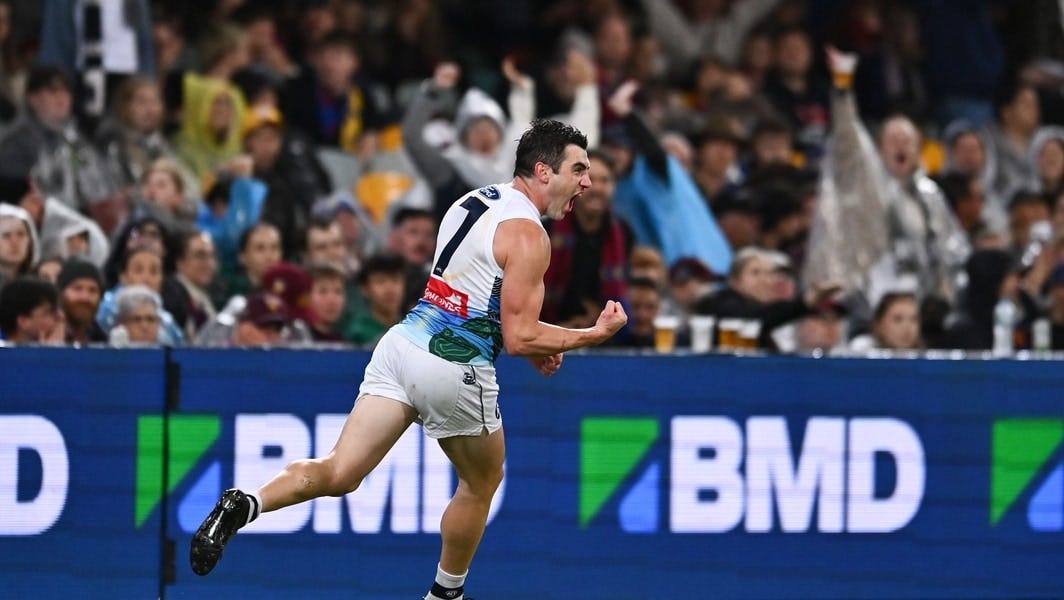
“We won’t make it past a Prelim.” Spend enough time around Cats fans and you begin to understand how sustained success over a long period of time can erode a sense of appreciation for the journey between trophies.
The pessimists may be right. Perhaps the Cats will go no further than a preliminary final this season. Perhaps they might fall sooner, and then the anti-Scott crowd (yes, they do still exist) will fire up as the “faithful” bemoan another flag scattered away to the winds of time.
I tend to think Geelong has managed itself to a 9-6 record pretty well, negotiating a ferocious fixture, a string of lingering injuries, and a gentle turnover of the list as the club positions itself for future flag tilts with fresh faces at key positions.
While the likes of Blicavs, Dangerfield, Cameron and Stewart are headed for the last season or two of their careers, Geelong’s next generation is taking shape. With Jeremy Cameron’s effectiveness lessened due to his lingering arm issue, future spearhead Shannon Neale has averaged career-best figures in marks, goals and goal assists, including a breakthrough seven mark, two goal, three goal assist performance against long-time problem team Brisbane.
A precipitous drop in form for Brad Close has opened the door for VFL goalsneak Oliver Wiltshire to claw his way into the side. His tackling numbers need to increase to ensure he stays locked in the team, but he’s booted five goals in his last two games and begun to look more comfortable at the level.
Bailey Smith and Max Holmes have been predictably excellent again, but Geelong could scarcely have dreamed that young ruckman Mitch Edwards would make such massive strides in his first season as an AFL starter.
Down back, Connor O’Sullivan rules the air, and Lawson Humphries controls the counter-attack, while Sam De Koning is beginning to transform into the next Geelong Swiss Army knife as the post-Blicavs era approaches. All that without mentioning arguably Geelong’s most exciting star of the future, Ollie Dempsey, or a VFL side that sits atop their ladder with just a single loss despite being pillaged of two standouts at the mid-season draft. The future is bright.
The truth is, Geelong is continuing to win despite being in the midst of a fairly significant list transition. In their 41-point win over Brisbane at the Gabba, the Cats started 12 players who weren’t on the field during their last flag triumph. During the nine-point road loss to Fremantle, the Cats fielded 14 such players.
Despite the change in personnel, Geelong’s very best has proved capable of beating the competition’s very best teams. Consistency has been the issue, with the Cats struggling to find their best more often than a few other top four contenders. At their best, the Cats hunt in packs, attack like lightning, and choke opponents out of the game with their marauding swarm of headband-clad interceptors. At their worst, they fail to link up inside 50, lack cohesion defending their front half, and are scored against freely on the counter and from stoppages.
Geelong in 2026 has been shifting the blocks on its Rubik’s Cube, working out how to configure itself into a flag-contending form. The Cats own some of the season’s most head-scratching losses, but also some of the campaign’s most impressive wins. Brisbane out of the Bye won’t tell us everything about the 2026 Cats, but I believe it will give us some clues as to what they can achieve by season’s end. The future, and the here and now, remain pretty bright.
Jake’s grade: A-
My thoughts
Be honest: are you surprised by any of this? Geelong being around the mark, turning over its list, demonstrating its recruitment and coaching remains best in-class, while being linked to high-profile free agents come the end of the season? No, because the Cats have made brilliance look boring. Only the most partisan supporters would deny the systemic advantage created by a true home-ground advantage paired with a Victorian side’s lighter travel itinerary. But equally, for all except those who believe that Geelong’s ongoing defiance of gravity is the product of a massive ongoing conspiracy, you have to hand it to them.
You want to know the secret? It’s not the farms. It’s not the local media cartel. It’s the stability, and the trust that stability and success create. That’s why Geelong’s recruiters have a spectacular strike rate in the hinterlands of the draft, why youngsters serve multi-year apprenticeships in a successful VFL program without a peep of frustration from fans, and why the club remains such an attractive destination for out-of-contract stars seeking success (and affordable farmland). Replacements for key first-team pillars are identified and developed years in advance. Duds are quickly ushered out the door (be wary of any player the Cats are willing to let go). Stars are lured on the understanding that their output is worth more than the potential of a draft pick. This is the blueprint for consistent contention.
This year’s Geelong is similar to last year’s incarnation. The operating principles remain the same: a strong intercept game franked by power running, verticality, and clever forward-half scheming. The Cats are handballing a little more and taking a touch less risk and distance with their disposals. They’ve slightly regressed in their clearance work but remain formidable in the turnover game, which is where modern footy is played. The knocks, such as they are, are outcome-based rather than procedural: two one-point losses (to Hawthorn and Adelaide) mean that finishing in the top four is merely “very likely” instead of “almost certain”. Jake is right to note the side’s personnel evolution. Jeremy Cameron’s modest decline has been replaced in the aggregate. Tyson Stengle may have played his last game for the club. That’s fine, Jack Martin and Ollie Wiltshire can replicate his output. Connor O’Sullivan isn’t particularly flashy, but he’s also a likely 300-game player in a high-value role. These are the dividends of stability and strategy. I wrote in my season preview that the Cats are footy’s index fund: rarely “exciting” in the boom-and-bust sense, but always prudent, always dependable, always there. I’m not sure if they’re the best team in it. But they’re part of a group of four that looks clearly stronger than the chasing pack. They will be there when the whips are cracking. Maybe forever.
My grade: B+
Melbourne
Win-loss: 9-6
Ladder position: 7th
Next four games: Hawthorn (A), Richmond (H), North Melbourne (A), Geelong (H)
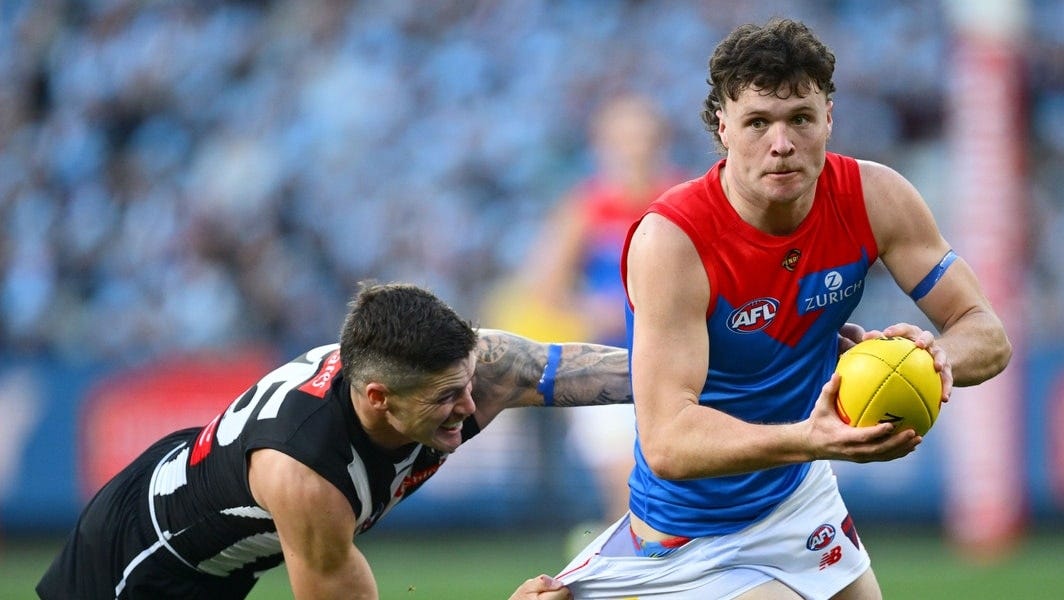
Emlyn Breese, This Week In Football contributor and friend of the newsletter
The easiest measure of this season is the degree to which expectations have changed. Coming into 2026, most Melbourne supporters wanted to see two things: evidence of a clear game style, and development of the younger players (a record ninth All-Australian selection for Max Gawn wouldn’t have hurt either).
Sitting now having (finally) reached the bye, we’re ready to have our hearts broken. Finals are no certainty, but they’re now the expectation.
Just three bad losses and a 3-4 return against the current top 10 is very respectable, and if you can only play one ground well, the MCG is the correct choice.
Red and blueprint
Steven King shares a central football tenet with his predecessor: territory is more valuable than possession.
In 2026, Melbourne is ranked 4th-lowest among all sides for time in possession differential and 5th-highest for time in forward half. This kind of mismatch reveals something about a team’s footy philosophy. If we look at the time in forward half you’d expect a team with a given time in possession to have, four of the biggest positive outliers are Melbourne – 2022 (9th), 2025 (6th), 2023 (5th), and this year at 3rd.
How are Melbourne gaining that territory though? That’s where, although there are echoes to the peak Goodwin years, the differences from last year become obvious.
Last year, Melbourne became a safe kicking team. This year, King has brought back the low-retention, high-threat kicking strategy of 2021-2023. Sydney and Fremantle both find themselves in the top 5 for xThreat and bottom 5 for xRetention. It seems a philosophy suited to the attacking-friendly rule set of 2026.
Of course, there are some big differences. Sydney and Fremantle rank 1st and 3rd for Handball receives, while Melbourne are 16th. When Melbourne do use handball, they’ve become more expansive than under Goodwin. They’re averaging double the metres gained per handball compared to 2021-23. They’re now also targeting Kysaiah Pickett with those handballs instead of Oliver, Petracca, and Viney.
Overall, the biggest difference appears to be one of freedom. Players have regularly spoken about the freedom to make mistakes in pursuing an attacking option. It’s seen them scoring 90+ points in 10 of their first 15 games, a figure they reached just eight times in 23 games last year. They’ve scored 12 points more per game while conceding just three more.
Without the ball, Melbourne are comfortable (arguably too comfortable) allowing their opponent free use. They’re deep in the negative for uncontested possession differentials and their neighbours are the properly bad Essendon and Richmond. They are bottom six for pressure acts per opposition disposal and tackles per opposition disposal, and dead last for forcing clangers per disposal. The league as a whole has seen big drops in pressure ratings in 2026. Perhaps this is King’s gambit – the rules undermine the effectiveness of pressure, so it’s best to put your focus elsewhere.
The cattle
Melbourne’s best 23 saw significant churn in the off season. The midfield was the deepest hit. Petracca and Oliver are gone, while Viney hasn’t been sighted due to injuries. The backline wasn’t unscathed either, the best full back I’ve seen wear red and blue, Steven May, is gone, as was young fan favourite Judd McVee.
So, who is filling the void? To start off, the really obvious answers. Max Gawn and Kysaiah Pickett are more important than ever to this team’s performance. Max Gawn is 35 this year and currently averaging his career highest rating points despite being played out of position in multiple games. The man is a freak and in my, admittedly very biased, view a clear-cut #1 ruck of all time. Kysaiah Pickett has taken his game to another level. When Melbourne utilises him, he is a nigh unstoppable force. His combination of extracting the contested ball himself, moving out of traffic, and then using it well is, in my opinion, unmatched.
Elsewhere, Kade Chandler has gone from a handy role player to the second most important part of Melbourne’s ball movement behind Pickett. His recent choice to opt out of free agency and sign a five-year contract extension was a boon for the build. Jack Steele and Brody Mihocek (before his horrific injury) have slotted in as exactly what their respective lines needed. Daniel Turner looks like a key defender to build around, while Jake Lever is recapturing his previous form and staying on the park.
There’s a trio of runners that have looked really well suited to King’s game plan. Harry Sharp went from a seeming permanent sub to a vital part of the group. Jai Culley (before his ACL) and Harvey Langford have created really awkward matchups for opponents with their combination of aerobic capacity and overhead strength. Koltyn Tholstrup and Tom Sparrow have both transformed from fringe players to an effective defensive multi-tool and a player embracing the new midfield minutes on offer.
Looking forward
The Demons looked dead on their feet the last three weeks. Getting over the top of Collingwood required them to dig very deep, and they were fortunately allowed to hold Essendon at arms-length without expending a huge amount of effort.
They came into their last game as the first team since the introduction of the pre-finals bye to play 15 weeks straight (excluding the oddities of the 2020 Covid-affected season). By the end of that game against Adelaide, they looked as tired as you’d expect them to be.
This is a young team. By median age of players selected week to week, only Richmond and West Coast are younger. The hope is the Demons return from the bye refreshed and looking like the team we saw earlier in the season. The fear is they fall away like many young teams do towards the end.
Even if Melbourne falls short of finals from here, you’d be hard pressed to not call the year a success. Kade Chandler and Bayley Fritsch have re-signed, it’s hoped Tom Sparrow will do the same soon. The side looks exciting after years of sludge. And a lot of it has been driven by players who will be there a long time. It is Melbourne, so there are still some off-season spectres haunting the place, but from the playing group themselves, the vibes are immaculate. It’s a genuinely exciting time to be a Demons fan.
Emlyn’s grade: A
My thoughts
Melbourne’s list, with apologies to Jack Steele, Brody Mihocek, and the club’s 2025 draftees, has less talent on it this season than last season. Losing Christian Petracca and Clayton Oliver will tend to do that. But this side is playing much better footy than the Late Goodwin Era, and the vibes are approximately a thousand times better. As Emlyn alluded to in his review, those two things are related. The vibes are better, partly because expectations have been reset and partly because the old guard has been moved on, which has helped a young side play with freedom, which improves the vibes, and so on. It’s a virtuous loop.
I’ve written before that “good” coaching, broadly speaking, comes in two different flavours: improving the culture and standards, or making in-game adjustments. Call it the strategic versus the tactical, or the macro versus the micro. Early indications are that Steven King has made real strides in both domains. His Demons don’t press very hard or high: Melbourne is equal-last for opposition clangers and 14th for opposition disposals per tackle. Instead, the Demons happy to sit slightly deeper and trust their defensive system and personnel to force their opponents to take tough shots on goal. Only Sydney and Collingwood boast a lower expected score per opposition shot. The Melbourne is exceptionally good at winning ground-level contests in its defensive 50 and using those wins as a springboard for sweeping counterattacking chains. I feel like I’ve seen Melbourne kick a goal from a move which begins inside its defensive half and features some combination of Kysaiah Pickett, Kade Chandler, Harry Sharp and Harvey Langford (at the MCG, of course) about 50 times this season.
What’s impressed me most about King’s start to coaching life is how quickly he’s added an attacking layer to what had become a very stale game plan under predecessor Simon Goodwin. Part of it, as Emlyn alluded to, is that he’s quickly grasped what had been under-utilised strengths on his list: Sharp’s running from deep positions, Chandler’s playmaking, Langford’s off-ball finishing.
Pickett and Gawn were not, it is fair to say, unknown or underappreciated talents. Any fair accounting of King’s debut season must incorporate the fact that between them (and other veterans who’ve maintained a high level, like Jake Lever), he’s not needed to spin gold from hay. But established talent has combined well with young talent. And Melbourne’s list appears to have a good supply of both. Langford looks every inch a Pick 5 in a well-regarded draft. Caleb Windsor has improved. Latrelle Pickett’s form has flagged as he’s tired from the exertions of a first AFL season, but he’s shown enough flashes. Koltyn Tholstrup has found a new lease of life as a defensive utility after failing to convince as a mid-forward. That’s a credit to the young players and a credit to the coach who’s kept playing them. More young talent will arrive in this season’s draft: Melbourne has its own pick plus Gold Coast’s first-rounder. The latter is currently looking like a much better pick than anyone would have expected after the first month of the season. The recent record of Melbourne’s recruitment team should give supporters cause for optimism.
As Melbourne’s coaches and players finally take a few days off, the questions surrounding this side are suddenly very different to the ones being asked before the season began. Is it time for a rebuild has given way to what Melbourne can achieve this season and – suddenly, improbably – is another genuine flag tilt is in reach while Pickett and [checks notes] Gawn are in their primes? While there’s every chance the accumulation of fatigue on young bodies will see results dip after the bye, it’s clear that this Melbourne side is closer to success than most observers – except for their shrewd novice coach – had understood. It’s good times at Demonland. The snow is crap this year, anyway. The real show is at the MCG on Sunday afternoons.
My grade: A-
St Kilda
Win-loss: 6-9
Ladder position: 13th
Next four games: Essendon (A), Port Adelaide (H), Geelong (A), North Melbourne (A)
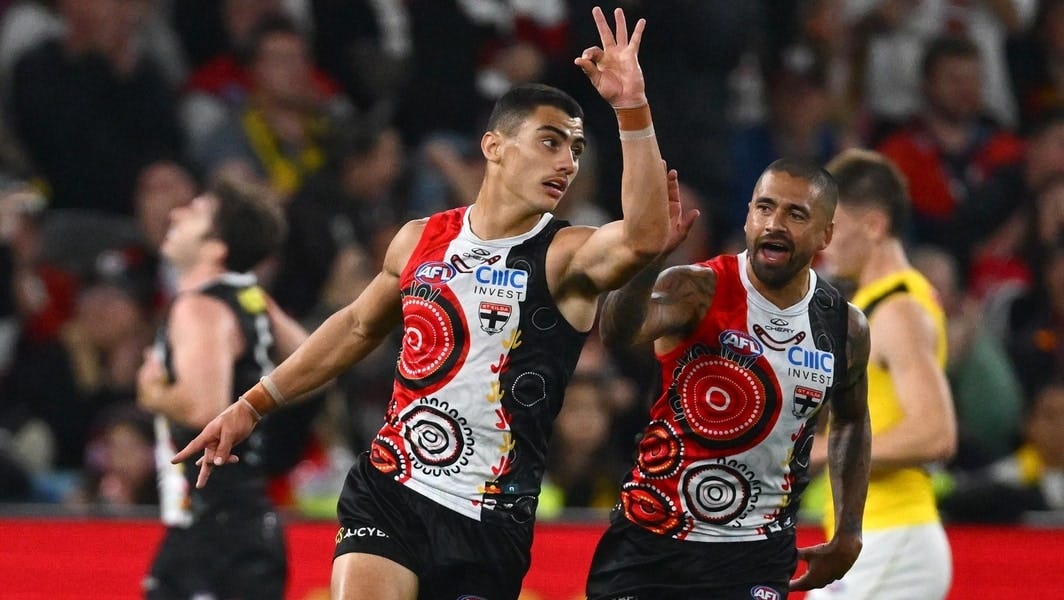
The 2026 season started with perhaps the highest external expectations of the club in the last decade. However, the messaging from the club itself was slightly different, suggesting this could still be yet another year of ‘growth’. Slightly more than halfway in, it seems as though the club was correct.
While the Saints have strung together a few ‘statement wins’ over West Coast, Carlton, and Richmond between Rounds 7 to 10, the broader story of their season has been one of agonisingly close misses. Narrow defeats to Collingwood, Melbourne, Adelaide, and Sydney has defined much of the campaign, with the semi-recent blowout loss to Hawthorn – where the Saints failed to kick a goal in the first half – being their only truly uncompetitive showing.
Beneath the frustrating state of the win-loss column, there have been some peripheral improvements that Saints fans have been desperate to see, one that is – or at least should – semi-successfully shifting the narrative away from complete stagnation, at least for now.
Jack Steele and Jack Macrae were mainstays of the Saints’ centre bounce crew last season. Steele attended 74% of centre bounces, while Macrae attended 67%. Hugo Garcia, Marcus Hindhager, and Nasiah Wanganeen-Milera (especially from Round 18 onward) would slot in depending on need and game state. One year on, Steele is no longer at the club and a declining Macrae has become a peripheral figure. Aside from the obvious inclusion of Nasiah Wanganeen-Milera, many were wondering who would step up in their absence. Currently, Hugo Garcia is taking the bulk of the CBAs and looks to have established himself as one of the best young clearance midfielders in the game, averaging 6.1 clearances (3.3 of which are centre clearances) – more than any other player under 23 and more than his former captain too.
Nowhere is St Kilda’s tactical shift more evident than in the development of Max Hall.
After registering just 34 CBAs for a 5% share last year, Hall has already quintupled that total with 173 attendances, pushing his CBA share to 40%. Furthermore, his centre clearance rate of 16.2% ranks him in the top 10 league-wide among all players with an equivalent or higher midfield percentile.
These changes have made St Kilda’s midfield much more effective and dynamic. Last year, the Saints were 14th for centre clearances and 13th for scores from that source. So far in 2026, they’re third for both. At the same time, they’ve become more efficient at scoring from stoppage clearances.
Questions about the quality and composition of the midfield have been answered. But others have emerged in their place. The Saints have bought in four players via trade and free agency: Tom De Koning, Jack Silvagni, Liam Ryan and Sam Flanders. The results have been mixed. Even before an Achilles injury ended his season prematurely, Flanders had been pushed out of the midfield. De Koning was starting to find some form despite lower numbers due to splitting his role, however he too is injured and looks set to miss a few weeks. That being said, Ryan and Silvagni seem to be fitting into their respective roles nicely, and touch wood it stays that way because the Saints will need them if they’re going to make a push for finals.
St Kilda’s run home features matchups against Essendon, Port, North, Carlton, and Richmond, all teams they defeated in their most recent encounters. However, securing a wildcard position will likely require more than just repeating those victories; the Saints will also need to steal a win against Geelong at GMHBA, or Sydney/Gold Coast at Marvel.
So what are the chances that St Kilda qualifies for an expanded finals series? Well, not great. Wheelo Ratings has the Saints with about a 40% chance to make the Top 10, and I’d say that’s not far off correct. If I were to have a guess, I think it’ll come down to percentage between 10th and 11th, this bodes well for the Saints still managing to stay over 100% despite only winning one of its last five games.
While many will argue that St Kilda should be getting more from their off-season acquisitions, it’s clear that if the Saints are to make finals from here, I’ll be because of the continued improvement from their younger players like Garcia, Hall, Wilson, Phillipou and alike; And when you think about it, that sounds like the exact scenario the club laid out earlier in the year.
Woody’s grade: C-
My thoughts
The Saints are trying to do two things – win tomorrow while contending enough today to retain the players who will hopefully contribute to winning tomorrow – in a league where it’s hard enough for most clubs, let alone one with such a history of misfortune, to do one. They have done a decent job. St Kilda has more “expected wins”, the number of wins you’d anticipate had each game played out according to its expected score, than Adelaide. However, given the scale of the challenge facing the club in the next 18 months, decent is not enough.
To very quickly recap: St Kilda, frustrated by the increasing difficulty of rebuilding through the draft in an environment where finalists often have access to its best talent, has chosen to supplement its young core with a group of mid-career and veteran players to patch holes in the list, drive short-term improvement, and persuade the brightest star of all, Nasiah Wanganeen-Milera, that his long-term future lies at Moorabbin. The contributions of the four new recruits have ranged from underwhelming in the case of Sam Flanders (although his season-ending Achilles injury gives him a mulligan), to fair (Tom De Koning), to good (Liam Ryan and Jack Silvagni). They’ve not moved the needle by far enough, nor have they been a problem.
Too much attention has been paid to the new guys, and not enough to the two unheralded names who have announced themselves as stars. Hugo Garcia and Max Hall were recruited for Pick 50 in the 2023 draft and Pick 4 of the 2024 Mid-Season Draft. They have become, if you consider Wanganeen-Milera a midfielder, St Kilda’s second and third-best midfielders. Their rise, together with Darcy Wilson becoming the competition’s most sought-after out of contract player (are Saints fans doomed for a nailbiting contract saga every year?) has largely offset concerns about St Kilda’s recent first-round drafting. Five first-rounders, including three top-10 picks, suited up for the VFL side, last weekend. You can mount defenses of all of them. Mattaes Phillipou has flashed good form at AFL level before. Alix Tauru is a kid still growing into his body. And Tobie Travaglia has been building and is likely to return to the senior side soon. But St Kilda has a narrower path to success than almost every other club. Every miss hurts. Given the context of Wilson and Wanganeen-Milera’s contractual situations, even every delayed win hurts.
The aggregate effect of the new recruits and organic improvement is that the Saints are a better team than they were last year.
As of three weeks ago, the Saints were seventh for quarters won. They are taking more risks with their kicks and forcing more turnovers. They are scoring almost nine points more per game while conceding almost two fewer points. Many of the old criticisms about coach Ross Lyon’s boring, risk-averse style are no longer applicable. His side is playing a much more modern brand of footy.
The problem is that motion hasn’t created momentum. For all the improvement, the Saints are just one win better off than this time last season. The clock is ticking – loudly – on the futures of star players. The problem is that the test wasn’t whether St Kilda has improved because the 2025 Saints were never the benchmark. The test was whether they had closed the gap to the competition’s best teams. Perhaps they have if you dig deep enough. But on the metrics that matter most to supporters and out-of-contract stars, the gap remains stubbornly unbridgeable. The Saints are still mired in what’s become all too natural a habitat: purgatory.
My grade: C
Enjoying this mid-season report card? Share it with a friend!
Western Bulldogs
Win-loss: 9-6
Ladder position: 8th
Next four games: Sydney (A), West Coast (H), Gold Coast (A), Richmond (H)
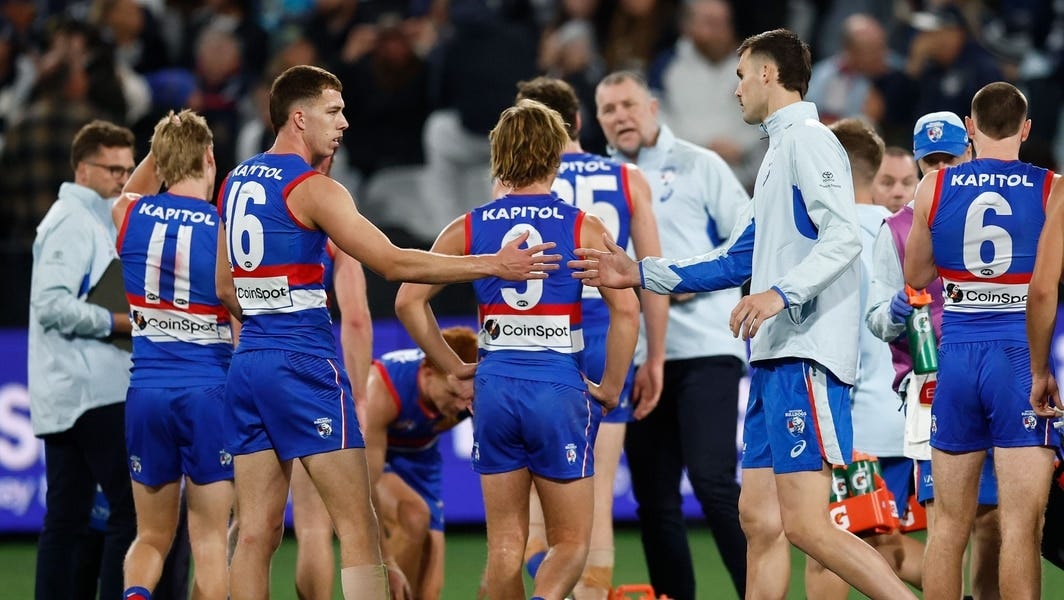
Adrian Polykandrites of From the Top Deck
Two things I probably knew have crystalised over the past month or so: we are bad at adjusting expectations, and the footy season is bloody long.
The Dogs’ impressive road wins over the Lions and Crows – which sandwiched a customary beatdown of the Giants – are a distant memory. It doesn’t even feel like the same season.
Everything changed in Geelong on that miserable Friday night when Sam Darcy’s season ended. Ten weeks on and I’m not really sure what this team is. It was never going to be the same without Darcy. It doesn’t matter, because he’s not coming back this season, so there’s no choice but to get on with it.
The record is fine – good, even. The cavalry has mostly returned, the skipper is moving normally again, and they have been able to grind out the kind of wins good teams need to grind out. The loss to Carlton was never as bad as it seemed and the win over Port was better than they got credit for. The Hawthorn win was a fluke but the loss to Fremantle – a kick in it deep into time on in the last – was one of the Dogs’ best performances of the season. They’ve had some luck in close games but they were the better team in most of those (Hawks game, again, was a fluke).
The biggest issue is that their best post-Darcy hasn’t looked nearly as good as their bad has looked bad. The Sydney loss is a write-off given the side they put on the park, but the Adelaide loss was an abomination. The game didn’t look particularly different to the first half of the Hawks game, the Crows just slammed the door shut with their kicking rather than keeping it ajar.
The profile is one of a middling team but given the fluctuation of the 23, that could mean everything or nothing: 15th for contested possession differential, fifth for clearance differential, 13th for inside-50 differential, 10th for scores from stoppages, 14th from scores from turnovers (uh-oh). They’re defending better in their back half but scoring has become a grind.
Of their best players, only Marcus Bontempelli, Bailey Dale and Aaron Naughton have been consistent(ish) across the season – and there’s an asterisk on all of them. Tim English has been great (other than the bath he was given by Lachlan McAndrew) [Mateo: respect McAndrew] or absent, Tom Liberatore has missed and been missed, Ed Richards has been up and down and was clearly playing hurt for a stretch. Adam Treloar is toast. Rhylee West has found some form after a dreadful start but is still a few rungs below his 2025 form. They miss Bailey Williams. Joel Freijah is still good and young and exciting but is finding life tougher with more required of him.
On the positive side, they’ve found a player they needed in Michael Sellwood, and Connor Budarick has been a shrewd recruit. Ryley Sanders has grown into a very capable onballer, Arty Jones has been their second best forward, and in one of the most welcome surprises of the season, Cody Weightman slotted in seamlessly. Cooper Hynes and Jordan Croft have shown enough on the wings to be encouraged, even if both will have you tearing hair out at times in the way young players do.
All in all… I don’t know. The ceiling is lower but the goal – be alive in semi-final week – should be the same. The bye has come at a nice time for them. The injury list is short, with Williams the only player certain to return to the line-up when fit. And they should be fresh for a real test against the Swans which will either answer questions or create new ones.
I just wish, once, this team would have a normal season. Alas.
Adrian’s grade: C+
My thoughts
No event has so changed the trajectory of one club’s 2026 season as violently as when Sam Darcy’s knee crumpled on that brisk April night in Geelong. When Darcy went down, so did the Dogs’ flag hopes. For a club with such a top-heavy talent distribution, every road to the flag ran through the guns firing every bullet they had in the chamber.
Darcy’s season-ending ACL injury was an especially bitter pill to story both because of the inherent tragedy of a young player being struck down and because, until then, the Dogs had been finding new ways to win. Last season, Luke Beveridge’s side was bad both at defending fast transition and slow plays. The problem was both structure and personnel. It’s not just that the blanket was too small – it’s as though there was no blanket at all. Beveridge’s big innovation this season was to drop the high press and semi-willingly concede opposition entries into a crowded 50. The bet was essentially that superior defensive numbers, and the ground ball prowess of the Dogs’ midfield corps, could create opportunities in attacking transition (which would also have the effect of giving Darcy more one-on-one contests).
The first month of the season offered good evidence for the theory. The Dogs emerged from the Lions’ den with four points despite a -13 inside-50 differential, and beat GWS and Adelaide in more conventional style (overwhelming midfield superiority and suffocating forward pressure). 4-0 looked like a perfect platform. Then came a limp Gather Round loss to Hawthorn – in a game that felt like a rerun of the last four encounters between the sides – and that dirty night down the Princes.
As Adrian says, everything changed when Darcy went down. It wasn’t just him, either. Tom Liberatore, Rory Lobb, and James O’Donnell suffered injuries in the same game. Ed Richards, who’d already been carrying a hamstring tendon injury, badly rolled his ankle in the dying stages of the defeat to Hawthorn. Truth be told, this version of the Dogs, despite improved contributions from role players like Michael Sellwood and Connor Budarick, isn’t as good as 9-6 suggests. They are flattered by a remarkable 6-0 record in games decided by a goal or less. That slightly inflated position, coupled with a relatively benign run home, may introduce some challenges in matching a bid for talented NGA prospect Khaled El Souki (and possibly the trade for Zak Butters). But that feels like small beer next to the excitement of winning close ones and the value of the finals experience for what’s still a young group.
There’s been growth through adversity. The question rattling around in my head is whether it’s reasonable for such a talent-studded side to be no better than league average with just one (admittedly, very good, very important) absence? Shouldn’t a team which still boasts the likes of Bontempelli, Richards, Naughton, and Freijah be… better? Perhaps it’s moot. This side will be different next season in a way that makes comparisons with the side they’ve been since April difficult. Darcy will be back. Butters is very likely to join. The club has signalled its pursuit of a key defender. There’ll still be important questions about talent distribution and game plan that haven’t been fully answered. But talent talks. The Dogs’ main objective for the rest of 2026 should be fortifying younger players with the experience they will need for the trials ahead.
My grade: B-
I've enjoyed these reviews. I appreciate the well written team focussed nuffie insights on their players and the fan expectations of the club.