


I’m looking for a sponsor. Click for more information.
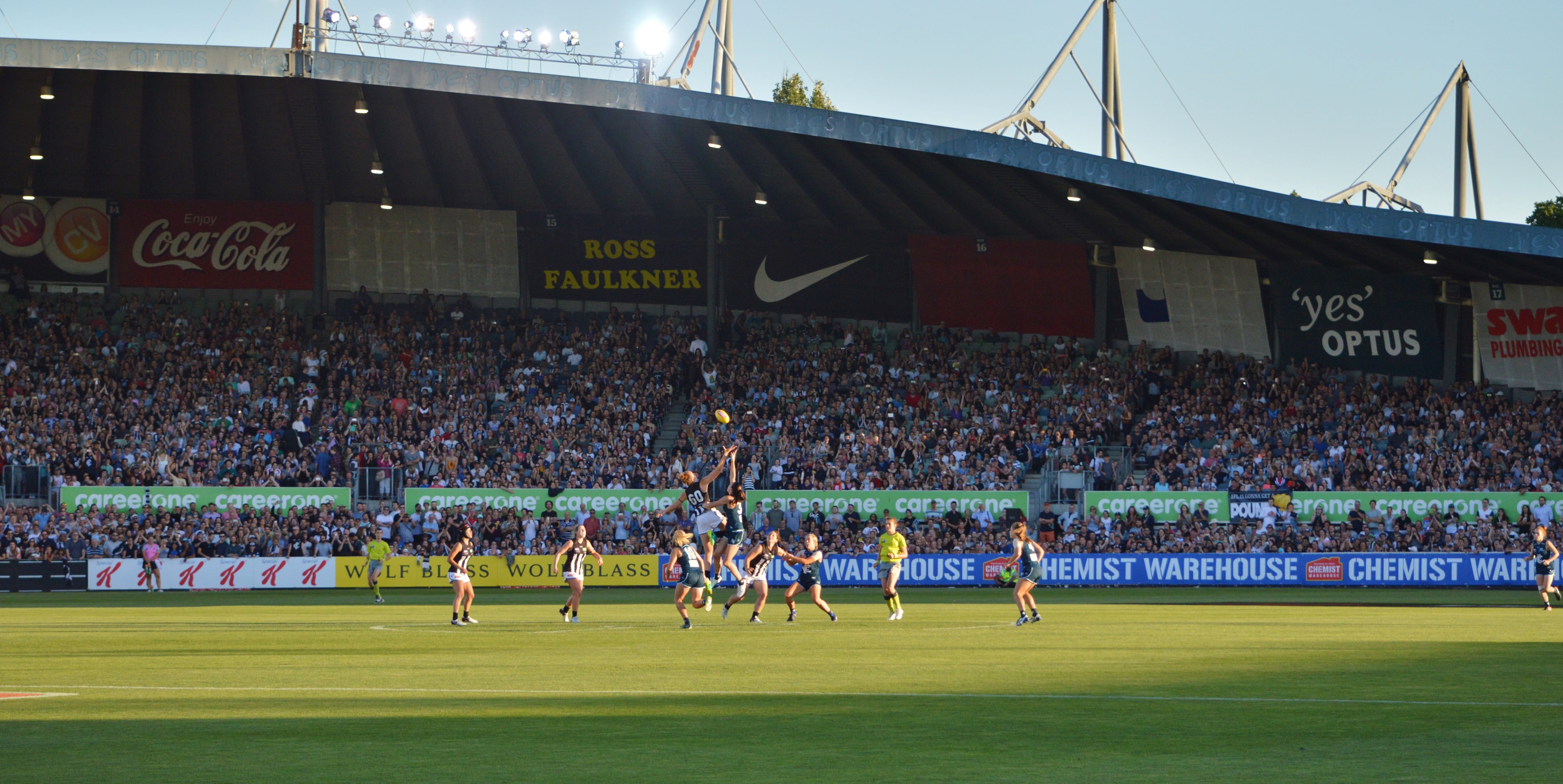
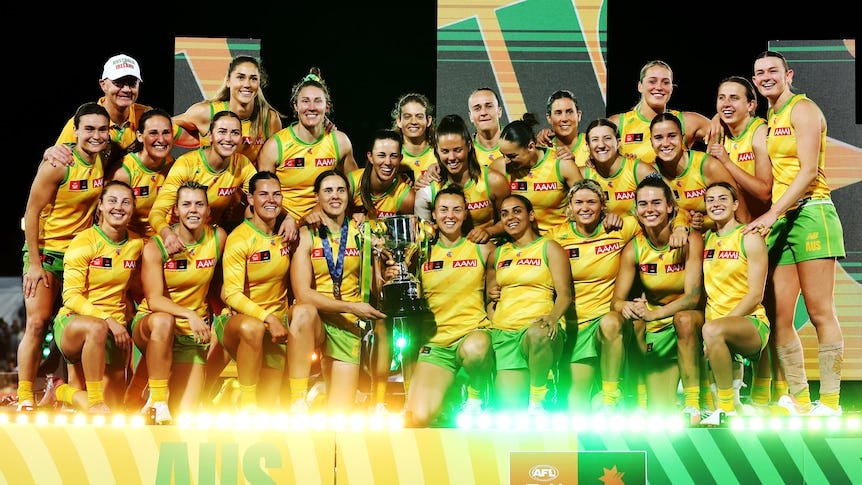
Last Saturday’s inaugural international AFLW game, between Australia and Ireland, illustrated just how far women’s footy has come in the nine and a half years since that balmy February night when supporters had to be turned away from Ikon Park before Carlton and Collingwood crossed swords. Saturday was electrifying. The Aussies burst from stoppages while the Irish unfurled elaborate running handball chains. Tahlia Randall slotted a snap on the run from 30 metres. Niamh McLaughlin, the first Irish-born captain of an AFLW club, fashioned an outrageous instinctive goal from the top of the square. Although Australia eventually proved far too strong, the 9,000 fans in attendance didn’t particularly seem to care. They were more interested in celebrating Irish contributions to women’s footy and the growth of the game. Behind the justified cheer, however, one could still discern some of the issues that have contributed to the sense that, on the eve of the 11th AFLW season, it still isn’t quite what it could be: ambivalence about the choice of venue, doubt about the sincerity of AFL House’s promotion of the game, uncertainty, in other words, less about the overall direction of travel than the league’s urgency to arrive at the destination most believe it can.
Unsurprisingly, several of Saturday’s best individual performances were delivered by women who, during the AFLW season, wear the blue and white stripes of North Melbourne. AFLW has had dynasties before, but none so dominant. Since a three-goal defeat to arch-rivals Brisbane in the 2023 Grand Final, the Kangaroos have gone 29 games unbeaten, a streak which includes 27 consecutive wins. It is a formidable record. My interview with Gemma Bastiani, writer for the AFL website, commentator for the ABC, and co-host of the W Daily podcast (so many hats!), therefore began in probably the only place a conversation about the upcoming season could: will anyone lay a glove on the champs?
“I don’t think they’ll go through the season undefeated again,” Gemma began. “Melbourne showed in last year’s prelim [Mateo: very possibly the best game of women’s footy ever played] how to beat them tactically. It’s just about doing it for long enough. I still think they win the flag, and they’re the most dominant team in the competition, but I don’t think the winning streak survives the home-and-away season.” In any elite sporting competition with an ultra-dominant side, the meta converges on finding ways to erode their superiority. You can see it in the men’s competition, where opposition coaches have designed defensive spacing and pressing schemes to disrupt Brisbane’s kick-mark game. It’s a sign of North’s dominance that predicting even a single defeat feels like a mildly hot take. But it does feel as though a blueprint to beat them – keeping them in the inside layer, denying them clean handball exits from contest – exists where perhaps it previously didn’t.
Crucially, that blueprint has been drafted and will eventually be executed by coaches that regard the AFLW as their primary vocation. In the AFLW’s early years, it felt like most coaches had either served a long apprenticeship in the VFLW and other state leagues, or were using the fledgling women’s competition as something of a stepping stone into men’s coaching. A decade in, there’s a distinct third category – coaches who understand that women’s footy is different, and appreciate those differences.
“A big part of that,” Gemma said, “is understanding the differences W actually brings. Dan Lowther [former Geelong AFLW coach] told me this about two years ago: the moment it clicked for him was realising you can’t just run the men’s game plan with women players. One, there are only 16 on the field instead of 18. There are fewer links in the chain. Two, biomechanically, the kicks are shorter and the ball is smaller, so it doesn’t travel through the air as well, so it takes more disposals and more possessions to move the ball up the ground. The moment they laid that out and understood it, everything changed in the way they moved the ball out of the back half.” Perhaps it sounds obvious in hindsight. But the differences are real: if you scale AFLW up to the length of the men’s game, there are about 20-30 more disposals per game, and two fewer metres gained per disposal. It’s not hard to see how a coach schooled in the ruleset of men’s footy might need some time to adjust their priors about what works. But in the likes of Lowther, Mick Stinear – who coached Melbourne in that epic 2025 prelim before decamping to Geelong’s AFLW side – and, of course, Darren Crocker, you can see coaches who’ve developed game plans which are well-suited for different constraints.
Beyond the basic mission of chasing down North, I was interested in understanding what Gemma saw as the main tactical themes of the upcoming season. “The big growth area in W over the last couple of years,” she said, “and something North Melbourne does exceptionally well, which is why everyone’s chasing it, is clean handball receive out of a contest. Ash Riddell is very good at it, but the league-wide challenge is finding more players who can do that. It lets you release better and get players on the run.” Gemma identified contested marking as the other one. Both strike me as attempted solutions to the same basic problem: the highly fragmented nature of the women’s game. There are fewer disposals per turnover in the AFLW compared to the AFL (3.9 to 5.6 when comparing the respective 2025 seasons). North is the best side in women’s footy at keeping the ball yet still turn it over more often, measured by number of disposals, than West Coast, the most profligate men’s side. “North Melbourne have both of those things in spades: clean handball at the contest through players like Riddell, Garner, and Ruby Tripodi, and reliable long targets like Tahlia Randall and Emma King. Having both is huge.” If you’re interested in reading more about what makes North’s AFLW side so good, Gemma’s piece in the ABC from last October is the best place to start.
Because we both have eyes, Gemma and I agreed that North will remain the benchmark in 2026. But what about other potential risers and sinkers? We’re both bullish on West Coast’s prospects this season. The Eagles made the finals for the first time in 2025. Daisy Pearce has made an impressive start to life as a senior coach while Ella Roberts has emerged as one of the stars of the league. While it’s true that their maiden finals campaign didn’t go to plan – the Eagles were smashed by Carlton in their elimination final – Gemma is confident the group has more room to grow. “Their biggest weakness is playing in the wet,” she said. “As a tall, aerial team, that changes everything for them – but they’ve actively recruited over the off-season to fix it.” In addition to acquiring three players in trades (including WA local Ella Slocombe from North), the Eagles drafted inside midfielder Mia Russo and Victorian forward Jovie Skewes-Clinton. Gemma doesn’t hesitate to name Skewes-Clinton as one of the new draftees she’s most excited to see in action. “I think she’s a real dark horse for impact this year. She can play literally anywhere on the ground. West Coast are very bullish on her, and she fits exactly what they want: flexible, tall players who can take a mark but also do damage on the ground. It’s just about finding where she can settle in her first year, because being a utility as a rookie can be disconcerting if you’re thrown everywhere. If they can bed her into one position this year and build from there, she’ll be really good.”
Unfortunately for this Adelaide-supporting writer, the Crows loom as the most obvious candidates for a decline. In truth, the decline had already started: Adelaide finished sixth on the ladder in 2025, its lowest-ever position in a complete AFLW season. The Crows have been knocked out of the finals by Brisbane and Melbourne in the last two seasons, and haven’t beaten North since 2023. Last season saw significant turnover. There’s a new coach (Ryan Davis), a new head of football, a new list manager, and Chelsea Randall and Anne Hatchard departed the club (the former forced into retirement due to persistent concussion issues). The club has acknowledged it is exiting one era of its women’s program and entering another. Gemma sees reasons for optimism. “I don’t think it’s the worst thing in the world for the Crows to take a step back. They had fallen behind the very best sides, so it’s time to replenish through the draft. There’s always good South Australian talent in the draft so I think they’ll bounce back pretty quickly.”
List management is precisely the topic I wanted to turn to next. Casual fans may have missed the news that AFLW players can now sign beyond the expiration of the current collective bargaining agreement in 2027. I ask Gemma if that’s shifting how clubs operate. “I think it already has,” Gemma began. “Eden Zanker signed with Fremantle until the end of 2029. You don’t get a player like her to move states without that kind of long-term commitment. It gives struggling clubs the ability to lure important players, but it also helps young clubs trying to find continuity.” The stability that signing players long-term helps to promote can create a virtuous cycle where it becomes easier to entice other players to join because the future looks clearer. It also gives clubs more ways to express confidence in a player long-term, with all the downstream effects that has on professionalism, not to mention the significant effects it can have on a player’s personal life. It’d be much easier to get pre-approval for a mortgage when you can show the bank a multi-year playing contract.

The next step in the professionalisation of the AFLW is the introduction, most likely in 2027, of a salary cap. Women’s footy is also being recognised within the league executive for the first time, with Laura Kane taking on the newly created role of Executive General Manager of AFLW, Health and Football Operations. It’s a slightly awkward one to spin given Kane’s redeployment was widely regarded as a de facto demotion when it was announced last year, but the silver lining is the new focus on the AFLW. I asked Gemma if those two announcements – particularly the coming salary cap – changed her beliefs about how seriously the league is treating the AFLW. “I think the cap is a realisation that the tiered pay model doesn’t work for what are increasingly full-time athletes,” Gemma said. “The old model works fine if you’re only asking players to train and perform for six months of the year, but for a year-round program, players need more negotiating power. There will probably be growing pains, because a lot of AFLW list managers have never worked with a salary cap before. I’d hope and expect the men’s list managers to lend a hand in setting those structures up, because we have a lot of list managers who are excellent at talent ID but have never had to operate outside of that.” That last point is a fascinating one. Today’s AFLW list managers are more likely to have cut their teeth as scouts and recruiters (if they didn’t come from the AFL) because list management didn’t really exist as a full-time occupation in women’s footy until a decade ago. AFL list management, as “Alex” attested in my piece from May, is a discipline with deep organisational norms. There is lots of wisdom to share.
One thing AFLW list managers must constantly be alert for is the requirement to absorb the loss of a player to a serious knee injury. It’s well-established in the medical literature that female athletes are more predisposed to ACL tears than their male counterparts. It has been estimated that ACL tears are approximately two to eight times more common in female athletes compared to their male counterparts in the same sport. In her piece on the subject from last month, the ABC’s Marnie Vinall estimated that, as of the end of last season, at least 15 AFLW players were recuperating from knee reconstruction surgery. The epidemic shows no obvious signs of slowing – the pre-season feels like it’s brought news of a fresh ACL injury almost every day. I asked Gemma if it felt especially bad this year, and how it was disrupting clubs’ planning. She was surprisingly sanguine. “There’s been a different pre-season structure this year,” Gemma said. “Some clubs have played up to six pre-season hit-outs, where previously the maximum was two. Typically the first two or three weeks of a season are when we see a spike in ACL injuries in the W, and then it fades away. So it could be that those injuries are being brought forward and happening in pre-season rather than in the early rounds. Obviously that’s not great, but means clubs can replace injured players before the season starts instead of being stuck with a smaller list for the rest of the year.” A club losing a player to an ACL injury is a blow both to club and player, but in 2026 it might be one that’s easier to absorb.
One part of Gemma’s answer I omitted was a reference to the AFLW soft cap – the share of a club’s budget that can be spent on coaching, administration, and support staff. It wasn’t the first time she mentioned the soft cap. So I bit, and asked if raising the soft cap would be the first thing she would change to improve the AFLW. Her response was adamant. “The limitations of the soft cap are the single biggest issue in the W right now,” Gemma began, “because it’s the root of so many other problems. Until it’s bigger, you can’t have bigger list sizes. Until it’s bigger, you can’t have your full staff available across pre-season. Until it’s bigger, you can’t have more than one doctor. I think the first step isn’t necessarily raising the cap itself – it’s introducing a mandated minimum spend on the women’s soft cap, the way there is in the men’s game. Money can flow from the men’s soft cap into the women’s, but not the other way, and very few clubs actually use that mechanism. There isn’t enough pressure on clubs to prioritise the women’s program.”
An honest disclosure, reader: I didn’t know AFLW clubs didn’t have a soft cap floor they had to hit. I suppose I can see the logic given the league’s priority in the last half-decade was on expansion, and it presumably wanted to set the bar to entry at a manageable height to ensure congruency of one AFLW side for each AFL side. But – and this goes right to the heart of the expansion vs. consolidation debate which is so prevalent in today’s AFLW – it’s also not a stretch to suggest that not setting a floor has acted as a handbrake on the tactical development and professionalisation of the competition. It’s easier to trust that a competition is worth supporting if you believe that every team is taking it seriously. Viewed this way, the soft cap begins to look like something of a master key for the AFLW: more money, better standards, better product, more interest, perhaps even a bespoke broadcast rights deal. But hey – I’m not in charge of anything.
Gemma and I spoke a few days before the Australia-Ireland game. She didn’t necessarily disagree that North Sydney Oval was the best choice of venue – and posterity will show that it produced an exciting game with a great atmosphere – but she didn’t love the process by which the venue was decided. “I sympathise with the position the league was in,” Gemma said. “But they built the situation where those were the only two options. If they’d played the game in Melbourne, they could have put it at Ikon Park and drawn 14,000 people, and made a much better spectacle of it. I don’t think North Sydney Oval is a good enough ground for professional football. It’s too small, and I don’t think it produces an attractive style of football. It might be high-scoring, but that’s only because it’s stoppage-kick, stoppage-kick, over and over. I did a breakdown a while back on ground size versus style of play, and North Sydney Oval has the second-highest average score in the competition but also the highest rate of stoppages. If congestion is the actual problem, that’s not the answer. I don’t want it at the SCG either, because I think the atmosphere there will be flat and it’ll look bad on TV. But the AFL created a situation where both remaining options were wrong.”
I feel like that last sentence could be applied to many of the league’s decisions. For what it’s worth, I thought North Sydney Oval was a better option than the SCG. It would have looked strange hosting a marquee game, a game pitched as a celebration, at a mostly empty stadium. And besides, while I appreciate that this is in slight tension with the AFLW’s self-professed desire to professionalise, I believe the suburban character of women’s footy is one of its most valuable assets. It is part of why the AFLW often feels so much more inviting and approachable, especially for young families, than the men’s competition. Being able to take your mum or dad, who remembers when men’s footy games were played at places like Moorabbin, to an AFLW game, is an underrated drawcard. Gemma agreed, with one caveat: “I think we should be consolidating around a handful of good venues,” she said. “Let’s get it down to four Victorian venues – GMHBA, Ikon Park, RSEA, and Whitten Oval. Get rid of Victoria Park entirely; the toilets are disgusting, the ground and rooms are awful, nobody enjoys watching football there. People do enjoy Ikon Park.”
The natural arc of my conversation with Gemma was from in to out – from the immediate to the existential. So it felt right to end our conversation by asking her to imagine travelling a decade back in time, to before the AFLW began, and informing her younger self about the progress that a decade had brought. Would 2016 Gemma be happy? “I think we have to remember that 10 years isn’t that long a time,” she said. We’ve come a long way in a short period. But the things we’ve moved quickly on aren’t necessarily the things we should have prioritised first. Player welfare and the actual state of the game should have come before expansion. I understand the logic of expanding; I follow a club that was part of the final wave of expansion, and there’s a real appeal to having all 18 clubs involved. But prioritising trying to get men’s fans on board over prioritising the women’s fanbase we already had has set the competition back in ways that are still playing out. The AFL’s whole framing has been ‘we need men’s fans to watch women’s football’ – but in chasing that, they’ve ended up highlighting everything men’s fans already dislike about football, instead of just getting them to actually support their own club’s team. I don’t know how effective that’s been, and I think not having a clear plan across those ten years has been a real problem.”
There’s a lot to unpack in this answer. There’s pride and satisfaction. And there should be. The rise in the standard of the game has been considerable. Dynasties have been forged and dynasties have been toppled. One side currently bestrides the rest, which has accelerated tactical evolution while also creating concerns about the short-term competitiveness that feels so essential to maintaining casual supporter interest. But there’s also some regret and perhaps even some anger. In a small way, I’m part of the problem Gemma describes. The 2019 Grand Final is one of my favourite footy moments – one of my favourite sporting moments, full stop – of the last decade. But, despite now living within walking distance of Ikon Park, my engagement and attendance has waned as the Crows have faded into the AFLW peloton. One of the risks of trying to appeal so much to men’s fans, one that I’m not convinced AFL House has adequately priced in, is that by September – or even August, in many cases – people are quite sick of footy. The men’s season consumes so much emotional bandwidth that, even acknowledging that they are different sports with different stakes and different storylines, it’s normal to want a sabbatical from people kicking an oval ball around for a while. And by the time the hunger to watch returns, the AFLW season is close to being over. It’s not a simple problem to solve. But Gemma and I agree that the AFLW could be promoting itself much more effectively.
“There’s no marketing built around how strategically the game has evolved, how close the contests are, or how genuinely fun they are to watch,” Gemma said. I suppose that a critic would say that of course people like Gemma and I – unreconstructed footy nerds – would think this way. We would lament that much of the marketing for the AFLW feels… fluffy. But there’s a real dilemma here: trying to appeal to traditional footy fans, most of whom are men, by simultaneously pitching that it’s a serious, innovative competition and one that’s fun, while also striking the delicate balance between attracting new fans and appeasing the ones who were there before there was ever an AFLW to support.
“I think there’s a middle ground here,” said Gemma. “Not every footy fan is going to love what I do or find the same things interesting that I do, and that’s the benefit of having a range of voices covering it: people who can push the lighter side, and people like us pushing the football itself, and finding a balance between the two. I don’t think we’ve ever struck that balance, and I don’t think the people in positions of power across the media and the AFL are being encouraged to find it. It feels like the men’s game is actually swinging back the other way – using tactical analysts doing proper film breakdowns and livestreams – but the women’s game has never really had the other side to swing back to in the first place. I’d like to see players, teams and coaches seen as athletes and tacticians and strategists, and at no point in this competition’s history has that really been encouraged. People can care about tactics and about a player’s TikTok videos. Both things can be true. That’s the gripe I’ve been banging my head against for my whole career in this industry. But I’m genuinely grateful for W – it’s my favourite thing in the world, and all I want is to help it grow. I think we could be doing a better job of that.”
The AFLW’s footprint is growing. The chart below shows the trajectory of total attendance at games. The main driver of this is that there are a lot more games these days. There were 117 games in last year’s AFLW season, compared to just 29 in the inaugural season.
How one chooses to interpret these numbers is probably related to one’s overall disposition about the trajectory of the league. The pessimistic view is that per-game attendance last season was 60% down from the inaugural season. Each game feels like less of an event. The optimistic argument is to flip that: each game feels like less of a special event – and that’s good. This is what it looks like when a league is establishing itself as a normal part of the sporting landscape.
Expansion is a very difficult plane to land. Smart people involved with the AFLW can and do disagree about the league’s choice to expand to 18 clubs for the second 2022 season. Gemma herself acknowledged her ambivalence while happily admitting that the club she supports was part of the final tranche of expansion. From the league’s perspective, expanding was about taking one or two steps backwards – wearing lower per-game crowd numbers, and recognising that it would take years for some of the new clubs to become competitive – to ultimately take many steps forwards. Caring about women’s footy because it’s a trendy or progressive thing to do is one thing. But I’m not sure that lasts. Having a club to support – even when it means developing hostility to other clubs – is what keeps fans invested. Rivalries and the bonds they forge matter.
While putting this piece together, I eventually realised that one of the strongest emotions Gemma and other passionate AFLW fans like her are expressing is impatience – excited impatience that the footy is getting better and the stars are shining brighter every year, and frustrated impatience that not everyone (including – perhaps – the AFL itself) sees what they see. It will take a long time for the AFLW to create emotional bonds as durable as those which bind AFL fans, because it took decades for the AFL to create them in the first place. But, as Gemma rightly pointed out, incredible amounts of progress have already been made. “The AFLW began as an extension of what the state leagues were,” she said. “Coaches and players were focused on winning the ball in the contest, getting it forward, grinding out territory. That’s still what VFLW football is, what state league football is. But AFLW has progressed past that into something more nuanced – and the turnover we’ve seen in coaching and heads of football is actually a sign of how fast the league is growing and learning. We’re so desperate for the league to already be what the men’s competition is – but the men’s game has been going for over a hundred years, and we’ve been going for 10. That’s an incredibly small sample of what we could still become.”
For much of the first decade of its life, it felt like the people in charge of promoting the AFLW spent too much time emphasising its similarities to men’s footy and not enough time celebrating its differences. Perhaps that’ll change with the AFL’s recent executive restructure. It’s OK to feel cautiously optimistic about the impending changes to how the AFLW is run. Yes, there are concerns. There always are. The league is a long way from commercial independence. Players want longer seasons. But 10 years in, they feel like footnotes to the real story. The standard of play has never been higher. Players and coaches have never been more committed. Girls around Australia have a new cast of heroes to cheer on and imagine themselves one day becoming. And, beyond it all, the AFLW offers something that the AFL feels increasingly disconnected from: the chance to watch footy on a suburban ground, with your mates and their kids, while bathing in the spring sunshine.
Great piece as always. One thing I will say about North, while the offence is as much a force of wills that gets it done, defence is system based and at some point someone will figure out how to unpick it and if it’s at the wrong time of the season for North then it could be anyone’s season.
Melbourne in season 8 is a good case study. Reigning Premiers. Clear favourites. Easily the best % and top of the table with a game to go before the holes in their armour got exposed and they didn’t even make the Prelim!
I do have a view on the AFLs lack of promotion of AFLW and it does centre around the fact that right now North Melbourne would be the ultimate beneficiary of any positive promotion of AFLW (The Oz-Ireland game being a good example of this) and as North is basically the only current club left for the AFL to exterminate, they are unwilling to create growth for the club that may cause such a future decision to be even more problematic than it might currently be. I expect the AFL to be much more enthusiastic of AFLW once the North Melbourne era is over.
Excellent insights!