


Summing up the Sons of the West.
2025 ladder position: 9th (14 wins, 9 losses)
2025 best-and-fairest: Ed Richards
Senior coach: Luke Beveridge
Story of the season
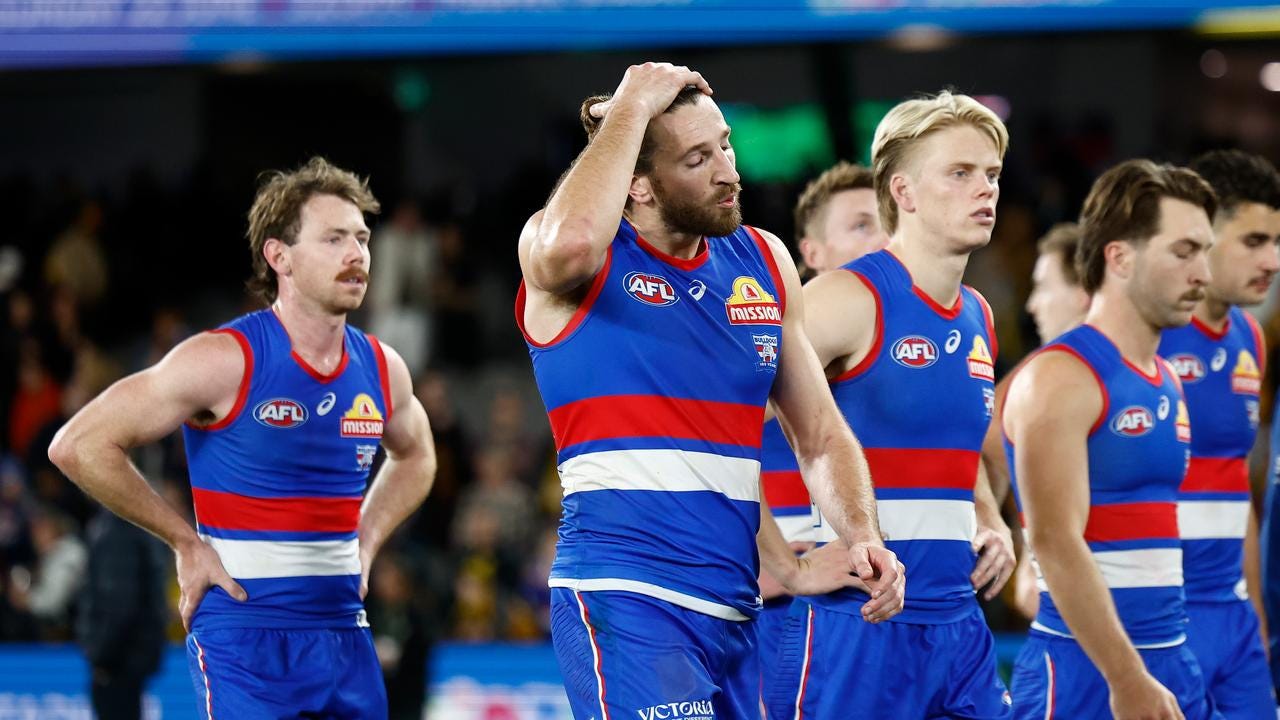
You couldn’t engineer a better Western Bulldogs season under Luke Beveridge for the Footy Media-Industrial Complex. The Dogs won 14 games in 2025 (that’s good!). But they went 2-9 against top-eight sides (that’s bad!). But their heaviest defeat was only 22 points (that’s good!). But they suffered injuries to key players (that’s bad!). But they won eight games by 71 or more points (that’s good!). But they finished ninth after decisively losing a virtual knockout game against another finals contender (that’s bad!).
Everything that, fairly or not, has come to be seen as shorthand for Bevoball since the 2016 flag – spectacular scoring power, fragile defending, noble failure – was in abundant supply in 2025. Pundits and critics, especially those who revel in declaring the Dogs the best list in footy and any subsequent failure a damning indictment of the coach, will see plenty of negatives: the frustration of missing out on September, Marcus Bontempelli turning 30, ongoing structural and personnel issues in defence. Sure. But there are at least as many positives: Sam Darcy and Ed Richards emerged as true stars. Aaron Naughton had the best season of his career, easing the feeling of “what could have been” surrounding Jamarra Ugle-Hagan. Joel Freijah spent time in the middle and looked bloody good doing it. There is reason to believe this team will improve, not stagnate. 2025 was immensely frustrating. But it might also have yielded the tough lessons the Dogs need to stamp their authority on the competition.
Summary of game style
The Bulldogs’ game is built on a largely-warranted confidence in their own superiority. They ranked 1st for total disposals in 2025, 2nd for disposals per chain, 5th for marks, and led the AFL for inside-50 differential, scores from the back half, and percentage of possession chains that turned into scores. They win territory and convert that into points more efficiently and at higher volumes than any other side.
The Dogs’ elite midfielders win the ball at stoppage and generate repeat entries. Strong key forwards turn those entries into high-quality shots, reflected in their league-leading xScore per attempt and ranking for offensive one-on-ones. The system is designed to win first possession, recycle it cleanly, and reload quickly. If they don’t score, they reset and go again. That’s why their chains are long but not especially fast. Playing the majority of the game in the front half is the way the Dogs attack and one of the main ways they defend.
This combination of talent in high-impact roles and aggressive off-ball defensive positioning simply overwhelms weak sides. If you can’t stop the Dogs running downhill out of the centre square, or find a way to neutralise Sam Darcy, you will almost certainly lose. But the same system produces fragility at the top end. In 2025, the Bulldogs were below average at forcing turnovers and 17th for tackle differential. They do not generate much defensive friction. Teams that stand up defensively – those that can absorb entries, win aerial contests, and exit with composure – pose a particular problem. They can deny the Dogs cheap entries, force them to defend in space, and exploit their limited two-way wings and thin key defensive stocks to prosper in transition, especially in wide areas. Aggressive positioning can produce ugly results when things break down. Only Melbourne conceded a higher average value of shots last season. The benefits (control of possession and territory) are often harder to appreciate.
The Dogs accept volatility because their expected return per possession is so high. Does that make them a glass cannon? It’s fairer to say that their style is shaped by their list’s strengths and weaknesses. They optimise for accumulation, repeatability, and belief in their own scoring power. When it works, they overwhelm their opponents. When it doesn’t, they are frequently exposed by savvier opponents. But given their list profile, it is the game they have to play. The Bulldogs don’t lose in the boring way (a lack of talent). They lose in a much more interesting way – because their talent is distributed in ways that force them to incur defensive risk.
List changes
In:
Lachie Carmichael (2025 National Draft, Pick #21)
Louis Emmett (2025 National Draft, Pick #27)
Will Darcy (2024 National Draft, Pick #60)
Connor Budarick (trade – Gold Coast)
Out:
Jamarra Ugle-Hagan (trade – Gold Coast)
Anthony Scott (delisted)
Caleb Poulter (delisted)
Jason Johannisen (delisted)
Taylor Duryea (retired)
Liam Jones (retired)
List profile
Number of top-10 draft picks: five (T-10th)
Average age at Opening Round: 24.9 (8th)
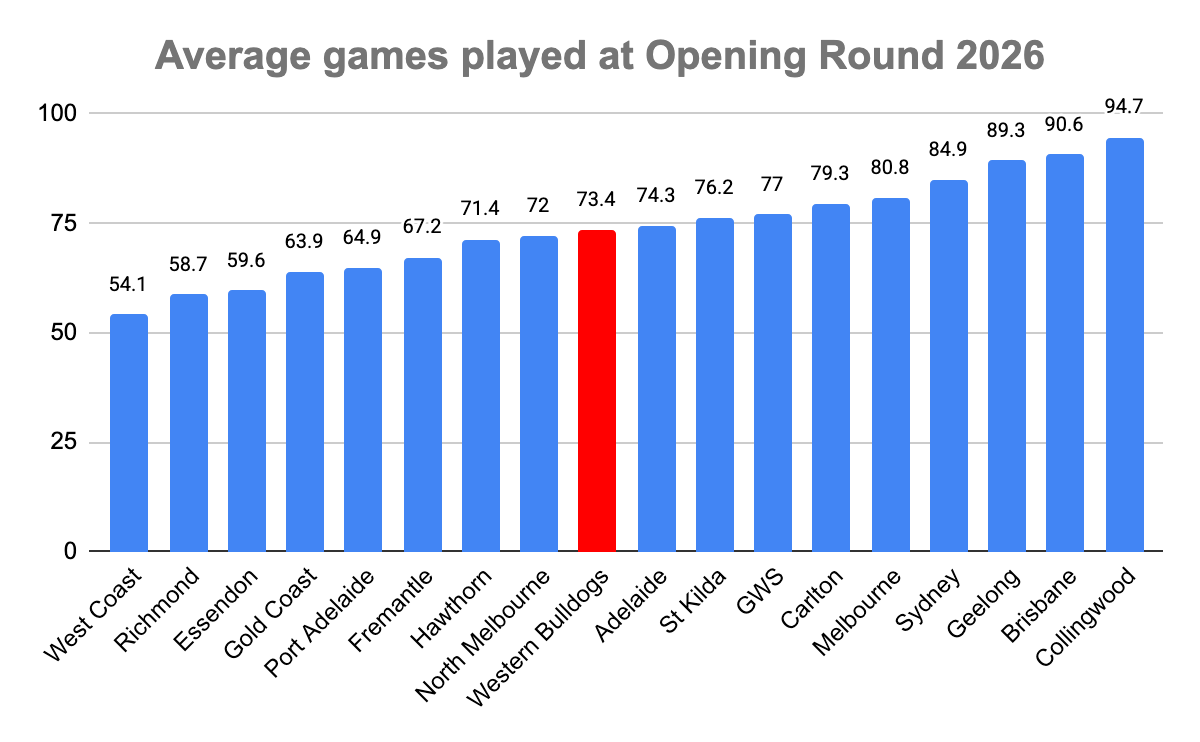
Average number of games played: 73.4 (9th)
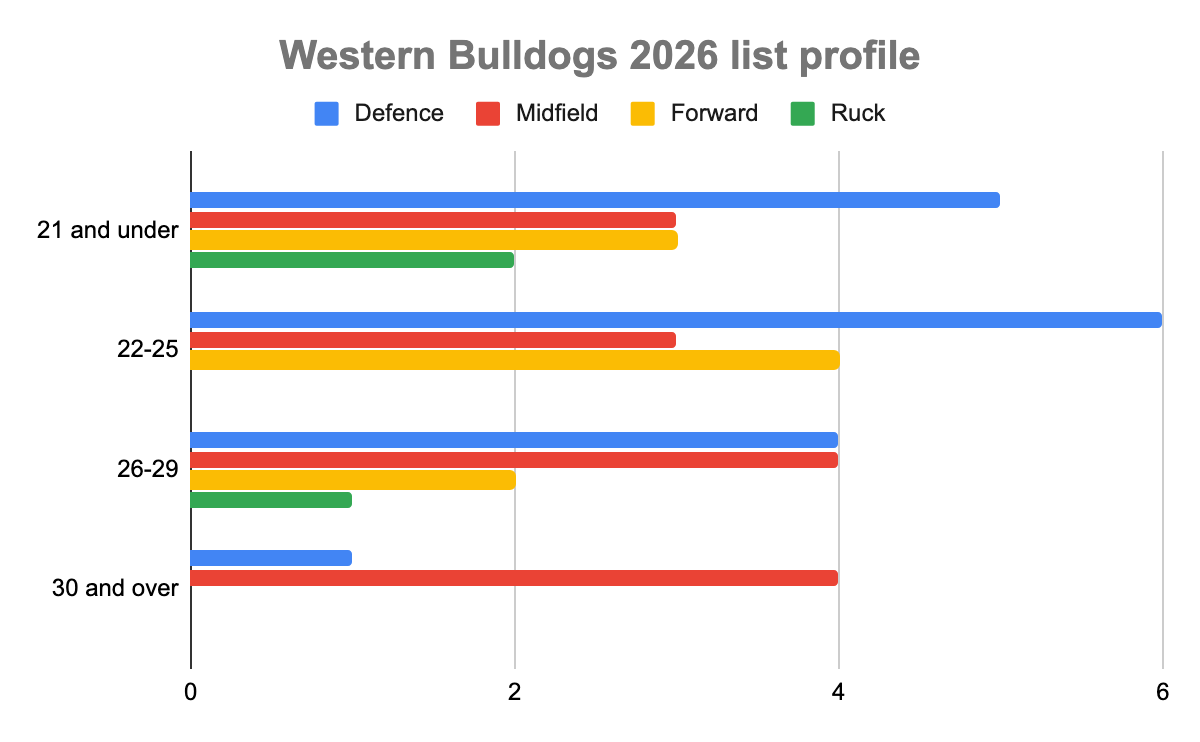
After bringing in six players across the 2024 draft and trade period, the Dogs were quieter this time around, making three selections and trading in Gold Coast’s Connor Budarick for Pick 37 (with Pick 70 coming back). Lachlan Carmichael, a Sydney academy prospect, is a versatile small-medium defender who can play taller or smaller than his listed 185cm. Louis Emmett is a mobile tall who supplements the Dogs’ ruck/key position stocks, and Will Darcy is a speculative shy at the stumps who, at Pick 60, will at the very least be a cheap way to keep older brother Sam happy. Budarick, meanwhile, looks like a smart acquisition given the Dogs’ struggles containing opposition smalls and mediums. They join a list that had already been supplemented by two players taken in last year’s Mid-Season Draft: Michael Sellwood (a West Australian half-back with a raking left-foot kick) and Zac Walker (an intercept defender from Phillip Island). Sellwood was apparently close to debuting late last season and the early word is that Emmett’s development is ahead of schedule.
It remains to be seen exactly how Budarick fits in Beveridge’s defensive scheme, and how prospects like Carmichael, Sellwood and Walker develop. But the Dogs have diagnosed the problem correctly: the defence is the weakest part of the list, and where their talent distribution issue is most pronounced. Rory Lobb has done an admirable job since his reassignment as a defender, but gives up size and craft to the game’s best key forwards. Beyond him, the key defensive posts look paper-thin. Jedd Busslinger, to put it politely, hasn’t yet earnt the trust of Beveridge. To put it less politely, his seven games last season did not look like the beginning of a successful AFL career. James O’Donnell has provided great value for a former Category B rookie but is limited. It’s no coincidence that the Dogs tend to struggle against forward lines with multiple tall threats. The small/medium stocks look better but, with the exception of Bailey Dale, short on stars. Overinvestment of draft capital into the defensive line is a risk – but so is underinvestment.
There are no similar complaints about the investment or return on investment when it comes to the midfield. The Bulldogs averaged +17.5 points per game from the differential of scores from stoppages in 2025. No other side managed +10. But the output masks changes to personnel. Adam Treloar went from being a constant presence at centre bounces in 2024 (when he attended 80 percent of centre bounces he was eligible for) to a bit-part player, attending just 24 percent of centre bounces across his four games. His midfield minutes were taken by Matt Kennedy and Joel Freijah. The biggest question is how the Dogs will reconfigure when it’s time to phase out Tom Liberatore. Libba bleeds red, white, and blue. But he’ll turn 34 midway through the season, and he’s one head knock away from a forced retirement. His defensive discipline and ability to win the hard ball will need replacing (at least in the aggregate). The weakness in the Dogs’ midfield is found on the wings. Bailey Williams and Sam Davidson are willing runners and good soldiers, but in an era where wingers are getting bigger, and teams increasingly opt to advance the ball via wide areas to hedge against turning it over in the corridor, their athletic limitations expose the Dogs in the air and in defensive transition.
A year ago, I said that uncertainty surrounding Jamarra Ugle-Hagan made the Dogs’ forward line a hard read. That was fairly spectacularly wrong. The Dogs were first in the AFL for expected score, goals per inside 50 entry, and scoring shots per inside 50. Everyone knows that a fit and committed Ugle-Hagan is a very good AFL forward. So it’s a great credit to Sam Darcy, Aaron Naughton, and the Dogs’ coaches that his absence was barely noticed (at least on the field). Darcy would have been named All-Australian had he not missed six games with a knee injury (the ominous reports of him piling on the goals in internal trials – admittedly, against his own defenders – suggests he’ll probably put on a blazer this year), Naughton had a career-best year, and Jordan Croft showed enough to suggest he’ll be a handy back-up if either are unavailable (or Bevo is feeling frisky and wants to play with three talls). Closer to the ground, Rhylee West became a very good small forward in 2025, combining clever positioning with effective finishing to register 39 goals. He did so in the total absence of Cody Weightman, whose pre-season patella injury turned into a horrible saga. The aerial ability of a fully fit Weightman would round out the Dogs’ forward line – but he’s only recently started running again. It would be a surprise to see him at AFL level before the mid-season bye.
Line rankings
Defence: Average
Midfield: Elite
Forwards: Elite
Ruck: Above Average
The case for optimism
The fact that their team missed the finals while at the same time being regarded by analysts as possibly the best team in the AFL is, uh, scant consolation for frustrated Dogs fans. But it does matter. There is a world of difference between missing the finals the way the Dogs did and the way that, say, the Eagles did. Several things had to go wrong to miss out with 14 wins. They all did. That sucks – but it makes the path to redemption much shorter.
The case for optimism is simple: the Dogs were two wins from finishing in the top four, and there’s still growth left in this group. Enough of that growth could be driven by just one man: Sam Darcy. He’s already very possibly the best key forward in footy – no one would seriously begrudge him a spot on the podium – and yet it still feels like he’s just scratching the surface of his vast potential. Imagine if he undergoes the Riley Thilthorpe Exercise Regimen – his gravity alone will create more opportunities for his teammates. The broader point is that, given Darcy’s freakishly high ceiling and the dazzling array of midfield talent, the Dogs’ most viable path to success might not involve material defensive improvement – it could just be becoming a historically great attacking side.
Dogs fans should also feel optimistic that, beyond Darcy, the list will be deeper and stronger in 2026. Joel Freijah and Ryley Sanders will get better. The 2024 draft crop has shown good flashes. Cody Weightman might play footy this season. The Bont isn’t going anywhere. Connor Budarick isn’t a star, but should be a solid defensive presence. Combine those improvements with some better luck with injuries and in-game variance, and it’s not at all a stretch to see 14 wins turning into 16 or 17 – and a real flag tilt.
The case for pessimism
The maximally pessimistic argument for the Dogs in 2026 is that their struggles against the good sides are the product of real structural and personnel issues, not just bad luck, and that they didn’t improve the quality of the personnel by enough. The 2-9 record against top-eight sides wasn’t a fluke. The Dogs only “won” two of those games on expected score – a blow out against GWS late in the season, and (just barely) the Round 11 meeting against Geelong, which didn’t convert into an actual win. Take out that second GWS game, and the Dogs cumulatively scored 144.4 fewer points on expected score in fixtures against the top eight. Sure, they could have jagged a couple of those games. Just one would have been enough to make finals. But that doesn’t change the larger point, which is that there was an identifiable and repeatable blueprint to beat the Dogs in 2025: sit deep, lure them forward, turn the ball over and exploit them going back the other way, taking advantage of their undersized wingers – a significant structural issue – and overmatched key defenders. Luke Beveridge couldn’t find an answer that held up.
Although I’ve focused predominantly on the issues the Dogs have defending in transition, they also struggle to defend slow plays. They struggle to end defensive sequences full stop. The Dogs were 15th for scores conceded from opposition kick-ins (not a big number, but indicative of a problem) and below league average for opposition chains that began in the defensive half and ended in a score. When opponents enter their defensive 50, they generate shots at an above-average rate, whether by mark or at ground level. The problem isn’t only the structure ahead of the ball. It’s the absence of a defensive fail-safe behind it.
The apparent pursuit of Adelaide’s Jordon Butts suggests internal recognition that there’s an issue. But it’s an oversimplification to say that Beveridge should simply dial down the aggression in big games. Players spend months learning the intricacies of defensive zones and pressing triggers. The costs of switching to “Plan B”, which might be better-suited for the specific match-up but definitely won’t be as well-honed, are usually bigger than the benefits. There’s been talk that the Dogs have placed a renewed focus in pre-season and tackling and pressure. Sure – but find me a team that doesn’t talk a big game about their contest and pressure work. The Dogs’ defensive frailties aren’t about effort (oh, how I’d love to expunge that word from the footy lexicon). They’re structural. Perhaps the solution is to accept this iteration of the Dogs will never be defensively elite and try to win regardless. It’s not unthinkable the Dogs could become an even more potent attacking force. Darcy will get better. Weightman could actually play games. But teams that are bad at defending without the ball don’t usually win flags. And there are other vulnerabilities. The Dogs have done a good job of getting younger while staying good, but Tom Liberatore is still a load-bearing presence in the middle and, as a midfielder whose primary role is defensive, doesn’t have an obvious replacement currently on the list. Most of the Dogs’ best players are young or in their prime. Libba isn’t.
Enjoying this preview and think a Dogs-supporting friend might too? Share it with them!
Breakout player
I’m giving myself a pat on the back for nominating Joel Freijah here last season. It didn’t require much insight, but the footy mainstream has cottoned on to what Dogs fans realised right away – the kid is seriously good. Pending his recovery from a hamstring injury he sustained early in pre-season, Ryley Sanders could be the next cab off the rank. The Pick #6 in the 2023 draft has made solid progress in his first two years at senior level and the picture of the player he will become is looking clearer. Although he doesn’t obviously possess the athletic traits of someone like Freijah, there’s scope for him to be an effective accumulator who links possession chains and pops up with the odd goal – the new Adam Treloar? An honourable mention for Lachie Jaques, who Freijah himself has tipped for a breakout in 2026.
Most important player
This is the third season I’m writing these and the first time the answer to this question (and many others regarding the Dogs) isn’t obviously Marcus Bontempelli. He’s still probably the best player in footy. But the addition of Matt Kennedy to the on-ball rotation, as well as the emergence of Joel Freijah, and (especially) Ed Richards as viable first-rotation midfielders, lifts some of the burden from his shoulders. He might not need to be Hercules anymore. Sam Darcy’s reach and ability to distort gravity in the forward line makes him a wholly unique proposition. The Dogs still won two of the six games he missed last season by 90 or more points, but could only go 3-3 over that stretch. Bontempelli has replacements who are somewhat close to his level. Darcy does not.
Biggest question to answer
Unless Jedd Busslinger reaches a level he hasn’t yet, or Luke Beveridge engineers another unlikely positional change (Jordan Croft to full back, perhaps?), the Dogs will persevere with essentially the same defensive personnel as they did last season. Given that, the question becomes: will Bevo and his coaches dial down the aggressive defensive positioning, even if it makes the Dogs a little less potent, or will they decide that their approach is ultimately the one most likely to yield success?
What success looks like
Given the AFL’s new wheeze of expanding finals to more than 50 percent of the league, it’s unthinkable that the Dogs won’t be playing some kind of elimination match in September. But finishing 10th ain’t the same as finishing 1st. If their best players stay fit and keep firing, and Beveridge can find solutions in areas of relative weakness (the wings, small defenders, transition defence), the Bulldogs will be one of the best teams in footy. As it is, they’re not far off. Anything less than a home final would feel like drift.
In a nutshell
Bevo’s Dogs are actually Schrödinger’s Dogs – they are both the plausibly best team in footy, and the ninth best. They have stacks of talent, but not in all the positions you need. The immensity of their scoring power is offset by the risks they take to generate that power. Nothing from Premiers to play-in would surprise.