


Piling into the Minivan for my final preview.
2025 ladder position: 18th (1 win, 22 losses)
2025 best-and-fairest: Liam Baker
Senior coach: Andrew McQualter
Story of the season
Winning just a single game in a new coach’s first season before losing a co-captain to free agency – to the back-to-back Premiers, no less – would usually prompt the kind of existential crisis and mass-firing event that eventually yields an Amazon Prime documentary. And let’s not beat around the bush: 2025 was a miserable season for the West Coast Eagles, especially in the context of the three miserable seasons that preceded it. Supporters experienced every kind of footy-related pain: six defeats by 10+ goals, four by 10 or fewer points, the Oscar Allen farrago. But 2025 was also the clean break with the past the club required – and some green shoots really did poke their heads warily through the smoking ruins. Andrew McQualter rebooted the club’s tactical identity. Allen’s departure may have felt tawdry, but the compensation pick yielded a high-end draftee. They almost beat the minor premiers. A handful of exciting young players announced themselves as parts of a better future. And Willem Duursma became the club’s second number one pick in three years.
If there’s such a thing as beneficial misery, that’s what West Coast went through in 2025. Not good – but a prologue to “possibly good”. I’m not sure if the Eagles were the best one-win side in AFL history. But no one-win side has ever generated as much (reasonable) belief among supporters that something better could finally be coming.
Summary of game style
The single most important thing to understand about Andrew McQualter’s theory of footy is that it’s as different to Adam Simpson’s as can be. Under Simpson, the Eagles’ identity was built around control: kick-mark chains, retention, territory management, structural safety. Even as personnel declined, the instinct remained to circulate, reset, and protect. McQualter has moved them sharply away from control and embraced chaos. The statistical profile screams it. Since 2023, Simpson’s final full season in charge, the Eagles have gone from bottom four to top half for speed of ball movement. Metres gained per disposal have gone from 17th to fourth. At the same time, handball metres gained more than doubled – clear evidence that the Eagles now look to quickly surge and gain territory. Marks fell from midtable to 17th. Disposal retention – a proxy for risk tolerance – went from fifth in 2023 to dead last in 2025.
The influence of McQualter’s former boss, Damien Hardwick, is clear. The Eagles now seek contests instead of seeking to circumvent them. Their contested possession share rose from 17th in 2023 to sixth last season. Scores from turnover – a non-negotiable KPI for chaos teams – improved meaningfully, even if still below league average. The new model Eagles willingly trade retention for direct territorial gain and an increased likelihood of destabilising opposition defences. Win possession, release by hand, surge into open space, kick long and direct. A slight but real increase in time in forward half – from 44.4 percent in 2023 to 46.3 last season – is evidence that the plan is having some of the desired effect.
The obvious problem is that, for the time being, ambition has outpaced capacity. Chaos cuts both ways: when the ball spills, better teams punish you faster than you can punish them. The Eagles are easy to cut apart. Forward of centre, chain-to-score and stoppage scoring remain 18th. The system is producing greater variance but not (yet) sustained scoring pressure. 2026 is likely to focus on continuing to bed down the principles of McQualter’s game plan – speed, territory, contest, pressure – until they become second nature. The next layer is structural: tighten transition defence and turn forward-half pressure into reliable scores. If the Eagles can lift their forward-half scoring into the middle third of the competition and stabilise their transition defence, the win-loss column will begin to follow. Although progress thus far has been modest, the direction of travel is clear. The Eagles no longer try to win through control. They try to win through chaos. The ultimate objective is to master it.
List changes
In:
Willem Duursma (2025 National Draft, Pick #1)
Cooper Duff-Tytler (2025 National Draft, Pick #4)
Josh Lindsay (2025 National Draft, Pick #19)
Sam Allen (2025 National Draft, Pick #29)
Tylah Williams (2025 National Draft, Pick #39 – NGA)
Brandon Starcevich (trade – Brisbane),
Tylar Young (trade – Richmond)
Fred Rodriguez (2025 Rookie Draft)
Harry Schoenberg (Supplementary Selection Period)
Finlay Macrae (Supplementary Selection Period)
Deven Robertson (Supplementary Selection Period)
Milan Murdock (Supplementary Selection Period)
Out:
Oscar Allen (free agent – Brisbane)
Liam Ryan (trade – St Kilda)
Campbell Chesser (trade – Carlton)
Callum Jamieson (delisted)
Coen Livingstone (delisted)
Jack Petruccelle (delisted)
Loch Rawlinson (delisted)
Jeremy McGovern (retired)
Jayden Hunt (retired)
Dom Sheed (retired)
List profile
Number of top-10 draft picks: four (T-13th)
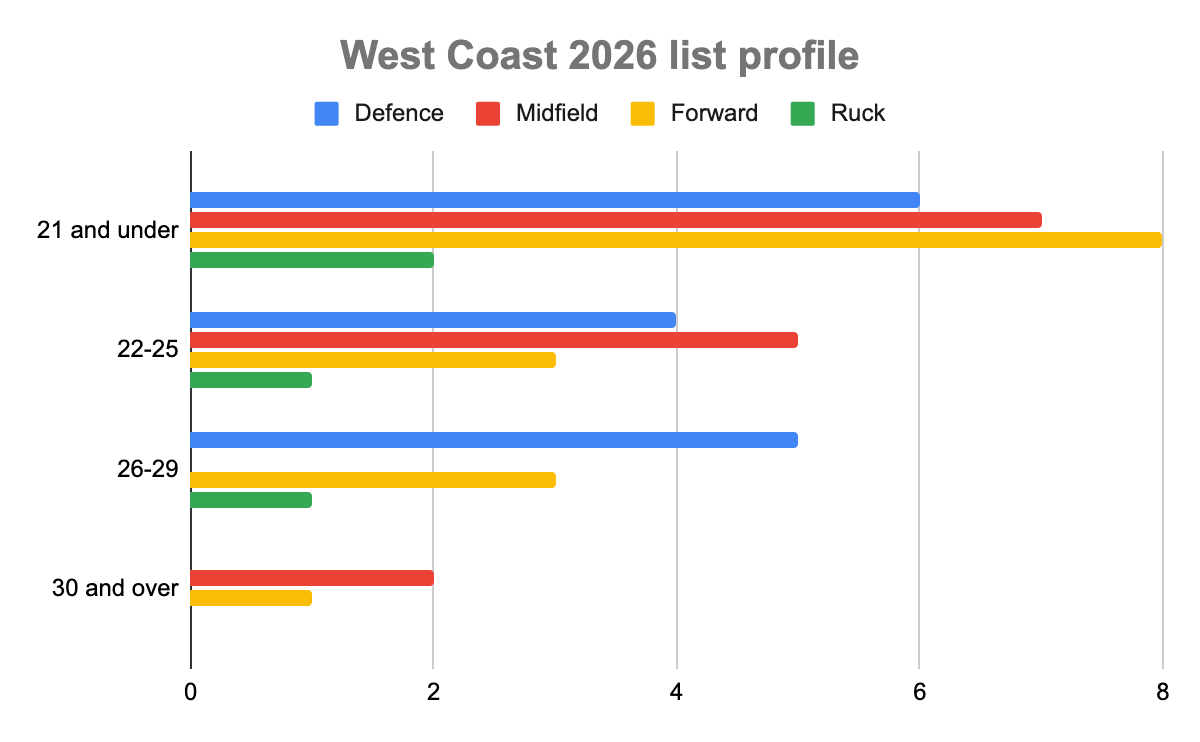
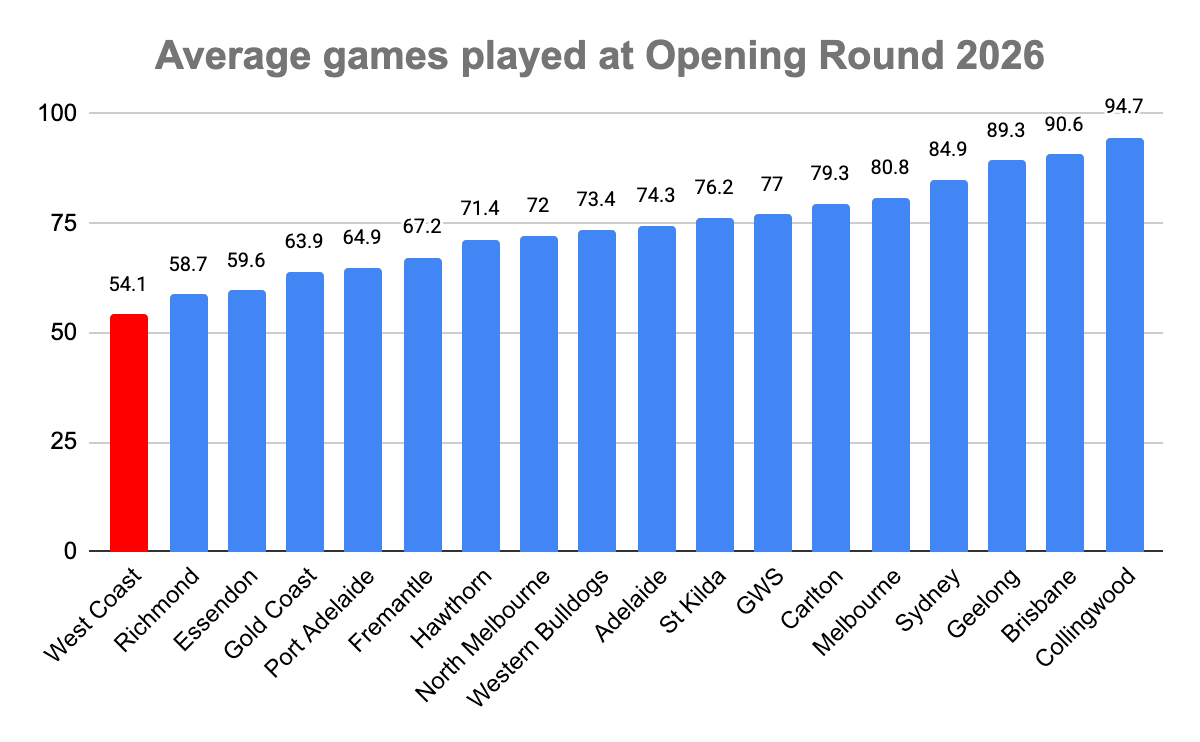
Average age at Opening Round: 23.6 (18th)
Average number of games played: 54.1 (18th)
The proceeds from the departures of Oscar Allen and Tom Barrass hit the account and the Eagles had a bob each way. They selected five players in the National Draft, traded in two, and added depth with four SSP signings. Willem Duursma separated himself from the chasing pack to finish 2025 as the clear number one pick. His height, frame and athleticism have drawn comparisons to Marcus Bontempelli. Cooper Duff-Tytler is perhaps even more intriguing – an ultra-mobile 200cm ruck/forward who runs all day and gathers cleanly below his knees. The error bars on both are wide, but so is the upside. Josh Lindsay, widely regarded as the best kick in the draft pool, addresses a glaring need for class (with Tom McCarthy likely shifting into the midfield), while athletic midfielder Sam Allen and energetic NGA small forward Tylah Williams rounded out the draft haul.
West Coast paired mercurial draftees with experienced role players. Brandon Starcevich arrived in a deal that stretched the definition of Mega Trade. When available, he’ll provide toughness and leadership down back; given his concussion history, availability is the question. Tylar Young adds some ballast to a key defensive mix that already skews blue collar. The Eagles also added Finn Macrae, Harry Schoenberg and – in the fulfilment of footy’s lowest-stakes prophecy – Dev Robertson via the SSP process. All will believe they can play a dozen senior games this season. Clubs in West Coast’s position must raise both floor and ceiling; the Eagles can reasonably argue they’ve done both.
The departures of Barrass and the sad retirement of McGovern left two large holes in defence that needed patching. Reuben Ginbey flourished in his first season as a full-time defender; his size and speed make him a versatile and challenging match-up. Harry Edwards also emerged as a viable long-term option, though the recruitment of Tylar Young suggests the club is not fully convinced by Sandy Brock or Rhett Bazzo. Starcevich slots straight in alongside Liam Duggan as part of a dependable lockdown duo. It’s safe to say not all Eagles fans were convinced by the decision to bring in Liam Baker (the club published an article on its website defending the deal). But he really was good in his first season in blue and gold. A Best & Fairest and promotion to captain was his reward. He’ll spend time at half-back and wherever else required. After spending significant time in the midfield last season – to reasonably good effect – Brady Hough has spent the entire pre-season training as a defender. Ryan Maric has been retooled as a tall rebounder, although I don’t see the argument to play him over Josh Lindsay if both are fit.
The best-case scenario is that West Coast’s midfield levels up to become mediocre in 2026. The modal outcome is that it remains the worst in the league. The obvious issue is there aren’t enough guys you’d trust to regularly win first possession against good opposition midfield units. Persistent injuries (Elliot Yeo) and declining form (Tim Kelly) have prevented continuity. Only ruckman Matt Flynn attended more than 60 percent of centre bounces in 2025. A Yeo anywhere near close to his old best and a fit Harley Reid are automatic selections. Beyond that, it’s speculative. Elijah Hewett’s talent is hard to question, but his size, defensive impact and durability are not. Jack Graham and new recruit Dev Robertson profile as defensive enforcers more focused on stemming bleeding than causing it. Starcevich has flagged a desire for midfield minutes; whether he gets them remains to be seen. Duursma is unlikely to play significant midfield time in 2026 – half-back or wing looks more probable. Macrae and Milan Murdock will believe they can force their way into calculations. The barrier to entry to the 2026 Eagles midfield isn’t very high.
The forward line probably has the most immediate upside, largely because Jake Waterman was an All-Australian the last time he completed a full season. Jobe Shanahan appears to have overtaken Archer Reid and Jack Williams as the second key forward option. The Pick 30 from the deep 2024 draft leads well and can clunk them in a way that reminds many Eagles fans of a certain bearded forward that wore number 17. Cooper Duff-Tytler should get early games and will excite Eagles fans. Beyond them, questions remain. The most obvious is that, with the departure of Liam Ryan, there isn’t a reliable crumbing option. Jamie Cripps is going around again. He’s crafty, but at such an early stage of the rebuild, I’m not sure his value as a teacher is greater than the opportunity cost of playing him. One could say the same of Matt Owies. Giving opportunities to Jacob Newton (who’s impressed since joining the club), Tylah Williams and Malakai Champion feels more aligned with the Eagles’ timeline. Expect any combination of Hewett, Kelly, Graham, Robertson, Schoenberg and Tom Gross to rotate through half-forward. Whoever settles there, McQualter’s objectives are clear: the forward line must become both more dangerous at ground level and a more reliable first line of defence. Right now, it’s closer to a trampoline.
Line rankings
Defence: Below Average
Midfield: Poor
Forward: Below Average
Ruck: Poor
The case for optimism
The Eagles are very bad. But the case for optimism in 2026 begins with an important caveat: they weren’t quite historically inept in the way a one-win season suggests. They recorded one actual win but finished with 2.7 expected wins – the number they’d have claimed had expected score broken evenly. A one-win season could easily have been a three-win season with nothing changing except variance. Even so, 2.7 expected wins was less than half the 5.8 expected wins of 2024. The regression was real. But here’s the catch: much – perhaps all – of that regression can be traced to three things: the loss of key players, the transaction costs of switching game plans, and a surprisingly difficult draw.
An efficient way to turn a poor side into a very poor one is to subtract Tom Barrass and Jeremy McGovern. The costs of Barrass’ trade were front-loaded; the proceeds – Josh Lindsay, Sam Allen, Tylah Williams and more reps for Harry Edwards – won’t vest for some time. McGovern’s retirement was all downside. Add the loss of Jack Darling, whose workhorse presence insulated young forwards, and it’s hardly surprising that a riskier game plan, combined with the removal of the club’s two best defenders, led to further defensive deterioration. The Eagles embraced chaos at the same time as losing players well-positioned to help them absorb it.
The second reason for optimism is boring old continuity. The Eagles have now had a full additional pre-season drilling McQualter’s system. Beyond the obvious talent gap they faced last season, there was also a familiarity gap. They were learning a foreign language while playing opponents fluent in theirs. Liam Baker and Jack Graham were brought in to accelerate the shift, but there were moments when players visibly wrestled with the conflict between muscle memory and new tactical instructions. Repetition breeds instinct. Expect a more fluent version of the McQualter model in 2026.
It’s dull to talk about draw difficulty. But it matters! The Eagles had the joint-easiest draw in 2024. Last season, no side had a bigger discrepancy between expected and actual fixture difficulty. Seven of the top 10 sides ended up with an easier draw than West Coast. That’s significant at the bottom of the ladder. The Eagles are projected to have the 13th-hardest draw in 2026. Although it’s perhaps not as generous as a side in its position might hope, it’s far less brutal than last season.
Explaining why West Coast went from bad to very bad in 2025 is more anti-pessimism than true optimism. Proper optimism begins with the recognition that, for the first time in years, there is a reasonable volume and spread of young talent: Harley Reid, Willem Duursma, Cooper Duff-Tytler, Jobe Shanahan, Josh Lindsay, Reuben Ginbey, Elijah Hewett, and Tom McCarthy (not young, but inexperienced). That group still has a lot to prove, and fit remains an open question. But the distribution is healthy. There are power midfielders, outside runners, key forwards, distributors and defenders. That reduces positional bottlenecks and, more importantly, maximises the most valuable developmental resource: minutes. They’ll also be supported by a mature cast bolstered by Brandon Starcevich, Tylar Young, Deven Robertson and Harry Schoenberg. These aren’t stars, but they are floor-raisers who, alongside second-year Eagles like Baker and Graham, ensure the young core isn’t carrying everything.
It took West Coast too long to admit a rebuild was necessary. Now that they have, those young players will play significant football in 2026. They’ll either swim or struggle. Either way, the club gains clarity. The Eagles won’t be good even if everything above materialises. But they should be far more competitive. With some luck, four to five wins feels achievable.
The case for pessimism
The optimistic view is that West Coast have paid the upfront costs of stylistic reinvention and are therefore positioned to reap the benefits. The pessimistic view is that the bill has only just arrived and that the benefits, if they ever arrive, are a long way away.
A game model rooted in chaos is exhilarating when it works. It is also unforgiving – on multiple axes. The first is tactical. Chaos without elite decision-makers and superior one-on-one players is just turnover. Chaos without effective counterpressing is just exposure. Betting on variance when you’re the less-talented team in most games might be notionally rational. But variance is a double-edged sword. It does not simply increase your chance of an upset; it increases the likelihood of heavy defeats. High-variance systems produce high-variance margins. For a young side, frequent big losses do more than damage percentage. They distort learning, obstruct habit formation, and can test belief in the model itself.
That goes directly to the second danger of chaos: it punishes young bodies. High-speed transition, repeat contests and constant defensive recovery runs generate fatigue and collision load in ways controlled possession football does not. A young list asked to surge, press, chase and re-press for two hours every week can break down. Soft-tissue injuries and late-season fatigue can snowball into stalled development and defeats that compound the psychological toll if the conditioning base isn’t yet mature. The Eagles flagged physically in their final pre-season hitout, against Port. Perhaps it was evidence of a heavy training load. Perhaps it was evidence that Miniball is hard to sustain.
There’s nothing inherently wrong with the chaos model. Most clubs are embracing some version of it. But it is a difficult wave to ride because it functions best when compounding a particular kind of advantage: power, speed and one-on-one superiority. I wrote above that the Eagles have assembled a promising cohort of young talent and are approaching the rebuild correctly by accelerating list turnover. But, as of today, very few of those prospects are sure things. Talent is not the constraint for Harley Reid – but his long-term commitment to West Coast might be. Nor is talent the issue for Elijah Hewett – but durability has been. Stack enough of these questions together and an uncomfortable possibility emerges: the young core may be deeper than it is transformative. Rebuilds fail not because they lack prospects, but because they lack genuine difference-makers. Beyond Harley, that question remains very open. West Coast has drafted interesting, diverse talent. It hasn’t yet assembled that into the spine of a good team, let alone a contending team. The gap between where the Eagles are right now and competence still looks more like a chasm. Everyone still assumes that West Coast is too big to keep failing. How many more seasons down the bottom until that assumption begins to waver?
Enjoying this preview and think an Eagles-supporting friend might too? Share it with them!
Breakout player
There are few players across the AFL I’m more intrigued to see in action this season than Tom McCarthy. The number one pick from last year’s Mid-Season Draft has been a revelation since his debut on West Coast’s half-back flank. The fact he’s come from relative obscurity, rather than an elite finishing school environment, raises the exciting possibility – the likelihood – that he’s got a lot of growth left. He’ll start the season in the Eagles’ midfield. Jobe Shanahan is a close second. The young key forward also impressed in his debut season and the departure of Oscar Allen, together with Jake Waterman’s return to fitness, should give him the opportunity and continuity needed to thrive. Josh Lindsay – yes, I’m getting greedy – is probably worth a mention too. He may already be the best kick in a side he’s only been a part of for four months. That says much about him and the current state of the club he’s joined.
Most important player
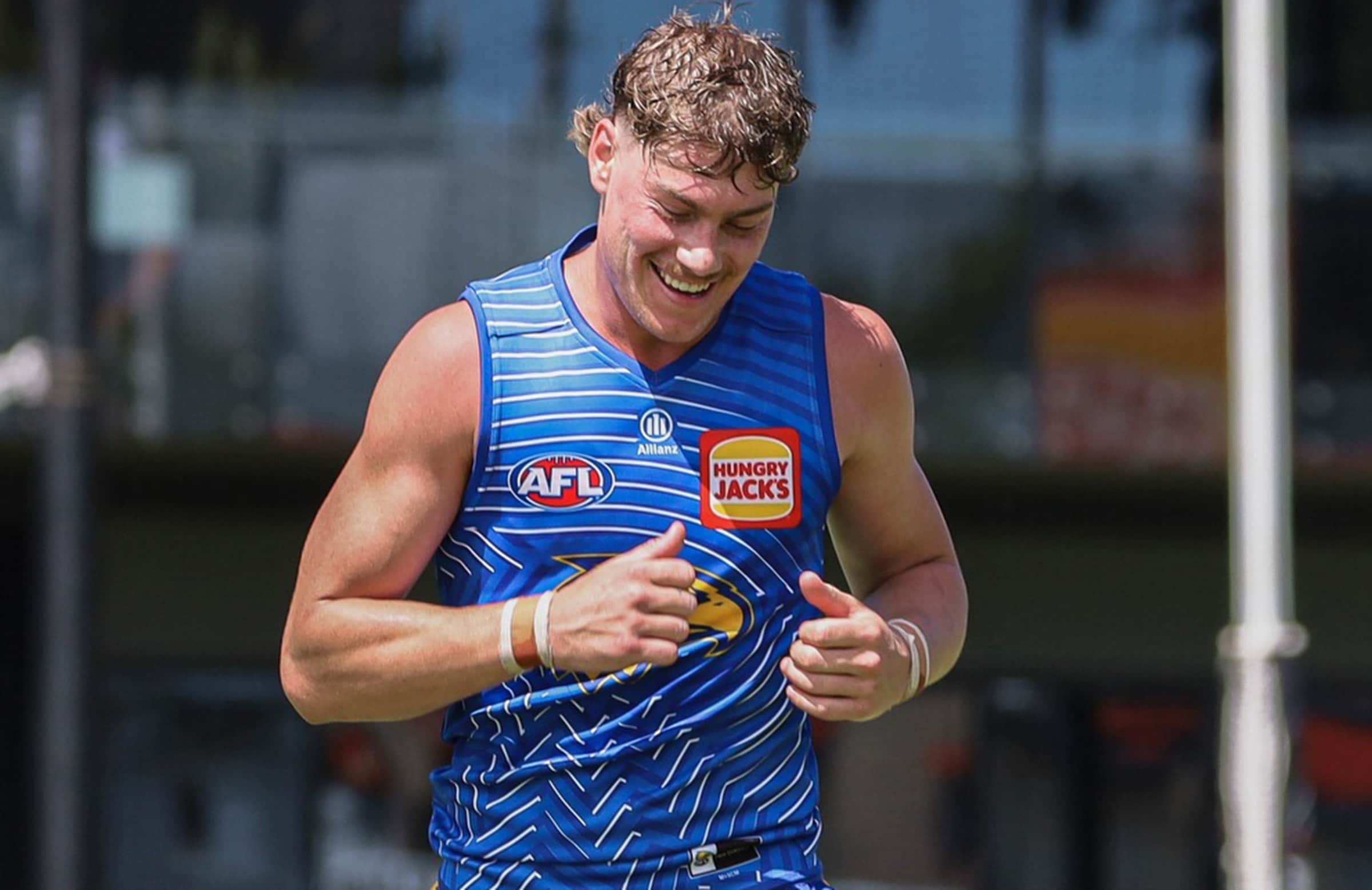
It’s probably Harley Reid. He’s not West Coast’s best player yet, but he could be by season’s end. In theory, his Dustin Martin-esque combination of power and pace traits (minus, for the time being, the forward acumen) make him the perfect flagbearer for a game plan indebted to Damien Hardwick’s great Richmond side. Reid’s debut season was outstanding (it also wasn’t a coincidence that most of it was spent alongside a fit Yeo). His second season – aside from his decision to re-sign with the Eagles until the end of 2028 – didn’t quite meet the same standard. It’s far from the club’s biggest concern. Signs from pre-season have been largely positive. But if Harley Reid is to become the top-10 player most believe he can, he must take the next step in 2026.
Biggest question to answer
Good teams stack talent or develop a system that holds up. The best teams optimise their talent-system fit. The most important question for West Coast’s current build – and therefore the question that needs answering, as a priority – is how good is the young talent, and how well does it mesh with Andrew McQualter’s game plan?
What success looks like
The continued development of what is now clearly the youngest and least experienced list in footy remains an obvious priority. But individual progress is inseparable from collective tactical progress. Therefore, McQualter and his coaches will be looking for continued improvement in key metrics of his game model: scores from forward half, turnovers forced, and post-clearance contested possessions. If West Coast can become competent in those, a jump up the ladder may not be too far away. Do that, upset a good team – Freo, ideally – along the way, and it’ll be a pass mark.
In a nutshell
Many things about West Coast’s season will not surprise. The Eagles will lose the vast majority of their games, many by large margins. But if they continue to embed the principles of Andrew McQualter’s game plan, while unearthing the core of their next good team, supporters will believe that progress is finally being made.
Enjoyed these previews a lot, great analysis