


Rounding the bend with a visit to the Harbour City.
2025 ladder position: 10th (12 wins, 11 losses)
2025 best-and-fairest: Isaac Heeney
Senior coach: Dean Cox
Story of the season
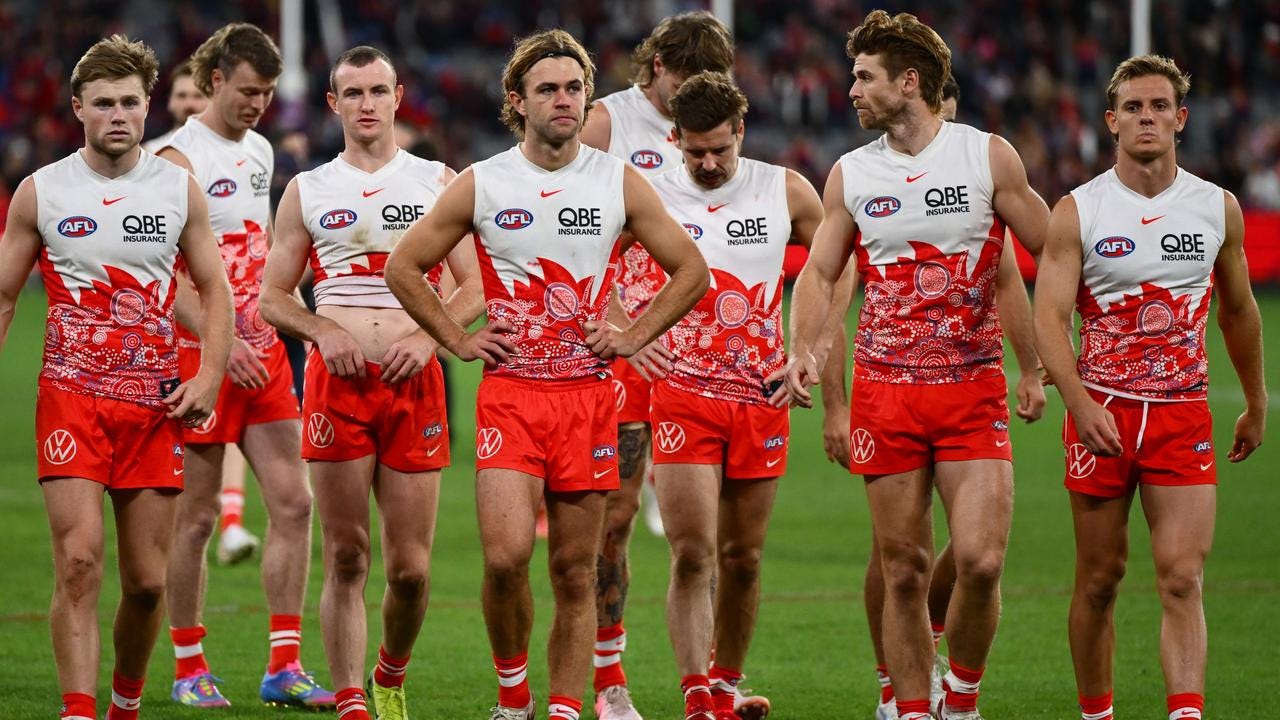
And another one gone, and another one gone – another one bites the dust (nooo). Queen’s earworm became the unofficial and very much unwelcome anthem of Sydney’s season as serious injuries to serious players derailed Dean Cox’s first year in charge. Errol Gulden was the first to succumb; a broken ankle in pre-season kept him out until Round 15. An ankle injury also did in Logan McDonald, this time for the whole year. Captain Callum Mills missed the first half of the season, as did small forward and Most Valuable Pest, Tom Papley. Without them, the Swans fell behind the count and couldn’t recover. A 90-point home defeat to the Crows, capped off by Wayne Milera’s surprising admission that the Swans were “a bit of a rabble”, was the nadir.
Finals were already out of reach by the time key players returned to replenish the ranks. But when they did – shock – the picture became much brighter. The Swans looked somewhere close to their best; vibrant in attack and, helped by some tactical tweaks from Cox, resilient down back. Winning eight of the final 11 games helped the Swans at least finish with a positive win-loss record – and reminded the rest of the AFL that the side which made the 2024 Grand Final can play some scintillating footy. Sydney’s hierarchy wasn’t complacent, either: some frenetic wheeling-and-dealing saw Charlie Curnow become a Swan in the final hour of the Trade Period. The cost – three first-rounders and Will Hayward– was rich, but the rewards could be too. The Swans will be back.
Summary of game style
Reader, I’m going to give you a peek behind the veil. I usually compile these summaries of game style by checking my qualitative priors about how a team plays – call it the eye test – against a list of key metrics that inform different phases of play (transition, contest structure, turnover method, etc). I usually look at metrics for the last two full seasons, because they allow me to see where sides have weakened/strengthened, or – more significantly – what they have chosen to prioritise or deprioritise. I decided on a slightly different approach for Sydney this season. Instead of using the full 2025 stats, I’ve instead looked at metrics for the final 10 games of last season, when key players like Errol Gulden returned and Sydney became not only a much better team, but one which was able to play footy more aligned with coach Dean Cox’s preferences.
Doing that revealed evolution rather than revolution, but with a couple of significant structural changes. First, the similarities. The Swans still build from their back half with patience. They still use short kicks and uncontested marks to shift the opposition’s first defensive layer before looking inboard to puncture it. They still tend to seek corridor access, and they still rely on the burst of players like Gulden and Chad Warner to turn small gaps into cascading overlap. Sydney were again among the slowest teams for raw ball speed late last season, but that obscures the real rhythm of how they want to play: deliberate shaping, followed by sudden release. Slow-fast. Changing angles by foot. Conceding goals to Sydney is like what Hemingway said about going bankrupt – it happens gradually, then suddenly.
Now for the differences. In 2024, the Swans paired corridor ambition with an aggressive forward press. No side scored more than they did from forward-half chains. That model carried them to a Grand Final, but it also revealed an ultimately fatal vulnerability. When opponents beat the first wave and controlled possession with clean kick-mark sequences, Sydney could be disarmed. In six of their seven losses that season, they lost the uncontested marks count. In their heaviest defeats, the gap was huge. Control and ball monopolisation was the antidote to their press.
Dean Cox noticed that. That’s why, late last season, the Swans began to look more like the teams that had given them so much trouble. In the final 10 games, Sydney’s expected score from turnover chains fell sharply – but opposition turnover scoring fell further. No side spent more time in possession across this stretch. The Swans went from forcing and conceding turnovers at an average rate to forcing and conceding fewer than just two sides. Clearance differential and hard-ball differential both strengthened, and their expected score from stoppage chains climbed into the competition’s top tier. The bottom line: the Swans stopped seeking chaos.
The press has not disappeared, but it softened. The numbers suggest fewer all-out hunts and a greater emphasis on rest defence: improved intercept positioning, reduced spoil dependency, and some of the lowest opposition expected threat per kick in the competition. Sydney are committing fewer men to the ball but setting up better behind it.
More than once across this pre-season, Errol Gulden has spoken about how his side intends to “put more speed on the ball” in 2026. To the extent that has a meaning beyond being a proxy for “play better”, I don’t think it means the Swans will get frantic. Instead, it probably means earlier trigger points, less time spent dwelling in sterile back-half circulation, and more decisive corridor release. Unless Cox has discarded the club’s long-held preference for slow-fast ball movement, the Swans will still prefer to surge when the field is shaped to their liking.
Charlie Curnow is likely to be pivotal in this. He’s not a bailout pack-crasher. He is a leading, one-on-one predator who, like a mirror image of Buddy Franklin, can swing around on his right foot and kick goals from 60+ metres. To maximise him, Sydney must be disciplined. If they bomb long into density from deep positions, as Carlton did too often, they will blunt his greatest weapon. If they can isolate him inside 50 – after having shifted the defence laterally and created separation – he will flourish. In theory, his presence significantly raises the ceiling of a system already adept at manufacturing high-quality entries but often without the same quality of personnel finishing that good work.
A significant reason John Longmire’s game model often came unstuck in Grand Finals – sorry, Swans fans – is that its tendency to rely on clean ball: corridor access, uncontested marks in build-up, and forward entries delivered to advantage. Big finals are precisely the games where those conditions are hardest to engineer. Some of Cox’s tweaks – greater stoppage authority, improved rest defence, fewer cheap turnovers, a call to restore the “Bloods” contested identity – look like an attempt to make Sydney less fragile under stress. But the attacking focus is likely to be a more robust version of the existing model than anything new. In 2026, expect a side that is deliberate and selective in possession, more secure behind the ball, and more interested in winning territory at stoppage. Whether that sturdier defensive shell is enough to protect a geometry-first attack in September is probably the question that will define their season.
List changes
In:
Harry Kyle (2025 National Draft, Pick #14 – Academy)
Jevan Phillipou (2025 National Draft, Pick #35)
Billy Cootee (2025 National Draft, Pick #42)
Max King (2025 National Draft, Pick #49 – Academy)
Charlie Curnow (trade – Carlton)
Malcolm Rosas Jr. (trade – Gold Coast)
Jai Serong (trade – Hawthorn)
Noah Chamberlain (Category B Rookie)
Liam Hetherton (Category B Rookie)
Out:
Oliver Florent (trade – Carlton)
Will Hayward (trade – Carlton)
Jack Buller (trade – Collingwood)
Indhi Kirk (delisted)
Blake Leidler (delisted)
Caleb Mitchell (delisted)
Ben Paton (delisted)
Robbie Fox (delisted)
Aaron Francis (delisted)
List profile
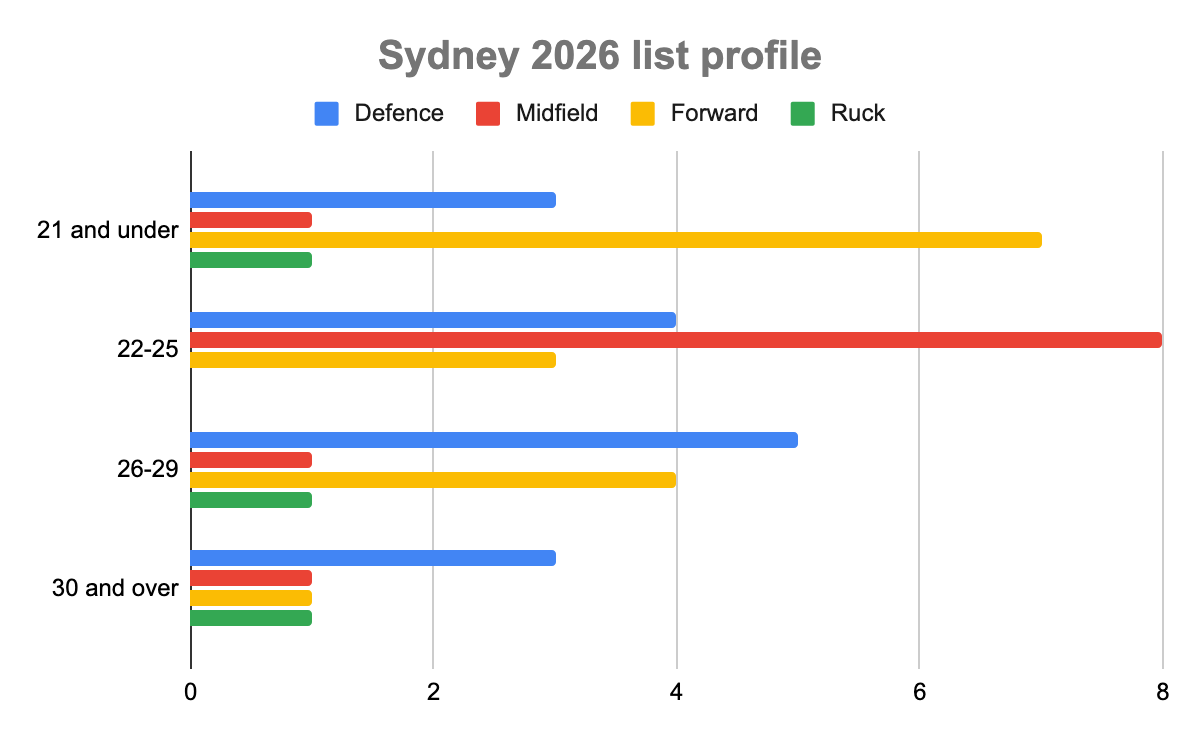
Number of top-10 draft picks: four (T-13th)
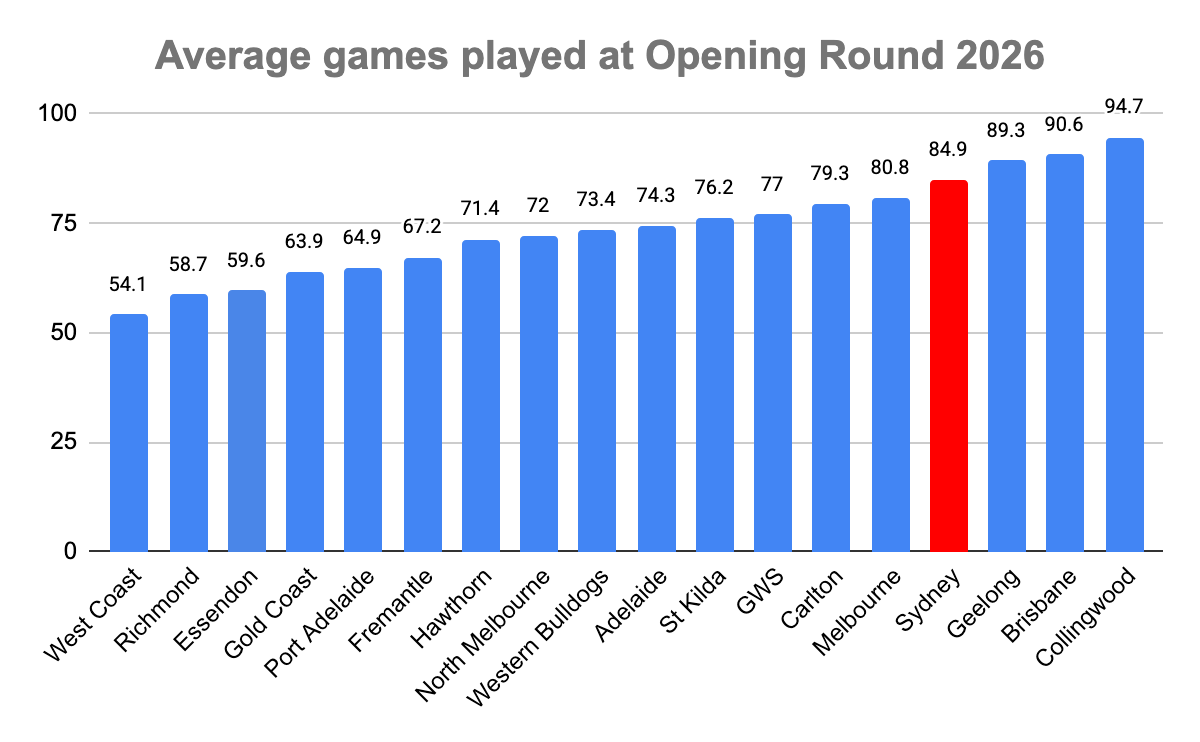
Average age at Opening Round: 25.1 (5th)
Average number of games played: 84.9 (4th)
The Swans knew they had three draftable academy prospects and also knew they could probably only match bids on two of them. They decided they liked Harry Kyle best. His powerful athleticism – he posted three top-10 results at the National Draft Combine – has a whiff of Finn Callaghan to it. He’ll probably begin at half-back or on a wing. Matching the Giants’ bid on Kyle meant the Swans didn’t have enough points to match the Western Bulldogs’ bid on medium interceptor Lachlan Carmichael. Expect that to happen more in an era of super-productive Northern Academies and tightened bid matching rules. The Swans did, however, have the points to match Adelaide’s bid for forward Max King at pick 49 (the Swans academy prospect, not the perennially injured St KIlda forward). In between those two Academy prospects, they also selected overage Norwood midfielder Billy Cootee – one of the best players in the SANFL – and Jevan Phillipou, a mid/forward who’s younger brother of St Kilda’s Mattaes. I’m a fan of Jevan’s athletic traits and a fan of his unabashed self-belief. Pretty much every elite athlete is irrationally self-possessed; Jevan just says it out loud.
As intriguing as Sydney’s draft haul was, the trades dominated the headlines. Ollie Florent and Will Hayward were on holiday in Argentina when they got a phone call from Dean Cox and Leon Cameron summarily informing them their time at Sydney was up. Neither wanted to go, but both needed to in order to pave the way for Charlie Curnow. It’s a ruthless industry. Hayward’s ability to stretch defences vertically and knit together play in the forward half will need to be distributed across other players. There’s nothing more to say about Curnow that I won’t have written elsewhere in this preview – suffice to say it’s a big statement, more or less precisely the profile of player Sydney most needed, and puts them firmly in Win Now mode. It’s a peak-aged list: several of the role players are old, but, crucially, the stars aren’t. Isaac Heeney is probably investigating that weird tech billionaire’s anti-ageing protocol as we speak.
The defence is good less because of star power and more because of disciplined spacing that reliably forces tough shots (Sydney was first for opposition expected score per shot in its two recent Grand Final years, third in 2025, and fifth in 2023). Tom McCartin, Lewis Melican and new recruit Jai Serong (a sneaky good trade) will make a reliable if unglamorous trio. Sam Wicks and Matt Roberts are more defensive options, while captain Callum Mills organises structure and ball movement from half-back. Nick Blakey gets to do the really fun stuff; he has licence to move up the field and even carry through the corridor. Much of Sydney’s ability to speed up its chains runs through The Lizard.
There isn’t much we don’t know about the midfield by now. Rowbottom tackles, Jordon tags, Warner weaves, Gulden kicks, and Heeney does a bit of everything. It’s versatile and dangerous, although the very best opposition midfields can exploit its relative lack of size and its division of duties; the defensive midfielders offer little attacking threat while the stars don’t do a heap of defensive running. I’m interested to see how Angus Sheldrick fits. The West Australian, taken with Pick 18 in the 2021 draft, didn’t play a single AFL game in 2024 but injuries ahead of him allowed him to establish himself as part of the on-ball rotation in 2025. At the very least, he will improve the depth of the Swans’ midfield.
The addition of two new players, both of whom are different archetypes to what Sydney had before, will significantly change the look and threat of the Swans’ forward line. I’ve written about Curnow already and will write more about him further down. The fit with Logan McDonald will be important. I think the best way to make it work is for McDonald to play the role of a deluxe Eric Hipwood: kick his share, contest, block, run, and create space for the alpha. The addition of Malcolm Rosas Jr. could provide Sydney with a ground-ball danger they lacked last season. The idea of deploying Papley slightly higher up the ground to replace some of Will Hayward’s forward-half connection, while leaving Rosas closer to goal, makes sense to me. Joel Amartey and Hayden McLean will duke it out for minutes, while Braeden Campbell will continue on a half-forward flank alongside whichever one of Isaac Heeney or Chad Warner isn’t on ball.
The Swans haven’t rebuilt. They didn’t need to. They’ve rebalanced, keeping the spine intact while sharpening the forward line for a tilt right now.
Line rankings
Defence: Above Average
Midfield: Elite
Forward: Above Average
Ruck: Above Average
The case for optimism
The human tendency to overextrapolate recent trends means there are lots of people who’ve forgotten how good the Swans are when the list is healthy. Sydney was the second-best team in the AFL in 2024 and the best for most of it. Since then, they’ve effectively swapped Will Hayward and Ollie Florent for Charlie Curnow, Malcolm Rosas, and Jai Serong (I’m ignoring the minimal list changes after the 2024 season). The three new arrivals will make the Swans better in ways that really matter – stability down back and potency up forward. Adding Charlie Curnow and a dangerous small forward to a side that made the Grand Final just two seasons ago is a good place to start from.
Another reason for optimism is that 2025 functioned as a live audit of Sydney’s depth. Injuries to key players – Gulden, McDonald, Mills, and Papley all missed heaps of footy – didn’t just remove star power; they forced role players into structural responsibility. Angus Sheldrick went from not playing a senior game in 2024 to playing all but three in 2025, including significant midfield stints. He’ll be better for the experience. Braeden Campbell took a step. Riley Bice proved he can hang at AFL level. It was a tough season – but one that also provided the Swans coaches with important information about who can hold under pressure. When the A-graders returned late in the season, they plugged back into a group that had been stress-tested by their absence.
Swans fans should be optimistic for reasons that go beyond the quality of new personnel and availability of old. As I wrote in the Summary of Game Style section, Sydney’s statistical profile late in the season once their stars returned suggests that Cox is approaching the problem of fixing his side’s fragile defensive profile the right way: more front-half footy, more time in possession, and a defensive structure that more effectively neutralises threat. Based on 2024, the Swans don’t need to become something new. They just need to become incrementally harder to score against when momentum swings against them.
Cox said he learnt a lot from his first season as an AFL head coach. Part of why he did, beyond the pressure of the position and the challenge of being without so many important players, is that he had one of the smallest coaching groups in the AFL. Despite Sydney’s reputation as one of the most organisationally stable clubs in the AFL, it looked a slightly puzzling decision even then. In 2026, he’ll be armed with the experience of a bruising first season – and he’ll be surrounded by more people to bounce ideas off. Melbourne Premiership coach Simon Goodwin has joined Sydney as Director of Coaching, and former Sydney player and VFL coach Jeremy Laidler will return as an assistant after three years behind enemy lines at the Giants.
Put it all together and the case is straightforward. Instead of looking for a new identity, the Swans are trying to sharpen one that took them to the last Saturday in September just two years ago. If they are healthier in 2026 – and a bit tougher to score against – they should return to what they consider to be their rightful place at the pointy end. The Swans are in Win Now mode. That’s exciting.
The case for pessimism
Trading three first round picks in three consecutive drafts to land Charlie Curnow is a clear declaration that Sydney believes it can Win Now. That’s exciting. It’s also scary – because it leaves little margin for error. If 2026 does not yield genuine contention, the only realistic asset replenishment lever they can pull is the one marked “Chad Warner to West Coast”. Losses matter more when you’ve already spent the future. Consolidating assets into a superstar key forward is also inherently risky, particularly one whose health has been capricious and whose commitment has – at times – been less than absolute. On paper, Curnow transforms Sydney’s forward line. He also concentrates structural responsibility into a role that’s already highly sensitive to variance. An unhealthy dependency on Charlie undermined one club’s flag ambitions. Sydney’s list is more coherent than Carlton’s was; its style more conducive to coaxing forth his immense talent. But there aren’t many silver bullets in footy.
There is also the question of whether the defensive improvements I noted late in 2025 represent a real change or statistical fluke. The numbers noticeably improved once key personnel returned, and the emphasis on front-half control makes sense. But late-season samples can flatter. The Swans played some good sides in their final 10 games of 2025. They also played Port Adelaide, North Melbourne, Essendon, and West Coast. Sydney’s defensive vulnerabilities are rarely exposed against those sides – they’re exposed against the best ball movement teams. Much sterner tests await.
Then there is the standard of opposition. Footy does not stand still. Sydney will be better in 2026 than last season. But so will other sides – including the one that just won a second straight flag. Several younger sides are entering their athletic peak and doubling down on volatility at the same time Sydney appears to be leaning more in the direction of control. As Brisbane has shown, you can win by zagging while other teams zig – if you’re good enough. The Swans should be very good. But in a league this tight, very good can still mean fourth.
Enjoying this preview and think a Swans-supporting friend might too? Share it with them!
Breakout player
Angus Sheldrick is probably the rational candidate here, given the way injuries created room to establish himself in the senior side last year. Jesse Dattoli is a romantic choice (he was one of my favourite prospects in the 2024 draft pool). But I think the most compelling candidate is Malcolm Rosas Jr. The evidence from pre-season is that Charlie Curnow won’t be the only new addition to the Swans’ forward line that could significantly augment the threat it poses opposition defences. It’s early, but he – in combination with a fit-again Tom Papley – could give the Swans a genuine ground level threat they’ve not had for some time.
Most important player
Isaac Heeney is still Sydney’s best player, but last season convinced me that Errol Gulden is its most important because of how he knits everything together. He’s both very good and very unique: a hybrid wing/outside midfielder who will often be the first to bite off the inboard kick that accesses the corridor and then run hard for a follow-up handball to be the one delivering inside 50. His fitness and connection with Curnow – it could be the most devastating one-two punch in footy – will go a long way to determining Sydney’s ceiling in 2026.
Biggest question to answer
Theoretically, it all makes sense: take the side that was the best team in footy for most of 2024, add Charlie Curnow, a dangerous small forward, more defensive solidity, and greater support for a young coach, and you should have a contender. The question – given the expectations those additions create – is how good will the end result look on grass?
What success looks like
It’s rare that a side which missed finals in one season that – the health of key players permitting – has no excuse to miss out again. But that’s Sydney’s situation. The elite talent is there. The role players are there. The system that has yielded success should be there. The top half of the ladder was mightily congested last season. But a Swans side operating anywhere near its theoretical maximum in 2026 should be better than several of the teams which finished above them in 2025. Sydney doesn’t need to finish in the top four. But it should believe it can. And it should aim to win at least one final.
In a nutshell
Fortified by the arrival of Charlie Curnow (and Malcolm Rosas Jr.) to the Harbour City, the Swans should be unrecognisable from the side that began 2025 and materially stronger than the one which ended it with eight wins from 11 games. This is not a list building toward something. It is a strong list in its prime.
How are you able to put in so much work into this Mateo? These previews are phenomenally better than anything on afl.com.au or Code. And it’s the AFL’s loss if they don’t give you press credentials for the season coming up.
Will you do a ladder prediction after all the team previews are done? Really enjoying reading your work 👍
Great preview mate, comprehensive and thoughtful. Looking forward to the season and your assessments of it.