


Going bayside for my 15th season preview.
2025 ladder position: 12th (9 wins, 14 losses)
2025 best-and-fairest: Nasiah Wanganeen-Milera
Senior coach: Ross Lyon
Story of the season
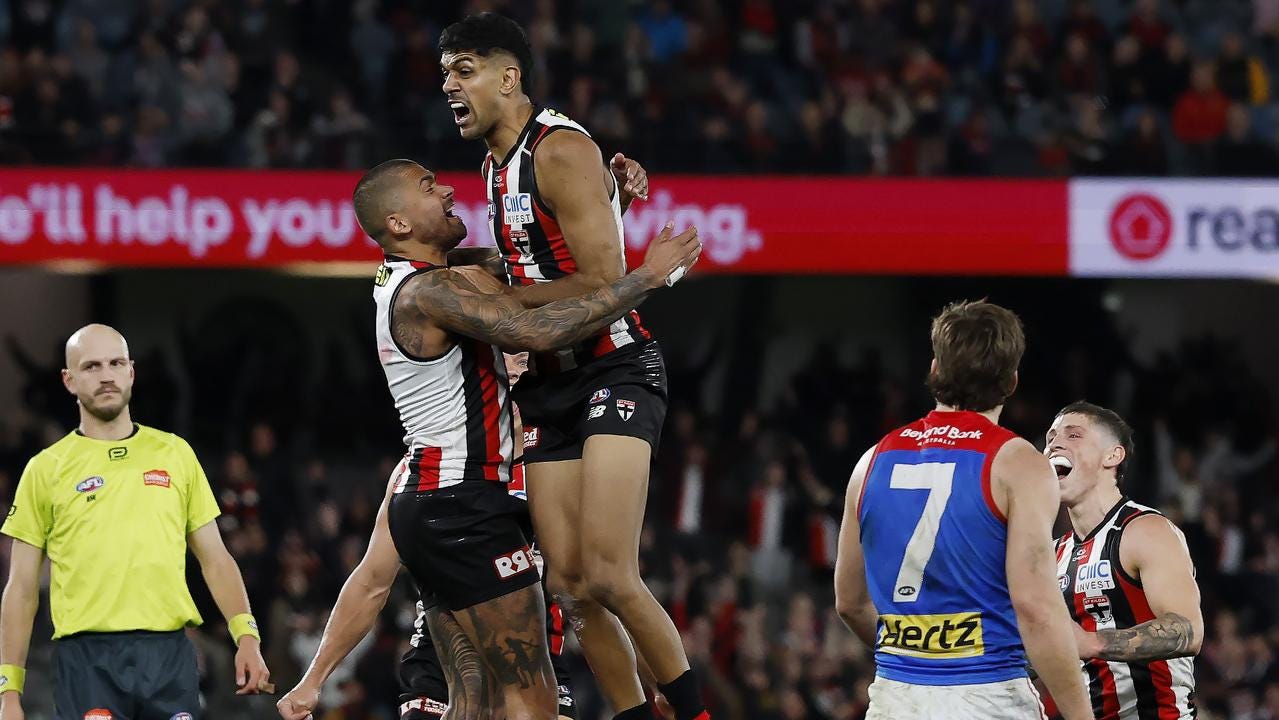
The start and the very end were good – the middle, not so much. The Saints brushed off an opening 10-goal loss to an Adelaide side that ended up being better than anyone expected by winning their next three, including their now-customary defeat of Geelong at Marvel Stadium. But their oddly large gap between ceiling and floor was demonstrated by a run of six defeats in seven which included West Coast’s only win of 2025 and was only broken by an incredible 10-goal win against Fremantle. As it soon became clear that the Saints wouldn’t be taking part in September, the footy faded into the background, replaced by the most momentous off-field storyline of the season: the future of Nasiah Wanganeen-Milera. The stakes were raised with every headline performance. Even a frankly bonkers fourth-quarter comeback against Melbourne in Round 20 was partly overshadowed by the young superstar’s decidedly non-committal responses about his future after the final siren.
I’ll be honest – I thought he was a goner. That would have been a devastating blow for the Saints, a club that’s only made finals twice since 2011, and strong evidence for the theory that the AFL’s equalisation mechanisms are breaking down. Which made it a very welcome surprise, when, on August 17th, Cal Twomey announced that Wanganeen-Milera had rebuffed intense interest from both South Australian clubs to extend with St Kilda until the end of 2027. Inspired by the clear message of Wanganeen-Milera’s choice to only re-sign for two years – give me a good supporting cast – the Saints were extremely aggressive during the Trade Period. Tom De Koning, Sam Flanders, Liam Ryan, and Jack Silvagni will all wear red, black, and white in 2026. Most importantly, so will Nas.
Summary of game style
Ross Lyon continues to coach his sides to play according to a stable set of maxims: reduce volatility and manage risk. In 2025, the Saints again ranked prominently for key metrics of control-oriented football such as kick share (4th), marks (4th), disposal retention (4th), and expected retention per kick (2nd). Their ball movement was built around structured kick-mark chains rather than handball surge or early corridor access. Progress was incremental and frequently funnelled toward the boundary, with the flanks functioning as both attacking lanes and defensive buffers.
Lyon understands that turnovers are unavoidable but believes their impact can be neutralised. St Kilda’s games consistently feature fewer aggregate turnovers than those of most other sides, reflecting a deliberate effort to confine possession changes to compressed, low-risk zones. If you’ve ever felt like watching the Saints under Lyon is like watching a basketball game (but slower), then you’re onto something. Defensively, the Saints prioritise structure over pressing. They are content to sit deep, absorb pressure, and trust their zone to funnel opposition possession into low-value areas. Maintaining defensive shape is often preferred to actively hunting turnovers.
This comfort with conceding territory and defending deep helps explain St Kilda’s distinctive attacking profile. At their best, the Saints are a strong back-half scoring side, capable of turning controlled defence into prepared counterattack. In 2025, only Greater Western Sydney generated a higher share of its scoring (and only just) from back-half chains. Strong structure and selective aggression combine to produce an offence that’s low-volume but relatively efficient. Just four teams generated fewer inside-50s than the Saints in 2025, but once inside, the Saints created shots as often as Brisbane. The central question, given their aggressive off-season recruitment and rising expectations, is how Lyon now incorporates greater risk without undermining the defensive base.
The clearest pathway to offensive improvement runs through Nasiah Wanganeen-Milera. His speed, evasiveness, and willingness to carry the ball to draw opponents out of position provide St Kilda with a genuine line-breaking outlet inside an otherwise conservative system. If chains are moulded to his unique strengths, Nick Daicos-style, then he can help the Saints improve their ability to selectively access the corridor – the model’s current missing link. Tom De Koning’s clearance strength, meanwhile, should enable the Saints to begin more chains closer to goal rather than in their back half. Behind the ball, Jack Silvagni, alongside Cal Wilkie, adds intercept capacity without sacrificing structural discipline. At the other end, Liam Ryan will introduce volatility in forward areas where Lyon-coached sides have tended to struggle to create it.
All told, these pieces point toward evolution rather than reinvention. Lyon isn’t dogmatic, but he has his principles. He’s unlikely to abandon control and risk mitigation as the bedrock of his footy. Instead, his improved personnel could allow him to preserve the foundations of his system while giving specific players permission – in specific moments – to break it. The potential rewards are there. So are the risks.
List changes
In:
Sam Flanders (trade – Gold Coast)
Liam Ryan (trade – West Coast)
Tom De Koning (free agent – Carlton)
Jack Silvagni (free agent – Carlton)
Charlie Banfield (2025 National Draft, Pick #41)
Kye Fincher (2025 National Draft, Pick #52 – NGA)
Kobe McDonald (Category B rookie)
Out:
Jack Steele (trade – Melbourne)
Max Heath (trade – Melbourne)
Harry Boyd (delisted)
Zaine Cordy (delisted)
Zak Jones (delisted)
Angus McLennan (delisted)
Arie Schoenmaker (delisted)
Jimmy Webster (retired)
List profile
Number of top-10 draft picks: eight (T-6th)
Average age at Opening Round: 24.5 (10th)
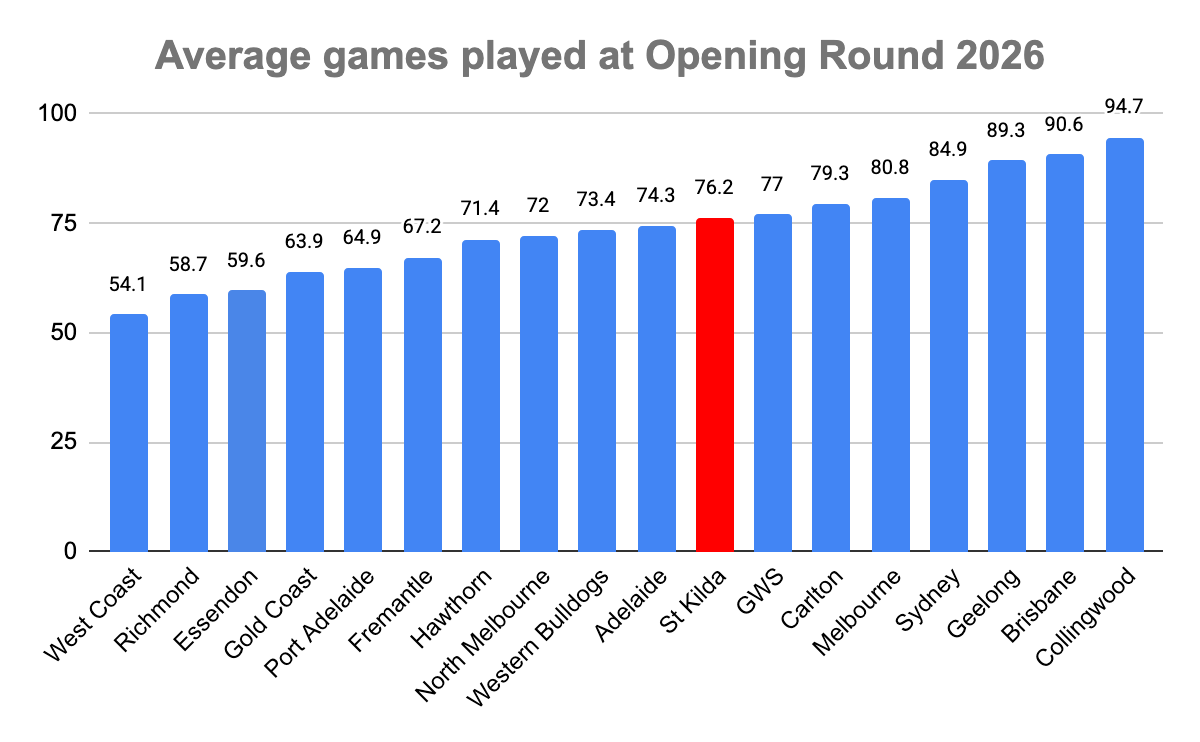
Average number of games played: 76.2 (8th)
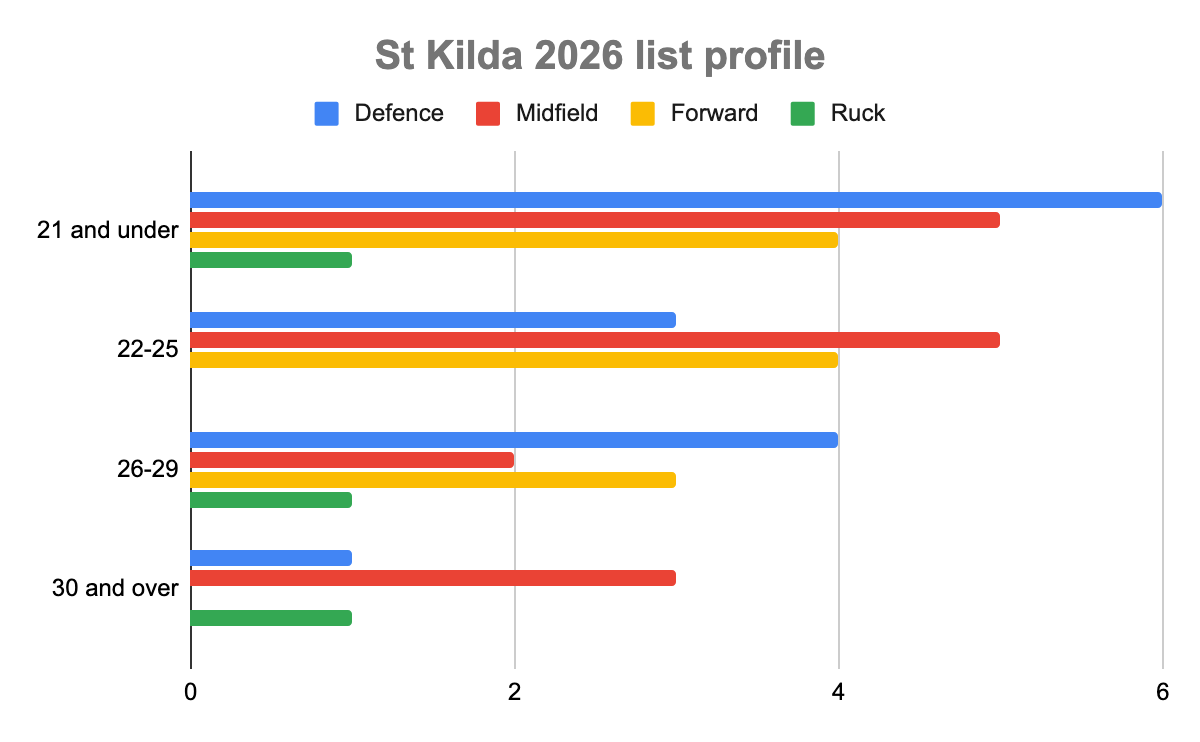
St Kilda’s choice to compress its contention timeline by pivoting from the draft towards the aggressive pursuit of mid-career players will have immediate ramifications for all three lines. The logical second-order consequence is that the Saints, by rising up the ladder as soon as this season, are de-emphasising the importance of future drafts to its list construction. That raises the stakes – not just for the new recruits, but for the players they’ve drafted since 2021.
This being a Ross Lyon-coached side, St Kilda’s backline is the most resilient part of the team. Callum Wilkie is the defensive general. While one cannot fault Anthony Caminiti’s endeavour, the size he often gave up to opposition forwards forced Wilkie to man the opposition’s biggest forward while also minding the second tall. Dougal Howard is big enough, but I’m not sure his body can be trusted enough. The addition of Jack Silvagni will help. Although he’s listed as a couple of centimetres shorter than Caminiti, he’s a bigger body and a better natural interceptor. The solidity of a Wilkie-Silvagni pairing should give Lyon greater tactical flexibility. A plausible response would be to continue to tolerate contests inside defensive 50, trusting the duo’s ability to repel opposition entries. A more audacious one would be to give other defenders more license to disrupt opposition chains higher up the ground. Unless Alix Tauru is sent down back as a roaming interceptor, Caminiti is likely to continue to feature. The question of which players will be responsible for drive from the back half will – like so many questions about the Saints in 2026 – be dominated by where Wanganeen-Milera plays most of his footy. To put my cards on the table: I am adamantly pro-midfield Nas, even if it means he isn’t the first link in the rebound chain. Jack Sinclair is an excellent half-back, and it’s time to see what Tobie Travaglia can do alongside him.
If we assume that Wanganeen-Milera will be a midfielder in 2026, as he was for the final seven games of last season, that transforms the nature and severity of the threat that the Saints’ midfield will present to opposition teams. Despite not possessing the frame for repeat hard-ball contests, Wanganeen-Milera is a superb ground-level player and a constant protagonist. The appeal of him getting the ball closer to opposition goals is too tempting to resist. The Saints’ choice to trade captain Jack Steele to Melbourne for spare change opens up an engine room vacancy that one assumes will be filled by Sam Flanders. Something like a Macrae/Flanders/Wanganeen-Milera/Windhager core rotation, with players like Sinclair, Hugh Boxshall, and Hugo Garcia (and Max Hall, please, Ross!) getting some reps, looks like a much more multi-dimensional midfield unit than the bland groups of years past. I’ve not mentioned Mattaes Phillipou’s name yet. The talented but luckless South Australian attended only seven centre bounces last season, in St Kilda’s desperate and unsuccessful attempt to avoid defeat to West Coast. He is the archetypal big-bodied midfielder who can drift forward and kick goals. His determination to wring every ounce of his talent out of himself (and his teammates) is absolute. If his body can withstand it, he needs to play in the midfield. The Saints’ midfield looks better this season. But given the current composition of the list, and the fact the club has signalled that it’s done with drafting (for the time being), it needs Phillipou to step up if it’s to become great. Darcy Wilson, Brad Hill, and Mason Wood will likely start on the wings, but expect names like Travaglia, Hall, and – if he ever gets his body right – Liam Henry to roll through at different times.
There is a big question mark, in the exact shape of Max King, hovering over the St Kilda forward line. Without him, the Saints will be too dependent on either creating separation (possible against bad sides, very hard against good ones) or bringing the ball to ground for small forwards like Jack Higgins and Lance Collard (I guess?) who can actually hit the scoreboard. With him, they offer a genuine aerial threat that makes opposition key defenders think twice before peeling off, and creates a beneficial concertina effect where players like Mitch Owens, Alix Tauru, and Cooper Sharman can take lesser defenders. King’s availability will determine how potent the Saints can be in 2026. Tauru is an interesting wildcard. His athleticism and lust for the contest will make him a handful no matter where he plays, but I think the priority should always be to see what such a maverick talent can do in the forward line.
Even if I’m aware that’s what it took to prise him out of Western Australia, I’m sceptical of the decision to award Liam Ryan a three-year contract. However, the fit makes theoretical sense. At his best, Ryan provides a hybrid aerial/ground-level threat that should complement both the Saints’ talls and their smalls. I’m just worried he’s no longer at his best. And then there’s Rowan Marshall. He remains a good ruck, but has historically offered little as a forward – as, to this point, has Tom De Koning. Playing both is tempting against sides that rely on clearance wins, but it only works if one of them can genuinely threaten inside 50. If De Koning is the long-term number one, Marshall risks becoming an awkward fit in a forward line that already hinges on Max King’s health. For now, he looks less like a focal point and more like a talented spare part.
Line rankings
Defence: Above Average
Midfield: Above Average
Forward: Average* (a fit Max King could make it Above Average)
Ruck: Above Average
The case for optimism
I wrote about St Kilda’s decision to crowbar their contention window open back in October. There’s a section, which I’ll quote here, that underpins why I think Saints fans should feel more optimistic about 2026 than at any point in the past few seasons:
The Saints aren’t content with living and dying meekly anymore. In the recent trade period, and the months preceding it, they’ve chosen a different approach, one which sharply diverges from the one they’ve pursued since 2021, and indeed one that’s rarely associated with the club: audacity. It’s a challenge to conventional wisdom of how to build a competitive AFL list. It’s recognition of the narrow path the club must walk to find success. And it’s a demonstration of the extent to which one player will define their prospects for the rest of the decade.
There are two overlapping reasons for optimism contained in that paragraph. The first is that the Saints have rejected the default script offered to clubs in their position – draft patiently, hope the kids are good, hope they stay, and hope the timing lines up before gravity drags you back down the ladder. That model may still work for some. But for clubs without access to Academy windfalls or generational father-son pipelines, it is becoming harder to treat it as the only responsible path. But rather than sitting around lamenting their lot, the Saints are looking to do something about it. In addition to their daring strategic pivot, they’re getting Moorabbin up to scratch, fielding a standalone VFL team, experimenting with Irish talent, and publicly inviting the pressure of expectations. Whether their model will work remains to be seen. But until we know, supporters should feel encouraged that their club is being proactive rather than passive about its place in the hierarchy. They’re actually trying to win.
The AFL derives much of its legitimacy from the idea that club that make enough smart decisions, compounded over sufficiently long timelines, will find success. If that bargain is eroding, someone has to test a different one. The Saints believe the traditional pathway was unlikely to deliver what they needed – so they’re doing something different. That, at minimum, is preferable to drift.
The second cause for optimism is simpler: Nasiah Wanganeen-Milera stayed. Only for two years, mind – the circus will return soon enough – but his decision removes the weekly anxiety that hovered over last season. He will be a Saint for at least the next two years, and the message implicit in the length of that deal – show me progress – has already jolted the club into action.
Buying short-term wins can feel out of step with an era increasingly influenced by modelling and age-curve analysis. But analytics offers no clean solution to the problem of retaining a club-defining superstar while remaining competitive. Keeping Wanganeen-Milera doesn’t guarantee a flag. But losing him effectively guarantees the Saints won’t win one. In that context, going all in is the better move. And look, say what you like about buying short-term wins, but winning is fun. If, as they should, the Saints win more than nine games and play meaningful football in September, that alone represents progress. Momentum matters. It sustains belief inside the club and connection outside it. Good eras are preceded by good vibes.
The case for pessimism
Much of the optimism above is independent of on-field performance and instead rests on the psychic dividend of St Kilda’s choice to walk a different path. But ultimately, the success of the club’s strategic pivot will be judged by two closely related metrics: winning enough games, and retaining Wanganeen-Milera. I’m sceptical about the first – which makes me uneasy about the second.
The Saints should improve in 2026. But there is a fair way to go to catch the good teams, and a long way to match the best. St Kilda finished 12th on the ladder and 13th for expected wins. It wasn’t a small gap to the team ahead of them, either – they were 2.4 expected wins behind Carlton. Improvement is possible, of course. And there is usually significant variation from season to season. Adelaide’s surge from 15th to minor premiers will be cited all year as proof of that. But those rises are exceptions more than they are the norm.
The real risk is misalignment. After such an aggressive off-season, the expectations of supporters and, more importantly, of Wanganeen-Milera may outpace what this list can realistically deliver. If the threshold required to persuade Wanganeen-Milera to extend beyond 2027 is higher than what the Saints can achieve in the short term, the gamble becomes dangerous. Striving for the top and not making it is the worst place to be in professional sport – doubly so if it costs you your superstar. That’s how you end up with a list full of good second-tier AFL players but light on the stars needed to truly compete. Shooting for the moon is all well and good. I’ve lauded the Saints’ approach. But let’s not pretend it doesn’t increase the chances of ending up underwater.
Which brings us to Max King. Ross Lyon revealed this week that King’s calf injury is likely to sideline him for five to six weeks; an unfortunate revision of an earlier two-to-three-week timeline. King hasn’t played AFL since 2024. He has played 23 games across the past three seasons. He is a good forward. Given the timeline that the Saints have now committed themselves to, I don’t think the project works without him rediscovering fitness and the form that saw him kick 52 goals in 2022.
Audacity raises ceilings. It also raises stakes. If the Saints surge, clubs in their position will have a new model of how to compete. If they stall, the consequences will be sharper than they would have been under a slower build.
Enjoying this preview and think a Saints-supporting friend might too? Share it with them!
Breakout player
Max Hall’s form last season probably disqualifies him, but I’d like to mention him anyway. Hall suffered separate ACL injuries when he was 15 and 16, didn’t get drafted, and plugged away at Box Hill until St Kilda selected him with its first pick in the 2024 Mid-season Draft. Last season, he almost immediately became one of the Saints’ best players. It’s a lovely story. Ross – if you’re reading this – please give him some midfield reps! If Hall has indeed already broken out, then I’ll instead nominate Alix Tauru. The maverick key position player with the big leap and shock of blond hair – no, I’m not calling him “The Flying Viking” – displayed a golden retriever-like energy across his 10 games last season. If he can harness his exuberance and become a little more disciplined, he is likely to become a handful at either end of the ground.
Most important player
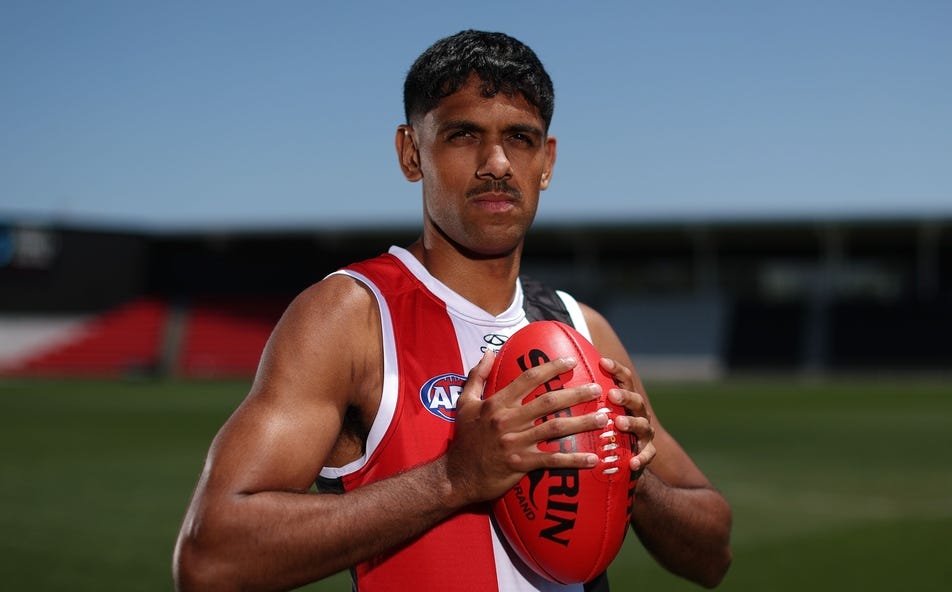
Sometimes this question does not have an obvious answer. This is not one of those times. Nasiah Wanganeen-Milera is St Kilda’s most important player because he is the club’s best player, its biggest recruitment asset, its biggest commercial asset, and genuinely load-bearing for its near-term future. No pressure, Nas!
Biggest question to answer
Beyond “what is the threshold level of success given last season’s aggressive recruitment?”, the questions that will likely define St Kilda’s 2026 season are: 1) how will Ross Lyon accommodate new players that enhance his side’s intercepting, clearance-winning, and finishing capabilities while preserving defensive integrity; and 2) is it medically feasible to transplant a healthy person’s legs onto Max King’s body?
What success looks like
The Saints’ last two seasons have effectively been over in June, leading to dull Sunday afternoon games played in front of half-empty Marvel stadium crowds. That can’t happen again. Playing finals must be the benchmark – and I don’t mean making the Wildcard Round. I mean making at least an Elimination Final. The Saints have a core of players, a supernova in the form of Wanganeen-Milera, and a canny old coach. Go and get it.
In a nutshell
The Saints have chosen to reject the default script – the one which says that, in footy, the strong do what they can and the weak suffer what they must. I’m not sure it’ll be enough to suddenly take them from mediocrity to contention. But, for the sake of the competitive integrity of the game, I hope it does. We probably all should.