


The traffic on Punt Road is always so bad. I’ll just walk.
2025 ladder position: 17th (5 wins, 18 losses)
2025 best-and-fairest: Tim Taranto
Senior coach: Adem Yze
Story of the season
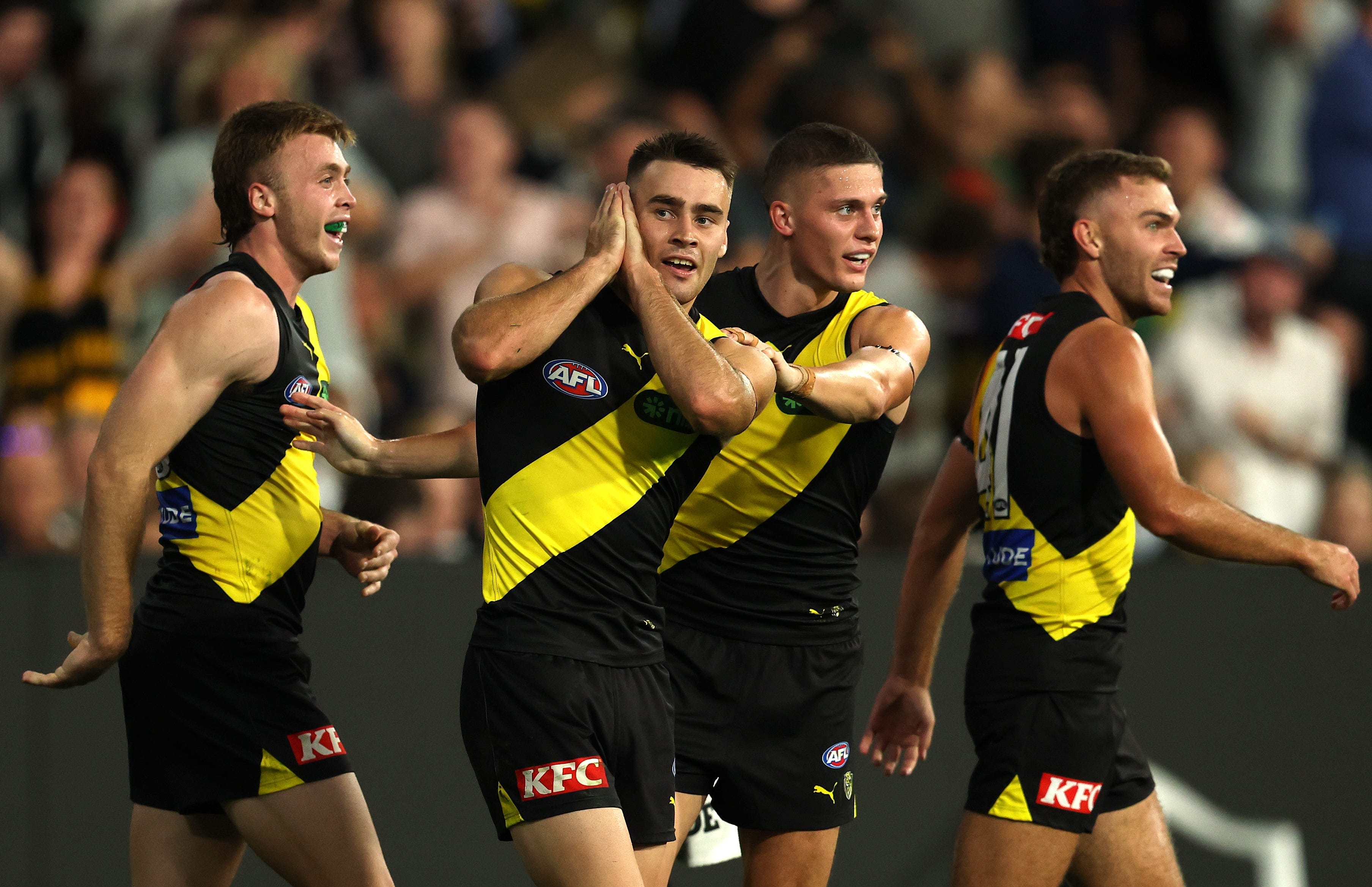
Anxieties about the early progress of the most ambitious rebuild in Richmond’s recent history were put to bed 32 minutes and 53 seconds into the last quarter of Round 1 when Seth Campbell outran Lachie Cowan to kick the match-sealing goal and, in an expression of spontaneous joy, celebrated with a backflip. Winless season? Tell ‘em they’re dreaming. In truth, the anxieties of all but the most neurotic Tigers fans had been allayed well before then. Their side roared back from a 41-point deficit midway through the second quarter, led by their grizzled veterans and impetuous kids. Sam Lalor, the number one draft pick, was the fourth highest-rated player on the ground on debut. They were strong, they were bold, and they fought until they won.
The wins were infrequent but special. The Tigers’ second, a month after their first, was special because it was against Damien Hardwick’s Gold Coast – at Marvel, no less. The third win, against West Coast, was special because it was sealed by Tom Brown’s heroic rundown tackle. The fourth was special because it was against Essendon and also possibly the worst game of footy ever played. There were some close losses along the way, too, but I doubt many supporters cared. The season was a success. The kids are alright. And four more highly-touted ones were welcomed to Tigerland during the draft.
Summary of game style
After Richmond’s 2024 season was wrecked by injuries, Adem Yze’s priority in 2025 was tactical, psychological, and physical stability. So he opted for caution. Ball movement slowed. Kicks were sent down the line instead of through traffic. Retention was improved and unnecessary contests were avoided. The underlying logic was simple: minimise a young list’s exposure to danger while embedding good habits that could scale later. It probably isn’t the final form of the Yze game model; just a provisional version until the talent catches up.
That conservatism was, in part, motivated by a desire for preservation. A physically developing side asked to play high-speed, contest-heavy football can break down. Seen this way, slowing the game and favouring controlled possession over chaotic pressure was also a form of on-field conditioning management, allowing young bodies to mature without being constantly pushed beyond their limits. Yze placed significant on-field responsibility on veterans – Nick Vlastuin, Nathan Broad, Tim Taranto, Kamdyn McIntosh, and Tom Lynch – who became the system’s on-field lieutenants. Much of Richmond’s play flowed through their decision making: steady exits, conservative switches, and low-risk territory gains designed to keep the team organised behind the ball. At the same time, Yze did not insulate his younger players from responsibility. Luke Trainor, Sam Lalor, and Jonty Faull were entrusted with important roles rather than protected cameos. The trade-off was inconsistency, but the intention was clear: learn the boring system stuff first, do the fun expression stuff later.
Richmond’s statistical profile reflected Yze’s desire for stability. Knowing they would rarely enjoy a territory advantage, the Tigers were happy to drop deep defensively (they were #2 in the AFL for defensive one-on-ones), trusting in the quality of experienced personnel like Nick Vlastuin and Nathan Broad. Those defensive numbers enabled them to become more reliable exiting defensive 50 and more disciplined in their spacing, even if it meant they were frequently toothless up forward. Time in forward half stagnated, forward-50 groundball control collapsed, and shot quality fell to league-worst levels. Some of that was simple: their forward line was physically overmatched. Some of it was the product of deliberate decisions made upfield.
For a decade, Richmond’s identity had been built on chaos, surge, and forward-half violence: win, swarm, overwhelm. Yze has almost completely dismantled that model and, in its place, built a system that – at least for now – favours discipline, structure, and repeatability. It’s possible that more layers will be added as his young team grows and gains confidence. But in 2025, the aim was to generate stability and reduce variance. The result was a side that became both harder to score against and easier to stop.
List changes
In:
Sam Cumming (2025 National Draft, Pick #7)
Samuel Grlj (2025 National Draft, Pick #8)
Zane Peucker (2025 National Draft, Pick #31)
Noah Roberts-Thomson (2025 National Draft, Pick #54)
Patrick Retschko (trade – Geelong)
Out:
Kamdyn McIntosh (delisted)
Jacob Bauer (delisted)
Jacob Blight (delisted)
Mate Colina (delisted)
Thomson Dow (delisted)
Jacob Koschitzke (delisted)
Tylar Young (trade – West Coast)
List profile
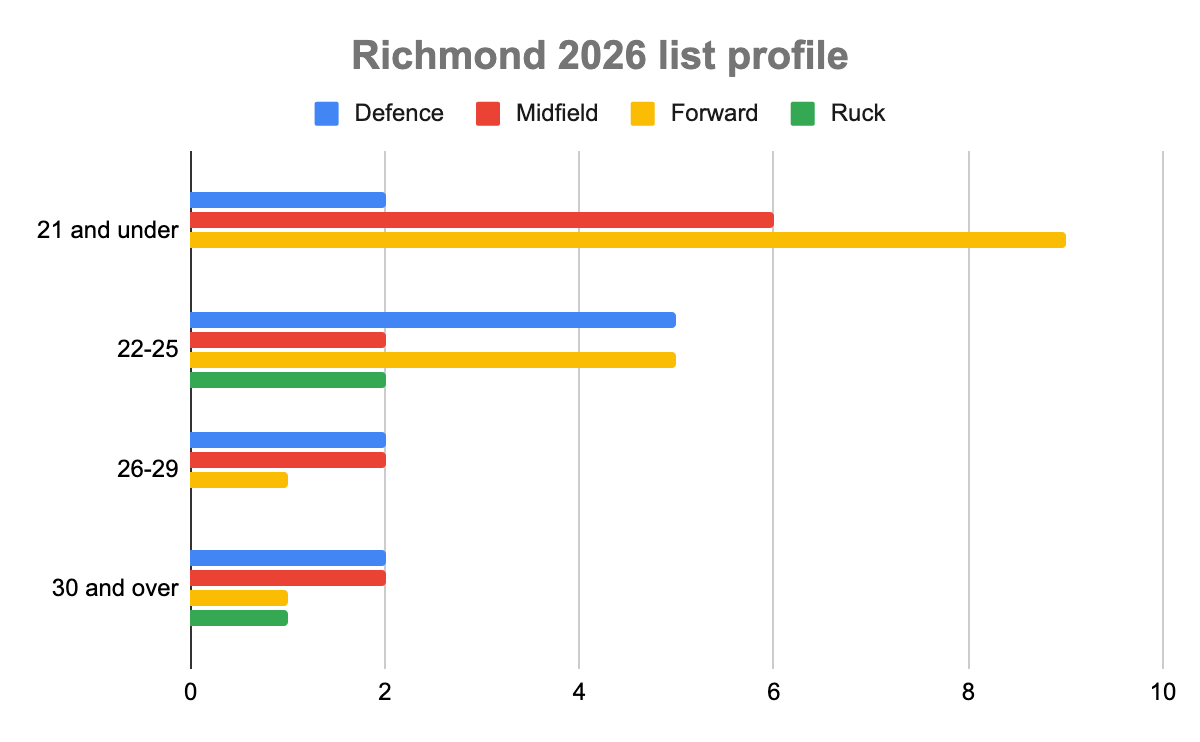
Number of top-10 draft picks: nine (T-3rd)
Average age at Opening Round: 24 (16th)
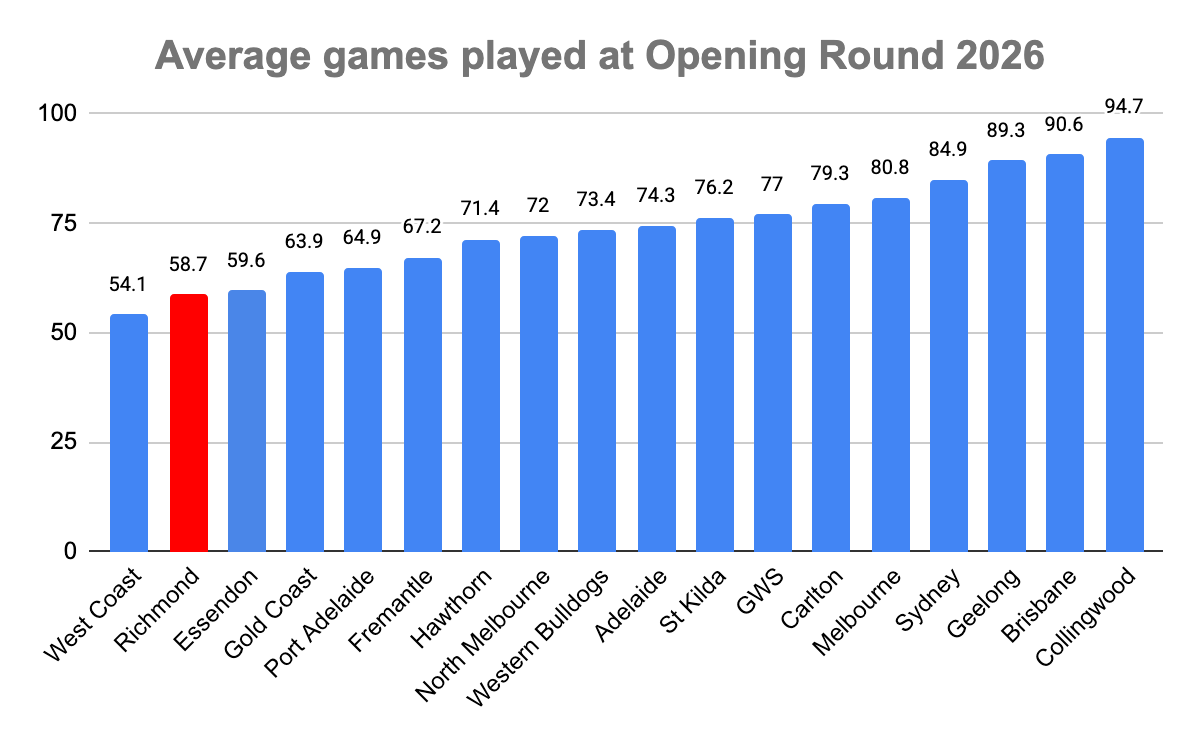
Average number of games played: 58.7 (17th)
Richmond’s recruiters are trying to win my allegiance by drafting South Australians. Nice try, but it won’t work – Sam Cumming technically isn’t even South Australian. He is, however, a talented mid/forward who excelled at senior SANFL level last season. Given his attributes, Richmond’s choice to draft him, when they already have players like Sam Lalor and Taj Hotton on their list, was an interesting one. The Tigers already have inside-leaning midfielders like Tim Taranto and Jacob Hopper on their list, but they’re unlikely to be around when the side is next in contention. The fact Richmond has largely stayed away from such types in its recent drafting – the club’s recruiters could have picked Dyson Sharp but chose not to – suggests they believe the extractor-type inside midfielder might be going out of style.
Instead, Richmond’s four selections in the 2025 draft showed a clear preference for dynamic physical attributes. What Sam Grlj lacks in vowels he makes up for in speed and explosiveness. Considered possibly the best athlete in last year’s draft pool, he again provides a signal of how Yze might add layers to his side’s game plan in coming years. Zane Peucker, who played alongside Cumming for South Australia at last year’s U-18 National Championships, is another mid/forward hybrid who models his game on Brisbane’s Zac Bailey. Noah Roberts-Thomson – another South Australian, and cousin of former Swans cult hero Lewis – is a similar type who fared well at SANFL U-18 level for Sturt.
The delisting of Jacob Blight and Tylar Young’s trade to West Coast indicate that Richmond’s first-choice tall defenders in 2026 will be Ben Miller, Josh Gibcus (who deserves a good run at it), and Noah Balta. No other bottom-four side will boast such a talented and balanced trio. The mediums aren’t bad, either. Nick Vlastuin remains one of the game’s best interceptors and his excellent 2025 season was rewarded (inadequately, according to most Tigers supporters) with a selection in the extended All-Australian squad. His experience and anticipation will make him an ideal mentor for young colleagues still learning their craft. One of those youngsters is Luke Trainor, the 21st pick from the 2024 draft who immediately looked at home at AFL level, even spending time on the wing and as a marking forward. Jayden Short, Tom Brown, and Sam Banks share responsibility for initiating Richmond’s exits from defensive 50.
Richmond’s midfield is precisely the work in progress you’d expect from a side still trying to climb its way out of a deep hole. Fitness permitting, there are three non-negotiables: Toby Nankervis, Tim Taranto, and Jacob Hopper, who last season finally shrugged off the soft tissue injuries that had disrupted his first two years at Tigerland. These three will provide the physical support for what will otherwise be a very young engine room. Expect Jack Ross and Dion Prestia – when fit, which isn’t always – to also feature regularly, but Yze will want to find the right balance between competitiveness and giving the next generation meaningful reps. All being well, Sam Lalor will see his centre bounce attendances dialled up this season. The footy world knew about the 2024 number one pick’s power and athleticism, but I’m not sure they knew about his composure and touch – I definitely didn’t. Hopefully we’ll get to see Josh Smillie sooner rather than later. Complex muscle injuries restricted the big-bodied midfielder, taken five picks after Lalor in 2024, to just four VFL appearances in his debut season. Given he and Lalor are a year ahead in their physical development, you’d expect them to get precedence over Grlj and Cumming for midfield minutes. The marquee 2025 draftees, who’ve reportedly impressed in pre-season, will probably begin AFL life on a wing or a half-forward flank.
Tom Lynch signing a one-year contract extension last August means he’s set to continue as Richmond’s full-forward this season. His performance – and whether he is offered another deal – will be judged as much by his contribution to the improvement of the Tigers’ young key forwards as it by his own output. The growth of those forwards, especially Jonty Faull and Harry Armstrong, will go a fair way to determining Richmond’s prospects in 2026 and beyond. They’re two distinct types: Faull loves to crash packs and bring it to ground inside 50, while Armstrong looks more comfortable on the lead (while still being capable of a contested grab). Key position players are probably the toughest part of the rebuild to nail, partly because – due to the physical development required – it can take longer to learn if you’ve found your guy or not.
Several key forwards on Richmond’s list will be vying for minutes. Liam Fawcett might not be as exciting a prospect as Faull or Armstrong, but he’s spent a year longer in the gym. Tom Sims, a forward who can also ruck, played 11 AFL games in his debut season and looked pretty good in the process. Mykelti Lefau, meanwhile, will be eager to get back to footy after a horror run with injuries and a pre-season drink driving indiscretion. Talls need smalls. Richmond’s main two are Seth Campbell and Maurice Rioli. Just like Faull and Armstrong, they’re quite different. Rioli has developed into a pressure machine who makes opposition defenders nervous. Campbell, meanwhile, belied his draft position – Pick #12 in the 2022 Rookie Draft! – with the sort of clean gathers and smart finishing you’d expect from a top-10 pick. He’s not a typical small. Much like Zac Bailey, he’s a good player who happens to be small. After those two, the picture is less clear. Taj Hotton would have played every game if not for the recent discovery of bone stress in his hip that’ll keep him sidelined for as long as four months. Yze may persist with the likes of Rhyan Mansell and Steely Green, or he might decide their roles are better filled by recent high draft picks who aren’t yet ready for the midfield (i.e. Grlj and Cumming). This is an example of the decision Yze will be making across different parts of the ground: how quickly to blood elite talent over more workmanlike senior players, and the costs and benefits of each approach.
Line rankings
Defence: Average
Midfield: Below Average
Forward: Below Average
Ruck: Above Average
The case for optimism
The kids look good! Most have already shown precisely the small signs of talent and composure you want from young players just starting out: clever handballs out of congestion, smart positioning, diagonal kicks when the bail-out down-the-line option was there, little taps to advantage. Lalor, in particular, has shown enough skill and composure – to go with his athleticism – to persuade Tigers fans that the club made the right choice calling his name out with Pick 1. But it’s not only him. Taj Hotton’s burst and front-half instincts translate at AFL tempo. Luke Trainor has composure that belies his age. Harry Armstrong and Seth Campbell have shown they can impact games in meaningful moments rather than merely accumulate developmental reps.
Only the most physically prodigious 18- and 19-year-olds can consistently compete in contests with mature AFL players. The real separator is whether their brains can process events quickly enough in the heat of battle. On that front, Richmond’s young core has mostly passed early tests. Smillie and Faull (the former because of injury) are probably the only two whose debut seasons weren’t a clear tick. Lalor, Trainor, Hotton, Armstrong, Gibcus, Campbell – it’s an exciting group, and more importantly, one that will gain experience together. And that’s not even mentioning the 2025 crop, or the high draft picks still to come.
Richmond’s progress up the ladder will probably plateau slightly as the older players who are still contributing – Nick Vlastuin, Tom Lynch, Dion Prestia, Nathan Broad, Toby Nankervis – age out. But I think Adem Yze and his coaches have made the right bet: the value of the experience those senior players bequeath to the next generation will, in the long run, be worth the short-term cost. That experience ranges from professional standards and emotional regulation to micro-habits like defensive positioning and leading craft. Mentorship, especially when you can trust the players doing the mentoring, is a performance multiplier. As North Melbourne and other clubs have shown, even elite talent can languish in non-elite environments. There was a risk of cutting too deep, or not deep enough, when Richmond embarked on its rebuild. The early evidence – and it is still very early – is that they’ve got the balance about right.
The case for pessimism
The biggest risk for the Tigers across the next couple of seasons is that lots of small, individually manageable problems begin to snowball. It starts with the list structure. For now, on-field performance is underpinned by a dependable but ageing core. But that scaffolding won’t last forever. When players like Toby Nankervis and Nick Vlastuin decline or depart, real questions will emerge. Who becomes the next number one ruck? Where does the next layer of inside and contested strength come from? Can the next generation of tall forwards reproduce Lynch’s gravity? None of these are fatal flaws. Much of the heavy lifting in this rebuild has already been done. But the basic question of “how many positions do we know we’ve nailed” lingers over every rebuild and haunts those that don’t pan out. Premium roles are the hardest to replace, and succession planning is where many otherwise sound regenerations falter. It’s possible that, in players like Sims, Trainor, Lalor, Smillie, and Faull, the Tigers already have replacements for those veterans on the list. But I don’t think we know that for certain just yet.
The statistical reality is that, as promising as most of the young crop has been so far, and the emotional investment supporters make in draftees, they won’t all make it – at least not at Richmond. Even in the maximally optimistic scenario, there probably won’t be room for them all in the side. Faull, Armstrong, and Sims is probably too top-heavy for the way footy is played these days (or will be in 2030) to work as a coherent trio. Could Lalor, Smillie, Cumming, Hotton and Grlj all play in the same midfield? Probably, but that doesn’t take into account the player, or players, that Richmond will draft with (presumably) high picks in 2026 and 2027. Good players who don’t play as often as they’d like, or don’t play the role they want most, can ask for trades. There’s uncertainty, and uncertainty creates risk. Rebuilds that look great in year one can still peter out.
The high priority of learning more about the young Tigers is why the injuries to Hotton and Smillie are so disappointing. Development is not linear, but it is cumulative. Missed pre-seasons and fragmented early years don’t just delay the progress of individual players. They can disrupt chemistry, role clarity, and confidence – all essential ingredients for shared success. For a list that is relying on several young midfielders improving together, even modest setbacks can hurt down the line.
Layered over all of this is the simplest risk of all: losing. Richmond probably over-performed in 2025 relative to its list profile. Regression, measured strictly by win-loss record, is possible in 2026. And young teams that spend too long on the bottom rungs of the ladder can begin to normalise narrow losses and honourable defeats. You don’t have to go far – you can find good examples if you look back far enough at Punt Road. Things should be different this time around. This is an environment shaped by success. People affiliated with the Tigers know what it takes to win. But even good environments are tested by disappointment. And from the most fundamental perspective of all – that of supporters – losing (which is what Richmond will be doing in most of its games this season) isn’t as fun as winning, even when losses are leavened by the memories of recent glory and the hope of glories to come.
Enjoying this preview and think a Tigers-supporting friend might too? Share it with them!
Breakout player
I was about to write a paragraph about why Taj Hotton could announce himself as the most exciting of all of Richmond’s recent first-round draftees when I saw the news that a diagnosis of bone stress in his hip will rule him out for as long as four months. It’s a massive blow for a player who already missed most of his debut season recovering from an ACL injury sustained during his draft year and a blow for footy lovers. That makes Sam Lalor the obvious candidate. He showed plenty last season. But a series of hamstring injuries limited him to only 11 games. If he properly breaks out, Richmond’s rebuild timeline compresses.
Most important player
Answering this requires taking a definitive position on the importance of contributing to wins this season versus contributing to wins when Richmond will really need them further down the track. Tom Lynch will be important in 2026 but not in 2030. But Toby Nankervis will be so important to Richmond’s ability to stay in games this season that he’s probably the natural candidate. Nankervis doesn’t just help keep them in games – he protects development by preventing games from becoming chaotic blowouts. The Tigers have drafted elite young talent across most lines. They don’t yet have an obvious replacement for their big ruck.
Biggest question to answer
Throughout this preview, I’ve alluded to a slight contradiction between the structured, rather safe game plan Yze and a list that is replete with dynamic (albeit young) athletes. The question arising from that contradiction is how soon will Yze seek to add attacking layers to Richmond’s game that maximise the talents of those dynamic young players. How can he engineer more one-on-one contests for Lalor to win? How can he use Faull’s contested acumen to create ground-ball opportunities for Seth Campbell and, when he returns, Taj Hotton? How can Trainor’s natural intercepting ability be best utilised? And, crucially, how can those layers be added in a way that promotes not just the growth of individual players, but the whole team?
What success looks like
Richmond’s KPIs in 2026, like any side this early in a rebuild, will all centre on the development of its extremely promising crop of young players. Yze will want to see moments, yes, but also more than moments: continuity, a progressive assumption of greater responsibility, and an increasing share of on-field value. He’ll also want a better look at how it all fits together. Richmond won’t be contending in 2026. But the more he can learn about his group and his game plan this season, the better it’ll make them in 2030. Another backflip would also be nice.
In a nutshell
Wins are tomorrow’s problem. In 2026, Richmond’s focus will be the same as it was last year: developing its young talent while playing enough of the veterans to stay afloat.