


Sizing up the Demons for preview number 11.
2025 ladder position: 14th (7 wins, 16 losses)
2025 best-and-fairest: Max Gawn
Senior coach: Steven King
Story of the season
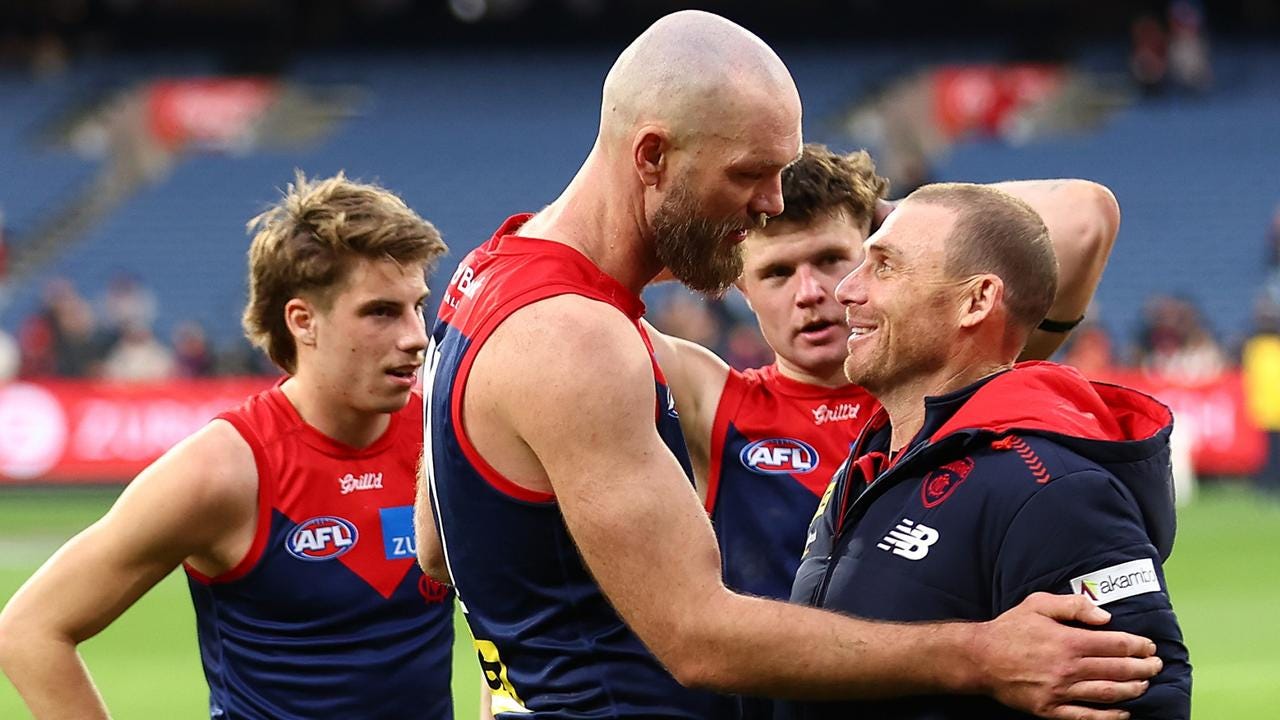
A rearguard effort to restore continuity that eventually became a definitive turning of the page of Melbourne’s most successful modern era. Simon Goodwin went into the season bullish that a revamped game plan – more on the specifics below – could revitalise a list beginning to show the ill effects of age and discontent. His stated belief that his side could still contend if he pushed the right buttons looked naive after a 0-5 start that made everything else academic. You can’t lose by 10 goals to North Melbourne and expect things to stay the same. The season wasn’t without highlights – a win at the Gabba! – and the Dees were desperately unlucky on the numbers. But it didn’t change the fundamental fact: this cycle had run its course, and the club’s board believed Goodwin wasn’t the right man to start the new one.
Not many coaches have been sacked three days after winning a game by 83 points. But then, not many coaches had a reign quite like Goodwin’s: an astonishingly dominant flag year followed by two seasons that yielded zero finals wins and a string of off-field headlines. It’s not possible to succinctly capture how Melbourne fans felt: relief, mingled with gratitude at what Goodwin had delivered and regret that there wasn’t more of it. Troy Chaplin assumed the reins on an interim basis, and on September 12th, Steven King (not the horror writer) was appointed as Melbourne’s new Senior Coach. His appointment reflected a decisive break with the past: the club sanctioned the departures of club legends Christian Petracca and Clayton Oliver, failed to keep hold of Judd McVee, delisted seven players, and brought in 10. The king is dead; long live the King.
Summary of game style
For most of the Simon Goodwin era, the Demons played with one of the clearest identities in the AFL: win contests, own territory, overwhelm opponents with volume. The fullest expression of that was the final 45 minutes of the 2021 Grand Final – 45 minutes of the most destructive footy played this decade. But by 2024 (it still worked in the 2023 finals series! Sometimes the ball just doesn’t bounce the right way), that system was beginning to fray. Some of it was opponents getting better at absorbing what Melbourne threw at them. But just as much, probably more, was personnel-based: Angus Brayshaw’s retirement, Clayton Oliver’s personal drama, Steven May’s physical decline (and personal drama). The model grew increasingly dependent on episodic individual brilliance to offset systemic wear.
Goodwin’s late-era – last-gasp – response was to try and adapt instead of doubling down. Before the beginning of the 2025 season, Melbourne signalled a desire to move away from brawn and towards brains: cleaner exits, more overlap handball, earlier involvement of outside runners. In theory, that evolution made sense. But in practice, it proved destabilising. Last season, the Demons were still one of the league’s strongest contested sides. But the clearance strength that had powered their dominance had degraded due to the combination of personnel decline and structural change. The Demons suddenly became leaky in the middle and lost their ability to close space quickly enough to constrict opposition transition. They won enough of the ball, but retention didn’t translate into control or damage.
The problem was that Goodwin believed that the old Premiership core, overlaid onto this new game plan, was capable of taking Melbourne back to the summit. The club’s hierarchy believed differently – and decided to go in a different direction. King’s early influence has been decisive. The club’s moves during the trade and draft period, as well as early pre-season games, point to further steps in the direction Goodwin was trying to go: away from clearance-centric football toward a faster, more networked system built around speed and transition.
Early patterns have (wisely) funnelled play through Kysaiah Pickett, not as a static forward target but as a mobile forward-half connector who receives on the move, gains territory via carries, and links via handball chains. Instead of relying on repeat inside 50s and contested marking to grind opponents down, Melbourne are positioning themselves to score more frequently from turnover and secondary transition. A renewed emphasis on speed and two-way running is designed to restore the integrity of the defensive layer. The caveats are clear: it’s early and no serious footy has been played yet. But it represents a decisive break with the Premiership identity and towards something faster, more exciting – and, perhaps, more dangerous.
List changes
In:
Xavier Taylor (2025 National Draft, Pick #11)
Latrelle Pickett (2025 National Draft, Pick #12)
Thomas Matthews (2025 National Draft, Pick #30)
Changkuoth Jiath (trade – Hawthorn)
Brody Mihocek (trade – Collingwood)
Jack Steele (trade – St Kilda)
Max Heath (trade – St Kilda)
Riley Onley (Rookie Draft)
Kalani White (Category A Rookie, father/son)
Oscar Berry (Category B rookie)
Out:
Clayton Oliver (trade – Greater Western Sydney)
Christian Petracca (trade – Gold Coast)
Judd McVee (trade – Fremantle)
Charlie Spargo (free agent – North Melbourne)
Jack Billings (delisted)
Kynan Brown (delisted)
Tom Fullarton (delisted)
Marty Hore (delisted)
Oliver Sestan (delisted)
Will Verrall (delisted)
Taj Woewodin (delisted)
List profile
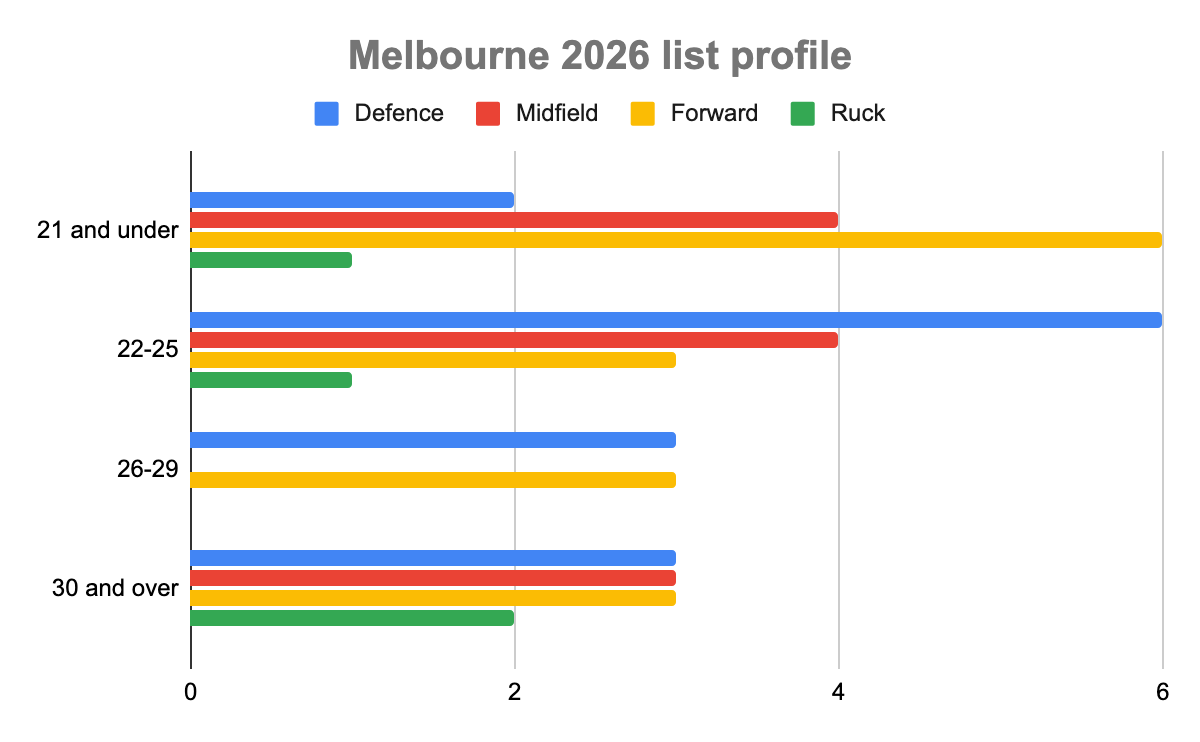
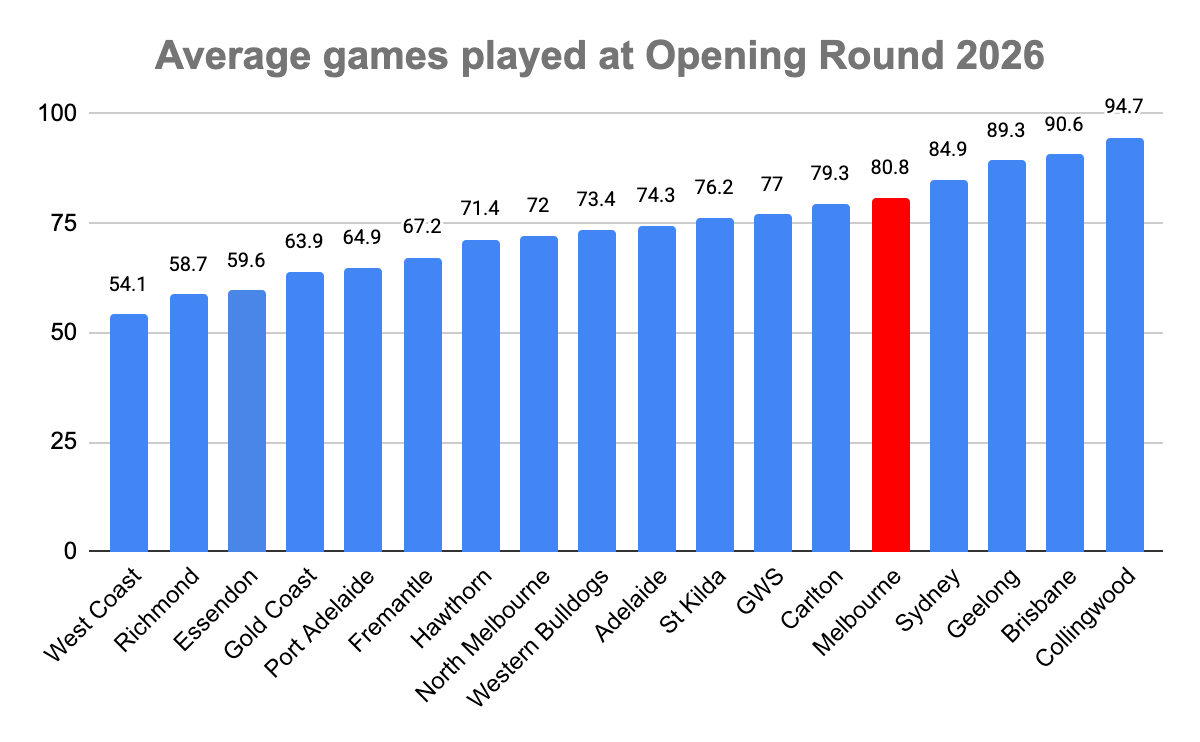
Number of top-10 draft picks: four (T-13th)
Average age at Opening Round: 25.6 (3rd)
Average number of games played: 80.8 (4th)
Melbourne’s off-season had two clear themes: to move on from the Goodwin Era and to recruit for speed. It’s not often you trade out two players who, between them, have seven All-Australian nominations, two Coaches Association Player of the Year awards, and a Norm Smith. It’s rarer still that doing so is the right decision. Petracca and Oliver will forever be heroes of the Melbourne Football Club. But enough baggage had accumulated that a reset felt necessary. Petracca fetched a significant return: Picks 7, 8 and 37 in the 2025 draft (used on Xavier Taylor, Latrelle Pickett and Thomas Matthews), plus the Suns’ 2026 first-rounder. Oliver garnered only a future third-round pick from GWS – a blunt reflection of his diminished standing.
Those departures were the beginning rather than the end of Melbourne’s list recalibration. Brody Mihocek arrived from Collingwood to mentor the younger talls and manufacture ground ball opportunities for smalls. Jack Steele adds leadership and a mature body to a midfield that suddenly looks short on both. The compensation pick for Charlie Spargo became Changkuoth Jiath. On draft night, the Dees targeted pace and rebound in Taylor and – to some surprise – Glenelg small forward Latrelle Pickett. Judd McVee, who had agitated for midfield time, departed for Fremantle, where he is unlikely to get any. Seven delistings underlined the appetite for renovation. Taken together, these moves prioritise experience, speed and flexibility over star power – a profile that makes more sense in the context of Steven King’s likely preference for overlap, width and transition rather than contest dominance.
The biggest defensive question surrounds Steven May. He was integral to Melbourne’s early-decade success, but he may no longer fit the club’s strategic direction, and the off-field noise now clearly outweighs the on-field value. To me, the answer looks clear: see what it looks like without him. Melbourne aren’t short of key defenders – Jake Lever, Tom McDonald (is he still doing that all-meat diet?), Harrison Petty (surely back where he belongs), Daniel Turner and Jed Adams can probably form a workable rotation. Even if they can’t, that’s valuable information in a year designed for recalibration. Jake Bowey remains the preferred distributor. Beyond him, the small and medium mix is unsettled: Andy Moniz-Wakefield is returning from an ACL, King might want to see Jiath on a wing, and Christian Salem’s skills remain exquisite but, at 30, the club may decide it’s time to see a younger face in his role.
Across two seasons, Melbourne’s midfield has shifted from the league’s most recognisable to one defined by transition. There is still talent. Max Gawn remains the best ruck in the game. Kysaiah Pickett is now a bona fide – and very good – midfielder. Steele offsets some of what was lost, even if he can’t replicate it. Jack Viney is the last of the old guard, but concussion interruptions and a serious achilles injury make it difficult to see him returning to his peak. Trent Rivers shapes as a more permanent midfield piece after a 2025 season in which he attended the majority of centre bounces in the games Viney missed with a concussion and almost none for the rest of the season. Melbourne fans, however, will be most excited to see Caleb Windsor and Harvey Langford. Langford’s debut season was impressive and further physical development should take him to the next level. Windsor’s second year was disrupted by injury and a switch to half-back that made some sense on paper but never really did on grass. He has looked sharp this pre-season. The wing roles, meanwhile, appear genuinely open – Ed Langdon (probably running laps of the MCG as I type), Xavier Lindsay, Jiath, Jai Culley (post-injury) and Harry Sharp all in the frame.
An average forward line worked well enough when Melbourne overwhelmed opponents with volume. That equation probably no longer holds. But a new method might produce greater efficiency. Kozzie Pickett will be Melbourne’s best forward when stationed inside 50 and their best midfielder when rotated on-ball. His cousin Latrelle will add speed and flair. Bayley Fritsch remains a reliable medium target; Kade Chandler is a clever and underrated small. Beyond that core lie many unresolved questions. Does Mihocek have two more strong seasons left? Is Jacob van Rooyen trending toward genuine second/third tall quality or plateauing as serviceable? Is there hope left for Matt Jefferson? Can King extract anything from Shane McAdam? Is it time to phase out Jake Melksham? What exactly is Koltyn Tholstrup? The virtue of Melbourne’s current phase is that they can afford the patience required to find out.
Line rankings
Defence: Average
Midfield: Average
Forward: Average
Ruck: Elite
The case for optimism
The disappointment of seeing a once-great side not quite fulfil its awesome potential before fading into irrelevance and acrimony might linger. But in 2026, another set of more positive emotions should begin competing for space in the hearts of Dees fans: curiosity about what the next great Melbourne side could look like, excitement about a faster, more attacking style, and hope that the club’s – perhaps belated – recognition of its predicament augurs well for its ability to keep doing the same in the future.
Style is not a trivial matter. Attritional footy is easy to accept if it delivers success. It’s rather harder to swallow if it produces a 14th-placed finish. This isn’t an argument against developing effective defensive structures. It’s recognition of the fact that there are many supporters who evaluate their relationship with their team – or at least the choice to spend their hard-earned to go to the footy on a freezing night – based on the endeavour of the stuff that’s served up. Melbourne shifting to a more exciting brand is something to look forward to.
There is cause for significant optimism, too, about several of the club’s recent draftees. There is lots of excited chatter about Caleb Windsor this pre-season. Harvey Langford looked excellent in his debut season. Both now have fewer players between them and meaningful midfield roles. Xavier Lindsay’s first year wasn’t as attention-grabbing as Langford’s, but he still looks like he could be an important piece of the next generation. There’s still hope for players like Koltyn Tholstrup. Jacob Van Rooyen should benefit from the presence of Brody Mihocek. It’s too early to say anything definitive about Xavier Taylor or Latrelle Pickett – perhaps beyond the fact that both make for good media interviews – but there’s also nothing wrong with getting excited about the prospect of Latrelle and Kysaiah linking up for the next decade. Not every draftee becomes a star. But extrapolating based on promising early glimpses is a core part of the footy fan experience. Long may it reign.
The cherry on top is that, despite Melbourne’s manifest frailties last season, they were a better team than their win-loss record showed. Based on expected scores, they should have won four more games than they did – the same number as Carlton and only 1.5 behind Greater Western Sydney. It’s interesting to consider what choice the club hierarchy would have made about Goodwin had those expected wins materialised into real ones. They might have been more open to his claims that last season’s list could still contend. Obviously, many of the players who contributed to the side in 2025 won’t be there in 2026. But some of them will be. If they perform, and the pendulum swings the other way, that may already be enough to put the Dees in the play-in conversation.
The case for pessimism
The first steps of any rebuild are especially treacherous because, in addition to the high stakes riding on every high-end draft pick, there’s a fundamental tension: coaches are motivated to seek wins to consolidate their job security, even if it might ultimately undermine the long-term objectives of the build. That’s why it’s so important that the board and CEO give the coach genuine permission to lose now in order to win later. Well-run clubs have a strong alignment between what the CEO and Board expect, and what the coach is trying to do. Melbourne have not been an obviously well-run club for many of the past few seasons. Supporters ought to be heartened by the early moves of the Brad Green/Steven Smith era, especially their steadfastness in sacking Simon Goodwin. But their resolve hasn’t been tested by on-field results not meeting off-field expectations. There is risk there.
Clubs undertake rebuilds because they recognise that their list can no longer compete at the pointy end of the ladder. Lists that can no longer compete at the pointy end typically lack two important things: enough star players and a coherent distribution of AFL-level talent. Those issues overlap but aren’t the same. In Kysaiah Pickett, the Demons have one of the brightest stars in footy. Until further notice, Max Gawn is still the best at what he does. The departures of Petracca and Oliver and decline of Steven May mean that’s probably where it ends (for now). The distribution of AFL-level players is lumpy – contributors at the top end, but holes created by players not yet living up to their draft position. There are multiple ways to interpret Melbourne’s choice to bring in Brody Mihocek. The most benign is that he’s there to provide structure, physical support, and experience to a callow crop of tall forwards. The least benign is that the club is concerned about the development of said tall forwards. Either way, importing short-term solutions to solve long-term development problems at the beginning of a rebuild is risky.
There are similar questions to be asked of the key defensive posts. Melbourne tried hard to make Steven May another club’s problem during the Trade Period. They did not succeed. The situation is far from ideal: a Premiership hero whose persistent off-field issues appear to have broken containment. The football solution is clear. The off-field solution is less clear; unresolved culture problems can metastasise.
To an extent, bad lists are self-correcting: they tend to finish lower down the ladder and have more opportunities to select better talent to drive improvement. But the impending entrance of Tasmania into the AFL landscape makes the next few years a more dangerous time to be rebuilding. The Demons have a productive Next Generation Academy (as Melbourne fans know, there’s a world, very similar to this one, where Mac Andrew wears red and blue) but that looks like rather small beer next to the Northern Academies. The AFL’s equalisation mechanisms are under stress. Dees fans know what it’s like to be stuck at the bottom for so long that you re-evaluate your relationship with footy. It shouldn’t be this bad this time. There is still top-end talent, a decent mid-career core, draftees that have shown great promise, and a capacity to develop talent. But they are still taking the first steps down a very long road. Not everyone gets to the end.
Enjoying this preview and think a Dees-supporting friend might too? Share it with them!
Breakout player
Harvey Langford finished fourth in last year’s Rising Star award. He impressed all who watched him (a shrinking audience, given how quickly Melbourne’s season went south). And yet it was clear that one was watching a player only beginning to scratch the surface of his potential. The disposal skill and quality of decision-making are already apparent. The next step is more meat on the bones. When Langford develops the strength to move inside and reliably shrug opposition tackles, his game should ascend to the next level.
Most important player
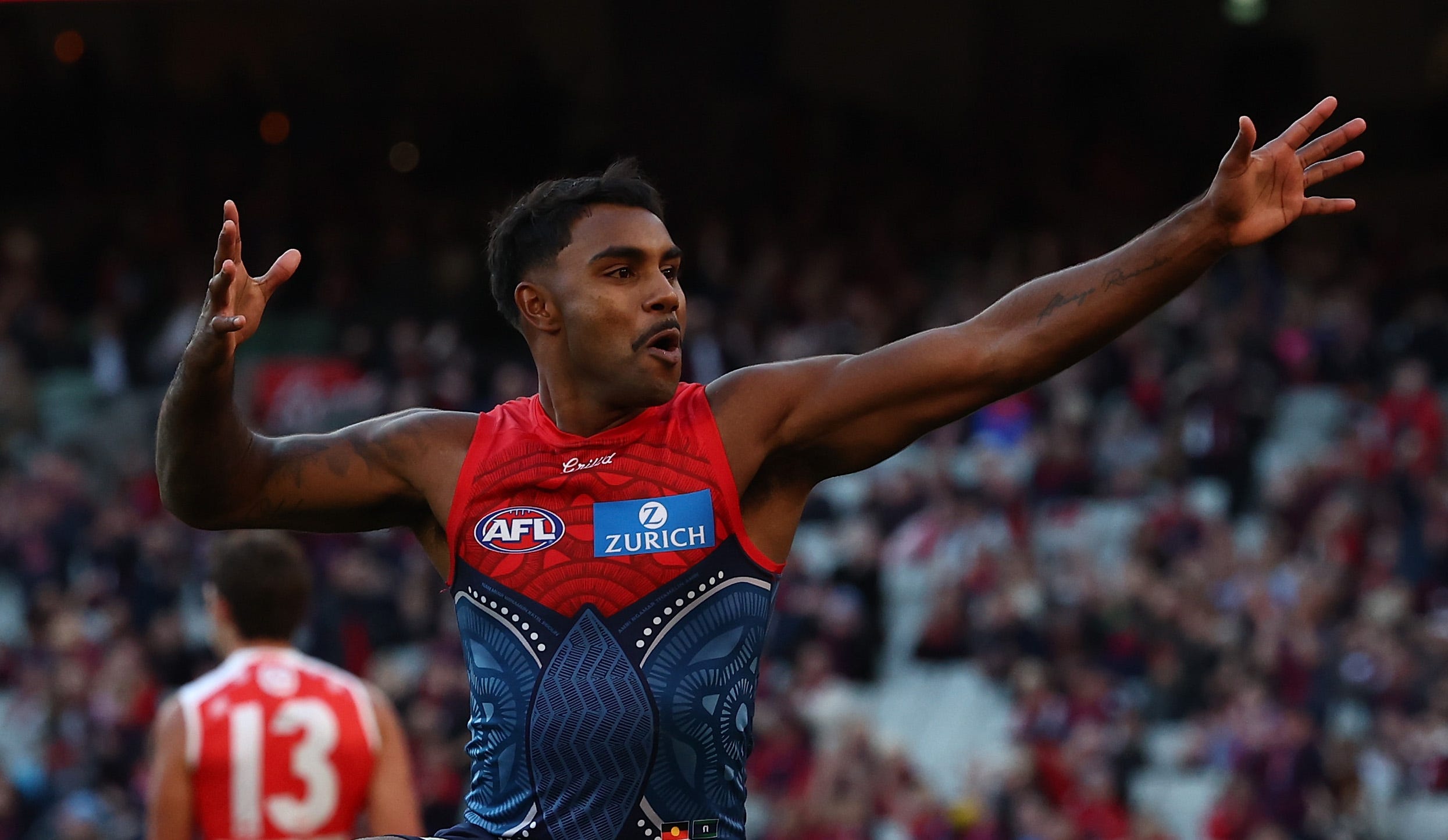
Kysaiah Pickett’s status as Melbourne’s most important player for the rest of the decade and beyond was cemented on June 12th last year, when he quashed persistent chat about his future to sign a contract until the end of 2034. His move into the midfield – only Max Gawn and Clayton Oliver attended more centre bounces! – elevated him into the game’s very top bracket as both a clearance winner and goal-kicker. Kozzie is a delight to watch. And for as long as he’s a Demons player (now almost certainly the rest of his playing days), there will be optimism.
Biggest question to answer
Throughout this preview, I’ve largely accepted the premise that Melbourne is embarking on a rebuild. There is strong circumstantial evidence this is the case: a new coach, with a new plan, and many new players. But it’s not quite definitive. There could be an element within the club which believes that a good season from key players, faster-than-expected development from emerging talent, and better luck could result in a return to finals. Given that, the decisions that King and his selection committee make about players like Steven May, Jack Viney (when they’re available) will probably reveal their preference: build, with the pain that implies, or hedge?
What success looks like
When the Melbourne board made the decision to sack Simon Goodwin and trade out Christian Petracca and Clayton Oliver, it implicitly agreed to the proposition that the win-loss record and ladder position should rank low on Melbourne’s list of performance indicators for 2026. It also committed to the idea that progress in 2026 is better measured by how successfully a new coach can embed a new game plan, how much younger players develop, and how much information is gained about which areas of the list need most attention. And, ideally, that process would also be rewarded with another couple of high-end draft picks.
In a nutshell
This time last year, Melbourne fans were debating whether to stick with the core and the coach that had delivered a drought-breaking Premiership or twist. That question was definitively answered. 2026 will be the dawn of a new era. There’ll be bad days. But, unlike the last two years, it might actually be fun.
Excellent.