


The final preview of the front nine considers the injury-ravaged Giants.
2025 ladder position: 5th (16 wins, 7 losses – eliminated at Elimination Final stage)
2025 best-and-fairest: Tom Green
Senior coach: Adam Kingsley
Story of the season
Adam Kingsley’s Giants entered 2025 as the flag favourites – at least according to Channel 7 and Fox Footy pundits. Those who were more sceptical of their credentials would have been bemused after a 52-point victory over Collingwood in Opening Round, in a game so determined by scoring variance that it could plausibly have been a loss. If that result showed their formidable upside, then a mid-season sequence of four defeats in five (the lone victory being their customary win at the Cattery) against other finals contenders showed the limitations of their game plan. Still, the Giants had little trouble staying ahead of the count, with statement victories against Brisbane and Gold Coast (both assisted by some expected score magic) capping a run of nine wins in 10 games that saw them finish the Home & Away season only percentage outside of the top four. The less said about the one loss in that run, the better.
Finishing fifth meant the Giants hosted Hawthorn in an elimination final. Home finals aren’t as big an advantage for GWS as they are for many other clubs. The Engie Stadium crowd isn’t as large or intimidating, and Adam Kingsley’s counterattacking style is highly effective away from home. Besides, the 2025 top eight was so clustered that this wasn’t a typical fifth vs. eighth match-up where there’s a small but real gap between the sides. The Hawks jumped the Giants to lead by 28 points at half-time and as much as seven goals midway through the third. That was the catalyst for another epic comeback attempt. Jesse Hogan’s goal early in the last quarter – the Giants’ seventh in a row – drew the men in orange level. A Jake Stringer behind a minute later actually gave them the lead. Sadly, that was as good as it got for the Giants. Hawthorn re-established control and kicked the final three goals to run out 19-point winners. The Giants, a pre-season flag fancy, departed the stage in the first week of finals. A 3-0 record against the two eventual Grand Finalists, while going 3-6 against other top-eight sides, was illustrative of this fascinating and fragile side’s immense strengths and manifest flaws.
Summary of game style
The Giants have built one of the AFL’s most distinctive systems around a simple belief: the most valuable possession in football is the first uncontested handball after a defensive contest. Everything flows from that. Much of this traces back to Adam Kingsley’s time as an assistant at Richmond, where he helped refine a handball-heavy transition game that powered their dynasty. His Giants are the modern upgrade of that model, shaped by his list’s distinctive strengths and weaknesses.
The Giants are like a coil: they bend, compress, absorb, then spring. Because they’re a mediocre clearance-winning side but elite at defending inside their D50, they often sit in a low defensive block, absorbing inside 50s and trusting their ability to win the next contest on their terms. They faced significantly more defensive one-on-ones than any other side (and were also first in the corresponding stat in 2023 and 2024). Beginning chains in their own defensive 50 isn’t a failure state for the Giants – it’s home turf. Their rebound volume and efficiency reflects a game model that treats deep defence as a launchpad rather than a liability.
When the Giants win possession in their back half, their wingers and small forwards – of which there are dozens, possibly hundreds – cluster in patterns around the ball, forming short, rehearsed handball networks that prioritise early corridor access. If that isn’t available, they’re happy to spread the field laterally. It’s no surprise that GWS lead the AFL in handball metres gained: it is the engine of their transition game. The ability to accelerate through their first layer is more important than top-end speed. Hyper-organised spacing is paired with intense off-ball running to draw opposition defenders up to the ball.
The “Orange Tsunami” label is evocative but slightly misleading. The Giants don’t chase speed at any cost. They absorb pressure, preserve geometry ahead of the ball, and strike in rehearsed bursts once an opportunity for uncontested release appears. The model is highly repeatable but, because of how many opposition entries it concedes, it’s highly volatile, especially if their defenders are overmatched by opposition forwards. But when the Giants have the upper-hand in their defensive half, few teams can transition upfield with greater force or clarity.
List changes
In:
Oskar Taylor (2025 National Draft, Pick #15)
Finnegan Davis (2025 National Draft, Pick #51)
Clayton Oliver (trade – Melbourne)
Riley Hamilton (Category B Rookie)
Jayden Laverde (Supplementary Selection Period)
Out:
Wade Derksen (delisted)
Josh Fahey (delisted)
Lachie Keeffe (retired)
Callan Ward (retired)
Jacob Wehr (free agent – Port Adelaide)
List profile
Number of top-10 draft picks: nine (T-3th)
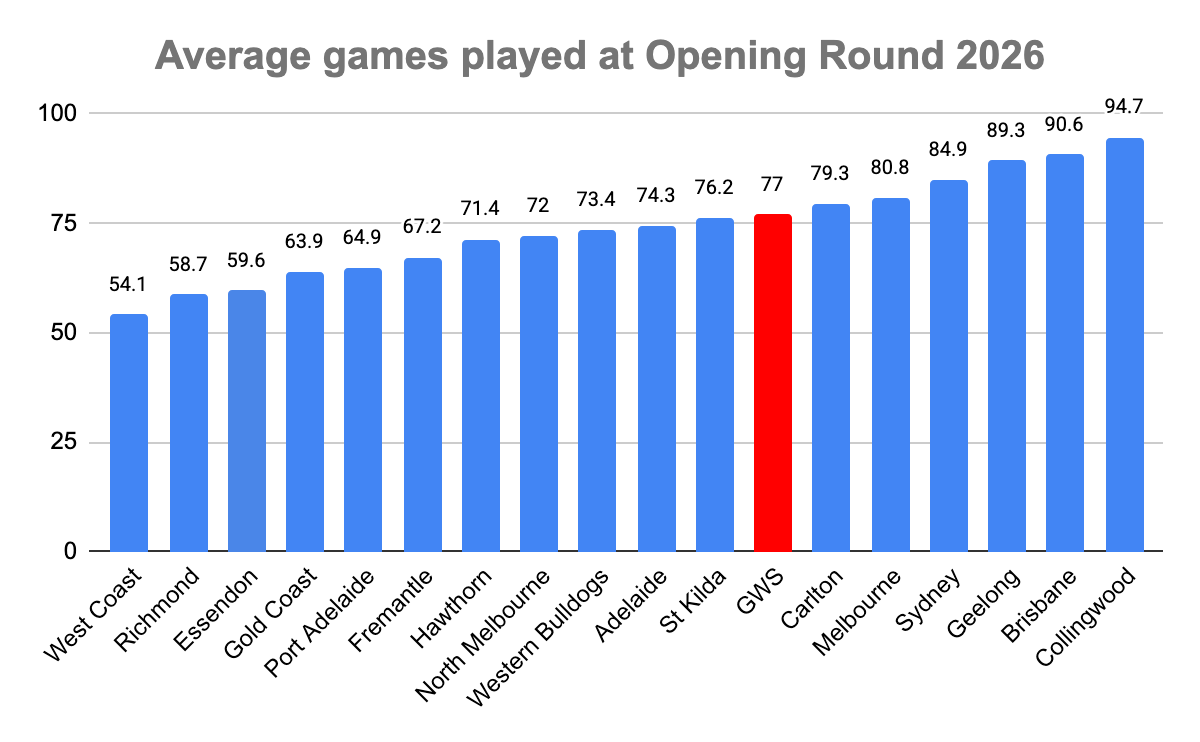
Average age at Opening Round: 24.4 (12th)
Average number of games played: 77 (7th)
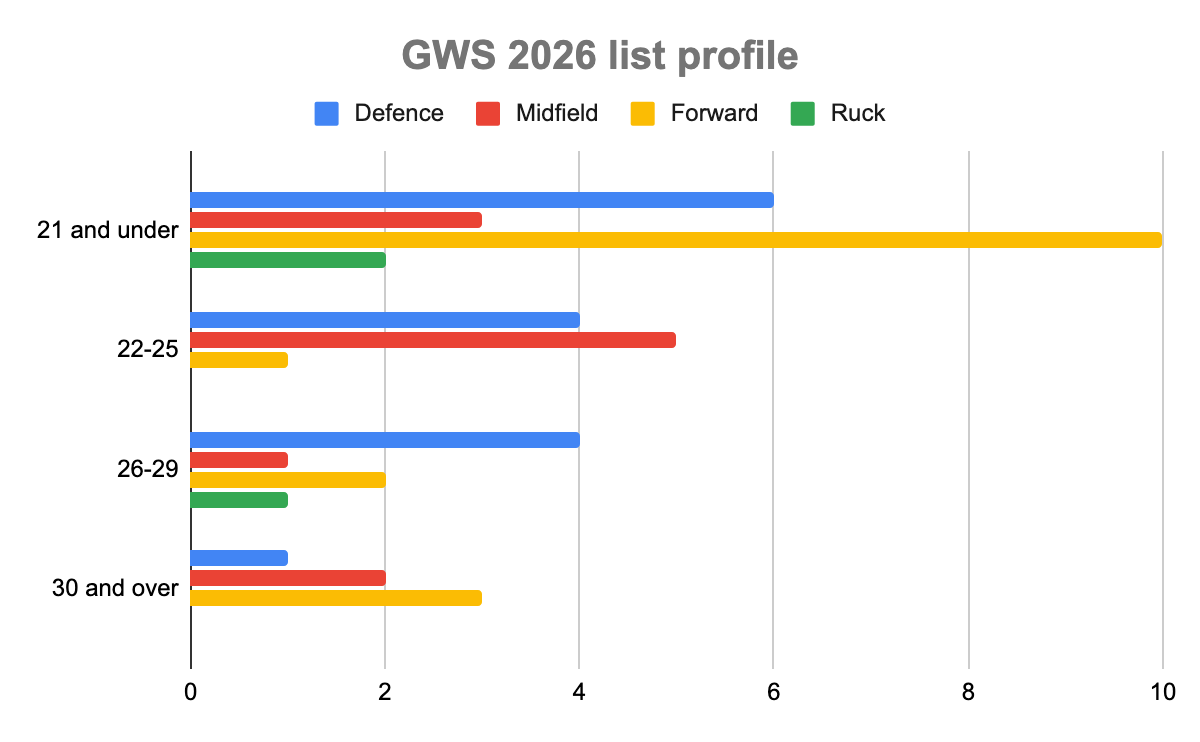
The Giants’ bespoke system is made possible by a bespoke list: superlative one-on-one defenders, bold rebounders, and a surplus of fast, skilful outside receivers and small forwards. It is also a list with a distinct hourglass shape: a high-end core capable of supporting a premiership challenge, and a comparatively shallow middle beneath it. The Giants have elite players in key structural roles, and they have intriguing long-term prospects. What they have less of is reliable, interchangeable depth in the 24-30 age bracket that can step up and play a role without materially weakening the system – a vulnerability accentuated by the departures of Harry Perryman, James Peatling, and Isaac Cumming at the end of 2024.
The injury cluster of the past twelve months has made the decisions to bring in Clayton Oliver and Jayden Laverde look increasingly prescient. Oliver was already likely to feature prominently in the midfield; he will now be a load-bearing presence. There was a plausible world in which a physically refreshed and psychologically re-engaged Oliver, alongside Tom Green, patched up the Giants’ persistent clearance weakness and allowed them to set up higher up the field. Instead, he is likely to be cast in a largely fire-fighting role. Laverde, meanwhile, shapes as Sam Taylor’s short-term replacement after the champion full-back’s significant hamstring injury. Of the new draftees, Oskar Taylor – believe it or not, a dashing rebound defender – is the most eye-catching. Callan Ward’s career-ending ACL injury tugged at the heartstrings, but the other departures are unlikely to shift the dial.
The Giants’ backline remains their strongest unit and, as outlined above, their first line of offence. Sam Taylor, Jack Buckley, and Connor Idun form footy’s premier one-on-one defensive trio. Harry Himmelberg continues to offer valuable flexibility, while Lachie Ash and Lachie Whitfield are the established rebounders who underpin GWS’s transition game. Joe Fonti emerged in 2025 as a reliable medium intercept option. The quality of the first-choice personnel is indisputable. But it gets thin quickly. The club’s persistence with Leek Aleer is understandable given his athletic upside, yet on the evidence of his 13 games last season, significant scope for development remains. Taylor’s absence in the opening rounds will be keenly felt.
The midfield was already the Giants’ weakest line before it was ravaged by injury. Now, every part of it has been compromised. Tom Green’s ability to win the hard ball and feed outside runners was central to the system, and the knee injury that will sideline him for the season is a hammer blow both to him and his club. Clayton Oliver and Stephen Coniglio – who is beginning to show the effects of age – will have their work cut out filling the void. The club is also sweating on Finn Callaghan’s fitness, given his importance to their running and transition game, while Josh Kelly’s extended absence after hip surgery further weakens the outside layer. Toby Bedford, the Giants’ designated run-with player, is also likely to miss the first 2-3 games of the season after hurting his hamstring in the same internal trial where Green did his ACL. The bottom line is unmistakable: a midfield that was already vulnerable at stoppage is now severely undermanned, with flow-on effects across the ground. The midfield that starts Opening Round will be very different to the one that finished 2025.
The forward line remains potent, though it too has been shaped by misfortune. Jesse Hogan and Aaron Cadman form one of the league’s best tall pairings. Hogan has pared his game back to its essentials – leading, contested marking, ruthless finishing – while Cadman’s breakout season showcased a blend of mobility and athleticism that evokes a younger Jeremy Cameron with a bigger leap. Toby Greene remains combative, creative, and decisive, but injuries further up the ground are likely to push him into the midfield more often. It is not a totally unreasonable solution – he is a good midfielder – but he is a great forward. The blanket is too short. Darcy Jones’s ACL injury deprives the Giants of the most electrifying kid with a lid in sports entertainment, while Brent Daniels’ emergence as an elite small forward has been disrupted by persistent recent injuries. He suffered a hamstring injury in the Giants’ pre-season hit-out against Collingwood; at the time of writing, its severity is unknown. These absences will increase the reliance on Jake Stringer.
Line rankings
Defence: Elite
Midfield: Average
Forward: Elite
Ruck: Average
The case for optimism
The Giants’ list management moves over the last two years are strongly indicative of a club that believes it’s in the contention window. Injuries have made that a remote prospect this season. But there is always hope to be found for those who look hard enough.
The first cause for optimism is situational. A year after the Giants had a middling difficulty of fixture, they are forecast to have the fourth-easiest draw in 2026. They will start at least warm favourites in six of their first 12 games – and staying in touch with the top eight – before the bye hopefully allows them to welcome back some of their stars. Similarly, you’d pencil in wins in five of their games after the bye. Win those, get some soldiers back, win a couple of the games where they’ll be underdogs (we already know their system works best when the Giants are on the back foot), and finals will still be achievable.
That brings me on, neatly enough, to the second reason for optimism (or, at least, not despair) – the bifurcation of the league and the expansion of the finals series. Last season, the AFL had nine good sides, one side that would have been good if not for injuries, and eight poor sides. There was a big gap between the haves and have-nots: Carlton (in 11th) finished three games behind Sydney. The same reason that the proletariat will find it so hard to join the bourgeois class in 2026 (the sheer gap in quality) is the same reason that even a significantly diminished GWS is unlikely to drop too far. That’s especially relevant because of the AFL’s decision to introduce Wildcard Round featuring the 9th and 10th-placed sides. It’s totally plausible that the Giants are one of those two sides but, fortified by the return of players like Sam Taylor, Darcy Jones, and Josh Kelly, are a much more formidable proposition than at the start of the season. It’s an insurance policy; perfect for a team that’s just had its front room burn down.
The case for pessimism
Every year, one AFL club gets whacked with the injury stick. The goal is to not be that club. There’s no evidence the Giants operate a substandard high performance program. Sam Taylor aside, they’ve had a reasonably good run with injuries since Kingsley became head coach. But chance’s pendulum swings in unpredictable ways. And now, the Giants face the predicament of losing a year of a contention window that’s closing fast. Players like Toby Greene, Jesse Hogan, Jake Stringer, and Lachie Whitfield don’t have many of their peak years left. Losing a season at this stage of their age curve is a heavy blow. The cliff can arrive suddenly.
The risk is amplified by the fact that the Giants’ underlying numbers remain volatile. They were the league’s luckiest team – by a significant margin – in 2024. You can argue the Giants revel in variance. But it’s hard to argue that was worth the equivalent of four “expected wins” of overperformance. They overperformed to almost exactly the same degree last season. Had all their results aligned with the underlying numbers, they’d have finished 10th. Their ceiling is high, but their floor is low. And the injuries mean we’re likely to see a lot more of the latter than the former.
Enjoying this preview and think a Giants-supporting friend might too? Share it with them!
Breakout player
This being GWS, there are multiple candidates – even if none quite project as superstars-in-waiting like Finn Callaghan and Aaron Cadman. Harry Rowston, nominally an inside mid, did a very good impression of a forward in the Giants’ Round 23 win against Gold Coast. Oliver Hannaford is said to have impressed in pre-season. James Leake will get more opportunities. After an injury and illness-disrupted first two seasons, Phoenix Gothard will hopefully have a chance to convince people he does actually exist. But my nomination is Cody Angove. A speedy midfielder/high half-forward from Western Australia? I’ve seen this movie before. I wonder if he’ll wear an orange helmet.
Most important player
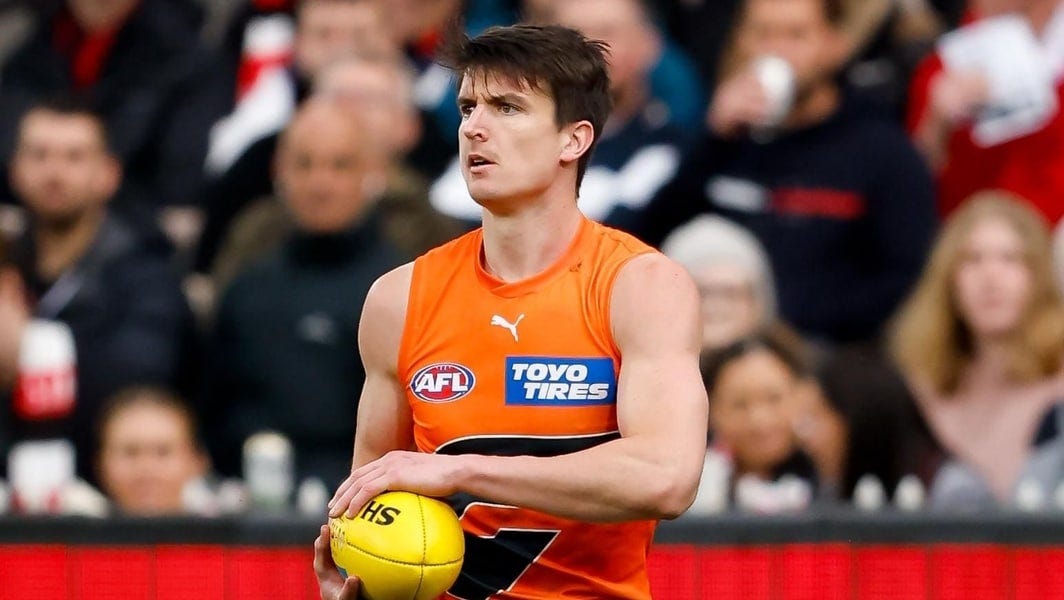
Sam Taylor is the player who makes the Giants’ high-wire act viable. He’s the best one-on-one defender – very possibly the best one-on-one player, full stop – in the game. His ability to neutralise elite key forwards in isolation is what allows the Giants to hold a low block, concede territory without conceding damage, and then organise their rebound chains with confidence. If he returns at full fitness and close to peak form, the Giants’ season still has a pulse. If he doesn’t, it doesn’t.
Biggest question to answer
Here are two. Firstly: how should the GWS hierarchy change the definition of success given injuries will likely scupper any chances of contention in 2026? Is it now about fast-tracking the introduction of younger players into the senior side – or is success still measured by ladder position and finals impact? Secondly: is there any plausible way that Kingsley and his coaches can shuffle things around to stem the bleeding and eke out one or two more wins until key players return from injury?
What success looks like
A succession of serious injuries to key players have materially changed the answer to this question from just a fortnight ago. A flag, or a serious tilt at one, is no longer a realistic proposition. Instead, the Giants should strongly consider using the first half of the season to get a good look at the kids who could help bring success in the post-Toby era.
In a nutshell
The Giants are a finely tuned but fragile side whose system remains among the AFL’s best when intact, but whose already-narrow margins for error have been shredded by injury. They could still be dangerous if they get healthy late, but in 2026, they’re more likely to be hovering around the bottom of the top 10 than meaningfully participating in the Premiership conversation.