


Staring directly at the Suns for preview number eight.
2025 ladder position: 7th (15 wins, 8 losses – eliminated at Semi Final stage)
2025 best-and-fairest: Matt Rowell
Senior coach: Damien Hardwick
Story of the season
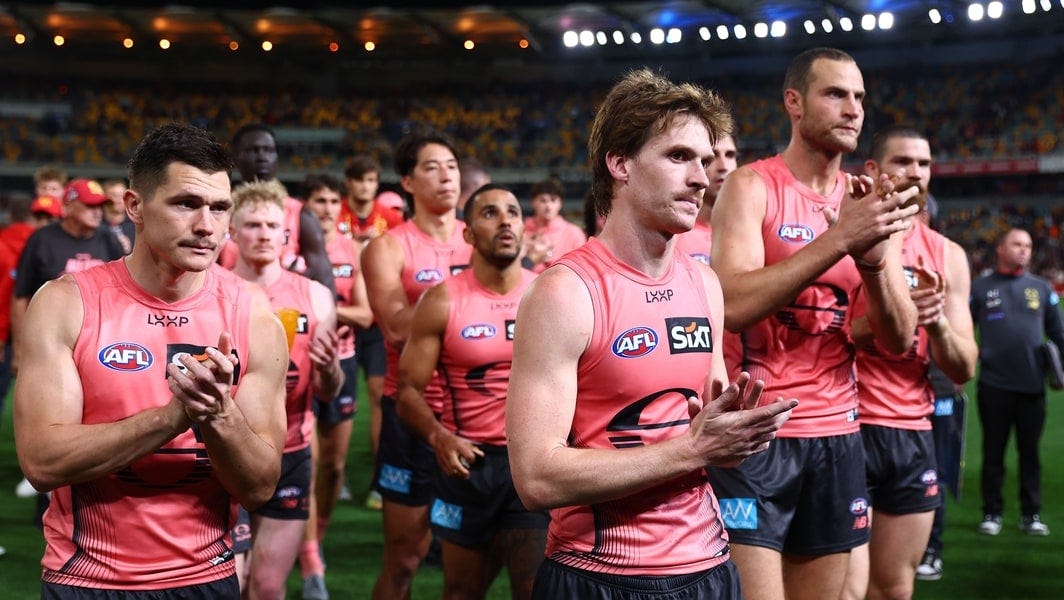
A maiden winning season. A maiden finals appearance. A maiden finals win. Tick, tick, tick, for what I’m sure were Damien Hardwick’s biggest objectives heading in 2025. He knows better than most what it takes to win a flag, and he would know better than anyone the progress Gold Coast is making against key Premiership benchmarks. His Suns flew out of the blocks in 2025. A “heated” and “somewhat controversial” (but mostly really bloody fun) one-point victory over the Crows in Round 4 was sandwiched by crushing defeats of also-rans. Banking home wins, including two against quality opposition in Darwin, put the Suns in a strong position to finish in the top four and earn the double chance. An egregious four-point loss to Port Adelaide in Ken Hinkley and Travis Boak’s final game showed that the old Suns were still there underneath the steely Hardwickian carapace.
That result meant a trip to Perth to play Fremantle, fresh off dismantling the Western Bulldogs the week before, in an Elimination Final. The Suns led all night, were reeled in, and then stuck the knife in at the very end. David Swallow’s point to win it with just seconds to go was one of his last contributions in a Suns guernsey and perhaps the most famous moment in the club’s history. The next game proved a bridge much too far; a 53-point loss at the Gabba demonstrating that, despite their real and significant improvement, there remains a way to go. Clearly, the Suns hierarchy felt that improvement was needed from outside sources. They were one of the most active clubs during the Trade Period, swapping Sam Flanders, Ben Ainsworth, Connor Budarick and Brayden Fiorini for Christian Petracca and Jamarra Ugle-Hagan – a clear Win Now move from a club that believes it has a Premiership-capable (and ready) list. A record draft haul, made possible by a bumper academy crop and some clever points juggling, served as a great chaser. They’re coming.
Summary of game style
The Gold Coast Suns have undergone the hard tactical reset they signed up for when they sacked Stuart Dew and replaced him with Damien Hardwick. Gone is the stale, conservative kicking game that used territory as safety. In its place is something faster, messier, and more dynamic. The Suns used to kick the ball downfield at glacial speed. In 2025, they were the fastest team in the AFL, and kicked it less often as a share of disposals than only Essendon. Metres gained via handballs has more than tripled. As any supporter of a team that was victimised by Hardwick’s Richmond sides would know, he doesn’t use handball as a retention tool – he uses it as a launch mechanism.
Hardwick’s Suns are built around propulsion rather than possession. The ball is moved quickly through congestion before being released long (the Suns led the AFL in metres gained per kick in 2025) and aggressively (second for expected threat per kick) into space. They are interested in taking as few seconds and steps as possible to get it forward. The trade-off is control. The Suns were 18th for expected retention per kick in 2025, while their turnover differential slipped from top-five to mid-table. This reflects a bet that Hardwick has always been willing to make: that territory and chaos matter more than possession hygiene, and that errors can be offset with the application of pressure.
The system is underpinned by winning contests. Last season, Gold Coast were fourth in the AFL for contested possession share, second for first possessions leading to clearances, and first for spoils. They are happy to manufacture secondary contests (aerial scraps, boundary throw-ins, ground-level congestion) because they trust their ability to win the ball back – especially in their forward half – and attack when their opposition is off-balance. Volume matters more than cleanliness.
Defensively, this tends to produce disruption rather than denial. The Suns are not elite at denying opposition territorial gains, but they’re good at preventing clean scoring sequences and defending inside 50. Offensively, the system remains slightly unsophisticated. Much of Gold Coast’s scoring hinges on creating a short road to goal (they were third in the AFL for scores from forward half chains but just 10th for scores from the back half) and finding Ben King in space. King is one of the last of a certain kind of full-forward: he stays home, he doesn’t pass it off, he just kicks boatloads of snags. The Suns’ attack reflects that profile. Transition is designed to generate early, deep looks at him and other tall forwards such as Ethan Read via long kicks into uncongested space.
Pressure, velocity, and physical power enable the Suns to shorten the field through pressure rather than possession, and prioritise initiative over stability. What’s missing is polish. But Hardwick’s track record suggests he believes polish isn’t essential to winning flags. Instead, he’s focused on instilling habits like tempo and aggression. Those foundations are now in place. Either he believes the next layer will come, or the base will get so good that it won’t matter.
List changes
In:
Zeke Uwland (2025 National Draft, Pick #2 – Gold Coast Academy)
Dylan Patterson (2025 National Draft, Pick #5 – Gold Coast Academy)
Beau Addinsall (2025 National Draft, Pick #18 – Gold Coast Academy)
Jai Murray (2025 National Draft, Pick #17 – Gold Coast Academy)
Avery Thomas (2025 National Draft, Pick #28)
Koby Coulson (2025 National Draft, Pick #46 – Gold Coast Academy)
Christian Petracca (trade – Melbourne)
Jamarra Ugle-Hagan (trade – Western Bulldogs)
Out:
Tom Berry (delisted)
Lloyd Johnston (delisted)
Alex Sexton (delisted)
Sean Lemmens (retired)
David Swallow (retired)
Ben Ainsworth (trade – Carlton)
Connor Budarick (trade – Western Bulldogs)
Brayden Fiorini (trade – Essendon)
Sam Flanders (trade – St Kilda)
Malcolm Rosas Jr. (trade – Sydney)
List profile
Number of top-10 draft picks: 12 (1st)
Average age at Opening Round: 24.2 (15th)
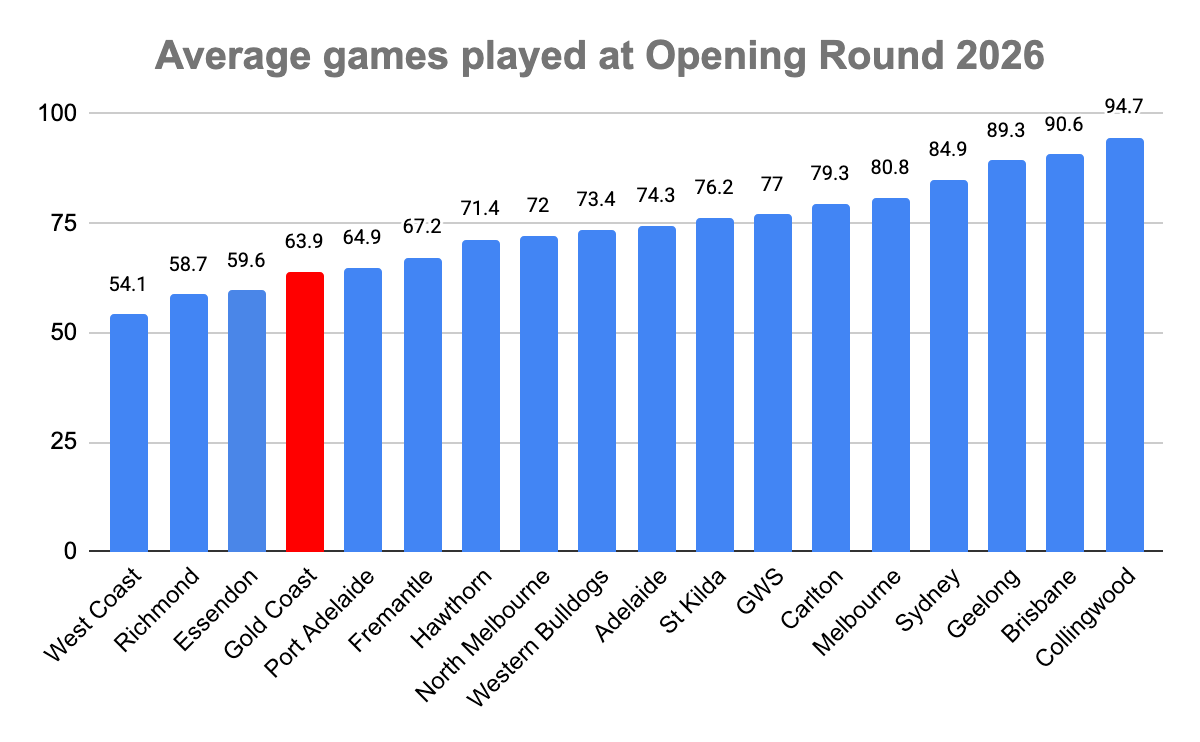
Average number of games played: 63.9 (15th)
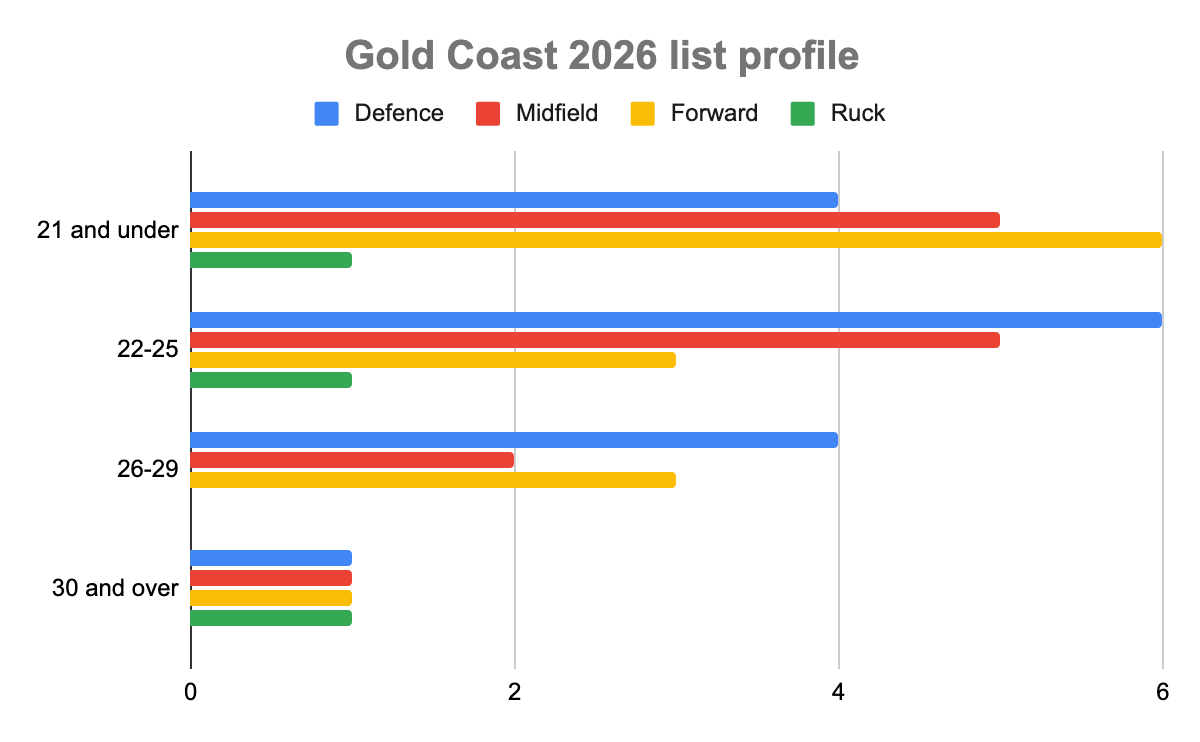
Adding the 2021 Norm Smith medallist, the number one pick from 2020, and two of the hottest prospects in the 2025 draft class to a list that won a final and was already bursting at the seams with young talent is great news for Suns fans, rather less so for fans of other clubs. Zeke Uwland and Dylan Patterson will both be midfielders one day, but will approach that destination from different origins: Zeke is the silky younger brother of (very good) current Suns player Bodhi. Patterson is a convert from rugby league whose astonishing blend of speed and strength dazzled scouts in his draft year. Beau Addinsall, Jai Murray, and Koby Coulson would have been a very good Academy crop on its own. Avery Thomas is an intriguing defensive prospect from Tasmania and precisely the sort of punt the Suns could afford. But Petracca and (to a lesser extent given how his career has derailed) Ugle-Hagan are the players who will improve the Suns in the short term. Each offers something different: Petracca the power and Premiership experience, Ugle-Hagan the aerial ability.
The backline is good, but probably not great. Six sides conceded fewer shots per opposition inside-50 entry than the Suns did in 2025. But there is realistic hope for short-term improvement. The most plausible is Charlie Ballard’s return from an ACL injury that kept him out of all but one-and-a-bit quarters of last season. His return feeds directly into the second reason the defence could get better: it will free Mac Andrew up to play a floating, intercepting role more attuned to his gifts. Sam Collins is the grizzled general and Bodhi Uwland clamps down on opposition third talls and medium forwards. Dan Rioli, Joel Jeffrey, and John Noble are entrusted with the responsibility to launch from defensive 50. Both provide speed and long kicking, while Rioli is trusted to relay coach Damien Hardwick’s instructions on-field.
The midfield is a powerhouse. I’m not sure there’s a better one-two in footy than captain Noah Anderson and (surprise?) Brownlow Medallist Matt Rowell. They’re great mates and great complements: Anderson the lithe runner and precise kicker, Rowell the hard ball brute. Petracca will probably get first dibs on completing the core centre bounce rotation, but Hardwick isn’t scared to rotate players through there to ask opponents different questions. Excited chatter about Touk Miller’s new half-forward role slightly obscured the fact that he still attended 343 centre bounces in 2025. The wildcard is Bailey Humphrey, a volatile talent primed to (sorry for the unfortunate bit of footy verbiage) EXPLODE in 2026. It’s an embarrassment of riches. Alex Davies adds solid inside depth, while Sam Clohesy, Lachie Weller, and probably some combination of Miller, Jake Rogers, Will Graham, and Leo Lombard will start on the wings. Jarrod Witts is still the number one ruck, but Ned Moyle looks ready to step in should age (and the new ruck rules) begin to bite.
Gold Coast’s forward line is rich with talent but just as rich with unanswered questions. 14th in the AFL for shots per inside-50 entry was an indictment of some unsophisticated entries (themselves partly the product of a system that prioritised speed over subtlety) and also an uneasy mix of personnel. Ben King is the guy who sits deep inside 50, benefits from space others create, and kicks goals. If that sounds like an indictment, it’s not! Kicking goals is important. Jed Walter’s stock price has fallen somewhat after a difficult second season, with the key forward dropped in the back end of the year. I remain confident he has the size and talent to succeed at AFL level. I am less confident he has the mobility or – for now – the craft. Ethan Read also briefly flickered with promise before burning out. The capture of Ugle-Hagan suggests a recognition that, at least while Walter and Read keep developing, short-term improvement is required. His acquisition is a risk – but so was standing still. Ben Long enjoyed a super season as an ersatz third tall, threatening in the air, applying pressure, and competing at ground level. Hardwick has tended to use his half-forward spots for midfielders rotating out of centre bounces: expect Humphrey, Miller, Petracca, Rogers, and Lombard to all spend meaningful time up there.
Line rankings
Defence: Above Average
Midfield: Elite
Forward: Above Average
Ruck: Above Average
The case for optimism
Suns fans should be optimistic about today and very optimistic about tomorrow. Let’s start with today. Gold Coast isn’t searching for its tactical and narrative identity anymore. Hardwick has built the foundations of a resilient and repeatable game model: contest-first midfield work, rapid post-turnover exits, forward-half pressure designed to manufacture repeat entries, and the structures needed to sustain it at high speed. The Suns have progressed past the stage where they need to learn what to do. Their path to winning – especially given they possess one of the clearest home-ground advantages in footy – is now Plan A, But More: better, faster, more pressure-tolerant. Iterating on a system is hard, but not as hard as engineering the paradigm shift.
Not many players help you go better, faster than Christian Petracca. If the Suns are getting peak (or near-peak) Petracca, then he makes them first-rung flag contenders. If what we actually saw last season – still very good, but his lowest-rated since 2019, and totally explicable as the long tail of that shocking spleen injury – was the beginning of a decline, then he still makes them top four contenders. Crucially, you can see the vision. With Matt Rowell as the extractor and Noah Anderson as the runner, Petracca becomes the attacking release; the player who converts stoppage wins into scoreboard pressure. He probably won’t make Gold Coast’s forward forays cleaner, but he’ll make them faster. One way to solve the problem of poor delivery inside 50 is simply to kick goals from 55. Petracca will have an impact on the field. He’ll also probably have a positive impact on the group. I struggle slightly with the concept of Premiership Experience, mostly because it’s hard to model, but it’s tough to argue that Petracca, Dan Rioli, and John Noble helping their younger teammates understand the level Premiership sides operate at is a bad thing.
Moving to tomorrow: the Suns have only just started tapping the potential of their existing core. Bailey Humphrey, Ethan Read, Jed Walter, and Mac Andrew are all still in the upward part of their development curves. I don’t think any of them need to become superstars next year for the Suns to win the flag (although Humphrey very well might become one); the key is that incremental gains distributed across enough players will materially raise the Suns’ level. That goes to the broad point of the side’s list profile. Bold trades (both incoming and outgoing) and a fecund academy haul, made possible by abundant high draft picks, have provided the Suns with a list that balances elite talent, depth, and age balance. Ballard’s return will strengthen the defence and permit Mac Andrew to do more freelancing. Petracca, meanwhile, represents a Win Now move layered onto a sustainable base – not a desperate roll of the dice. If his addition doesn’t yield a flag, then the [deep breath] Walter/Read/Leo Lombard/Zeke Uwland/Dylan Patterson cohort will give them several more loaded rolls of the dice. The Suns aren’t a project anymore. They’re a contender – one that’s only just beginning to rise.
The case for pessimism
The Suns are getting better. But so are the teams they’re chasing. Perhaps not as quickly, but by enough that there’s still a gap. The clearest reference point is last year’s Semi Final against Brisbane. OK, there was a lot of travel, the possibility of an emotional hangover given the circumstances of their win in Perth, and the intimidation of playing their bigger brothers. But they’d given the Lions an 11-goal hiding just seven weeks earlier. To lose by 53 points was a huge disappointment – and evidence that a gap remains. Like an elite cyclist racing up a mountain, Brisbane changed gears, and the Suns cracked. The Lions aren’t going anywhere. Teams like the Western Bulldogs and Fremantle are maturing. The top of the ladder is crowded.
There’s also the slightly uncomfortable fact that the long-term futures of Ben King and Matt Rowell aren’t fully resolved. King is eligible for free agency at the end of 2026. Rowell is contracted only until 2027. More broadly, Gold Coast are approaching the phase where their best players enter peak earning years – and the peak of their negotiating power. The existence of the salary cap is designed to prevent the accumulation of league-breaking amounts of elite talent. Some clubs respond by fostering cultures in which players accept less-than-market salaries in exchange for sustained success. Historically, the Suns have struggled with retaining star non-locals. Noah Anderson’s buy-in could break the cycle. But it’s still not a trivial challenge to solve.
Finally, there’s the fixture. Last season, Gold Coast benefited from a draw that, in hindsight, was almost exactly as difficult as West Coast’s. They played Essendon, Richmond, and Melbourne twice. They’re currently predicted to have the season’s second-hardest draw. Fixture strength isn’t especially interesting, but it does matter on the margins (which is what we’re talking about here). A tougher schedule can neutralise genuine internal improvement. Better football does not always translate to a better win-loss record or ladder position (just ask West Coast!). The Suns are rising into the echelon of the competition where fine margins matter. They should get better. It’s far from certain that’ll be enough.
Enjoying this preview and think a Suns-supporting friend might too? Share it with them!
Breakout player
It’s a long list to choose from. One could mount entirely convincing cases for Leo Lombard, Ethan Read, Jake Rogers, or possibly even Bodhi Uwland. But I think the case is actually quite clear: Bailey Humphrey’s irresistible combination of physical traits, contested ball-winning, and goal sense mean he’s surely destined for the top. He’s already the Suns’ sixth-highest rated player across the last 20 games. The next version of Dustin Martin, playing alongside the actual Christian Petracca, led by Dusty’s old coach? Not bad.
Most important player
I whiffed when nominating Mac Andrew last year. He’ll probably be fine, although he didn’t make the sort of progress that most pundits and perhaps his own coaches expected him to make last season. The actual answer to this question is Noah Anderson. He’s a brilliant midfielder and, just as importantly, he’s bought in: an elite prospect from metropolitan Melbourne has put down roots and assumed the burden of leading this upstart club to success and, frankly, to seriousness. Re-signing him will be high on the Suns’ list of priorities.
Biggest question to answer
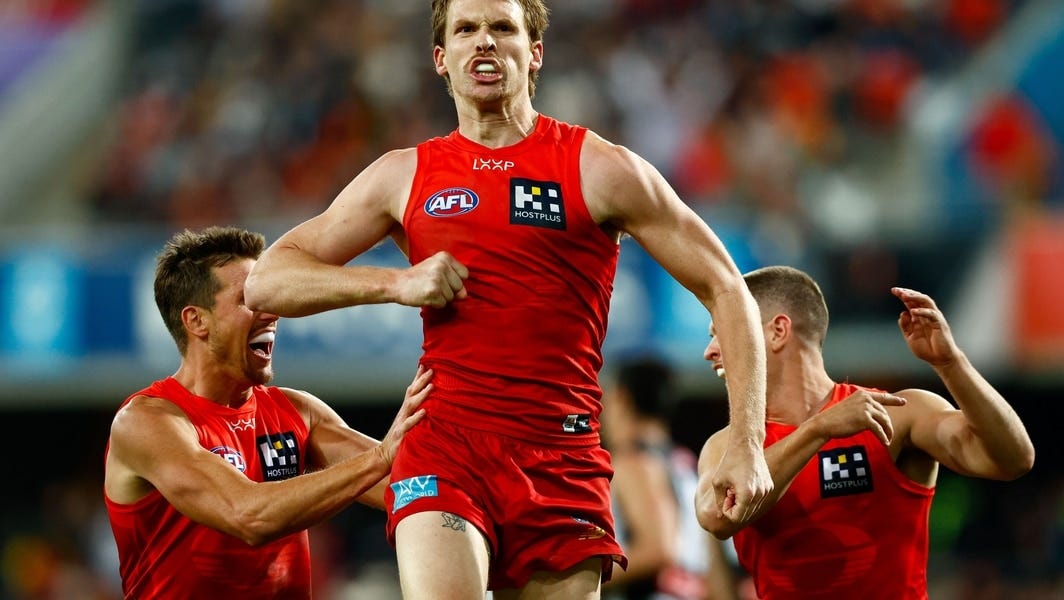
Do Petracca and Ugle-Hagan move the needle by enough to make the Suns flag fancies in 2026? The moves were absolutely the correct ones to make. The departures of Flanders, Ainsworth, and Budarick aren’t negligible, but the reasoning behind them is sound: none moved the needle, all have replacements on the list, and stars like Petracca win finals. There’s a deeper tactical question here, too: the Suns need to increase their scoring power. There are two roads to that destination: more finesse (better inside-50 kicking, more sophisticated spacing and blocking) or greater volume (more entries). Hardwick has tended to favour the latter. Petracca should help him achieve that goal.
What success looks like
Last year, I wrote that making finals was the pass mark. The Suns did that and a bit more. When they stack enough talent to win their first flag (plausibly as soon as this season), that win against Freo will be regarded as a significant milestone on their journey. Gold Coast’s enviably productive academy and clever juggling of draft points has allowed them to have it both ways: they can build for tomorrow while competing today. Making a prelim isn’t necessarily the expectation, but it’s the logical next step for a side aiming to win multiple flags. Doing so while giving real minutes to the next generation? That would just be greedy.
In a nutshell
Sides sometimes win flags before people think they’re ready. Don’t let the Suns’ age profile fool you. If the ball bounces their way enough times, and the guys who’ve been there before – Rioli, Petracca, Noble – help the younger players keep their heads, they could win it all this year. But a tougher fixture and greater opposition attention means slight regression is also a possibility.