


Heading down the Princes for the seventh preview.
2025 ladder position: 2nd (17 wins, 6 losses – Grand Finalists)
2025 best-and-fairest: Max Holmes
Senior coach: Chris Scott
Story of the season
The Cats are footy’s index fund. Sometimes they exhibit volatility in-season, sometimes they’re outperformed by more exotic options, but they pretty much always generate steady, above-market returns (NB: please do not make investment decisions based on what I write in this silly little newsletter). If they’re the index fund, then Chris Scott is the master fund manager: always searching for opportunities to tweak the portfolio composition in search of better returns.
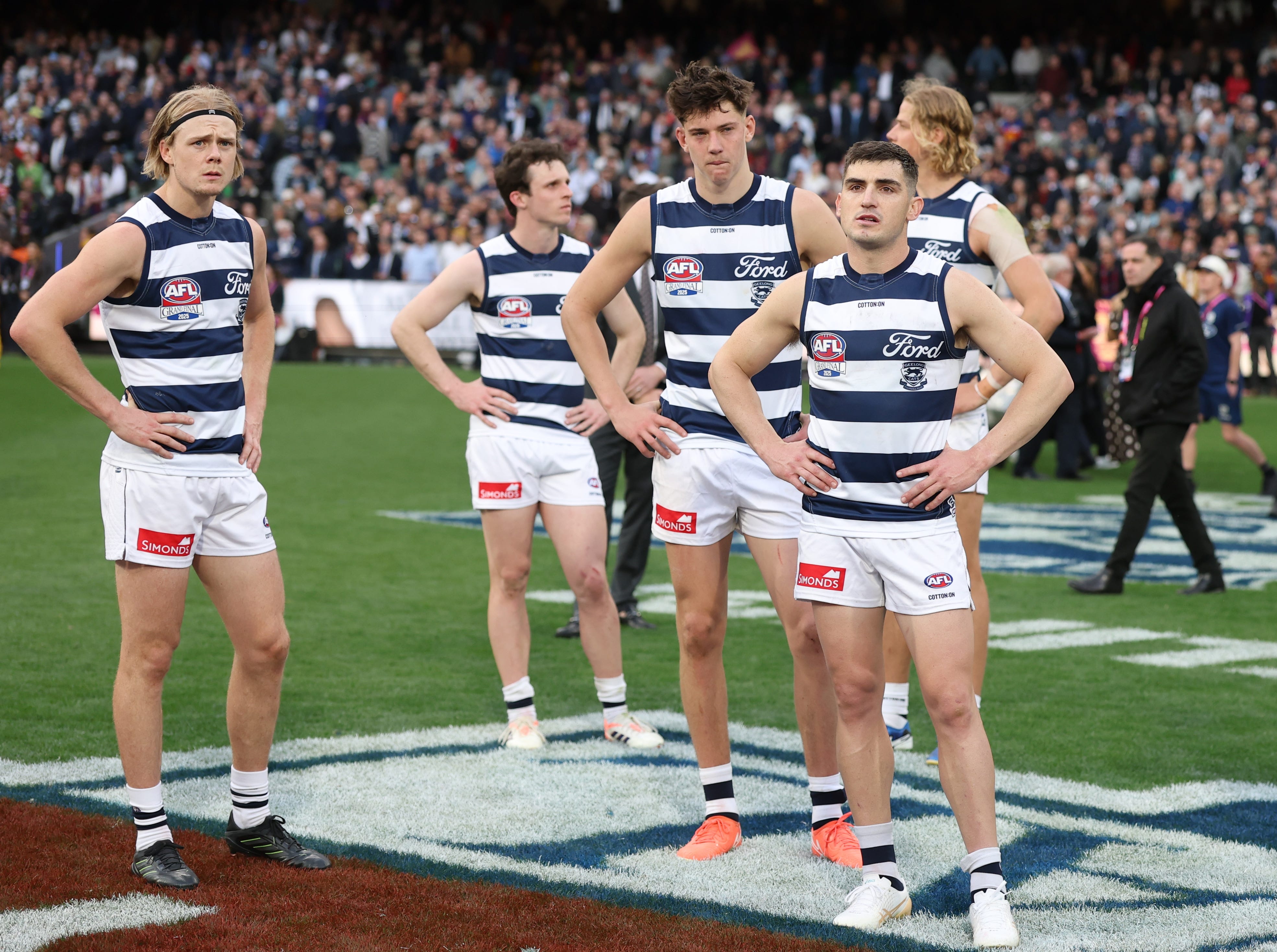
In this respect, the contours of 2025 were recognisable. Scott adjusted for players whose contributions rose and fell. Bailey Smith was integrated and became part of a formidable midfield pairing with Max Holmes, Patrick Dangerfield became a (very good) forward, Shannon Neale emerged as a key forward option, and the beginning of the decline of Tom Stewart necessitated a distribution of his responsibilities across the rest of the backline. Jeremy Cameron teased the footy world by briefly touching 100-goal pace. Geelong beat the teams worse than them – usually by devastating margins – and had middling results against their equals. They finished second without appearing to break a sweat, largely unaware of the carnage happening below them on the ladder. They convincingly beat Brisbane in the first week of finals, conjured the historical memory of the Kennett Curse to slay Hawthorn in the prelim, then convincingly lost to Brisbane in the Grand Final. Oh well. For many sides, losing a Grand Final can cause a meltdown. For Chris Scott and Geelong, it’s a data point about how to improve to generate better returns next year. Never overreact, never underreact.
Summary of game style
Geelong’s game model is built around controlled verticality. Their first priority is always to move the ball forward at speed. They go fast because they have total trust in the integrity of their defensive structure. A missed kick is rarely a disaster; it is simply the beginning of the next phase. That confidence is underpinned by their running power. Bailey Smith and Max Holmes stretch the ground in both directions, expanding the field in transition without ever losing connectivity. Tom Atkins specialises in turning clean opposition clearances into compromised possessions that eventually yield turnovers and offensive transition. The Cats will take territory from stoppage if they can, but winning clearances isn’t a prerequisite to winning games.
Up forward, Jeremy Cameron displaces defenders and forces constant defensive adjustments, pioneering the modern role of high full forward. Shannon Neale provides the counterbalance, anchoring the deepest line, keeping opposition defenders honest, and converting the space created by others into scoreboard pressure. Oliver Dempsey franks Geelong’s ability to manufacture field tilt by arriving late as a finishing off-ball winger. The key to knitting this all together is Scott’s use of his small and medium forwards. Through angled leads, lateral rotations, and precise in-board kicking, Gryan Miers, Brad Close, Shaun Mannagh and co. manipulate defensive spacing and generate multiple entry windows. Patrick Dangerfield’s evolution has added another contested layer to Geelong’s forward line. No longer required to spend most of his time in the middle (until – in the finals – he was), he has been redeployed as an elite forward-half contest player, using his old man strength to rip apart defensive structures. Once established in attack, the Cats rarely relinquish territory. Forward-half tackles, ground ball dominance, and elite rebound suppression allow them to “rest with field position” without resorting to sterile possession.
Underlying all of this is a peerless tactical flexibility. Scott is perfectly happy to make situational adjustments based on the strengths and weaknesses of the next opponent. The Cats tag more than any other side, deploying Oisín Mullin to blunt opposition weapons. The result of all this is a side that manufactures space in three dimensions: vertically through speed and running power, laterally through playmaking forwards, and territorially through pressure and retention. They are fast because the quality of their system permits it, and direct without being chaotic. Fast and organised – tough to beat.
List changes
In:
Harley Barker (2025 National Draft, Pick #24)
Hunter Holmes (2025 National Draft, Pick #33)
Nick Driscoll (2025 Rookie Draft)
Jesse Mellor (Category B Rookie)
James Worpel (free agent – Hawthorn)
Out:
Ted Clohesy (delisted)
Cam Guthrie (delisted)
Xavier Ilisic (delisted)
Patrick Retschko (trade – Richmond)
List profile
Number of top-10 draft picks: four (T-13th)
Average age at Opening Round: 25.4 (4th)
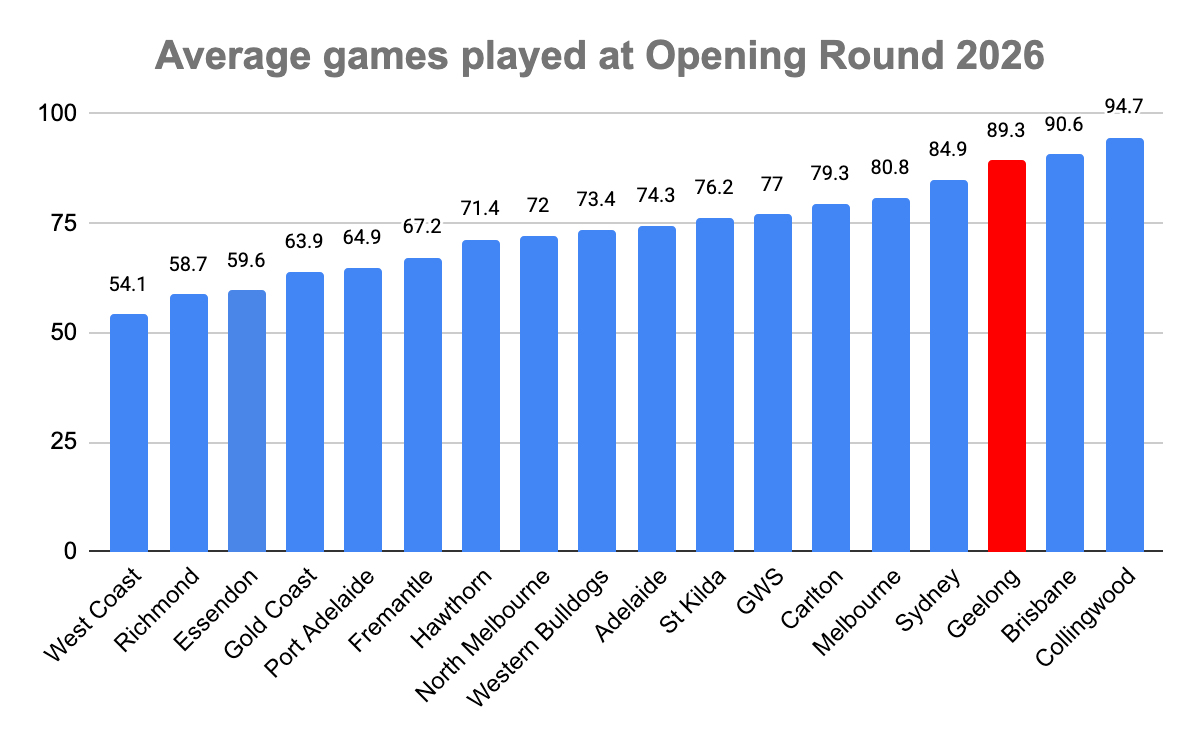
Average number of games played: 89.3 (third)
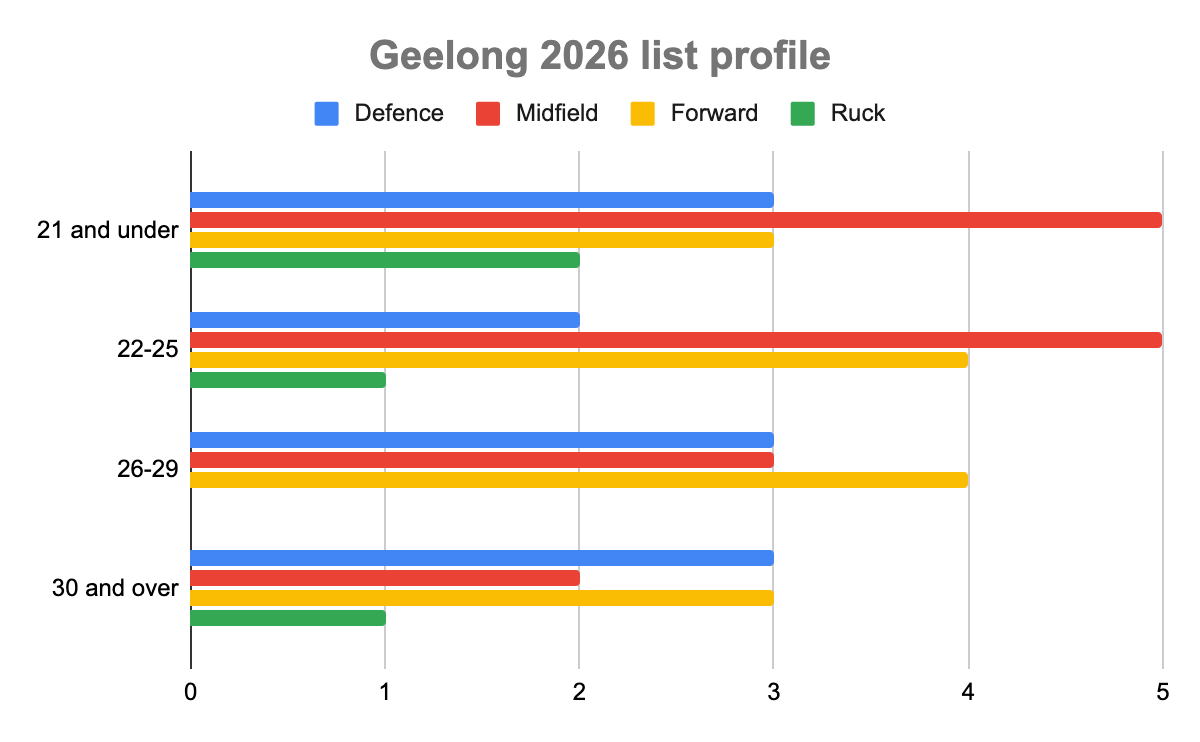
There was once a comforting theory for both West Wing liberals (in the American sense) and people who dislike Geelong: demography is destiny. Just as the United States was bound to turn Democratic, the Cats were bound to fall off the cliff. Yet here we are: Donald Trump’s America, Chris Scott’s, Andrew Mackie’s, and Stephen Wells’ AFL. Geelong didn’t do much this off-season. They didn’t need to. The throughline is there: athletes who can be moulded into Geelong footballers. Harley Barker and Hunter Holmes are acquisitions in the mould of Bailey Smith and Max Holmes – powerful athletes who can run all day. James Worpel is the recruit who’ll help most in 2026. The Bannockburn product will slot straight into the Cats’ midfield rotation. Cam Guthrie’s delisting is a reminder that there’s rarely room for sentiment in elite sport.
The defence is still the source of Geelong’s perennial competitiveness and most of its tall blonde dudes. The main difference from past years is the decline of Tom Stewart. He deserves a chance to show that his indifferent 2025 was a blip. But Chris Scott and his line coaches haven’t wasted any time, effectively allocating Stewart’s intercepting duties to Connor O’Sullivan and his rebounding responsibilities to Lawson Humphries. Sam De Koning, Jack Henry, Zach Guthrie are still very difficult to beat in the air, while Jed Bews and Mark O’Connor ensure similar solidity at ground level.
Geelong’s midfield is constructed to beat the best rather than itself being the best. Now that Patrick Dangerfield has become a forward with occasional midfield bursts, the Cats’ midfield is optimised for two archetypes: disruptors and runners. Tom Atkins does the bulk of the dirty work, clamping down on stars and mucking up opposition exits from stoppages. Smith and Holmes start in the centre but, despite Holmes adding significant inside ability in the last two seasons, both thrive as first receivers who create separation and gain territory. Expect James Worpel to slot straight in and provide a solid, if unspectacular, physical presence. Tanner Bruhn will also feature again – only two midfielders attended more centre bounces than he did in 2024. Oliver Dempsey and the ageless Mark Blicavs will start on the wings. Both are nightmare match-ups and key parts of Geelong’s system.
However one splits it, Geelong’s forward line was either the best or second-best last season. Jeremy Cameron is the most unconventional spearhead, frequently rolling upfield to get involved in possession chains and displace opposition defences. Shannon Neale is – and I don’t mean this pejoratively – a simpler type of player: a big guy who leads hard and kicks straight. Patrick Dangerfield’s redeployment as a battering ram forward has been bad news for Ollie Henry, who progressively fell out of form and favour as the season progressed. We know about the smalls: Miers, Close, Mannagh, Stengle. All possess subtly different traits, but they combine beautifully. Stengle appears likely to miss the early weeks of the season due to personal issues.
In aggregate, this is a list constructed less like a showcase of ornate parts and more like an engine. It prioritises power, adaptability, and fit. Geelong’s recruiters and list managers look for unfinished products that can be moulded into contributors just as intently as they look for stars. The result is a squad that rarely dazzles in isolation, but almost always works.
Line rankings
Defence: Elite
Midfield: Above Average
Forward: Elite
Ruck: Average
The case for optimism
The most obvious cause for optimism is also the least interesting to talk about: the Cats are still one of the best-run clubs in the AFL. Under Chris Scott, they have sustained a culture of strategic patience, internal clarity, [redacted], and continuous improvement that few rivals have lived with. They don’t sink into despair or lapse into complacency. They learn.
There is strong historical evidence of this learning capacity. After repeatedly coming up short against the Hardwick Richmond dynasty, Scott and his coaches did not simply tinker around the edges. They executed a fundamental strategic shift. A methodical, kick-mark, control-oriented team became one more interested in velocity and momentum. That adaptation underpinned their return to the summit in 2022. It remains the clearest example of Scott’s willingness and ability to learn and act. More broadly: although its novelty has waned, the system itself still works. The defence is strong, the midfield is dynamic, the forward line is lethal. When new players enter the senior side, usually after a lengthy apprenticeship in the VFL, they are absorbed into a structure and directed to play a discrete role. That coherence is why Geelong are always competitive.
At list level, concerns about how much Jeremy Cameron and Patrick Dangerfield are still contributing at their age should be partly offset by the fact that the players who enable Geelong’s ability to stretch the ground – Bailey Smith and Max Holmes – are entering their peak years. Both are now at the stage where physical maturity and tactical understanding begin to align.
In summary: the machine still works. The inputs remain strong. The feedback loops remain intact. For close to 20 years now, the Geelong Football Club has been iterating on a formula that delivers sustained contention.
The case for pessimism
As is virtually obligatory to point out, this is all relative. By the standards of most clubs, the Cats are exceptionally well placed for 2026. They have talent, a resilient system, and a football operations department that’s proven it can regenerate the list while maintaining elite competitiveness. But the margins might be narrowing.
I see three and a half reasons for mild pessimism. The first is a subtle but real defensive decline. In their 2022 Premiership season, the Cats were ranked second in the AFL for opposition shots per inside 50, first for preventing defensive-half exits into forward 50, and second for preventing opposition scores from the back half. Across the final ten games of 2025, those rankings slipped to eighth, seventh, and 15th respectively. Some context: that sample includes a greater share of matches against high-quality opponents. But in a way, that’s the point. Against the teams that matter most, Geelong’s defence has become more porous. This is important in itself, but also because Geelong’s attacking players have to believe that the system behind them will hold up. If that faith begins to waver, conservatism could creep in.
Geelong’s second cause for concern is their dependence on Jeremy Cameron. He connects the Cats’ forward-half game, distorts opposition zones, and finishes off scoring chains. We don’t really have an example of how Geelong’s offensive system holds up when he’s not there. He’s played virtually full seasons every year since 2021 (he missed a few games in the middle of 2023), but Tom Hawkins was still the alpha then. The Cats have complementary pieces and some promising developing talls. But it would not be lost on Chris Scott and James Rahilly that Shannon Neale had three of his worst games of the season in the finals, managing just three goals and 14 disposals over three games as the intensity went up a gear. Geelong don’t have a second Jezza. And the one they have is nursing a broken arm – and is two months away from turning 33.
The third cause for pessimism sits between defence and attack: the changing composition and shifting strengths of Geelong’s midfield. For much of their sustained success, Geelong were anchored by powerful inside players who could win first possession and stabilise games under pressure. That profile is changing. The Smith-Holmes duo (no, I won’t call them the Dash Brothers) provides enormous running power and transition threat, but it tilts the midfield in a more outside direction. Patrick Dangerfield’s move forward has accelerated that transition. That different midfield profile matters most in September. In finals, the share of scores generated from stoppages increases as ferocious pressure makes it harder to execute the same standard of transition. Power tends to displace speed. Deficiencies at the coalface are magnified. Will James Worpel help rectify Geelong’s slight weakness in this area by enough? The fact that Dangerfield helped turn the Qualifying Final and Preliminary Final in Geelong’s favour with devastating bursts through the middle is both testament to player and club (for managing him physically throughout the season) and a real worry (it still had to be him making the difference).
It’s possibly also worth mentioning – despite the Cats’ clear organisational indifference to the ruck position – their unsuccessful pursuit of St Kilda’s Rowan Marshall during the Trade Period. This suggests a recognition among the Geelong hierarchy that the ghost of Rhys Stanley, a promising but injury-afflicted Toby Conway, and an untried Mitch Edwards probably isn’t an adequate ruck corp, and that the opportunity cost of deploying the likes of Bicavs and De Koning as situational rucks might be too high.
The Cats are still very good. Their organisation remains elite. But there are some hairline cracks appearing. I suspect we may look back on 2026 as an interregnum year: the dying embers of the Cameron-Dangerfield Era, not yet replaced by the [insert name of star free agent Geelong will surely lure] Era.
Enjoying this preview and think a Cats-supporting friend might too? Share it with them!
Breakout player
The combination of Geelong’s preference for long apprenticeships, a lack of recent high draft picks, and my own criteria make this tricky. Nominating Connor O’Sullivan last season was a no-brainer. I’ve been hearing good things about young tall forward Jay Polkinghorne and roaming interceptor Lennox Hofmann. Mitch Edwards has impressed in pre-season and is likely to get his chance at AFL level early in the season, but no club has more disdain for the ruck position than Geelong. So I’ll relax my rules and nominate a player who is both a new draftee and currently recovering from an ACL injury: Harley Barker. The athletic winger was an important part of the SA side that conquered all at last year’s Under-18 National Championships. The Cats rarely rush young players into their senior side. Perhaps Barker will be an exception.
Most important player
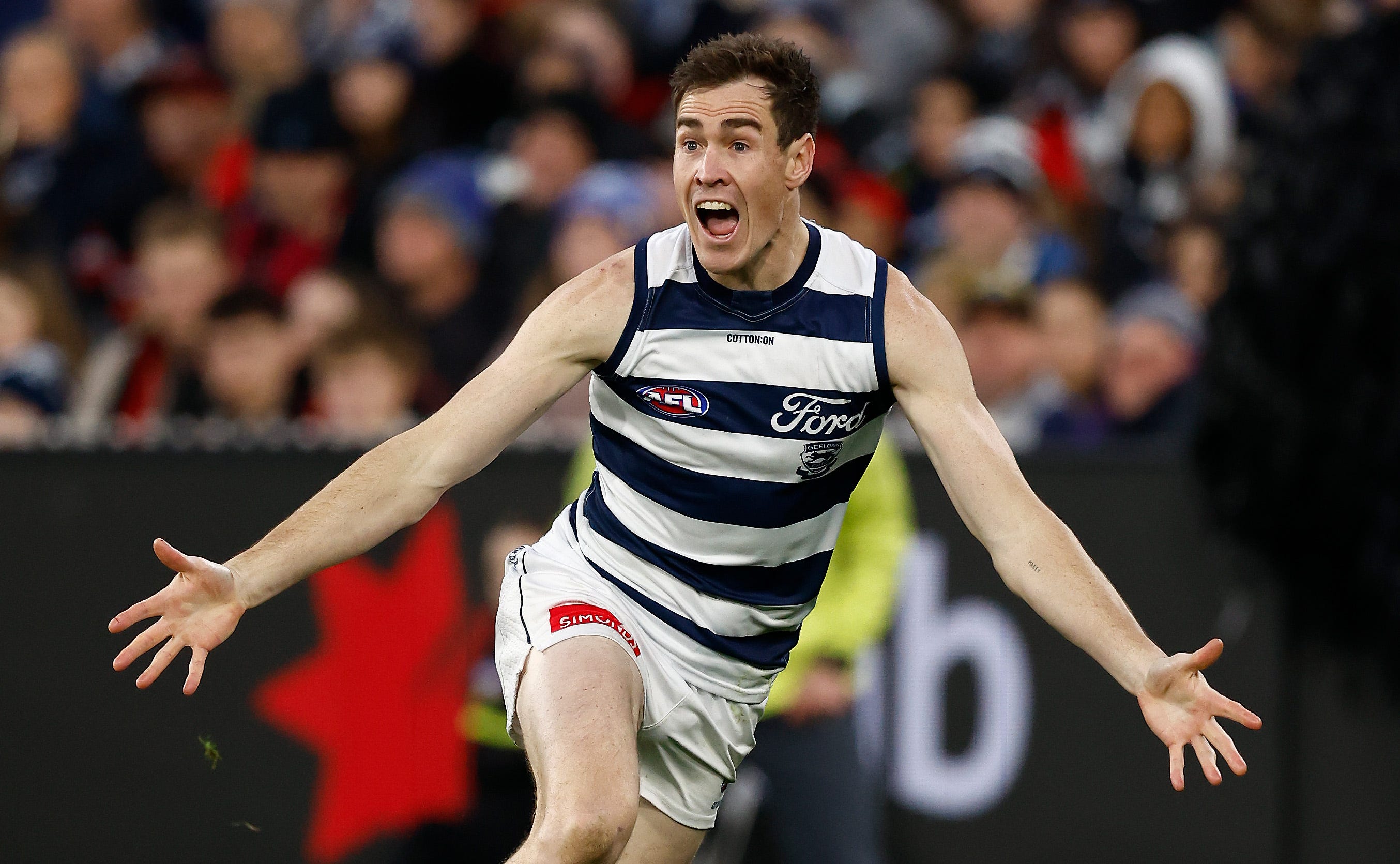
If Geelong’s system is an engine, then Jeremy Cameron is that stuff they use in the Fast & Furious films to send it into overdrive (NB: do not write to me about my lack of automotive knowledge). The bottom line is very simple: if he’s fit and in form, the Cats can win the flag. If he succumbs to injury, or the recovery from the broken arm he suffered in the Grand Final goes awry, or begins to show signs of age-related decline, they’re no better than a clutch of other contenders. And if it’s the latter, it’ll prompt harder questions about how Geelong must once again adapt to keep up. Cameron is Geelong’s best player and point of greatest fragility.
Biggest question to answer
How do Geelong go from being the second-best side to the best while, on paper, several of their rivals have strengthened more than they have? There’s a plausible case to be made that Geelong’s young and mid-age core – O’Sullivan, Humphries, Dempsey, Holmes, Neale, Smith – improve by enough to lift them one spot higher. The danger, in a league of ultra-fine margins, is that that growth is offset by a decline in output from veteran champions like Cameron and Dangerfield.
What success looks like
Continuing to pound the rock. Continuing to play with a mix of ferocity and control that’s too much for most other teams to bear. Continuing to put themselves in a position to challenge for the Premiership. Luring a star free agent. And continuing to make arrangements for the day when they can no longer call on Cameron and Dangerfield.
In a nutshell
Geelong will make the top eight. They will probably make the top four. Whether they advance to an 11th prelim in 16 years under Chris Scott (and beyond) will depend on the form and fitness of their best players, and whether Scott can conjure enough tactical marginal gains.