


Going west for preview number six.
2025 ladder position: 6th (16 wins, 7 losses – eliminated at Elimination Final stage)
2025 best-and-fairest: Caleb Serong
Senior coach: Justin Longmuir
Story of the season
After losing their last four games of 2024 to somehow miss finals, the Dockers were eager to sprint out of the starting gate and send a message to the rest of the competition. They did. But, much like when you accidentally send a text complaining about somebody to that person, it wasn’t the message they wanted to send. The pain and shame of a 78-point loss to Geelong down at the Cattery was only slightly ameliorated by debutant Murphy Reid kicking four goals in five minutes. The next game was possibly even worse; a three-point home defeat to a depleted Sydney. The grumbles that never seem far from the surface in the Justin Longmuir Era threatened to break containment. Despite that rocky start, and the occasional bizarre performance (they lost by how many to St Kilda?) the Dockers got things back on track, winning 12 of their final 14 Home & Away games, including a highly impressive victory over the Western Bulldogs in a virtual elimination final.
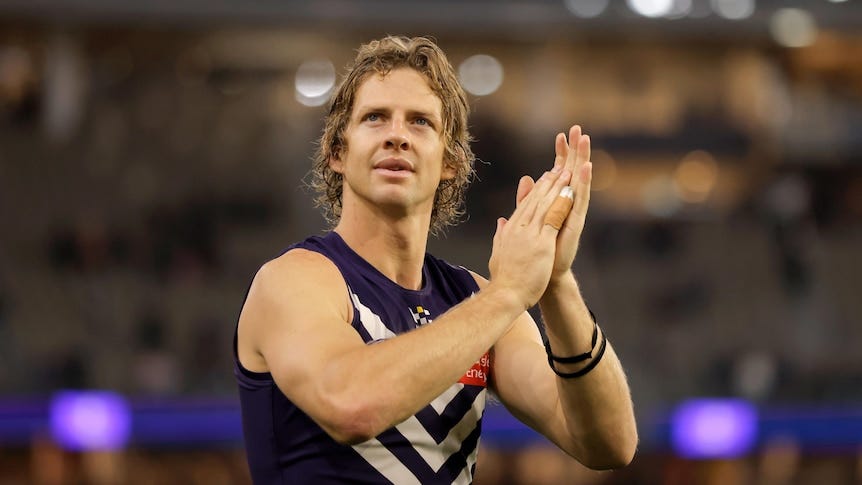
The Dockers’ reward for winning that game was an actual elimination final, against first-time finalists the Gold Coast Suns. Even at the time, the prospect of a young side with the burden of expectations but not the bedrock of past success taking on a brash team that had already broken new ground just making finals felt dangerous. And so it proved. The Dockers trailed almost all night. The fact they actually turned around a 26-point deficit to lead with five minutes to go just made the eventual result more painful. David Swallow’s point to win the game instantly became the most famous moment in Suns history, and the Dockers were once again relegated to the status of supporting characters in someone else's story. The curtain fell on their season – and on the mighty careers of Nat Fyfe and Michael Walters.
Summary of game style
Justin Longmuir has built on the foundations created by Ross Lyon and his own work as an assistant at Collingwood to craft one of footy’s most formidable defensive systems. Freo’s ability to control space, deny high-quality inside-50s, and suppress opposition transition has become ingrained. In 2025, the Dockers again conceded the fewest intercept marks in the league and ranked second for preventing opposition D50-F50 transition, meaning they remained a top-three side for restricting scores from defensive half turnovers. Structure remains the organising principle of their football.
What Longmuir has struggled with is adding attacking layers to that solid defensive base. Fremantle remain a handball-heavy, possession-oriented side (they were 17th in the AFL for kicks as a share of disposals in 2024, 15th in 2025) committed to manipulating defensive shapes through patient build-up. In 2024, that approach produced league-best disposal retention but limited penetration. In 2025, Longmuir tried to loosen the reins, trading security for territory: metres gained per kick jumped to second in the AFL, while expected retention per kick fell from fourth in 2024 to equal last. A by-product of greater risk without greater speed was the collapse of Freo’s marking game. They took the fewest marks per game in 2025 and marked inside 50 at the lowest rate. The result was a half-completed revolution – conservatism in construction, aggression in intent, and occasionally incoherent in practice.
Nowhere is that tension more evident than in their forward entries. Slow, multi-phase attacks allow opposition defences time to reset and compress space. Advantage is routinely deferred until it disappears. In 2025, Fremantle ranked 12th for shots per inside-50 and 13th for inside-50 retention. Their forward efficiency problems are less about personnel than they are about tempo: too many entries arrive under pressure, to static targets, with little separation. A similar dynamic constrains their midfield. With Caleb Serong and Andrew Brayshaw, the Dockers consistently win their share of clearances. Yet in 2025, they ranked only 14th for expected points generated from clearance chains. First possessions are too often followed by safety-first exits and lateral resets, neutralising what should be their trump card.
Despite Longmuir’s desire for order and structure, the Dockers often excel precisely when game states force the handbrake to be released. By my count, they won three games last season when behind by two or more goals in the fourth quarter, three more when behind by 15 or more points at some stage of the game, and almost staged the biggest comeback of all in the Elimination Final. I don’t think this is a coincidence, nor is it trivial. It’s a signal: when Freo force turnovers and dial up the aggression on their positioning and disposal, their two-way midfield and strong defensive base enable them to overwhelm opponents. This approach obviously comes with costs, but the stats are clear: Freo consistently win games where they force more turnovers than their opponent. The problem is that their system is designed to suppress volatility rather than create it. The Dockers thrive in disorder, but Justin Longmuir is reluctant to invite it.
List changes
In:
Adam Sweid (2025 National Draft, Pick #25)
Tobyn Murray (2025 National, Pick #40)
Leon Kickett (Rookie Draft)
Ryda Luke (Category B Rookie)
Toby Whan (Category B Rookie)
Mason Cox (Supplementary Selection Period)
Judd McVee (trade – Melbourne)
Out:
Will Brodie (trade – Port Adelaide)
Liam Reidy (trade – Carlton)
Jack Delean (delisted)
Odin Jones (delisted)
Quinton Narkle (retired)
Nat Fyfe (retired)
James Aish (retired)
Michael Walters (retired)
List profile
Number of top-10 draft picks: six (9th)
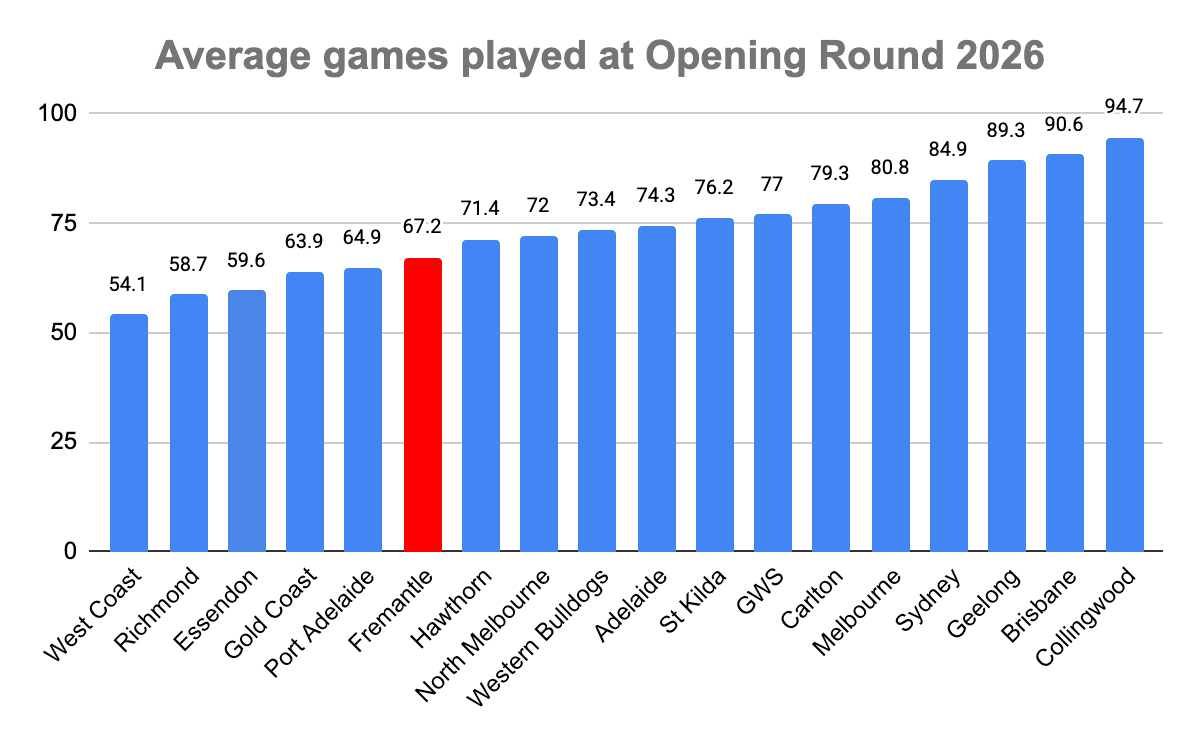
Average age at Opening Round: 24.5 (11th)
Average number of games played: 67.2 (13th)
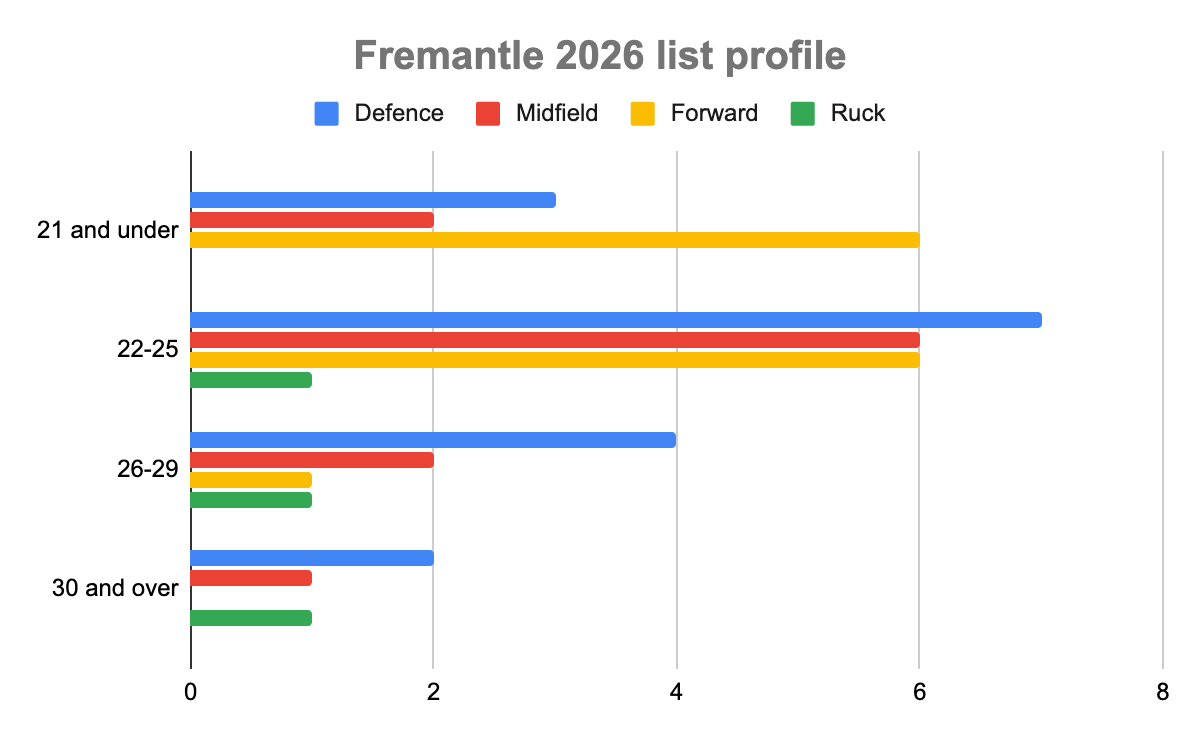
Freo’s list changes will make them better in the long run. But I think there’s some doubt whether – absent the internal improvement you’d expect from a young list – it makes them better in 2026. While it’s true that Nat Fyfe and Michael Walters were both substantially diminished by age, they still provided calm heads and mature bodies, two commodities the Dockers don’t always have in abundance. Elsewhere, these are the classic moves you’d expect from a club that believes it has the list to compete: a best-23 player traded in, ruck depth, a couple of high-upside draft picks that don’t need to hit, and then speculative prospects taken at virtually no cost. The Dockers have had good success with players who came to them via alternative pathways. None of Josh Treacy, Patrick Voss, Josh Draper, and Isaiah Dudley were selected in the National Draft (while other best-23 players like Sam Switkowski and Luke Ryan were taken with late picks). Even Judd McVee, the ex-Dee who wanted to come home, was originally taken in the Rookie Draft. If you believe you’ve cracked the code of obtaining value from late picks, keep doing it.
The Dockers’ backline is very good, but its flaws are a microcosm of some of the side’s broader issues. The triumvirate of captain Alex Pearce, Brennan Cox, and Luke Ryan (the latter is more of a medium-tall) provides good aerial protection – only four sides conceded fewer marks inside 50 than Freo – but their conservatism with ball in hand can cause the Dockers to get stuck when trying to exit defensive areas. The Dockers remain below league-average at moving the ball from D50 to F50. It falls to Karl Worner, Heath Chapman, Cooper Simpson (when fit), and – mostly – to the excellent Jordan Clark to generate rebound. New recruit Judd McVee is more of a shutdown back pocket than a true half-back, although he has shown a capacity to be an effective rebounder in the past (he averaged 3.6 rebound 50s in 2024). At this stage, it’s likely he’ll nudge Bailey Banfield, who’d been playing as the seventh defender, out of the senior side. Longmuir ought to consider the possibility of using McVee as a substitute for Luke Ryan so Freo can get smaller and swifter against sides that aren’t as tall up forward.
You could say similar things about Fremantle’s midfield – it’s very good, but last season, it wasn’t quite great. The biggest problem, as I explained in the Style of Play section above, is that it doesn’t punish the opposition enough. 14th in the AFL for expected scores from chains beginning from stoppage wins is a very poor return (and a reasonably consistent one, too: the Dockers were only league average in this measure in 2023 and 2024). The persistence of this issue makes it more likely that the problem is both system and personnel. Caleb Serong and Andrew Brayshaw are both fine midfielders, but neither present the kind of threat that makes the opposition pre-emptively take up more defensive positions. Hayden Young does. His speed, kicking, and directness offer a genuine point of difference. In such a tight league, his extended absence from the side could well have cost the Dockers a top-four spot last season. Justin Longmuir should study how other good sides (Collingwood and Adelaide come to mind) mould their possession chains to have their most damaging midfielders on the end of them, and apply those lessons to Young. Luke Jackson looms as an even bigger wildcard – and potentially the biggest midfielder in the game. That’s where he’s been spending time in pre-season, chopping out in the ruck, wrenching it out of dispute, and creating a match-up nightmare as he floats around the ground. He could unlock everything. An injury to Sean Darcy – it would not be the first – would force a reshuffle.
It feels like every one of my Fremantle season previews includes a discussion of a key forward that’s emerged and, in the process, transformed the potential of the forward line. This year, it’s Pat Voss’s turn. He’s different to Jye Amiss and Josh Treacy; less polished, perhaps, but more aggressive than both, and better at turning 40/60 contests into advantage. It’s a great three-tall setup that presents opposition backlines with a diverse range of problems. Isaiah Dudley aside (who impressed in cameos across 2025 but lacked AFL-level conditioning), Freo don’t really play with a classic goalsneak type of small forward. Instead, Freo’s small and medium forwards recreate those traits in the aggregate: Sam Switkowski provides the defensive hustle, Frederick the running power, Reid the connection, and Shai Bolton the freakish skill and athleticism. Somewhat surprisingly, given the talent of Freo’s forward line, they don’t excel at pressuring opposition defences: they were 12th for inside-50 tackles in 2024 and 13th last season. The best sides find escape routes against them.
Line rankings
Defence: Above Average
Midfield: Elite
Forward: Above Average
Ruck: Elite
The case for optimism
The optimistic case for Freo is pretty simple: they’re already hard to beat, their road to excellence is short, and the most unusual player on their list hasn’t hit his peak yet.
Let’s begin with the obvious: the list is good. Not “intriguing”. Not “on the right path.” Seriously good. Fremantle’s core is in the right age bracket, the right contract window, and the right phase of its development. Serong, Young, and Brayshaw are in their primes. The tall forwards are ascending. The key defenders aren’t about to age out. There are very few structural holes and even fewer list passengers. This is not a team waiting for a draft haul to save them. They are smack bang in the window.
And then you can add Luke Jackson into the mix. He isn’t called The Unicorn for nothing. He runs like a midfielder, competes aerially like a key forward, and can win centre clearances. Many of the very best teams in footy history had a player who, rather than being a superior example of an existing form, represented a new category of player – think Buddy, Dusty, Aker. I’m not saying Jackson is their equal. I’m saying that teams who can build around players who break the mould tend to age well because they force other sides to adapt. If he consolidates his best patches into something closer to weekly dominance, Fremantle’s ceiling shifts.
Another reason for optimism is that Freo’s to-do list to vault into genuine flag contention is much shorter than most other sides’. The defensive structure is solid, and the offensive leap required isn’t enormous. The Dockers don’t need to become 2007 Geelong. They need marginal gains: cleaner connection from stoppage, a bit more bravery, another half-step of speed and power around the ball (their focus on the latter throughout pre-season suggests they’re thinking the same way internally). The solutions to those problems might already exist on the list. When you’re already near the mark, small improvements can easily turn a top-six finish into a double chance. I know the last mile is the longest, and I know that part of what’s been animating the complaints of Freo fans is precisely the fact that they’re not far away – but they’re closer than most.
Finally, there is continuity. Persevering with the wrong setup is bad. But persevering with a coach and a system that you credibly believe could be the one yields real benefits. Systems get entrenched, automatisms get dialled-in, and chemistry improves. The list profile suggests that even if 2026 is not the year, the window will remain open. That is not something Fremantle have often been able to say.
The case for pessimism
If I were to conduct a poll, I’m confident the main cause of pessimism for Fremantle fans heading into 2026 would be Justin Longmuir. Longmuir’s teams have always had a high floor. They defend with structure, protect territory, and rarely get blown off the park. Under him, Freo are hard to score against and difficult to play through. But the same conservatism that helps Fremantle stay competitive can also limit their potential. They suffocate sides rather than overwhelm them. Narrow wins over inferior teams are banked without turning into percentage spikes or statement performances. The suspicion lingers: in a meta increasingly defined by scoring power, does Longmuir operate on the right part of the risk-reward spectrum?
That question becomes most prominent in the midfield. Andrew Brayshaw and Caleb Serong are elite competitors and accumulators. They win the ball and they run. But against the very best sides, games often turn on moments – who can create a half-metre from stoppage, who can break shape before defensive grids reset. Do Freo have enough burst and outside damage to complement the inside excellence? Is there another gear, or simply a higher volume of the same one? Many, myself included, thought the addition of Shai Bolton might solve that problem. It still could – he’s only been there one year. But it hasn’t yet.
This is where Hayden Young really matters. Last season was frustrating, perhaps more so because he had played essentially full seasons from 2022 to 2024. He isn’t inherently injury-prone. What he is, though, is essential to the type of footy Freo needs to play more often. Young is the midfielder who can kick 55 metres flat through the corridor, who can alter angles and punish sagging defences. Without him, the midfield looks more predictable, more plodding.
And then there is memory. Fremantle’s current list promises much. But recent history has been punctuated by almosts. Institutional memory does not show up in clearance differentials, but it shapes supporter expectations. Perhaps, on some level, it filters down. When stakes rise, so will the question: can this list – can this coach – get it done?
None of this is fatal. The foundations for sustained success are there. But so is the bearish case: a coach whose instincts may constrict his side, a midfield that needs a knife instead of more spoons, and a club that hasn’t yet proven that this time is different.
Enjoying this preview and think a Dockers-supporting friend might too? Share it with them!
Breakout player
You can’t break out more than winning the Rising Star award, so I’m afraid Murphy Reid is disqualified. He’ll survive. Next to him, there aren’t many obvious qualifying candidates. The Dockers are young in a slightly strange way: Reid aside, all their good players are between 23 and 30. I really like Isaiah Dudley. He’s very young in terms of miles on the clock, and the things that held him back from making more than a sporadic impact in 2025 feel eminently fixable. If he can improve his fitness, he has all the traits to be a very good AFL small forward. The pressure will be on: four of Freo’s new draftees play similar roles. (NB: the two Freo fans I asked to review this piece nominated Cooper Simpson and and Heath Chapman as smokey candidates.)
Most important player
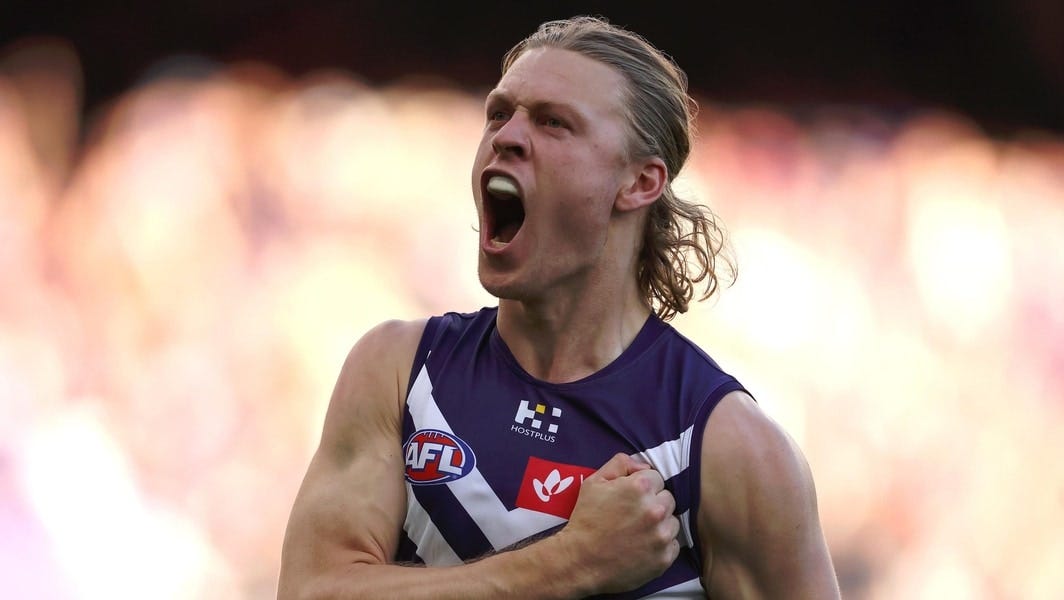
Hayden Young gives Fremantle something they otherwise don’t have enough of: speed, directness, and danger. He is the subject of the two most important personnel-related questions for the Dockers in 2026: how to keep him fit, and how to tweak their system to optimise for his strengths. There’s potentially a Premiership riding on the quality of the answers. Apologies to Luke Jackson, who is a fine alternative answer.
Biggest question to answer
Tactics are Fremantle’s biggest impediment to success, not talent. The defining question for them this year will be whether they can correct the lingering imbalance between risk and safety that’s held them back. Can they accelerate from stoppage, use the corridor more willingly, and commit numbers forward without sacrificing structure? If they can integrate territorial intent while adding dare, and yes, risk, then their ceiling rises sharply – all the way to genuine flag contenders. If not, the danger is they remain a highly competent side that struggles to create enough damage.
What success looks like
I’ve noticed that, over the last couple of years, there are some Freo fans – they are in no way unique in this respect! – who hide behind the youth of their list because it provides a convenient excuse for failure. The fact that the Dockers appear well-placed to contend for the next few years does not lower the stakes this year. They want for nothing, talent-wise. Not making the top four is probably excusable. It’s a tight competition. Not making the eight should probably spell the end of Longmuir’s tenure. Not winning a final should prompt serious discussions among the club hierarchy. The Dockers can’t just keep preparing for a future that’s no guarantee to ever arrive.
In a nutshell
The Dockers have elite talent and depth. What they have lacked thus far under Justin Longmuir is verticality, speed, and tolerance for risk. Minimising risk is itself risky. He must create more room for uncertainty, and find more trust in his team. 2026 looms large.