


Searching for the electrical substation near Windy Hill.
2025 ladder position: 15th (6 wins, 17 losses)
2025 best-and-fairest: Zach Merrett
Senior coach: Brad Scott
Story of the season
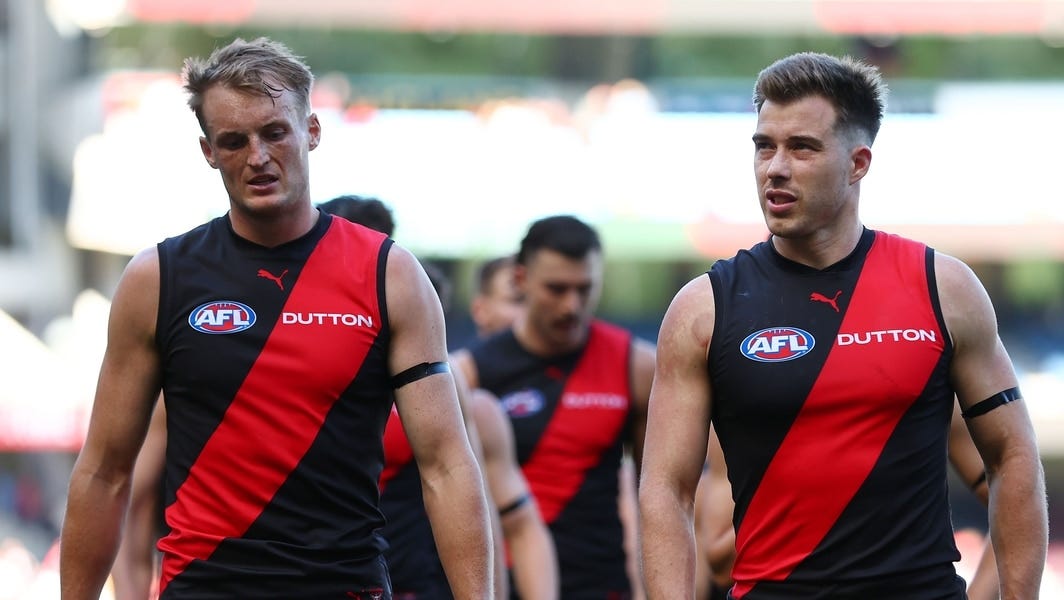
Like Game of Thrones before it jumped the shark, Essendon’s 2025 season was chaotic, violent, and increasingly implausible. Matches tipped to be close became routs. Key players disappeared without warning. By the end, the narrative had collapsed into recrimination and fatigue. At root, the season was shaped by two forces. The first was an unprecedented injury crisis. Fifteen Bombers made their debuts – an AFL record. It was good for social media but disastrous for continuity. Four players suffered ACL injuries, including Tom Edwards and Lewis Hayes (the latter on debut), while Sam Draper, Ben McKay, and Jordan Ridley missed long stretches with other ailments. Attempts to build coherence were repeatedly derailed.
The scale of the collapse made it easy to forget context. After an eight-point win over Sydney at Marvel in Round 9, Essendon sat only percentage outside the top eight. Two weeks later, they last sang the song. From there, a depleted, makeshift side – closer to VFL standard – lost its final 13 games. Supporters were broadly sympathetic to the on-field circumstances. They were less forgiving when captain Zach Merrett attempted to engineer a move to Hawthorn during the trade period. A contracted captain seeking to join a historic rival, especially one whose fans have relished pointing out the two club’s different trajectories in the 21st century, was an unwanted public signal of dissatisfaction after months of adversity. The club refused to engage, floating a price of four first-round picks and effectively closing discussions. The move stalled, and Merrett returned, displaying enough self-awareness to give up the captaincy but not enough to admit that his behaviour may have strained relationships with his teammates. In a competition increasingly governed by technocratic asset management, Essendon’s decision to retain an unsettled star was a reminder that emotion and identity still occasionally override pure calculation.
Summary of game style
As with most of this preview, this section needs to be accompanied by a big asterisk. The club’s injury list deprived Brad Scott of the opportunity to properly evolve his side’s game style in 2025, instead enforcing survival as the only viable mode from midway through the season. Before that happened, small amounts of progress were visible – but there was still a very long way to go.
Across the season, Essendon were first in disposals per chain and handballs per game, second for disposal retention, and last for contested possession percentage and metres gained per disposal. Put simply: they controlled volume, but not value. Too many disposals happened in low-value zones; too many chains stalled before territory was gained. The Bombers ranked near the bottom of the AFL for chain-to-score, scores from the back half, and D50–F50 transition. When they did lose it, it was often close to congestion – or their own goal – with the team spread for support rather than turnover protection. Their almost total inability to prevent opposition marks (18th in the AFL) and their league-worst turnover differential pointed to the same fragility.
Early in 2025, before injuries really began taking their toll, the Bombers showed a desire to exit stoppages more aggressively and generate overlap run to speed the game up and avoid opposition pressing traps. In essence: to go from merely retaining possession (without assuming control) to gaining impactful territory. But as senior players were lost to injury, muscle memory kicked in. Ambition defaulted to safety.
Based on reporting from Essendon supporters who know their side far better than I do, pre-season has focused on making the game style more resilient under pressure: quicker decisions and quicker disposals. It’s the right way to go. The Bombers don’t need to abandon their possession base; despite the growing importance of turnover scoring, plenty of sides can still succeed with control-oriented models. But they do need to strip it back. Fewer low-value touches. Earlier verticality. Greater trust in outside targets. If they can keep the retention but add intent (and continuity) the system could begin to look less like risk minimisation that doesn’t actually create safety, and more like managed aggression. I’m not sure the best defence is always a good offence. But making your opposition genuinely uncomfortable still feels like the right place to start.
List changes
In:
Sullivan Robey (2025 National Draft, Pick #9)
Jacob Farrow (2025 National Draft, Pick #10)
Dyson Sharp (2025 National Draft, Pick #13)
Max Kondogiannis (2025 National Draft, Pick #36)
Hussein El Achkar (2025 National Draft, Pick #53 – Next Generation Academy)
Cillian Bourke (Category B Rookie)
Brayden Fiorini (trade – Gold Coast)
Out:
Sam Draper (free agent – Brisbane)
Alwyn Davey Jr. (delisted)
Todd Goldstein (delisted)
Ben Hobbs (delisted)
Jayden Laverde (delisted)
Luamon Lual (delisted)
Jye Menzie (delisted)
Dylan Shiel (delisted)
Oskar Smartt (delisted)
List profile
Number of top-10 draft picks: 10 (2nd)
Average age at Opening Round: 23.9 (17th)
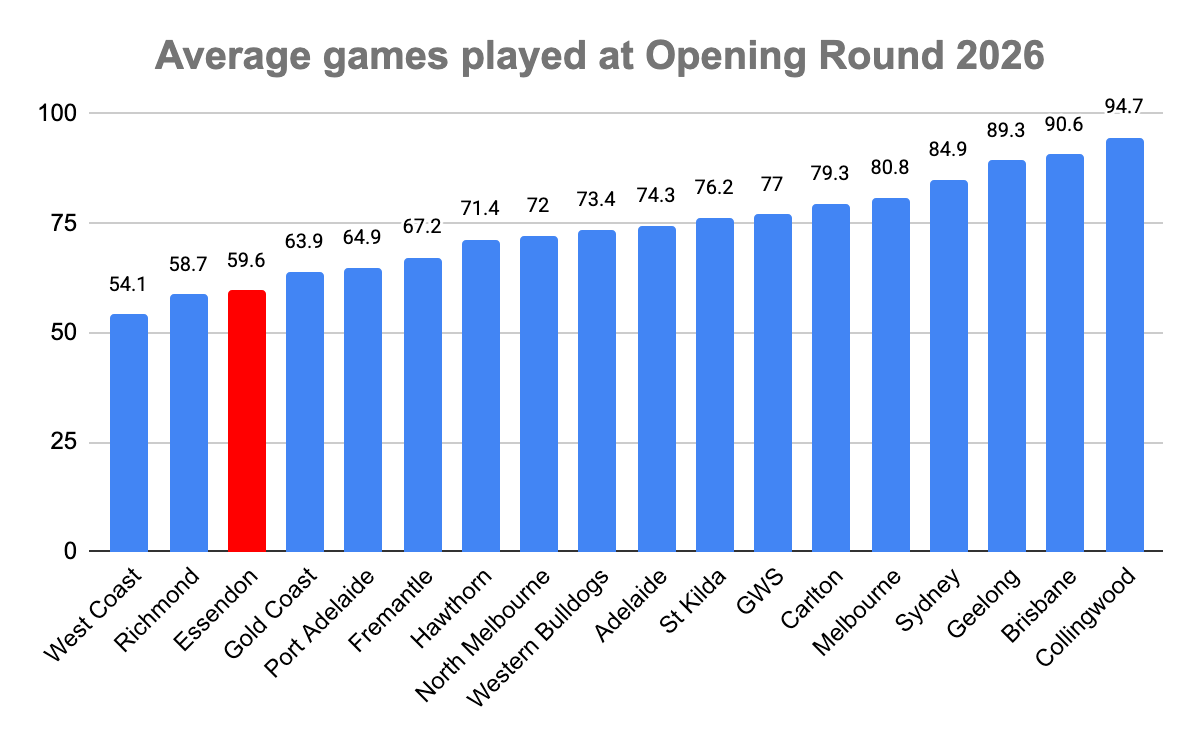
Average number of games played: 59.6 (16th)
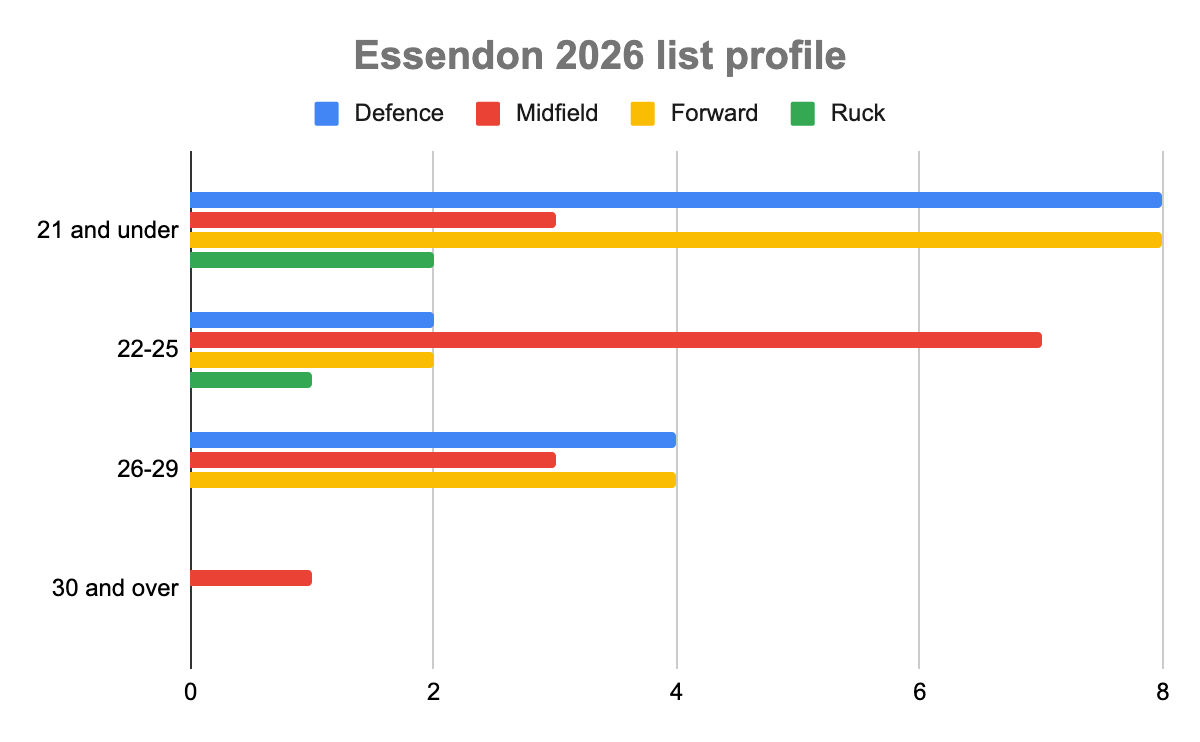
In 2025, Essendon’s list was the fourth-youngest and eighth-least experienced. It is now the second-youngest and third-least experienced. Roughly 10 games per player of experience have been shed. That fact becomes slightly less dramatic when you consider how many of those games belonged to Todd Goldstein, but the point stands: regardless of the language used internally, this is now the demographic profile of a club undertaking a full rebuild. That’s good. Essendon owed its supporters the honesty to admit that the list build which began with three top-10 picks in the 2020 draft wasn’t going to deliver. Circling the lower-middle of the ladder is the worst place in footy: not good enough to contend, not bad enough to reset properly.
If I ever get to present my case to the AFL for deregulating list size requirements and salary cap floors (we all need goals!), Essendon 2025-26 will be Exhibit A. The Bombers took four players in last year’s Mid-Season Draft because they could and because they had to. All showed something, but not all could remain. Clubs in Essendon’s position need talent; they should face fewer restrictions on acquiring and developing it.
That’s not to say the Bombers only shopped in the budget aisle. Compensation for Sam Draper’s move to Brisbane, plus clever manoeuvring to push their 2024 first-rounder into 2025 and protect their NGA position, delivered three first-round picks which were used on three distinct archetypes. Sullivan Robey, the big bolter of last year’s crop, spent time at full-forward and in the midfield in his underage year, doing damage in both roles. Jacob Farrow, a tall, elegant left-footer, profiles as a half-back with midfield upside. Dyson Sharp, long touted as a Pick 1 contender, slid amid concerns about his ceiling and polish; Essendon judged the risk worth taking. He will likely play senior football this year. Max Kondogiannis adds depth and run, and Hussein El Achkar is an opportunistic goalsneak. I thought rangy winger Luamon Lual was a touch unlucky to get delisted.
Essendon’s backline has talent. The main issues have been awkwardness of fit and lack of continuity. Jordan Ridley and Zach Reid are both good players, but injury has deprived them of years’ worth of development. If they can get their bodies right – admittedly, a big if – and Jacob Farrow is selected for seniors early into the season, Essendon will have three tall defenders with high-grade kicking skills. Elsewhere, Ben McKay can be shaky with ball in hand but is usually dependable enough at the actual defending. Mason Redman and new captain Andrew McGrath provide drive, and Kayle Gerreyn (and Saad El-Hawli, although he’s already had some experience back there) are being trialled in defensive roles. The raw materials of a solid defensive unit are beginning to emerge.
As is typical early in a rebuild, Essendon have plenty of midfield options. The task is balancing continuity with discovery: identifying which players genuinely belong in the next competitive side. Zach Merrett and Jye Caldwell are cornerstones. Sam Durham likely is too, but might spend some time up forward. Darcy Parish and Will Setterfield offer short-term stability more than long-term answers. Elijah Tsatas is in the last-chance saloon. Archie Roberts has impressed with midfield minutes across pre-season, and Sharp, Robey, Farrow and McGrath may rotate through (the latter played as a full-time midfielder in the last six games of 2025). Lachie Blakiston is expected to open as the number one ruck ahead of Nick Bryan, with Jaxon Prior, Angus Clarke, Harrison Jones and Brayden Fiorini on the wings.
The forward line carries similar uncertainty. Peter Wright looms large, but offers limited value if not hit on the lead. He does, however, draw the opposition’s best defender away from Nate Caddy, the obvious star in waiting whose chemistry with good friend and second-year small Isaac Kako will be central to Essendon’s future success. The selections of Archie May and Liam McMahon in last year’s Mid-Season Draft was a need, but between them, Wright, Caddy, Kyle Langford, Tom Edwards, and maybe even Xavier Duursma (who’s being trialled as a mobile marking forward throughout pre-season) the Bombers suddenly have a glut of different types of tall forwards. Which combination emerges as Brad Scott’s favourite will be one of the many storylines worth following this season. It’s probably the last opportunity for Archie Perkins, Jade Gresham, and Matt Guelfi to convince Brad Scott they have a future at Windy Hill.
Line rankings
Defence: Average
Midfield: Average
Forwards: Average
Ruck: Average
The case for optimism
There are plants that can only germinate after fire. Green shoots burst forth from blackened stems. In other words, destruction can be the catalyst for growth. I wouldn’t really wish Essendon’s 2025 – at least its second half, when their injury list became truly ludicrous – on my worst enemy. It must have been painful. But, by pushing the club further down the ladder (and closer to a better draft pick) and forcing it to cycle through virtually its entire list, it clarified things. No more circling around the Irrelevance Vortex (positions 8-13 on the ladder). It’s rebuild time. Sure, it’ll suck. Sure, it’s unfair that other clubs get to rebuild after actually tasting success. It doesn’t matter. It’s Essendon’s only choice. To be perfectly fair, Matt Rosa (Essendon’s General Manager of List and Recruiting since late 2024) already knew this. But 2025 was a devastating riposte to anyone inside the club who still believed that success was possible with some good fortune. The way forward is clear now – because there is no other way.
What this means is that Bombers fans will get to experience one of footy’s gifts: seeing draftees play real minutes and grasp their opportunities. One of my biggest gripes with the construction of Essendon’s list in the Late Dodoro Period was that it overindexed on two archetypes: skinny hybrids (Harrison Jones, Nik Cox) and smallish, one-paced midfielders (Ben Hobbs, Kobe Mutch, Dylan Clarke). Rosa and co. are moving past that: Essendon’s recent draftees possess physical tools that their predecessors didn’t. They need more guys like that – runners, jumpers, athletes; that’s the way footy is trending. Drafts aren’t won until years after they happen. But Caddy, Kako, Robey, Sharp, and Farrow look like Essendon’s best core of young talent for years – and one day, not too far in the future, could elevate the Bombers into the ranks of the relevant. When Sharp wins a centre clearance and kicks it forward to Caddy, or when Farrow hits a teammate with an arrowing kick coming out of defensive 50, or when Robey wins a contest in the forward pocket, remember those moments. They will be the seeds that could blossom into something real one day.
The case for pessimism
2026 probably won’t be as bad as 2025, and the win-loss record won’t be the most important measure of progress – but it will still be bad enough to test the mettle of most Essendon supporters. Here’s an insight that will make all new subscribers wonder why they didn’t do so sooner: losing sucks. And, despite what folks say about every loss being a learning opportunity, they can imprint bad physical and psychological habits. When young teams lose for years, they often learn to play safe, to shirk accountability, and to abandon structure late in lost games. Unlearning those habits is hard, and made even harder when a club has lost corporate knowledge of being a winner. This isn’t an abstraction for Essendon fans – they’ve seen it happen! It could happen again. (Related: this is part of why I think Zach Merrett’s public attempt to force his way out during the off-season was so damaging. If the captain is telling you that exit is a better choice than voice, what message does that send to young players?)
An accumulation of bad habits is one of the many ways a rebuild – which, let’s be clear, is what Essendon have embarked on – can fail. It’s not the only one. Coach-list fit is also a failure point. I think it’s important to ask how well Brad Scott’s established strengths as a coach – defensive organisation, in-game tactics, and maximising returns from a mature list – map onto Essendon’s current needs, which mostly involve developing their young core. We don’t know for certain Scott can’t do that. I just don’t think we know. The next, most common cause of a rebuild failing, is poor drafting. We don’t actually know if Essendon has an elite cohort of young players. The 2023 and 2024 draftees look encouraging so far (Caddy and Archie Roberts in particular), and the 2025 crop looks great on paper. But the error bars are huge.
The final cause for pessimism is that for all the good remedial work that Matt Rosa has done on the list since assuming the reins, there is still a lot to do. Essendon’s age curve is awkward. Merrett is 30. Will he still be good (or at the club) when the Bombers are next good? Underneath him, Redman and McGrath are still adding value in their late twenties. But it’s the middle of the age distribution – normally where most of the value is contributed – where past draft failures sting. Out of Sam Durham, Nic Martin, and Jye Caldwell, only the latter was recruited via the National Draft. There is a significant dearth of talent from them down to the 2023 cohort. The best player on the Bombers’ list younger than Sam Durham but older than Nate Caddy is Zach Reid: a good defender, but one who, due to injuries, simply hasn’t played enough senior football. This missing middle creates a danger zone where veterans decline before the replacements arrive, and young players are asked to carry too much, too soon – paradoxically, usually a bearish sign for the prospects of a rebuild. Drafting high doesn’t guarantee success. Rebuilds are gruelling. And not all of them work.
Enjoying this preview and think a Bombers-supporting friend might too? Share it with them!
Breakout player
What is a breakout? Has Nate Caddy had his? Has Archie Roberts? Both are good candidates regardless of how strictly the definition is policed. But my eyes are elsewhere: Isaac Kako had a very solid debut season, playing every game (quite a feat given Essendon’s wretched run with injuries) and surprising many with his defensive intent in a largely thankless role. The next step for him, and it’s one I have little doubt he will make, is adding more attacking threat while maintaining the defensive effort. If 15 goals can turn into 20, or even 25, this season (a small caveat: he’s currently nursing a hamstring strain), it’ll be a breakout – by any definition.
Most important player
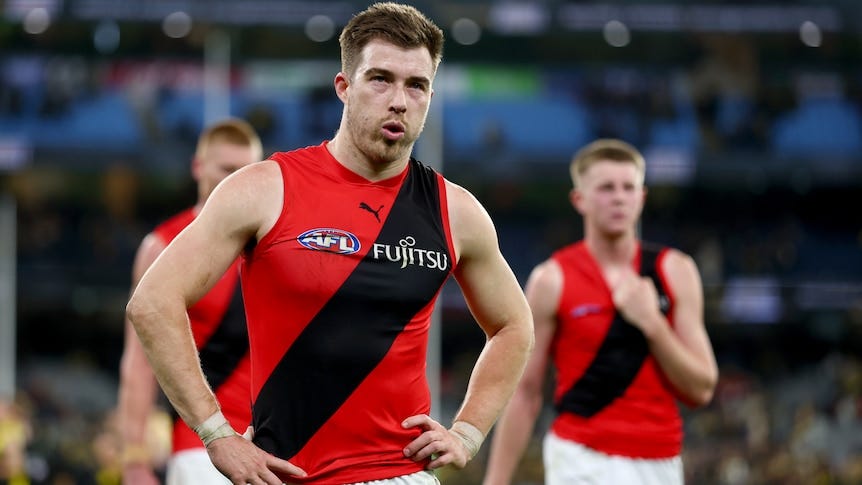
For better and worse, it’s Zach Merrett. Footy tragics, especially in conversation with other tragics, tend to create elaborate theories for why their team is bad. 99 times out of 100, the problem is extremely obvious: there isn’t enough talent. Merrett is, depending on where puts the bar, Essendon’s only star. Which is why his attempt to force a move to one of their bitterest rivals was so galling.
Biggest question to answer
What should Essendon do if Merrett revisits the idea of leaving? He remains the club’s best player by a distance. But he’s 30. That creates both value and timing pressure. There is a non-trivial chance that their next competitive window opens after his peak years. In that scenario, retaining him at all costs may not align with the club’s broader timeline. The rational approach would be to treat the situation as an asset-management decision rather than a loyalty test. If Merrett is committed – really committed – he can set standards for a young midfield. If he signals a desire to move, the club’s obligation should be to maximise their return, ideally in the form of high-end 2026 draft picks, to accelerate the rebuild.
What success looks like
Wins early in a rebuild can be false friends. Instead of signalling that the kids are ahead of schedule, they often indicate that the reset hasn’t gone far enough. They matter to fans, for whom matchday structures their emotional relationship with the club. They matter far less to the people charged with delivering success.
Which is to say that the win-loss record should not sit at the centre of any serious evaluation of Essendon’s 2026 season. What matters more is whether, by August, the club has real clarity. Whether it knows which young players can be trusted with responsibility, which ones belong in the long-term core, and which ones are depth. Whether the game style can hold under pressure for four quarters, not just in favourable patches. Whether effort, decision-making, and defensive connection hold up when the scoreboard turns bleak.
Developing a system that can survive a full season, accumulating reliable information about the list, and showing “more than isolated signs of progress”, as one Bombers-supporting friend put it, are better indicators of success than an extra two or three wins. That will all require continuity that the Bombers simply didn’t have last season, and in truth, have rarely had stretching back to the revelation of the supplements saga. If Essendon finish 2026 with fewer illusions and firmer answers, they will have achieved something that’s ultimately far more valuable than a flattering ladder position.
In a nutshell
As hard as it can be to accept, the only response to a failed build is to build again. That is where Essendon have found themselves. The best case win-loss scenario is scraping a play-in spot (would winning that count as winning a final?). The best long-term scenario would be realising they’ve hit paydirt in the last two drafts and continuing to shed the older players who aren’t part of the future. Pain is necessary. But, as Bombers fans know all too well, it doesn’t guarantee success.
Agree? Disagree? Either way, share your (polite) thoughts in the comments.