


Going down to IKON Park to leave my woes behind.
2025 ladder position: 11th (9 wins, 14 losses)
2025 best-and-fairest: George Hewett
Senior coach: Michael Voss
Story of the season
Footy delivers disappointment in as many shades as there are grains of sand. Wooden spoons. Grand final defeats. AFL House doing dumb stuff. But nothing hurts more than learning, over the course of a gruelling and dispiriting season, that the list you’d invested so much hope into just isn’t it. That it won’t be the one to break the drought. That Patrick Cripps won’t win a flag – at least not in navy blue. That’s what the Carlton Football Club and its massive following learnt last year.
It didn’t take long for reality to render its verdict, either. Carlton gave up a 41-point lead to a callow Richmond side that many people thought might not win a game all season to lose their first game of the year. Seth Campbell did a backflip. By the time the Blues lost to Collingwood three weeks later to slip to 0-4, the season was basically done. There were recriminations. Anti-Voss graffiti. A loss to North Melbourne. Charlie Curnow giving an unconvincing interview to club media about his desire to remain a Carlton player. It’s tough to pick a definitive lowlight. A bedraggled Carlton limped to the finish line, losing seven of its final 10 games. Failure brings change, and change is what happened: Graham Wright assumed the reins as CEO and quickly got to work, turning over key coaching and football operations roles and signalling that no stone would be left unturned in the search for success. A busy trade period saw Curnow, Tom De Koning, and (somewhat poignantly) Jack Silvagni depart and Will Hayward, Ollie Florent, Campbell Chesser, and Ben Ainsworth arrive. Father-son key defender Harry Dean became the club’s second consecutive #3 draft pick. Is it a rebuild? Perhaps not yet. But it’s recognition that Carlton couldn’t keep doing the same thing over and over and expecting the result to change.
Summary of game style
Michael Voss entered 2025 knowing that Carlton’s bash-and-crash brand was nearing its limits. Opponents were better prepared. The returns were diminishing. Too many of his own players were breaking down physically under the strain of making the style stick. His response was to fast-track evolution. In some respects, it worked. The Blues became far better at moving the ball from defence to attack. Their success rate of going from D50 to F50 went from 13th in 2024 to 4th in 2025 (better than Greater Western Sydney, Hawthorn, and Collingwood). Their metres gained per kick moderated while their metres gained by hand numbers increased. More layers, more consideration, less panic. That was the idea.
But the improvement stopped at the edge of the forward line. Despite generating a healthy inside-50 differential (the product of a midfield that is still very good at winning clearances), Carlton finished 17th for shots per inside 50 and 16th for scores per entry. Their expected score per shot barely changed. When they found opportunities, they converted them at roughly the same rate. They simply created fewer of them.
The problem was delivery and structure. Carlton remained among the league leaders for offensive one-on-ones and forward-half contests. In theory, that implied a level of threat. In reality, it often meant the opposite. High volumes of forward contests were less a sign of dominance than of failure to create separation. The ball was arriving in areas where defenders already were. Too many entries were shallow, high, and predictable. The ball arrived without the defence ever being properly displaced – territory, yes, but without advantage. Some of this was the product of fatigue. A physically demanding style encouraged early release. Some of it reflected personnel. The Blues lacked a reliable forward-of-centre connector; someone who could receive between the arcs, draw defenders, and kick to advantage. Too many attacks were launched from behind the centre circle instead of 70 metres out.
And some of the failure was down to habit and system. With Charlie Curnow in the side, “kick it to Charlie” became a crutch. Low-percentage entries became acceptable because they worked often enough. Early kicks became routine. Curnow did not simply mask structural weaknesses. His talent enabled them. And a slew of not-quite-good-enough small forwards couldn’t make it work for long enough.
Last year, Carlton tried to modernise their ball movement while still carrying those habits inside 50. They became better – significantly so – at getting the ball forward, but drastically worse at turning that territory into shots. Curnow’s departure lowers the ceiling but should also remove the temptation. With only Harry McKay as a dominant aerial target, the arithmetic should change as bombing it long becomes (even) harder to justify. The arrival of Will Hayward should help. He creates movement, stretches defences, and opens lanes rather than simply competing in them. The 2025 numbers show that Voss understood the need to change but either wasn’t able to devise a better system or couldn’t embed new habits. With the old pillars gone, the flaws in the final phase can no longer be concealed by talent alone. The question is: what happens now?
List changes
In:
Harry Dean (2025 National Draft, Pick #3 – father/son)
Talor Byrne (2025 National Draft, Pick #45)
Jack Ison (2025 National Draft, Pick #47 – NGA)
Oliver Florent (trade – Sydney)
Will Hayward (trade – Sydney)
Campbell Chesser (trade – West Coast)
Ben Ainsworth (trade – Gold Coast)
Liam Reidy (trade – Fremantle)
Out:
Jaxon Binns (delisted)
Alex Cincotta (delisted)
Orazio Fantasia (delisted)
Elijah Hollands (delisted – but favourite to get an SSP spot)
Harry Lemmey (delisted)
Will White (delisted)
Sam Docherty (retired)
Tom De Koning (free agent – St Kilda)
Jack Silvagni (free agent – St Kilda)
Charlie Curnow (trade – Sydney)
Corey Durdin (trade – Port Adelaide)
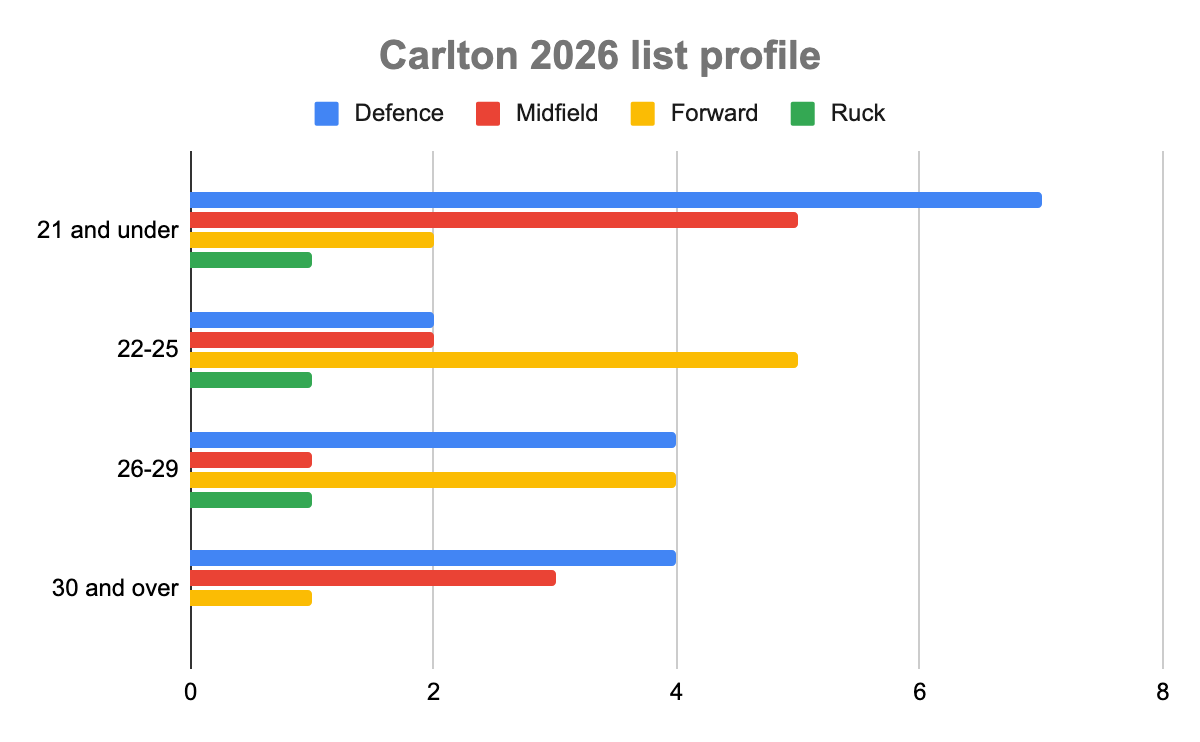
List profile
Number of top-10 draft picks: eight (T-6th)
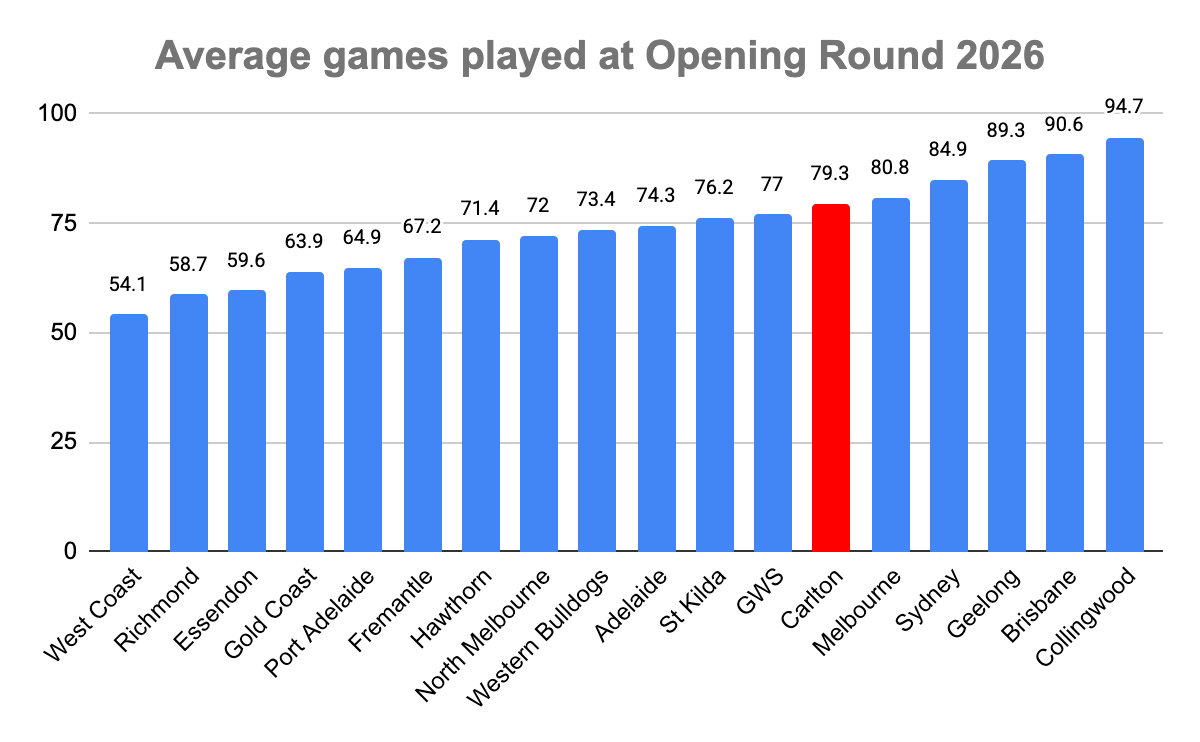
Average age at Opening Round: 25.1 (6th)
Average number of games played: 79.3 (6th)
Eight new arrivals and 11 departures – call it rebuild or call it refresh, but either way, this is a list in transition from something old to something new. Carlton lost three players; club officials would all have publicly professed a desire to keep them. Tom De Koning took the money (no shade here, I would have too!) St Kilda threw at him. Jack Silvagni did the same. There are too many layers of Silvagni family intrigue and bitterness and revenge here for me to parse, so I won’t even try. They’re both good players, even if De Koning hasn’t reliably produced what his talent promises. But Curnow is the biggest loss, both because his name adorned more kids’ jumpers, but also because (as I wrote in the style section above) his presence shaped how Carlton played.
The new arrivals are floor raisers, not ceiling lifters. Ollie Florent is steak knives, but Will Hayward is a good addition a year after Carlton made a big play for him when he was coming out of contract. Ben Ainsworth and Campbell Chesser both make sense as cheap rolls of the dice. Ainsworth will offer repeat contests inside 50, and while Chesser hasn’t yet lived up to his draft pick, his athletic profile was understandably intriguing to a team that often looks slow. Carlton’s draft was shaped by father-son prospect Harry Dean becoming the most bankable key position prospect in the pool. It left scarce capital for the rest of the draft, but clever small forward Talor Byrne and skilful NGA midfielder Jack Ison capped off a satisfactory two nights’ work. Don’t be surprised if Dean and Byrne get games early. The Curnow trade netted Carlton picks, which they can use to replenish their list in 2026 and 2027.
The Blues’ defence is uneven. It’s certainly not without its strengths. If I’m being critical, I’d love Jacob Weitering to show more endeavour with the ball and in his intercept work, but he’s still a high-class, set-and-forget key defender. Harry O’Farrell looked really promising in 2025 despite his callow frame; it’s a real pity he’ll miss the best part of the season while recovering from a torn ACL. Nick Haynes recovered well from a rough first few games in his first season as a Blue, but I’m not convinced either he or Mitch McGovern have the size or athleticism to play as the second key behind Weitering. The honest but limited Lewis Young will probably play more games than many Carlton fans would like. Nic Newman’s return from a knee injury will bolster Carlton’s small defender stocks and provide some much-needed composure. Next to him, Ollie Florent, Adam Saad, Matt Carroll, Billy Wilson and the seemingly forgotten Jordan Boyd will compete for the last couple of spots. There’s talent, but also a clear gap to the best half-back groups in the competition.
Carlton’s midfield remains the source of most of its power and much of its frailty. Cripps is still Cripps – heroic and tragic. George Hewett’s ball-winning and disciplined defensive running provide balance. The questions, when it comes to the established rotation, centre on Sam Walsh and Adam Cerra. Most observers thought Walsh would push on from being named best player in the 2023 finals series, but it hasn’t yet panned out that way. Could he still be carrying the ghost of the back injury that plagued his 2023 and 2024 seasons (but apparently not his 2023 finals)? His centre bounce attendances were noticeably reduced last year, often starting on a wing or at half-forward before pushing up to attend secondary stoppages. Cerra is a similar case: a player you suspect Carlton was banking on being great, but instead appears to have topped out at ‘good’. It leaves the Blues in something of a conundrum that might need the season to unfold before resolving: double down, or test the market and commit to a deeper rebuild? Carlton’s midfield rotations will be a strong signal of what Michael Voss wants to achieve in 2026. If Jagga Smith – whose “return” looms as one of the most intriguing storylines in the league – and Ben Camporeale see real minutes, it will suggest that the focus is on the future. Campbell Chesser, Ollie Hollands (who will probably return to the wing after a short experiment at half-back), Lucas Camporeale, and – sigh – Blake Acres will duke it out for the the wing spots.
The forward line will look very different without Charlie Curnow (insert joke about how he was physically but not mentally present for much of 2025). I’ve written about his influence above, so I won’t repeat myself here. The optimistic case is that it makes Carlton smarter and more patient with how they attack. For that to happen, however, the quality of delivery into the forward 50 will need to improve. Hayward and Ainsworth are solid additions who will help fill a gap of physically mature, medium-sized forwards. From there, things get speculative. Francis Evans’ hot streak to end the season was a rare (and lovely) bright spot in a tough season. Was it variance or the beginning of something real? Ashton Moir has talent in spades and has shown enough flashes – his challenge in 2026 is to add consistency of effort and output. A word for Jessie Motlop: it’s a shame that an ACL injury will deprive him of the chance to answer his critics.
Line rankings
Defence: Above Average
Midfield: Above Average
Forward: Average
Ruck: Average
The case for optimism
New CEO Graham Wright is a man in a hurry. He wasted little time ushering Head of Coaching Performance and Innovation Aaron Greaves, assistant coach Aaron Hamill, and Development and Talent Manager Tom Lonergan out the door after Carlton’s 2025 season ended. As I was writing this preview, it was announced that National Recruiting Manager Michael Agresta would also depart the club. And although recent history suggests we shouldn’t rush to congratulate the Blues on off-field appointments, it is a signal: Wright knows things have to change, and he has a fairly clear picture of what has to change. Openly stating that “we haven’t got enough good players” (he’s right!) is a bold stance for a club CEO to adopt. It suggests a desire to avoid drift and to act instead of react, which hasn’t always been true of Carlton’s decision-making.
The other cause for optimism for Carlton fans is that, assuming there’s widespread acceptance that the definition of success has materially changed from last season, they’ll have a chance to see a different-looking team play a (hopefully) revamped style of footy under expectations that aren’t quite so stifling. I am not a Carlton fan – but I’m excited to see Jagga Smith and Harry Dean. I’m intrigued to see if Will Hayward, Ben Ainsworth, and Ashton Moir can help Carlton’s forward line look more modern. To see if Harry McKay can (again; he already did in 2021) flourish without Charlie Curnow beside him. To see if Frankie Evans can pick up where he left off last season. Perhaps these sound like the expectations of a team that’s rebuilding, not contending. But I think that’s where Carlton is at. The answers to these questions aren’t trivial. They will help determine the club’s fortunes over the next half-decade. And the added cushion of the wildcard round means that the Blues might yet play a knockout game in 2026. Even if it’s not a Grand Final, a packed MCG in early spring with tens of thousands of your brothers and sisters in navy blue is an experience worth having.
Oh, and Cody Walker is coming next year. That’s pretty exciting.
The case for pessimism
I think it’s best to address this to two separate groups of Carlton fans: those who believe the current iteration of the list is still capable of contending, and those who believe that the best course of action is to commit to a thorough overhaul of the list, even if it takes longer.
To the first group: it’s not going to happen. Yes, Carlton were unlucky last season – only Melbourne underperformed more on the basis of expected wins across the season. But even if the Blues had won those extra two games, their ladder position wouldn’t have changed. The side’s injury problems were real but not season-defining as they were in 2024. The verdict was clear. The combination of list, style, and coaching was not competitive at the level expected by Blues fans.
The realisation that the fog of injuries wasn’t actually obscuring a Premiership-capable list is a painful one. A long emotional journey, and its many highs and lows – the Jamie Elliott dagger in 2022, the Blake Acres-induced delirium in 2023, the brief euphoria of that season’s prelim before the crash down to Earth – didn’t end at the desired destination. Some of Carlton’s players, one curly-haired key forward in particular, clearly knew it, too. Riding the boom and bust cycle is hard, especially when Carlton’s great historic rivals (except for Essendon) have all experienced periods of sustained success since the Blues were last a great power. So behind the excitement of the unknown – Jagga Smith, Harry Dean, a different forward line, Cody Walker – lurks an unwelcome, nagging set of questions: really? Again? Why should we trust that it’ll be any different this time?
Perhaps Graham Wright really is the new messiah. I’m sure he also understands that heaping unreasonable amounts of hope and expectation on the shoulders of individuals – Anthony Koutoufides, Denis Pagan, Chris Judd, Michael Voss, Patrick Cripps – is one of the main reasons Carlton has been unable to sustain success in this century. The solution isn’t a better messiah. It’s to actually take the steps required to be a modern, professional organisation. But that takes time and patience. And Carlton fans have already given their club an awful lot of both.
Enjoying this preview and think a Blues-supporting friend might too? Share it with them!
Breakout player
When I began writing these previews in 2024, I rather stupidly committed myself to only nominating players who’d already actually debuted as breakout candidates. I’m opting out of my self-imposed rule to nominate Jagga Smith. Track whispers are better understood as club propaganda rather than actual signals of player performance. But there really has been a lot of noise about Smith, both last pre-season before he cruelly ruptured his ACL, and on the recovery trail. His player archetype – slippery and skilful, sort of a Zak Butters/Sam Walsh hybrid – is precisely what’s missing from Carlton’s current list. Many people believed he was the best player in the 2024 draft pool. He will now get his chance to show if it’s true.
Most important player
When Carlton believed they were contending for flags, their most important player was Patrick Cripps: the Hercules whose effort and suffering embodied their journey. But Carlton isn’t in the messiah phase anymore. So the attention, and perhaps some of the centre bounce attendances, should shift elsewhere. Symbolically, for what he represents for the next decade, Jagga Smith might be one of Carlton’s most important players even though he hasn’t played a senior game yet. Hell, Cody Walker could be Carlton’s most important player. Sam Walsh is important for what he represents, too: the bridge between the present and the future, the kid superstar who hasn’t quite gone on with it. But Carlton’s most important player in 2026 will be Jacob Weitering. Just consider this: who the hell plays as the main key defender if he isn’t there? Blues fans are hoping that early reports that he didn't suffer any structural damage from the nasty collision in the State of Origin game are accurate.
Biggest question to answer
Have the people who make the big calls at Carlton – Robert Priestley, Graham Wright, Michael Voss, Nick Austin – fully twigged that the best way to move forward in the long run is to take a few steps backwards in the short run? Even if that means undertaking a process that a) isn’t guaranteed to succeed; and b) might cost some of them their jobs?
What success looks like
A Premiership is no longer the standard, because that’s currently – painfully, for everyone affiliated with Carlton – not an attainable goal. So instead, the focus should shift: instil the foundations of a more fluent style, create the conditions for a talented younger core to flourish, learn whether the prudent choice is to supplement the list or commit to a rebuild, decide if Michael Voss is the guy, and try to win a play-in and/or elimination final.
In a nutshell
Last season, the Blues learnt they were further away from success than they’d hoped. Their off-field moves and list turnover (even if not all of it was voluntary) suggest an understanding that it’s time to change and modernise. That’s probably good for the future – if not necessarily for 2026.
Agree? Disagree? Either way, share your (polite) thoughts in the comments.
Another great write up, Mateo (I know this is only the third preview for 2026, but have been enjoying these so far). Will be interesting to see how the refresh/reset goes for Voss and the players. Surely there won't be another 0-4 start?
The Weitering collision was brutal, if he doesn’t pull up well it will be an even longer year for the Blues.