


Steak too juicy, lobster too buttery, etc.
2025 ladder position: 3rd (16 wins, 6 losses, 1 draw – Premiers)
2025 best-and-fairest: Josh Dunkley
Senior coach: Chris Fagan
Story of the season
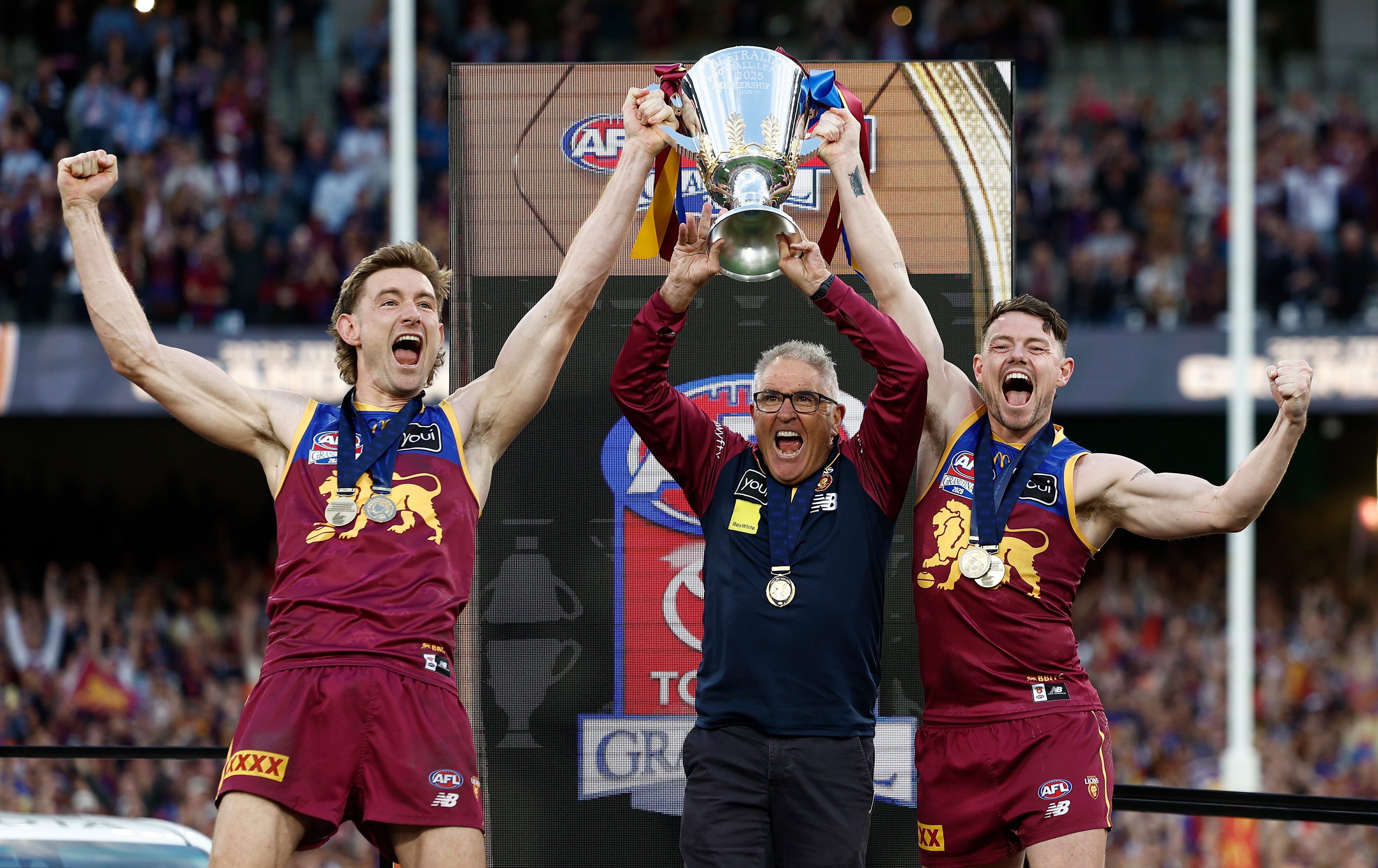
Different journey, same destination. The Lions won the flag on permadeath mode in 2024, dropping five of their first seven games and dancing on ice the rest of the way. Things were more sedate in 2025. Brisbane won its first five to cement its place in the top four and, despite the odd head-scratching Home & Away result, and rivals stacking wins, never really looked in danger of missing out. Finishing third meant a trip to the MCG to play Geelong in the Qualifying Final. That didn’t go well. But the rematch in the Grand Final went rather better. The Lions wiped their eyes, cracked their knuckles, and swiped their big paws, summoning a performance of rare power in the second half to win by eight goals (it could easily have been 10+). Not only are the Lions loaded with talent, they’re also good learners. They turned their three biggest losses of the season – 52 points to Collingwood, 66 points to Gold Coast, and 38 points to Geelong – into 29, 53, and 47-point wins during the finals series.
The Lions’ third consecutive Grand Final and second straight flag was accompanied by a league-wide recognition that not only are they not going anywhere, their embarrassment of Academy and Father-Son riches means we probably haven’t even seen their final form. In a league which (inconsistently) encourages parity, the Lions are breaking the mould.
Summary of game style
Understanding the back-to-back Premiership version of the Brisbane Lions requires understanding a simple premise: no team in the AFL is more committed to playing football on its own terms. The Lions circa 2024-2025 are built on possession and on denying their opponents the right to possess the ball in any coherent way.
That control began at stoppages. Across both premiership seasons, the Lions were elite in stoppage clearance differential, finishing second in 2024 and first in 2025. If good-quality territory was available, the Lions were happy to take it. But they were equally content to use stoppages as a way of winning first possession, exiting congestion, and establishing their rest offence – even if that meant exiting on the defensive side. Territory was negotiable. Clean possession was not.
Once the Lions get the ball, they don’t like giving it back. In both Premiership seasons, Brisbane finished miles clear of the rest of the league in marks differential. In 2025, they averaged +24.6 marks per game more than double the next-best side. In 2024, the gap was even bigger. The Lions create asymmetry. They are allowed to build uncontested chains. Their opponents are not. Instead, they’re progressively funnelled into uncomfortable positions where Lions players can create a contest, mop up a loose ball, and reset. Statistically, this preference shows up everywhere: league-leading control ratio, first for xRetain per kick, top-two for time in possession, first for marks, second for disposals.
The key to making this all work is Brisbane’s surgical kicking game. Rather than defaulting to full switches or boundary safety, they specialise in half-switches, delayed corridor entries, and narrow-angle entries designed to bend and distort defensive zones. That distortion is amplified by clever off-ball movement. Brisbane’s forwards – with Eric Hipwood being the clearest example (and the most maligned!) – use their brains and their legs to drag defenders away from high-value areas, open up leading lanes for each other, and block intercept paths.
The 2025 version of the Lions looked a little different than the 2024 model. They still moved the ball efficiently but did so from a more conservative base (merely 4th for chain to score, instead of 1st). Their speed of ball movement decreased. Turnover and stoppage scoring declined. Pressing intensity softened. It was partly regression, partly management. The Lions redirected some energy from constant pressure and toward structural security. They became less interested in overwhelming opponents and better at forcing mistakes from them.
The Lions create mistakes because the quality of their skills and decisions give their opponents bad options. Press too high and they’ll slip half-switches into the vacant space. Sag off and they’ll rack up uncontested marks until your structure stretches thin. Overcommit to stoppage and they will hurt you on the spread. Teams can disrupt the Lions’ first look. But they’re so good, and so difficult to contain, that they will usually force you to commit to sub-optimal choices. The Lions know they don’t need to win every phase to win a game. Instead, they win by controlling the basic stakes: who gets to control, who gets to build, and who gets to breathe. It’s usually them.
List changes
In:
Daniel Annable (2025 National Draft, Pick #6 – Lions Academy)
Koby Evans (2025 National Draft, Pick #38)
Cody Curtin (2025 National Draft, Pick #43)
Tai Hayes (2025 National Draft, Pick #44)
Sam Draper (free agent – Essendon)
Oscar Allen (free agent – West Coast)
Ben Murphy (Category B Rookie)
Out:
Brandon Starcevich (trade – West Coast)
Callum Ah Chee (delisted)
Darcy Craven (delisted)
Deven Robertson (delisted)
Brandon Ryan (delisted)
Sam Day (retired)
Oscar McInerney (retired)
List profile
Number of top-10 draft picks: five (T-10th)
Average age at Opening Round: 25.6 (2nd)
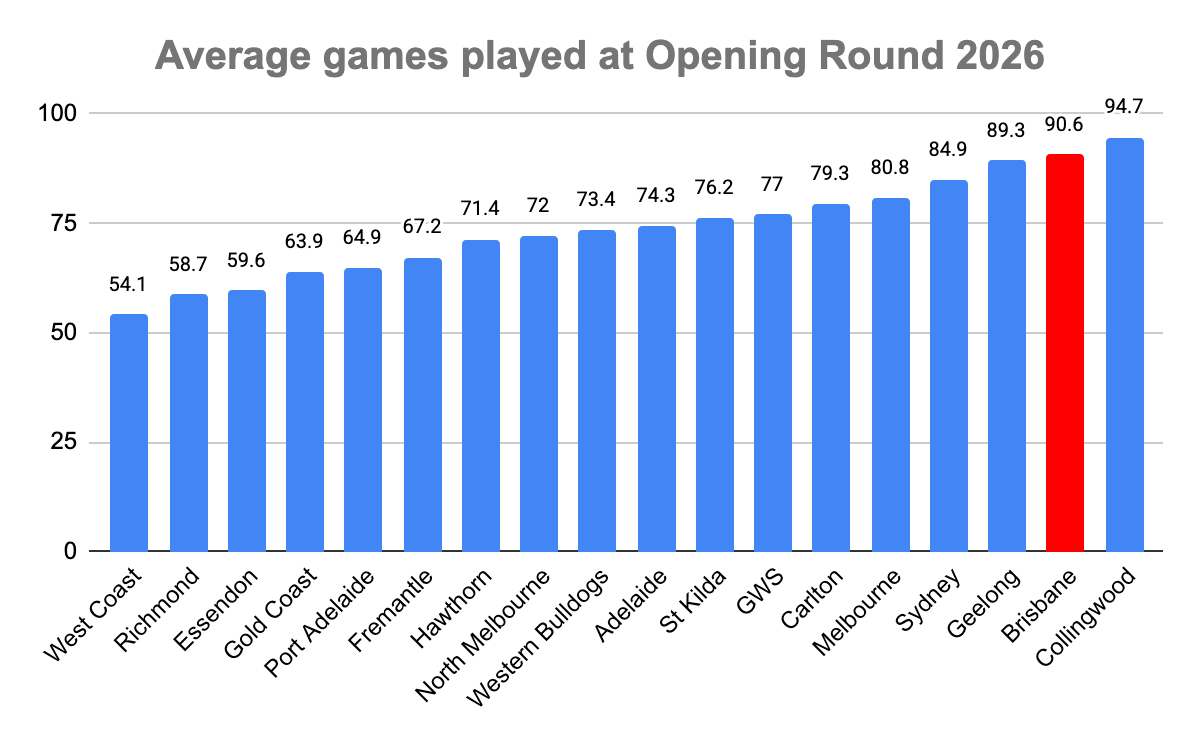
Average number of games played:90.6 (2nd)
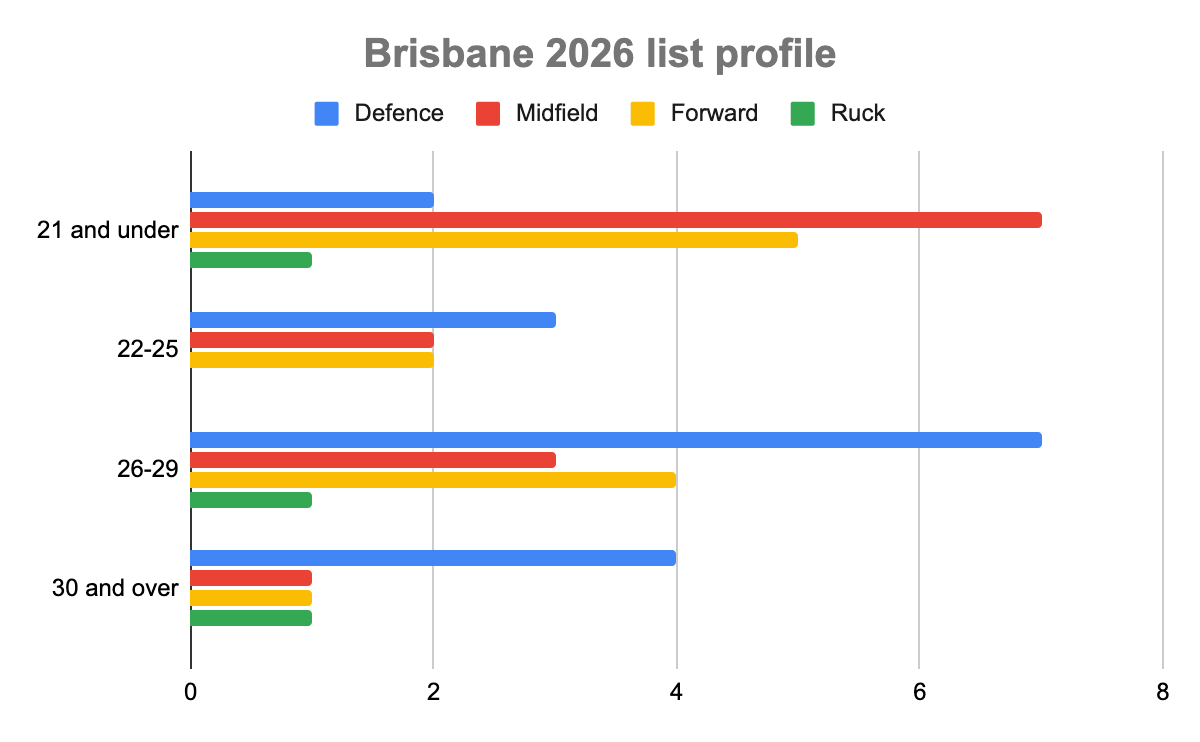
Adding two high-quality free agents and an Academy prospect many reputable scouts were calling the best pure midfielder in the 2025 draft crop (similar to how many rated Levi Ashcroft as the best midfielder in 2024) to a list that’s just won back-to-back flags feels greedy. It turns out that basking in sunshine, success, and relative anonymity is a pretty tempting pitch for guys who’ve been plugging away at struggling teams for years. A year ago, I wrote here that, given Joe Daniher’s retirement, the Lions’ list had probably gotten slightly worse in the short term. That is not the case heading into 2026! Oscar Allen and Sam Draper reinforce areas of clear (by Brisbane’s modern standards) weakness up forward and in the ruck. Annable is another name on the talented young midfielder pile. He’ll probably be ready for significant inside minutes just as Lachie Neale begins to age out. Most clubs must confront the basic trade-off of whether to build a list to Win Now or one that might Win Later. The lucky Lions get to do both.
The Lions’ backline is like a spring. It bends, rarely breaks, and provides the bounce that underpins the team’s style. In terms of personnel, it will be very recognisable to last season. And why wouldn’t it be? Harris Andrews is in the best handful of key defenders in the game. Dayne Zorko has apparently discovered the fountain of youth (the secret ingredient is spite). Darcy Wilmot and Jaspa Fletcher are either well on the way to becoming stars or already there. Keidean Coleman is said to have progressed well from the knee injuries that have wrecked his last two seasons. Behind them, Tom Doedee (not a stranger to a knee injury), Noah Answerth, and Lincoln McCarthy – redeployed to half-back during pre-season – provide good depth. The biggest question mark is the one surrounding Jack Payne. The dependable defensive partner to Harris Andrews is still on the comeback trail from a ruptured patella tendon (some injuries just make you wince) which he suffered against GWS in June. The latest, at the time of writing, is that the club expects him to “be available very close to the start of the season”.
The midfield looks set to remain one of the best in the competition. The core three of Neale (the extractor), Hugh McCluggage (the connector), and Josh Dunkley (the defender) compliment each other’s skills beautifully. Will Ashcroft is now established as the clear fourth midfielder. The dual Norm Smith medallist attended more than half of centre bounces last season. Cam Rayner, Zac Bailey, the impressive Sam Marshall, and – one assumes, given how his older brother was introduced to the midfield – Levi Ashcroft will get inside minutes when Chris Fagan wants to present his opponents with a different challenge. Expect Jarrod Berry, Bruce Reville, and Levi to patrol the wings, ably supported by the likes of Wilmot dashing past. The wildcard in all this is Sam Draper, a distinctly wildcard presence. Expect some of the flamboyance of his Essendon days to be tamped down in Brisbane’s ultra-organised system. His remit will be to compete hard in the ruck, mark around the ground, and float down forward. The mazy runs probably won’t be required.
The forward line is where we’ll see the most change. Oscar Allen will be a walk-up start. As disappointing as the last two seasons were for him and West Coast, he’s a good key forward when fit and motivated. It’ll be interesting to see how he combines with Logan Morris. Morris is a star in the making. But he was a beneficiary of Eric Hipwood’s intelligent off-ball running. Hipwood, who’ll miss most of the season while recovering from a ruptured ACL, is happy to be second-fiddle in the forward line. Will Allen? Ty Gallop, who impressed in his six appearances last season, is likely to start the season as the preferred third tall. They will be supported by one of the most imposing batteries of small and medium forwards in the AFL. Charlie Cameron is slowing down but still goes pretty quick. Rayner and Bailey do damage when they’re down there. Kai Lohman will be eager to rebound from a disappointing season. Crucially, the smaller forwards all present different threats: Cameron is the trickster, Rayner the brute, Bailey the connector, Lohmann the aerialist.
Brisbane has the best list in footy – and might still have the best list in five years.
Line rankings
Defence: Elite
Midfield: Elite
Forward: Above Average
Ruck: Above Average
The case for optimism
[Gestures broadly at Brisbane’s recent success, productive Academy, and stacked list that is ideally constructed for sustained competitiveness]
I should probably say more. So let’s break it down into two parts: the case for optimism (2026-2027) and the case for optimism (2028-2030). Let’s start with the near-term. The Lions are extremely good – and they’re extremely good in a way that feels sustainable. Last season, they switched modes to a less kinetic style. They dialled down the aggression in their press, trusted in the ability of their defence to progress the ball from slightly deeper positions, and didn’t move it down the field quite as quickly. They rested with the ball. That approach probably cost them a game and a half’s worth of wins in the Home & Away season, but it paid dividends in September. So now, Chris Fagan has two models of success: the intensity of 2024, the consolidation of 2025. It means Brisbane have another tool to win: they have the talent, they have the system, they have the productive academy, and in moments of stress and adversity, they have deep reserves of belief that they will triumph.
The data point that bridges the near- and medium-term is that Brisbane’s age profile is deceptive. The Lions have the second-oldest (25.1 years) and second-most experienced list (90.6 games) in the AFL heading into 2026. But their younger players are already doing lots of heavy lifting. Half of the 10 non-ruck Lions with a player rating of more than 10 in the last 20 games are younger than 27. Three – Will Ashcroft, Jaspa Fletcher, and Darcy Wilmot, are younger than 23. Look further, the trend holds. Levi Ashcroft and Sam Marshall were bit-part players in 2025, but showed enough to suggest they will step up when it is their time. Logan Morris and Kai Lohmann are fixtures in the forward line. Assuming they get back to their old selves after their injuries (not always a given), Keidean Coleman, Tom Doedee and Oscar Allen are “younger” in terms of their career trajectory than their biological age.
This gets to the point which should make every Lions fan cheer: the list is perfectly constructed to continue defying gravity. The replacement for almost* every older best-23 player is already on the list. The Academy is productive and will continue being nourished by waves of migration to Queensland. Chris Fagan’s superpower is his even temperament. He has succeeded in creating an environment, a culture, where his players are empowered to perform to their peak, and is part of a coaching group that has – with the help of Marcus and Rebekah Ashcroft – built a list primed for long-term success.
The case for pessimism
I see two reasons the Lions might fall back to the chasing pack. Neither should fill supporters of rival teams with much confidence. The first is the basic fact that lots of smart, driven people are working hard to identify potential areas of vulnerability – weak links, “tells” which inadvertently give away a particular possession scheme, set plays the Lions use to create space and overloads. Nothing here is new. But the higher you go, the further there is to fall, and the more people there are trying to deflate your balloon.
The second, and I am reluctant to wade into these brackish waters, is that there has been rather a lot written about Lachie Neale’s extramarital affair during the off-season. It was only two years ago that the footy-tabloid nexus was briefly agog at the revelations of what might have happened during the Brisbane players’ trip to the United States. That trip might have tested some interpersonal relationships. But it didn’t appear to affect Brisbane’s on-field performance. So I suppose my baseline hypothesis is that the same will be true of the Neale farrago. It’s unseemly, yes, but “footy player does something stupid” is a dog bites man story. For our purposes, moral infraction only matters if it affects performance. The cynical hypothesis here is that “culture” is just a nice, progressive way we say “winning a lot”. But it took more than just barbarians to sack Rome. It also needed the rot and decadence of the late Empire. Maybe – probably – nothing happens, we forget about this story the moment the ball is thrown up for the start of the first game of the season. Or perhaps it reveals faultlines in Brisbane’s playing group. (I doubt it.)
Enjoying this preview and think a Lions-supporting friend might too? Share it with them!
Breakout player
Logan Morris was my pick for last season’s breakout Lion. He was a good choice. Sam Marshall will probably feature more prominently this season. He couldn’t crack the core midfield rotation in 2025, but added energy and good disposal, especially as a sub. I suspect that, by the end of this season, we’ll be talking up Levi Ashcroft as Brisbane’s most improved player. His introduction to AFL football came in an unglamorous role – as a winger who occasionally came up to stoppages but otherwise held width. Towards the end of the season, his centre bounce attendances began to be ramped up. As he continues to gain the trust of his coaches and teammates, he will assume a more prominent role. Perhaps he can take a Norm Smith off his older brother?
Most important player
Above, I wrote every older established Lions player has their placement already on the list. The one exception is Harris Andrews. His intercept marking, organisation, and cool head make him one of the most valuable players in the league. If Brisbane do regress this season, it’ll be partly because he misses a block of games.
Biggest question to answer
The biggest question for the Lions to answer is how to find the motivation to keep working just as hard when you’ve already achieved the goal you work so hard for – twice. The biggest question for the Lions’ rivals to answer is: how the bloody hell do we beat this lot?
What success looks like
The concept of supporting a footy team that could possibly regard merely two consecutive Premierships as a disappointment is very alien to me. You can’t guarantee a flag. But winning two in a row would make you pretty confident. The Lions should finish in the top four. They should make a prelim. Do that, and they will believe they can match the achievement of the extraordinary 2001-2003 threepeat side.
In a nutshell
The Lions are testing the integrity of the AFL’s equalisation measures. They will once again be in the first rank of Premiership contenders, and it is hard to see them falling out of contention for the rest of the decade.
Agree? Disagree? Either way, share your (polite) thoughts in the comments.
The Lions are stacked, aren't they. Their game style feels very Hawthorn circa 2013 (obvious, I guess, given the Fages link). Elite kicking, possession-based footy, calm heads at the back (apart from Zorko, ha ha), the occasional Cyril (Lohmann? Ashcroft? Rayner?) flash of brilliance. They'll probably win it again.
Not your fault - McClure started the incorrect reporting on the location at the beginning!
One thing I’m interested in substantively is where the evolution of Brisbane’s offensive game goes next. You’ve hit on the subtle changes from 2024-2025 and I think there will be further trial and error as to what to do next as opponents adapt.
Some of the changes in 2025 felt like they were driven by opponents changing how they defended Brisbane and some impact on the cracking down on 15m emphasis that occurred at the beginning at the season.